INTERNACIONAL
‘Unprecedented’: Judges reveal behind-the-scenes coordination on Trump immigration cases


Federal judges in Minnesota tasked with deciding a flood of habeas petitions challenging the detention of immigrants swept up during President Donald Trump’s Operation Metro Surge weren’t working entirely on their own — behind the scenes, they were regularly consulting one another through running email threads and developing tools to quickly handle recurring legal questions.
The behind-the-scenes coordination among Minnesota’s federal bench, revealed in a New York Times report Thursday, included regular meetings, running email threads, an informal spreadsheet created by court clerks showing which judges to turn to with particular legal questions, and templates some judges developed to quickly issue orders when similar detention disputes repeatedly came before the court.
The disclosures are fueling questions over whether the judges were colluding on separate cases involving the same Trump administration immigration policies, or simply sharing expertise to manage an extraordinary caseload.
FEDERAL JUDGE TIES ICE AGENTS’ HANDS WITH RULING ON WARRANTLESS SOUTHERN CALIFORNIA ARRESTS
«The idea of a running email chain involving a variety of cases — it strikes me as very weird and frankly unprecedented,» Robert Luther III, a professor at George Mason University’s Antonin Scalia Law School whose work includes federal courts and judicial ethics, told Digital. Federal judges can and routinely do consult colleagues, Luther said, particularly about procedural or evidentiary questions. But each judge is ultimately responsible for independently deciding the cases assigned to them — a distinction Luther said makes the coordination significant.
The disclosures have also drawn criticism from the Trump administration on two fronts. Department of Homeland Security (DHS) General Counsel James Percival accused the former chief judge who led the district during Metro Surge of «essentially conspiring with his judicial colleagues» to thwart federal immigration enforcement. The Justice Department (DOJ), meanwhile, questioned the decision by sitting judges to give extensive on-the-record interviews about their experience with the administration’s immigration operation.
Seven of the district’s judges spoke to the Times for Thursday’s report, including former Chief Judge Patrick Schiltz, who sat for a 90-minute interview about the court’s experience during Metro Surge. Schiltz declined to discuss ongoing cases, according to the Times, but described what happened in Minnesota’s federal court as having «created a grave threat to the rule of law.»
«It is remarkable that sitting federal judges are giving on-the-record interviews attacking this Administration’s policies rather than ruling from the bench,» a Justice Department spokesperson told Digital. «If judges followed the law in adjudicating cases, there wouldn’t be an ‘overwhelming’ habeas caseload. Judges who have made public comments on pending or related matters should consider whether recusal is warranted going forward.»
OBAMA, BIDEN JUDGES DRAW FRESH FIRE AS TRUMP’S IMMIGRATION COURT CLASHES HEAT UP: ‘ALMOST IMPOSSIBLE’
But Chief Judge Eric Tostrud, who was himself among the Minnesota judges interviewed by the Times, rejected suggestions that the coordination described in the report compromised individual decision-making. He told Digital that every member of the bench independently decided the merits of each petition assigned to them, while pointing to an extraordinary surge in litigation — from 12 alien-detainee habeas petitions during all of 2024 to 1,427 through August of this year — and noting that many involved similar or identical, often novel, legal questions.
«The bottom line is that each of us made an independent decision with respect to the merits of each and every petition we were assigned,» Tostrud told Digital.
Tostrud stressed that the judges did not uniformly reach the same conclusions, saying that while some reached the same result on certain legal questions, they «reached different outcomes regarding other legal questions.» He said the judges’ ability to communicate helped them resolve the cases quickly and thoughtfully, regardless of whether individual petitions were granted.
What exactly the judges were sharing behind the scenes, however, remains unclear. Tostrud declined to disclose the contents of the court’s internal working materials, saying documents created by judges and court staff «are not public.»
TRUMP ADMINISTRATION’S IMMIGRATION PUSH FUELS ICE’S BIGGEST ARREST MONTH IN AGENCY HISTORY
That distinction could be significant, according to Luther, who said administrative templates are commonplace in federal courts, but drew a line between those and templates touching the substance of a case.
«Templates that deal with administrative matters strike me as entirely appropriate and commonplace in federal courts,» Luther said. «Templates for substantive matters — that seems like something altogether different.»
The coordination unfolded amid a broader clash between Minnesota’s federal bench and the Trump administration over Operation Metro Surge. The dispute came as immigration litigation inundated the district. During the first three months of 2026, Minnesota’s federal court received 1,116 habeas petitions, compared with just two during the same period the previous year, according to the Times. Court staff worked 16-hour days, seven days a week to process the incoming cases.
Patrick Schiltz, who served as the district’s chief judge during Metro Surge before taking senior status — a form of semi-retirement — this summer, emerged as a prominent judicial critic of the administration’s handling of the operation. In a Jan. 28 order, Schiltz accused ICE of violating nearly 100 court orders during that month and warned that «ICE is not a law unto itself.»
OBAMA JUDGE’S PECULIAR TRUMP REBUKE IGNITES FURY OVER ‘UNPROFESSIONAL’ LANGUAGE: ‘EMBARRASSMENT’
The cases cited in Schiltz’s January list of alleged violations have largely concluded, according to the Times, which reported that the administration ultimately corrected the issues flagged by the court in many of them.
DOJ said its review of the cases found that in the «large majority» of them, detainees were released on time and no violation occurred, while in most of the remaining cases the department said it ultimately did what the court ordered despite missing an additional deadline.
MASSACHUSETTS’ HIGHEST COURT PUBLICLY REPRIMANDS JUDGE ACCUSED OF ENABLING IMMIGRANT TO ESCAPE ICE
Federal judicial ethics rules generally prohibit judges from publicly commenting on the merits of pending or impending cases, but permit judges to explain court procedures and engage in broader speaking and teaching about the law, legal system and administration of justice.
The DOJ argued that judges who publicly commented on pending or related matters should consider whether recusal is warranted. The Times reported, however, that Schiltz declined to discuss ongoing cases, while Judge Nancy Brasel, a Trump appointee who also participated in the interviews, defended judges’ ability to speak publicly about judicial independence.
«We are allowed to speak out about judicial independence,» Brasel told the Times. «And so we should, in order to keep it.»
Luther, however, took a different view of the judges’ decision to participate in the interviews.
«Judges should be speaking through their judicial orders, not through their surrogates at The New York Times,» he told Digital.
federal courts, federal judges, immigration, immigrant rights, illegal immigrants, politics, justice department, homeland security











INTERNACIONAL
Mexican judge arrested after U.S. charges him of accepting $2M bribe in case linked to former Olympian

Luis Benítez Alcántara, a Mexican judge accused of accepting a bribe to release a transnational cocaine smuggler, was arrested in Colombia on Sunday after the U.S. charged him with nine counts of being an accessory after the fact.
Benítez, according to a Thursday announcement from the U.S. Department of Justice, accepted a $2 million bribe from Canadian national Ryan Clark, who the DOJ alleges was second-in-command to former Olympic snowboarder Ryan J. Wedding in the latter’s international drug dealing empire.
«Benítez Alcántara was a district judge in Mexico City who allegedly accepted $2 million in exchange for granting bond to and ordering the release of Wedding’s second in command, while Wedding was orchestrating a billion-dollar transnational criminal organization and the largest supplier of cocaine to Canada with connections in Colombia, Mexico, and the U.S.,» FBI Director Kash Patel said in a statement.
US CHARGES MEXICAN GOVERNOR, TOP OFFICIALS IN CARTEL CONSPIRACY AS MEXICO FIRES BACK OVER PROOF
Clark was initially arrested in Guadalajara, Mexico on Oct. 8, 2024, according to a superseding indictment. He appeared in front of Benítez for extradition proceedings on Oct. 9 after the U.S. requested his extradition.
Beginning in Nov. 2024, Clark sent approximately $2.75 million to intermediaries over the course of four months, according to the indictment. On Feb. 24, 2025, Benítez received $2 million in payments from those intermediaries and granted Clark bond and release that same day, per the indictment.
Among the nine counts, Benítez is charged with being an accessory after the fact to aid and abet Clark.
Clark and Wedding are also charged with murder, conspiracy to distribute and possess with intent to distribute a mixture and substance containing a detectable amount of cocaine and continuing a criminal enterprise, according to the indictment.
If convicted, Benítez faces up to 15 years in federal prison.
«Crooked public officials, no matter where they are, who assist drug traffickers operating here at home will face justice in the United States,» Attorney General Todd Blanche said in a statement.
«Thanks to the work of the Homeland Security Task Force and our international law enforcement partners, Mr. Benítez will be held accountable. The Department of Justice will continue identifying and dismantling transnational criminal organizations that threaten the safety of the American people,» Blanche concluded.
HIGHEST-RANKING TREN DE ARAGUA MEMBER EVER EXTRADITED TO US SET TO APPEAR IN HOUSTON COURTROOM: DOJ
Despite Benítez’s role in granting Clark bond and release, Mexican law enforcement officers arrested Clark again days later and handed him over to U.S. authorities on Feb. 27, 2025.
Following Clark’s arrest, he cooperated with FBI and U.S. officials in supplying information about his and Wedding’s roles in their criminal enterprise, according to a DOJ indictment against Wedding.
KASH PATEL DEFENDS FBI’S ‘MOST WANTED’ BUSTS AMID MANIPULATION ACCUSATIONS, HIGHLIGHTS ‘SUMMER HEAT’ SUCCESS
Wedding, a former member of the FBI’s Top 10 Most Wanted List, was arrested in Mexico in January 2026.
In addition to running a cocaine distribution empire that the indictment alleges imported the majority of illicit cocaine into Canada, Wedding is also accused of orchestrating the murders of numerous informants and other affiliates of his illicit activities.
5 MEXICAN CARTEL BOSSES CHARGED IN WEAPONS, DRUG TRAFFICKING, TIMESHARE FRAUD SCHEMES, DOJ SAYS
In January, he pleaded not guilty to federal charges of running a criminal enterprise, murder, conspiring to distribute cocaine and other crimes.
His empire allegedly worked in concert with the powerful Mexican Sinaloa Cartel to move and distribute cocaine through Colombia, Mexico and the rest of North America, according to the indictment.
«This individual and his organization and the Sinaloa cartel poured narcotics into the streets of North America and killed too many of our youth and corrupted too many of our citizens. And that ends today,» FBI Director Kash Patel said in January after Wedding’s arrest.
politics, crime world, organized crime, mexico, latino, fbi, justice department, corruption crime
INTERNACIONAL
Oil-rich UAE makes massive AI bet as Sam Altman unveils ambitious plan to transform energy industry

NEWYou can now listen to Fox News articles!
ABU DHABI, United Arab Emirates — At the opening of the world’s largest energy conference in Abu Dhabi, artificial intelligence took center stage alongside oil and gas as OpenAI CEO Sam Altman joined senior UAE officials for the announcement of a major partnership aimed at bringing advanced AI into the energy industry.
The opening ceremony of ADIPEC 2026, attended by Fox News Digital, brought together senior government officials and energy industry leaders at a time when the war involving Iran and disruptions to the Strait of Hormuz have placed extraordinary pressure on global energy supplies.
But amid discussions about oil production, shipping routes and energy security, Dr. Sultan Al Jaber, the UAE’s minister of industry and advanced technology and chief executive of state-owned energy giant ADNOC, delivered a different challenge to the technology industry.
OIL SQUEEZE TIGHTENS AS IRAN-BACKED ATTACKS CRIPPLE HORMUZ ESCAPE ROUTES
From left, Mark Chen, Chief Research Officer at OpenAI; Sam Altman, CEO at OpenAI; Sheikh Khaled bin Mohamed bin Zayed Al Nahyan, Crown Prince of Abu Dhabi; Ahmed Al Kuttab, Chairman at the Department of Government Enablement – Abu Dhabi (DGE) announce the Machine-Readable Government initiative in Abu Dhabi (Abu Dhabi Media Office)
«From the moment ChatGPT was born, the world has asked what energy can do for AI. And now, together, we will find out what AI can do for energy,» Al Jaber told the audience, introducing a partnership between ADNOC, OpenAI and Abu Dhabi-based technology company G42.
The announcement marked a significant step in the UAE’s ambition to become a global center for artificial intelligence, using its energy resources, financial strength and growing partnerships with American technology companies to help shape the industry’s future.
Yet the question of what AI can actually deliver for the energy industry goes beyond the technology announcements.
THE AI REVOLUTION WILL GO WHEREVER THERE’S ELECTRICITY — AND CHINA KNOWS IT

OpenAI CEO Sam Altman speaks at the opening ceremony of ADIPEC 2026 in Abu Dhabi, United Arab Emirates, on Nov. 2, 2026, as ADNOC, OpenAI and G42 announced a major partnership to bring artificial intelligence into the energy industry. (Efrat Lachter/Fox News Digital)
Speaking exclusively to Fox News Digital on the sidelines of the conference, Dr. Angela Wilkinson, secretary general and CEO of the World Energy Council, said the most encouraging element of the presentations by Altman and Al Jaber was their focus on the role of people.
«That it isn’t about AI taking decisions for humanity, it’s about AI enabling people to make better decisions,» Wilkinson said.
Wilkinson argued that the growing relationship between energy and AI should be understood not simply as a way to automate industrial processes, but as an opportunity to expand human capabilities.
«I think what really cheered me up most is the recognition that it’s a people-centric conversation on both sides of the equation,» she said.
ONE OF AMERICA’S OLDEST MANUFACTURERS SAYS AI IS CREATING JOBS — NOT REPLACING THEM

Dr. Angela Wilkinson, secretary general and CEO of the World Energy Council, speaks with Fox News Digital at ADIPEC 2026 in Abu Dhabi, United Arab Emirates, about the future of global energy markets, the growing role of artificial intelligence and the need for greater resilience amid regional instability. (Efrat Lachter/Fox News Digital)
Amos Hochstein, a managing partner at TWG Global and a former senior adviser to President Joe Biden, welcomed the potential benefits of the new OpenAI-UAE partnership but warned that the rapid expansion of artificial intelligence must be balanced against its financial and societal costs.
Speaking to Fox News Digital at ADIPEC, Hochstein said, «The energy sector is going to be one of the big beneficiaries of AI coming into the sector.» But he cautioned that the U.S. must remain a leader in advanced AI while ensuring Americans are not left paying the price for its expansion, calling on the Trump administration to work more closely with industry and other sectors of society to maximize the benefits and minimize the risks.
The ADNOC partnership is intended to connect advanced AI systems across the company’s operations, from oilfield development and reservoir management to refining, logistics and commercial trading.
According to ADNOC, one of the initial applications will bring together decades of information from thousands of oil wells, multiple reservoirs and hundreds of facilities, with the goal of completing complex development plans in hours rather than months.
The company says the technology could improve operational efficiency, lower costs and help energy producers respond more quickly to changing market conditions. Those projected improvements have not yet been independently demonstrated.
For the UAE, the initiative represents something larger than a single agreement.
AI ISN’T JUST A PROBLEM, IT’S A SOLUTION. SOME PEOPLE ARE ALREADY MAKING THE MOST OF IT

Unmanned AI-led vessels on display at the 2026 ADIPEC conference on Nov. 2, 2026. (Efrat Lachter/ Fox News Digital)
The country is already a partner in the planned Stargate UAE project, a major computing infrastructure initiative involving American technology companies. The project is part of Abu Dhabi’s broader effort to establish itself as an international AI hub.
In a separate interview with Fox News Digital in Dubai, Mohammed Baharoon, director general of the research center B’huth, described the country’s technological ambitions as an evolution from exporting barrels of oil to exporting digital computing capacity.
Baharoon said the rise of AI could produce an economic transformation comparable to previous industrial revolutions, creating new industries and opportunities even as existing professions are disrupted.
But he cautioned that governments are struggling to keep pace with the technology’s development.
«We will need to bring in the concepts of regulation at the point of development, not after the development has happened,» Baharoon told Fox News Digital.
He argued that governments and technology companies need to begin addressing potential dangers while systems are being created, rather than waiting until they have already entered widespread use.
THE BIGGEST THREAT IN AMERICA’S RACE WITH CHINA ISN’T BEIJING, TECH EXECUTIVE WARNS

Attendees gather at ADIPEC 2026, one of the world’s largest energy conferences, held in Abu Dhabi, United Arab Emirates, Nov. 2–5, 2026, as industry leaders discuss global energy security, technological innovation and the growing role of artificial intelligence. (Efrat Lachter/Fox News Digital)
The question of human control was also central to Altman’s remarks at ADIPEC.
During a panel, Altman argued that AI should remain a tool serving people rather than replacing human decision-making.
The OpenAI chief also acknowledged a fundamental challenge facing his own industry: The enormous amount of energy required to power increasingly capable AI systems.
Asked to identify his biggest challenge, Altman answered with a single word: «Energy.»
The exchange illustrated the complicated relationship between two industries that are becoming increasingly dependent on each other.
AI companies need vast quantities of electricity to operate data centers, while energy producers are increasingly looking to AI to improve efficiency, optimize production and identify vulnerabilities before they disrupt supplies.
AI BOOM: DEMAND FOR DATA CENTERS DRIVES INNOVATION BY ENERGY, TECH INDUSTRIES TO PRODUCE NEW POWER SOURCES

Racks of graphics processing units (GPUs) with a closed-loop liquid cooling system are seen inside an operational Microsoft data center. (Yasuyoshi Chiba/AFP/Getty Images)
The stakes are particularly high in the Gulf, where the war involving Iran and disruption to shipping through the Strait of Hormuz have forced energy producers to reconsider how they protect infrastructure and ensure supplies reach international markets.
In his opening address, Al Jaber warned that nearly a billion barrels had been drawn from global oil inventories since the disruption of Hormuz, illustrating how quickly geopolitical instability can affect global energy supplies.
The ADNOC chief presented artificial intelligence as one element of a broader effort to strengthen operational resilience, arguing that companies must develop systems capable of anticipating problems rather than simply responding after disruptions occur.
ONE OF THE WORLD’S HOTTEST INDUSTRIES IS SPARKING A BLUE-COLLAR JOBS BOOM

The exhibition floor at ADIPEC 2026 in Abu Dhabi, United Arab Emirates, where global energy companies showcased new technologies and innovations amid growing concerns over energy security and regional instability. (Efrat Lachter/Fox News Digital)
Altman, meanwhile, praised the UAE’s commitment to adopting AI across government and industry, describing it as the world’s most forward-looking country in embracing the technology.
For Abu Dhabi, the emerging partnership between its traditional energy industry and the world’s leading AI companies offers an opportunity to extend its economic influence beyond oil exports.
But whether these investments ultimately deliver the promised improvements in productivity, energy security and technological innovation remains to be seen.

AI data center. (Kurt «CyberGuy» Knutsson)
As the discussions at ADIPEC demonstrated, the question is no longer simply how much energy the AI revolution will require, but whether artificial intelligence can help solve some of the very energy challenges its growth is creating.
world, artificial intelligence, innovation, technology
INTERNACIONAL
Corralito, protestas y vacío de poder: Paraguay vive una crisis que recuerda a diciembre de 2001 en la Argentina
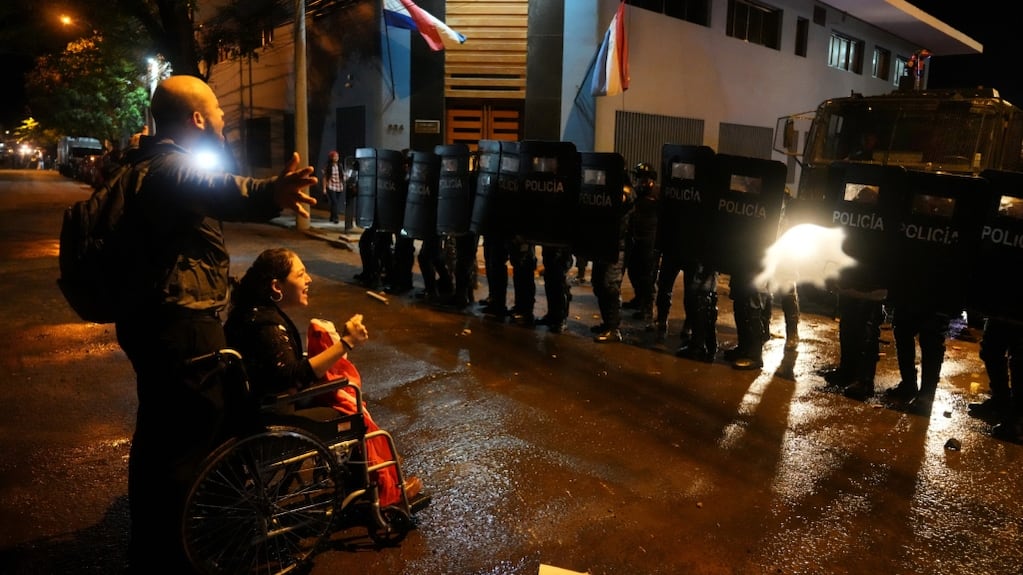
Paraguay vive hoy en la Argentina de diciembre de 2001. Con un presidente renunciante y repudiado, un corralito que afecta a la mitad de la población y un creciente clima de protesta en las calles, el país se hundió en una peligrosa crisis política y financiera.
Uno de cada dos paraguayos tiene hoy sus ahorros congelados por la intervención del Ueno bank, en un escándalo que dejó al gobierno virtualmente acéfalo después de la renuncia del presidente Santiago Peña y un interminable debate en el Congreso sobre el inicio de un juicio político.
“Se cortó la cadena de pagos, se afectaron a los emprendedores. La gente está desesperada”, dijo a TN la exsenadora independiente Katya González.
Argentina vivió un tsunami social, financiero y político a fines de diciembre de 2001 que provocó la salida del presidente Fernando de la Rúa y un “corralito” que dejó a los ahorristas sin su dinero. Fue el inicio de una crisis sin precedentes cuyas secuelas se viven aún hoy en el país.
Los paraguayos atraviesan una situación similar que recuerda a la peor emergencia social y económica de la historia argentina. Con una salvedad: un solo banco, con tres millones de clientes, causó esta hecatombe financiera..
El problema es que se trata de un país de seis millones de habitantes. La mitad de la población fue afectada. Pero además en la entidad quedaron congelados unos 850 millones de dólares de distintos organismos estatales.
Incluso, el Ueno bank manejaba fondos de pensiones, lo que refleja la profunda gravedad de la crisis. Se trata de una tormenta perfecta.
¿Y ahora qué?
Cientos de paraguayos se concentraron el jueves frente al Congreso para exigir el inicio de un juicio político contra Peña, a quien responsabilizan de la crisis. Hubo insultos, forcejeos e incidentes con la policía.
Al mandatario (del Partido Colorado y en el poder desde el 15 de agosto de 2023) se lo acusa de mantener vínculos con el banco intervenido hasta el año pasado. La entidad está bajo sospecha de serias irregularidades que van desde vaciamiento hasta negociados.
Los manifestantes rechazaron la renuncia del presidente. Querían su juzgamiento y destitución en el Congreso. Una renuncia aceptada abría el camino a fueros que el mandatario tendría como senador honorario, un derecho reservado a todos los expresidentes, según la Constitución.
No solo reclaman por sus ahorros. También por justicia. En las protestas se repetían gritos de “ladrón” y hasta se colaban consignas como “que se vayan todos”.
Peña

Iliana le dedicó una carta a su papá Juan Carlos Calabró a 13 años de su muerte: “Gracias por seguir acá”

Mexican judge arrested after U.S. charges him of accepting $2M bribe in case linked to former Olympian

Oil-rich UAE makes massive AI bet as Sam Altman unveils ambitious plan to transform energy industry

El Gobierno considera que la crisis política en Paraguay no altera el escenario regional ni cambia su estrategia para el Mercosur

ANSES: cuándo cobro en noviembre 2026 si mi DNI termina en 4

Atacó a puñaladas a su ex pareja en una plaza de Catamarca y fue detenido horas después

La oposición cuestionó la suspensión de embargos a las pymes y criticó el plan económico: “Llegaron tarde”

Milei parte nuevamente a España y en el gobierno dicen que no bajará el tono de sus críticas a Pedro Sánchez

Sindicatos del transporte y de la industria se diferencian de la estrategia de la CGT y deciden acciones propias

Padrón provisorio para las elecciones 2027: dónde y hasta cuándo se puede consultar

 POLITICA2 días ago
La oposición cuestionó la suspensión de embargos a las pymes y criticó el plan económico: “Llegaron tarde”
- POLITICA3 días ago
Milei parte nuevamente a España y en el gobierno dicen que no bajará el tono de sus críticas a Pedro Sánchez
- POLITICA2 días ago
Sindicatos del transporte y de la industria se diferencian de la estrategia de la CGT y deciden acciones propias