INTERNACIONAL
What the US gets from Israel alliance as support for aid to the Jewish State erodes on left and right: report


The U.S.-Israel alliance was tested when Washington and Jerusalem found common cause against Iran — and when defending Israel drew heavily on American weapons stocks. Meanwhile, that ongoing conflict has now sharpened a question for Washington: what does the alliance deliver, and what does it demand in return?
A new report from Advancing American Freedom (AAF) and the Zionist Organization of America (ZOA) argues that Israel’s military reach and regional role make the alliance a strategic asset for Washington.
Its authors call Israel «the largest U.S. aircraft carrier» in the Middle East. But this is in direct opposition of critics who say that the alliance costs the U.S. a lot and delivers very little in return.
The report, dated Oct. 26, 2026, arrives as public support for Israel continues to fall across the political spectrum — even among Republicans and MAGA supporters.
FROM INTELLIGENCE SHARING TO MISSILE DEFENSE, HOW ISRAEL’S PARTNERSHIP PROTECTS AMERICAN SECURITY
President Donald Trump and Israeli Prime Minister Benjamin Netanyahu have discussed ending direct U.S. military aid, but the U.S. leader has also called Israel «a great ally, much more reliable than most» and said Washington would help if Israel needed it.
The report specifically points to intelligence sharing, joint weapons development and military cooperation as returns on what the U.S. gets for providing support to Israel.
One of the clearest examples is missile defense. The U.S. and Israel develop systems including David’s Sling and Arrow, while American companies manufacture components for several programs. More than 100 companies across 34 states participate in missile-defense co-production, according to the Congressional Research Service. In August, a Raytheon-Rafael facility in Arkansas delivered the first Iron Dome Tamir interceptor built entirely in the U.S.
Those programs support U.S. manufacturers and give the Pentagon a role in developing missile-defense systems. During the Iran conflict, however, U.S. forces also expended large numbers of interceptors — costly weapons that can take years to replace.
US REBUILDING WEAPONS STOCKPILE COULD DELAY ORDERS FROM ALLIES
In September, the Congressional Budget Office (CBO) estimated that the U.S. had probably used between half and two-thirds of its combined inventory of Patriot, THAAD, SM-3 and SM-6 interceptors since June 2025.
The estimate includes weapons used during the earlier 12-day war with Iran and is based on publicly reported expenditures compared with the number of those interceptors the War Department has purchased. CBO said rebuilding stocks could take at least five years, even if production increased.
Intelligence sharing is another return cited by supporters of the alliance. Former CIA Director John Brennan said Israeli intelligence was among the «thousands of bits» considered during the years-long effort to find Usama bin Laden. He did not specify what Israel provided or how much it contributed to the operation.
A more recent exchange shows how Israeli reporting can prompt U.S. action even when its accuracy is uncertain. Israeli officials warned the U.S. of a possible Iranian plot to kill Trump during a trip to Turkey. The Secret Service took precautions, including moving him to another aircraft. U.S. intelligence agencies could not independently verify the threat, however, and the CIA assessed some of the Israeli reporting with «low confidence,» according to Reuters and The Washington Post.
NETANYAHU REVEALS HE WANTS AMERICAN FINANCIAL SUPPORT FOR ISRAEL TO ‘DRAW DOWN TO ZERO’
The financial relationship has also become part of the debate. Under the current agreement, the U.S. provides Israel with $3.3 billion annually in Foreign Military Financing and $500 million for joint missile-defense programs. Most of the military aid pays for weapons and services from U.S. contractors, according to CRS. Israel’s ability to spend a portion of the funding on domestic purchases is scheduled to phase out by 2028.
The report’s authors call the $3.8 billion in annual U.S. military aid «one of the highest returns on investment of any U.S. foreign assistance.»
Trump has said he wants to end annual aid, while Netanyahu has also publicly called for phasing it out over time. U.S. and Israeli officials have been negotiating a new agreement that could wind down direct assistance while expanding joint defense projects and weapons production. The current agreement runs through 2028, Congress controls appropriations, and no successor deal has been reached.
TRUMP WANTS LARGEST-EVER ISRAELI HEAVY BOMB TRANSFER — BUT PROPOSAL HAS CONGRESS PREPARING FOR $2.8B FIGHT
The debate is also becoming more politically consequential as Americans question the relationship’s terms.
A 2026 Chicago Council survey found that 56% favored reducing or ending U.S. military aid to Israel. Republicans remain more supportive than Democrats and independents, but the right is divided: Joe Kent blamed Israeli pressure for the Iran war, Rep. Thomas Massie has pushed to cut aid, and Vice President JD Vance has called for changing the relationship while continuing to describe Israel as a strategic ally.
The two countries have cooperated against Iran and developed defenses against missile attacks, but their goals have not always matched during the war. A Stimson Center analysis says Israel sought to broaden the conflict beyond what Washington preferred. That does not establish that Israel drew the United States into a war it opposed. It does show how cooperation can leave Washington managing military costs even when its preferred limits differ from Israel’s.
The next agreement will help determine whether the alliance continues to rely on direct grants or shifts toward joint weapons development and production. Either way, the military and intelligence cooperation described in the report comes with commitments of U.S. money and weapons — and leaves Washington weighing those costs against the advantages it expects the alliance to deliver.
foreign policy, israel, defense, war with iran, benjamin netanyahu, politics, national security, spending









Una estrella recién descubierta en el cielo austral gira a la vertiginosa velocidad de más de 260 rotaciones por segundo, enviando pulsos regulares de energía hacia la Tierra. Estrellas de este tipo, conocidas como púlsares, proporcionan entornos ideales para estudiar la relatividad general y las ondas gravitacionales, e incluso pueden utilizarse para la navegación espacial. Sin embargo, encontrar púlsares en la inmensidad del universo es una tarea computacionalmente tan exigente que un intento anterior de detectar este púlsar en particular fracasó pese a haber requerido un tiempo de computación equivalente a 600 años en un único núcleo de procesador.
Ahora, investigadores del Instituto de Ciencias Weizmann han desarrollado un nuevo algoritmo que les ha permitido, junto con sus colaboradores del Instituto Max Planck de Física Gravitacional de Hannover, Alemania, y de la Universidad Tecnológica de Chalmers de Gotemburgo, Suecia, completar la tarea en solo 100 minutos. El descubrimiento del púlsar —denominado PSR J1622-7204— se describe en un artículo publicado hoy en Physical Review Letters, y el nuevo método ya se está utilizando para descubrir púlsares adicionales.
Cuando las estrellas con masas de entre ocho y 20 veces la de nuestro Sol agotan su combustible nuclear, colapsan hacia el interior y pueden convertirse en púlsares: estrellas de neutrones ultradensas que giran rápidamente. Los púlsares generan campos magnéticos billones de veces más fuertes que el de la Tierra. Estos campos aceleran partículas cargadas y producen potentes haces de radiación. A medida que el púlsar gira, su haz barre el cielo y apunta hacia la Tierra solo durante un breve instante en cada rotación. Como resultado, desde la Tierra parece que la estrella emite energía en pulsos regulares. Debido a que los púlsares pierden energía continuamente a lo largo de su vida, su rotación se ralentiza gradualmente a medida que envejecen y la frecuencia de sus pulsos disminuye.
El primer púlsar, descubierto en 1967, emitía ondas de radio, al igual que casi todos los púlsares descubiertos durante las cuatro décadas siguientes. En 2008, el lanzamiento del telescopio espacial de rayos gamma Fermi de la NASA, que detecta radiación de alta energía, abrió nuevas posibilidades. En sus 18 años de funcionamiento, Fermi ha identificado casi 1.000 regiones del cielo que emiten rayos gamma con características típicas de los púlsares. Sin embargo, identificar de forma concluyente un púlsar sigue siendo una tarea complicada. Para hacerlo, los astrónomos deben encontrar una combinación de la posición exacta en el cielo y de propiedades rotacionales —como la velocidad de rotación y su ralentización gradual con el tiempo— que coincida con el patrón de pulsos observado.
“Intentar encontrar la combinación correcta entre todas las posibilidades sin una estrategia inteligente nos obliga a probar un número astronómico de conjeturas”, explica el doctor Barak Zackay, del Departamento de Física de Partículas y Astrofísica del Weizmann. “Otro desafío es que, aunque un pulso de energía llega a la Tierra con cada rotación de un púlsar, el telescopio Fermi solo logra detectar un único paquete de energía —un fotón— aproximadamente una vez cada 100 millones de rotaciones. Además, el propio telescopio se está moviendo: orbita la Tierra mientras la Tierra gira alrededor del Sol. Todos estos factores hacen que el cálculo necesario para encontrar un púlsar sea extremadamente exigente”.
Una solución geométrica para un problema de física
En 2025, el grupo de investigación de Zackay demostró que la búsqueda de púlsares podía simplificarse radicalmente. Su enfoque se basa en la premisa de que cada pulso detectado marca la finalización de una rotación completa del púlsar y su regreso a la orientación en la que su radiación se dirige hacia la Tierra. Sin embargo, como se ha señalado, Fermi capta solo una fracción diminuta de los pulsos, por lo que se desconoce el número de rotaciones completas realizadas entre observaciones. Si esa información estuviera disponible, los científicos podrían calcular directamente la velocidad de rotación de la estrella y determinar sus demás propiedades.
El algoritmo desarrollado por los investigadores del Weizmann busca proporcionar esta información faltante.
Los investigadores se dieron cuenta de que cada conjetura posible —que corresponde a una secuencia de rotaciones de números enteros— puede representarse como un punto en una estructura geométrica conocida como retícula. Para visualizar una retícula, imagine que está situado en la esquina inferior izquierda de una cuadrícula y que solo puede desplazarse en pasos de números enteros hacia arriba y hacia la derecha. Cada intersección de la cuadrícula representa una combinación particular de pasos hacia arriba y hacia la derecha; en otras palabras, un conjunto de números enteros.
Los científicos introducen en el nuevo algoritmo los tiempos de llegada de varias decenas de fotones, sospechosos de ser pulsos de un púlsar no identificado. A partir de estas mediciones, el algoritmo construye una retícula en la que cada punto representa una hipótesis sobre el número de rotaciones que el púlsar completó entre observaciones. Cada conjunto de recuentos de rotaciones corresponde a una estrella con una frecuencia de rotación específica. Si la hipótesis es incorrecta, calcular el número de rotaciones completadas entre observaciones utilizando esa frecuencia arroja valores no enteros.
El algoritmo del Weizmann busca una solución que minimice tales desviaciones no enteras, una tarea conocida en matemáticas como el problema del vector más corto. La ventaja de reformular el problema de física como uno geométrico es que la estructura de la retícula permite sumar y restar hipótesis previas, generando así rápidamente nuevas soluciones potenciales. Aunque el problema sigue siendo computacionalmente difícil, se han desarrollado algoritmos eficientes para resolverlo, y el algoritmo del Weizmann es una adaptación de los más potentes entre ellos.

Un nuevo faro en el universo austral
A finales del año pasado, científicos del laboratorio de Zackay y del grupo de investigación del profesor Bruce Allen, del Instituto Max Planck de Hannover, comenzaron a aplicar el nuevo método para buscar púlsares en regiones prometedoras del cielo.
“Encontramos el PSR J1622-7204 en muy poco tiempo”, afirma Zackay. “Ejecutamos el nuevo algoritmo 20 veces, cada vez utilizando un conjunto ligeramente diferente de 80 fotones que sospechábamos que procedían del mismo púlsar, y una de esas ejecuciones produjo la respuesta correcta. Cada ejecución tomó solo cinco minutos en un único núcleo de CPU, lo que nos permitió determinar las propiedades de la estrella en menos de dos horas. Sin embargo, tuvimos algo de suerte, ya que los cálculos teóricos mostraron que deberían ser necesarias 300 ejecuciones para alcanzar una probabilidad de éxito del 95 %”.
“Pudimos calcular la velocidad de rotación del púlsar con gran precisión y determinar el ritmo al que se ralentiza con el tiempo”, afirma Dotan Gazith, del laboratorio de Zackay, quien dirigió el estudio junto con el doctor Daniel Pook-Kolb, del grupo de Allen. “Nuestros cálculos muestran que, dentro de unos 100 millones de años, la estrella completará aproximadamente cinco rotaciones menos por segundo de las que completa hoy. Desde entonces hemos ampliado la búsqueda y ya estamos descubriendo púlsares adicionales mediante este nuevo método”.
Los púlsares se conocen a veces como los faros del universo. Un experimento de la NASA realizado en 2018 demostró que una nave espacial puede determinar su posición en el espacio con una precisión de unos pocos kilómetros midiendo los tiempos de llegada de pulsos de distintos púlsares. El descubrimiento de púlsares extremadamente rápidos —aquellos que giran cientos de veces por segundo— es particularmente importante porque pueden servir como base para relojes extraordinariamente precisos. Grupos de investigación de todo el mundo trabajan para desarrollar esos relojes no solo para la navegación, sino también porque las desviaciones en su medición del tiempo podrían revelar efectos predichos por la teoría general de la relatividad de Einstein, formulada hace más de un siglo.
El principio central de la relatividad general es que el universo tiene cuatro dimensiones —longitud, anchura, altura y tiempo— y que los objetos masivos deforman el espacio-tiempo a su alrededor. Como una piedra arrojada a un lago, las masas aceleradas generan ondulaciones en el espacio-tiempo —conocidas como ondas gravitacionales— que se propagan por todo el universo.
Cuando una onda gravitacional atraviesa la Tierra y deforma nuestro espacio-tiempo local, los tiempos de llegada de los pulsos de los distintos púlsares deberían desviarse ligeramente de sus valores esperados. Para detectar tales desviaciones, causadas por ondas gravitacionales de baja frecuencia, se está llevando a cabo actualmente un esfuerzo internacional para realizar sistemáticamente mediciones ultraprecisas de los tiempos de llegada de los pulsos de una red de púlsares excepcionalmente estables. Aunque las ondas gravitacionales de alta frecuencia ya fueron detectadas mediante otros métodos en 2015, la teoría predice la existencia de muchas ondas gravitacionales de baja frecuencia que requieren métodos diferentes para ser observadas.
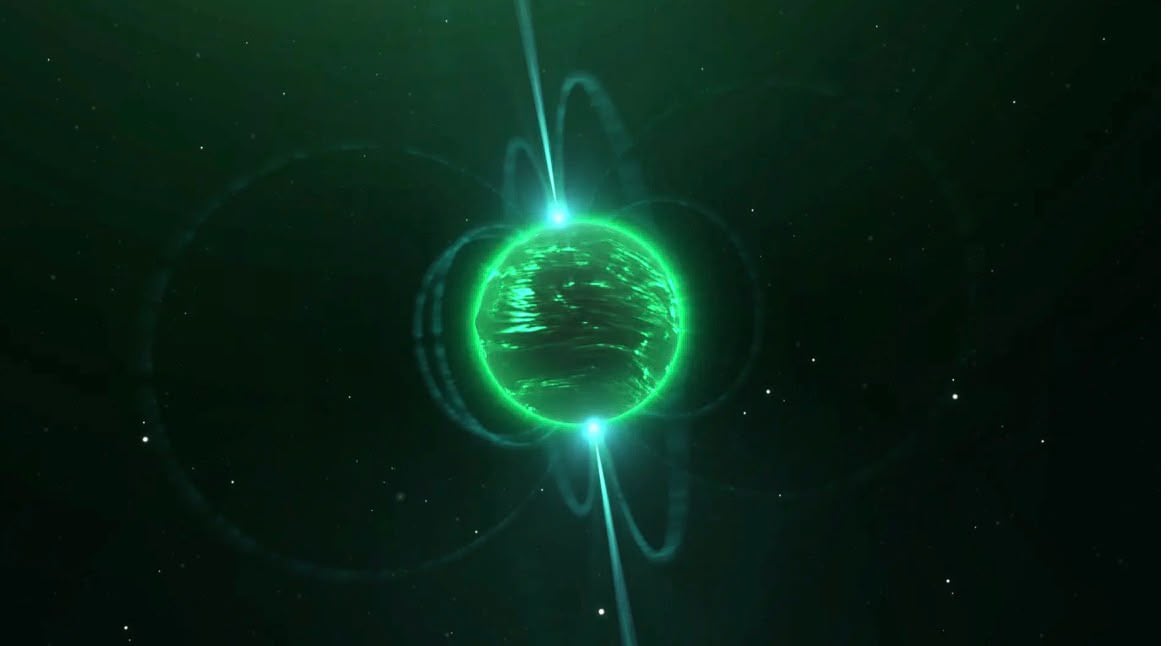
Estas observaciones podrían revelar acontecimientos dramáticos, como las fusiones de agujeros negros supermasivos, cada uno con una masa mil millones de veces mayor que la del Sol.
El púlsar recién descubierto es solitario, pero muchos de los púlsares rápidos conocidos forman parte de una pareja cósmica. En estos sistemas binarios, un púlsar y una estrella compañera orbitan un centro de masa común, lo que los convierte en extraordinarios laboratorios para poner a prueba las leyes de la relatividad general.
Debido a que la estrella compañera curva el espacio-tiempo a su alrededor, las señales del púlsar deben viajar a través de un paisaje cósmico distorsionado. Como resultado, los científicos en la Tierra pueden observar un ligero retraso en la llegada de las señales del púlsar. Medir ese retraso puede revelar propiedades fundamentales de la compañera, incluida su masa. Este es solo un ejemplo de los muchos efectos relativistas que pueden estudiarse en tales sistemas.
Estas asociaciones estelares también podrían ayudar a resolver uno de los mayores misterios de la astronomía: el origen de elementos pesados como el oro y el uranio. Algunas hipótesis sugieren que los procesos que provocan la expulsión de materia de las estrellas de neutrones en sistemas binarios pueden dispersar estos elementos pesados por todo el cosmos.
“Lo que ha ralentizado hasta ahora el descubrimiento de púlsares en sistemas binarios es que teníamos que caracterizar la estrella compañera antes de estudiar el propio púlsar”, afirma Zackay. “El nuevo y eficiente método nos permitirá encontrar púlsares en sistemas binarios a ciegas, sin información previa sobre la compañera, e incluso conocer las propiedades de la compañera mediante observaciones del púlsar. Las estimaciones sugieren que cientos de estos púlsares están esperando ser descubiertos”.
También participaron en el estudio el doctor Colin J. Clark, del Instituto Max Planck de Física Gravitacional de Hannover, Alemania, y el profesor Erik Agrell, de la Universidad Tecnológica de Chalmers de Gotemburgo, Suecia.
*Este contenido fue producido por expertos del Instituto Weizmann de Ciencias, uno de los centros más importantes del mundo de investigación básica multidisciplinaria en el campo de las ciencias naturales y exactas, situado en la ciudad de Rejovot, Israel.
Instituto Weizmann de Ciencias,rayos gamma,astrofísica,mapa celeste
INTERNACIONAL
Yemeni military official brands Iran Houthis’ ‘godfather,’ says Tehran is directing war

NEWYou can now listen to Fox News articles!
Yemen’s military is vowing to defeat the Iran-backed Houthis and retake one of the world’s most strategic maritime choke points, warning that Tehran is directly involved in the planning and execution of a war with implications far beyond Yemen’s borders.
In an on-the-record briefing Tuesday attended by Fox News Digital, Col. Majed Abdullah Al-Nuzaily, the official spokesperson for the Yemeni Armed Forces, acknowledged recent military setbacks but insisted that government forces were prepared to counter the Houthi offensive.
«This is not a conventional battle against an isolated local armed group,» Al-Nuzaily said. «What we have seen on the battlefield proves that we are not facing the Houthis alone. This is an Iranian battle: Iranian in its weapons, in its planning and command, and in its direction and timing.»
RUBIO ACCUSES IRAN OF FLYING IRGC PERSONNEL INTO YEMEN AS HOUTHI THREAT ESCALATES
Members of the Saudi-backed Yemeni government forces react during what they say to be clashes with Yemen’s Iran-aligned Houthis in a location given as near as Al-Hazm, Yemen, in this screen grab obtained from a handout video released September 9, 2026. (Media Centre Of The Yemeni Armed Forces/Handout via Reuters)
The colonel said external supply networks had provided the Houthis with ballistic and cruise missiles, sophisticated drones and advanced electronic warfare capabilities, enabling the group to threaten neighboring countries and international shipping. «Iran is the Houthis’ patron, their godfather,» he said.
Al-Nuzaily said Yemen’s Interior Ministry had identified 21 foreign experts working with the Houthis, including 14 from Iran’s Islamic Revolutionary Guard Corps (IRGC) and seven from Hezbollah, allegedly assisting with missile and drone operations, naval attacks and the selection of commercial ships to target. «And we have the evidence to prove it,» he said.
The briefing comes as Yemeni government forces face mounting pressure from the Houthis, who, according to Al-Nuzaily, now control the coastline along the Bab el-Mandeb Strait and Mayyun Island, which sits in the middle of the strategic waterway connecting the Red Sea to the Gulf of Aden.
HOUTHIS ENTER US ‘KILL BOX’ AFTER SEIZING RED SEA ‘CORK,’ FORMER PENTAGON OFFICIAL WARNS

Satellite imagery shows Bab el-Mandeb Strait, a key shipping waterway and the gateway to the Red Sea, as Iran threatens using Yemen’s Houthi allies to shut the Bab el-Mandeb gateway to the Red Sea, in this handout picture dated July 12, 2026. (NASA Worldview/Handout via Reuters)
«Bab el-Mandeb remains a priority. We retook it once in a matter of days. We will retake it again, and next time we will hold the mountains as well as the shore,» he said.
Al-Nuzaily warned that Tehran views the waterway as a source of leverage against Washington.
«Control of Bab el-Mandeb is at the heart of Iran’s strategy. Together with the Strait of Hormuz, it gives Tehran another card to play in its confrontation with the United States, and a way to improve its terms at the negotiating table.»
But Yemeni officials warned that the Houthis are increasingly developing their own transnational terrorist network, including cooperation with Somalia-based al-Shabab, meaning a potential agreement between Washington and Tehran would not necessarily eliminate the threat.
NEW RISK FOR US CONSUMERS AS IRAN-BACKED ATTACKS THREATEN A SECOND MAJOR OIL CHOKEPOINT

Houthi supporters chant slogans during an anti-U.S. and anti-Israel rally in Sanaa, Yemen, Monday, March 17, 2025. (AP Photo/Osamah Abdulrahman)
«When ISIS paraded a single missile, the world trembled – and took action. Today, the Houthis have thousands of ballistic and cruise missiles,» Al-Nuzaily said.
Ambassador Marwan Ali Al Noman, political adviser to Yemen’s minister of foreign affairs, expressed gratitude for the Trump administration’s support and the U.S. designation of the Houthis as a terrorist organization, while calling for greater international assistance.
«We are not asking anyone to fight this war for us,» Al Noman said. «We are asking for partners.»
SAUDI ARABIA TELLS TRUMP NOW IS THE TIME FOR MILITARY ACTION AS IRAN-BACKED HOUTHIS ADVANCE

Houthi supporters demonstrate in solidarity with Iran, amid a two-week ceasefire between the U.S. and Iran, in Sanaa, Yemen, April 10, 2026. (Khaled Abdullah/Reuters)
He said Yemen was seeking military equipment, training, coast guard assistance and expanded sanctions against networks supplying the Houthis with weapons and financing.
Yemen launched Operation Dawn of Yemen on Oct. 4 with the stated objectives of restoring state institutions, retaking the capital, Sanaa, and ending Houthi rule.
Government forces have since faced setbacks, including a withdrawal from the Bab el-Mandeb earlier this month. Al-Nuzaily acknowledged that Houthi forces were approximately 37 miles from Aden, the seat of Yemen’s government, but insisted the city was secure and that military forces now operate under a unified command.
«Some say this war cannot be won,» Al-Nuzaily said. «I say to them: you do not know the Yemeni people.»
«For 12 years, they have been told to accept the Houthis. For 12 years, they have refused. They have buried their sons and kept fighting. They have lost their homes and kept fighting. They will not kneel to men who rule by fear, who send children to die and who answer to Tehran rather than to Yemen.»

Protesters hold weapons during a demonstration of predominantly Houthi supporters to show solidarity with Palestinians in the Gaza Strip and to condemn U.S. strikes in Yemen, in Sanaa, Yemen, May 30, 2025. (REUTERS/Adel Al Khader)
«Dawn has come to Yemen. It will not be turned back.»
war with iran, middle east, terrorism, wars, national security

Congress is nearing the deadline to avert a government shutdown, and Senate Republicans are taking a leap of faith as the clock ticks: trusting Senate Democrats to dodge a holiday disaster.
When the upper chamber returns on Nov. 30, there will be just shy of two weeks for both sides to reach an agreement to thwart another partisan closure. At the center of the issue is the Iran war: Democrats intend to use the government’s purse strings to bring the eight-month conflict to an end.
Republicans, meanwhile, want to put together an emergency supplemental funding package with hundreds of billions of dollars dedicated to the military, munitions and war effort. They have, for now, pressed pause on ramming those tax dollars through the party-line budget reconciliation process, and instead are opening the door to work with Democrats.
DEMOCRATS COULD ENTER CONGRESSIONAL MAJORITY IN A GOVERNMENT SHUTDOWN
There’s history here: Senate Democrats have twice now ushered in a government shutdown. And though Republicans agreed behind closed doors to move forward with their counterparts, they know it’s a leap in the dark.
«Each side is a gamble,» Sen. Tim Sheehy, R-Mont., told Digital.
«I mean, obviously, if it’s party-line, when you look at the House side, you know, we got members not showing up,» he continued. «So, either way, it’s a gamble. It’s a toss-up whether we try to do [appropriations] or reconciliation.»
There is a middle ground beginning to form, however.
Senate Democrats are aligning behind a plan that would fund several of the GOP’s and administration’s defense priorities, particularly refilling dwindling munitions stocks that have taken a hit from the war.
Sen. Tim Kaine, D-Va., who has been working with a small group of Senate Democrats to produce a plan, said that while they want funding prohibitions for the war, there are some exceptions, like «defense of U.S. troops if the president seeks an authorization, evacuation of U.S. personnel.»
SENATE REPUBLICANS PLAN 54-DAY BLITZ TO PUSH TRUMP’S AGENDA BEFORE DEMOCRATS SEIZE POWER
Those exceptions would likely ride on a short-term continuing resolution (CR) that would keep the government open into early next year.
He acknowledged that it was a give-and-take with Republicans, given that they do want up to $350 billion in emergency supplemental funding for the war and Pentagon, and that some limited agreements on guardrails for Iran war funding could be used as a bargaining chip for broader funding through the emergency package.
«I think there’s a pretty wide recognition on both sides of the aisle that some of the munitions replacement money is needed pretty soon,» Kaine said. «It’s not like it produces weaponry soon, but you kind of have to start it soon.»
MORE THAN HALF OF SOME US WEAPONS STOCKPILES USED IN IRAN WAR, RAISING CONCERNS ABOUT CHINA THREAT
Others in the caucus, like Sen. Bernie Sanders, I-Vt., are firm in their position that the war must end.
«This is an illegal, unconstitutional and horrific war,» Sanders told Digital. «I want that — the American people want to see it ended as soon as possible.»
And Republicans are all too familiar with the recent history of record-shattering shutdown after record-shattering shutdown.
Sen. Jim Banks, R-Ind., told Digital that, boiled down, the issue was about «supporting our troops and investing in our military.»
«I would think the Democrats would want to support that,» Banks said. «I find it baffling that they’re not willing to. So I hope they’ll come to the table in the interest of keeping America safe and supporting our military.»
Turning to the normal government funding process, or at least using a CR, instead of reconciliation could pay off for Republicans down the line, too, when Democrats take control of the Senate next year.
Sen. Thom Tillis, R-N.C., balked at Democrats’ recent history of shutdowns and told Digital that «if you always assume the worst-case scenario, the worst-case scenario is always gonna happen.»
He argued that Senate Appropriations Committee Chair Susan Collins, R-Maine, and appropriators should be given a chance «to say, look, we know we have areas of controversy, but some of this … spending is very, very important.»
«At least try that, because then you’re laying the groundwork for maybe some bipartisan regular order appropriations next year if you go down this path,» Tillis said.
Senate Majority Leader John Thune, R-S.D., has been keyed into the ongoing negotiations, and said that there was «some interest, as you know, probably on our side» in striking a deal with the Democrats.
When asked if it was a proposal President Donald Trump could support, Thune said, «I hope so.»
politics, government shutdown, spending, senate, democrats senate

Suben el dólar oficial y el blue en medio de una nueva rueda negativa para los bonos y acciones

Frigerio se alinea con el objetivo de Milei y busca suspender las PASO en Entre Ríos

La Plata: ladrones quisieron escapar en un auto robado, los chocó un móvil policial y fueron detenidos

La CNEA refuerza la prevención en los sitios nucleares ante el fenómeno El Niño

Después de las críticas, el Bayern Munich respaldó públicamente a Musiala: «Cuenta con todo el apoyo en su proceso de recuperación» :: Olé

Un “faro” cósmico escondido: el hallazgo que cambia la forma de explorar el universo

Financial Times duda de la economía argentina: riesgo país, financiamiento e imagen Milei

El economista Luis Secco cuestionó el programa económico de Milei: “Estamos estancados desde fines del primer trimestre de 2025″

Agustín “Rada” Aristarán se despide de Chanta: “Con esta obra dejé de ser un impostor”

NYC college put on notice after Jewish campus group shunned by student government: ‘rude awakening’

 ECONOMIA3 días ago
Financial Times duda de la economía argentina: riesgo país, financiamiento e imagen Milei
- ECONOMIA16 horas ago
El economista Luis Secco cuestionó el programa económico de Milei: “Estamos estancados desde fines del primer trimestre de 2025″
- DEPORTE3 días ago
“Tenemos una buena relación, pero me pongo nervioso antes de encontrarme con él”: Jayson Tatum habló sobre su vínculo con Michael Jordan