Connect with us

INTERNACIONAL

Dentro del brote de ébola

Published

on


El ébola ha asolado al mundo durante décadas, pero ningún país ha sufrido más brotes que el Congo, que actualmente atraviesa el último.

Se han registrado 17 brotes de ébola desde su descubrimiento en la década de 1970 (y recibió su nombre de un río en el norte del país).

Advertisement

Sin embargo, este es uno de los más mortíferos, en parte porque se detectó tardíamente.

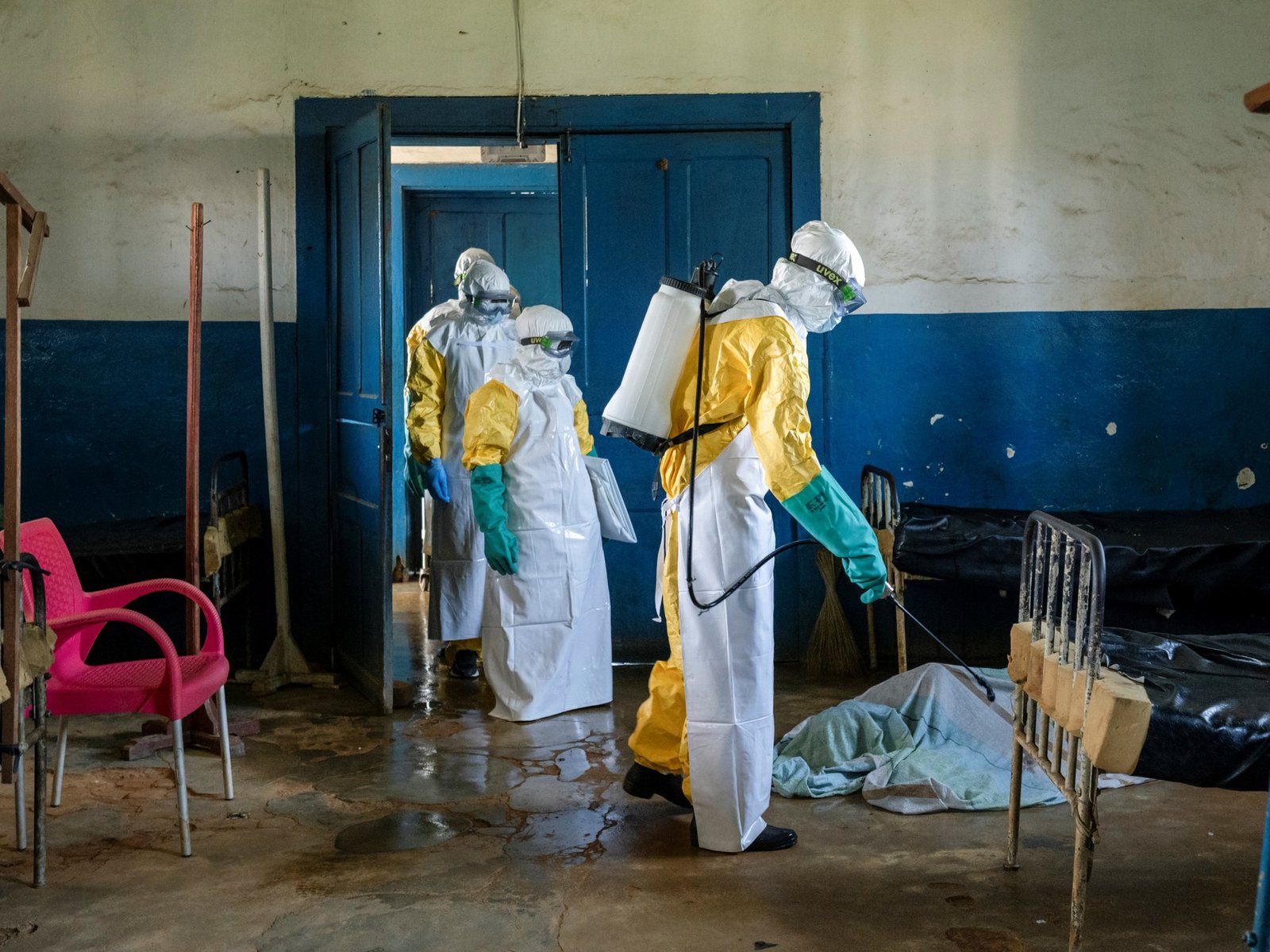
Mi colega de The New York Times, Declan Walsh, nuestro corresponsal jefe en África, se encuentra en el Congo, donde pasó un tiempo en una sala de pacientes con ébola observando cómo trabajadores sanitarios con escasos recursos intentaban tratar a múltiples pacientes con poco apoyo externo.

Hablé con él sobre lo que vio.

Advertisement

Una carrera contrarreloj en el Congo

-Declan, te encuentras en el epicentro de este último brote de ébola. ¿Dónde estás exactamente y cómo es la situación?

Me encuentro en Bunia, la capital de la provincia de Ituri, en el Congo, y he estado informando desde Mongbwalu, una ciudad situada a 80 kilómetros al norte de aquí, donde se cree que comenzó el brote.

Advertisement

El trayecto en coche nos reveló bastante sobre el brote.

Había soldados y puestos de control por todo el camino, consecuencia de la larga historia de violencia étnica en esta zona.

Además, es una región minera de oro con miles de trabajadores migrantes procedentes de otras partes del Congo.

Advertisement

Todo ello la convierte en un caldo de cultivo ideal para un virus.

-¿Cómo están afrontando la situación los habitantes de la zona?

Los médicos y el personal sanitario realizan una labor heroica, pero están completamente desbordados.

Advertisement

La sala de ébola en Mongbwalu era alarmantemente insegura:

la gente entraba y salía sin control, y nadie llevaba mucha protección. Carecían de todo tipo de equipos, medicamentos y suministros básicos. Y casi no tenían kits de diagnóstico, que son cruciales para frenar la propagación de la enfermedad.

Carecían de todo tipo de equipos, medicamentos y suministros básicos.

Advertisement

Y casi no tenían kits de diagnóstico, que son cruciales para frenar la propagación de la enfermedad.

-¿Qué tan grave es este brote en comparación con los anteriores?

Ya es el tercer brote más grande, y aún estamos en las primeras etapas.

Advertisement

El Congo ha sufrido numerosos brotes de ébola, pero este se distingue por varios factores.

Uno de ellos es que está siendo causado por una especie diferente.

El principal virus del ébola se conoce como el virus Zaire, y actualmente existen varias vacunas contra él.

Advertisement

Sin embargo, para este virus —el virus Bundibugyo— aún no hay vacuna ni tratamiento aprobados.

La tasa de mortalidad puede alcanzar el 50%.

Además, se descubrió tarde. Hubo un enorme desfase entre el aparente inicio del brote, posiblemente ya en marzo, y el primer caso identificado el 15 de mayo.

Advertisement

-La semana pasada escribimos que este brote era grave, pero que era poco probable que se extendiera por todo el mundo. ¿Sigue siendo así?

Sí, según los expertos. Se trata de un brote extremadamente grave.

Se ha extendido a al menos otras dos provincias congoleñas, a la vecina Uganda y posiblemente a Sudán del Sur.

Advertisement

Pero, por ahora, se ha mantenido en gran medida dentro de esta región.

Eso no es ningún consuelo, por supuesto, para las personas que viven aquí y que están sufriendo mucho.

Combatir este brote no es solo cuestión de dinero y medicamentos.

Advertisement

También implica luchar contra las percepciones y costumbres que, sin querer, contribuyen a la propagación del virus.

Han circulado teorías conspirativas que afirman que trabajadores sanitarios y organizaciones no gubernamentales extranjeras conspiraron para traer el virus a la zona o usarlo para exterminar a la población.

No puedo ni contar la cantidad de teorías conspirativas que hemos escuchado.

Advertisement

-Pero, ¿acaso la gente no está ya acostumbrada a los brotes de ébola?

Bueno, esta es una ciudad que se salvó del último brote, así que los lugareños no tienen un recuerdo común de haber lidiado con el ébola.

Desde su perspectiva, hubo una ola de muertes misteriosas durante todo abril y principios de mayo, hasta que finalmente se declaró la epidemia de ébola.

Advertisement

Cuando la gente enferma aquí, suele acudir primero a un curandero tradicional.

Esto significa que, para cuando llegan al hospital, la enfermedad ya está muy avanzada y a menudo mueren en cuestión de días.

La gente ha llegado a asociar el hospital con la muerte, no con la supervivencia.

Advertisement

Ven a sus seres queridos entrar para recibir tratamiento y luego ven salir ataúdes.

Además, uno de los principales vectores de transmisión han sido los funerales.

Aquí, la gente suele abrazar a los difuntos al despedirse.

Advertisement

Pero el cuerpo de una víctima de ébola es extremadamente contagioso, por lo que los funerales tradicionales se convierten, de hecho, en eventos de supercontagio.

-¿Cómo se puede evitar que eso suceda?

Hay que educar a la gente y convencer a las comunidades locales de que les conviene asegurarse de enterrar a sus seres queridos de forma segura.

Advertisement

Lo que más me impactó fue que, incluso en esta situación caótica, peligrosa y difícil, los voluntarios locales se arriesgaban sin reservas.

Se trata de personas que apenas una semana antes eran agricultores, mineros de oro y comerciantes.

Se inscribieron como voluntarios de la Cruz Roja.

Advertisement

Recibieron una capacitación muy rápida.

Les proporcionaron equipo de protección.

Y desde entonces, han estado visitando estas comunidades, ayudando a desinfectar cuerpos y a convencer a la gente de que practiquen entierros seguros.

Advertisement

Es increíblemente inspirador.

-¿Qué está haciendo el mundo para ayudar?

La respuesta se ha visto obstaculizada por la reducción de la ayuda internacional, incluido el cierre de USAID.

Advertisement

Los sistemas de vigilancia que antes existían se han reducido considerablemente.

Especialistas en ébola y organizaciones de ayuda internacional están comenzando a llegar a la zona, aportando su experiencia y recursos para abordar el problema.

Mientras visitábamos la sala de pacientes con ébola, Médicos Sin Fronteras estaba construyendo una sala de aislamiento en el exterior e intentando asegurar el recinto para que las personas que trabajaban allí y los familiares de los fallecidos no se contagiaran.

Advertisement

Pero es una carrera contrarreloj porque este virus ha tenido mucha ventaja.

c.2026 The New York Times Company

Advertisement
Advertisement

INTERNACIONAL

Obama-appointed judge blocks Trump’s election order as SAVE America Act fight intensifies

Published

on


NEWYou can now listen to Fox News articles!

An Obama-appointed judge blocked President Donald Trump’s effort to curb noncitizens from registering to vote or voting in federal elections.

Advertisement

«President Trump is committed to ensuring that Americans have full confidence in the administration of our elections. The President’s executive order lawfully protects our elections, and we are confident that we will ultimately prevail in its implementation,» White House spokesperson Abigail Jackson told Fox News Digital. 

The lawsuit centers on President Trump’s March executive order, Executive Order (EO) 14248, which directed the creation of a federal voter registration list and imposed new restrictions on eligibility for voting by mail as part of the administration’s broader effort to combat voter fraud.

U.S. District Judge Indira Talwani ruled Thursday that the president does not have the power to set election rules because only Congress and the states have that authority. Talwani has served on the U.S. District Court for the District of Massachusetts since 2014, after then-President Barack Obama appointed her to the bench.

Advertisement

‘ROGUE’ OBAMA JUDGE’S SMACKDOWN OF TRUMP ELECTION RULES PROVOKES OMINOUS WARNING FROM WHITE HOUSE DEPUTY

«President Trump has also urged Congress to pass the SAVE America Act and other legislative proposals that would establish a uniform standard of photo ID for voting, prohibit no-excuse mail-in voting, and end the practice of ballot harvesting to secure our elections for generations to come.» (Kevin Dietsch/Getty Images)

The lawsuit also comes after Trump recently threatened to withhold support for the bipartisan 21st Century Housing Act in an effort to pressure Congress to pass the Safeguard American Voter Eligibility (SAVE) Act.

Advertisement

«President Trump has also urged Congress to pass the SAVE America Act and other legislative proposals that would establish a uniform standard of photo ID for voting, prohibit no-excuse mail-in voting, and end the practice of ballot harvesting to secure our elections for generations to come,» Jackson added.

Trump’s EO ordered a federal voting registration list and directed the U.S. Postal Service to deliver mail-in ballots only to individuals on said list.

TRUMP VOWS BLOCK ON SIGNING NEW LAWS UNTIL SAVE AMERICA ACT PASSES SENATE

Advertisement
An official ballot drop box outside City Hall in San Francisco, California.

An official ballot drop box is set up outside City Hall in San Francisco, California, during early voting for the California primary election on May 26, 2026. (Jason Henry/Bloomberg via Getty Images)

Talwani’s ruling prevents the administration from enforcing those provisions ahead of the Nov. 3 midterm elections.

The lawsuits were brought by a coalition of states led by California Attorney General Rob Bonta, joined by 22 other states and the District of Columbia as well as voting rights organizations.

The decision found that Trump exceeded his authority by trying to change election rules through executive action, writing that the Constitution gives that power to Congress and the states, not the White House.

Advertisement
California voting booths arranged in a room

Voting booths are set up in California for the election process. (Adam Gray/Bloomberg via Getty Images)

CLICK HERE TO DOWNLOAD THE FOX NEWS APP

The ruling follows a decision Tuesday that struck down parts of President Donald Trump’s March election integrity executive order titled, «Preserving and Protecting the Integrity of American Elections.»

Obama-appointed U.S. District Judge Denise J. Casper found that the order went beyond enforcing existing law and instead attempted to create or change election rules on its own.

Advertisement

The decision blocks the administration from requiring documentary proof of citizenship for federal voter registration, changing voting rules for military and overseas voters, or withholding election funding from states that reject certain election rules, including counting ballots received after Election Day.

Trump abruptly canceled the signing of the 21st Century ROAD to Housing Act on Wednesday and issued an ultimatum demanding passage of the SAVE Act.

The Safeguard American Voter Eligibility (SAVE) Act includes Trump’s long-sought voter ID and citizenship verification requirements ahead of the midterm elections.

Advertisement

Fox News Digital’s Elaine Mallon contributed to this report.

federal courts, donald trump, midterm elections, federal judges, elections state and local, voter fraud concerns, politics

Continue Reading

INTERNACIONAL

«Grande y efectiva»: Trump promete ayuda logística militar para Venezuela

Published

on


El presidente de Estados Unidos, Donald Trump, se comprometió a desplegar recursos estadounidenses y ayuda logística militar “grande y efectiva” para ayudar a Venezuela, que ha sufrido una enorme devastación por los terremotos que arrasaron edificios en Caracas, provocaron centenares de víctimas y un estado de emergencia nacional.

«Estados Unidos está preparado, dispuesto y capaz de ayudar», dijo Trump en una publicación de Truth Social el miércoles por la noche. El presidente añadió que había instruido a todas las agencias gubernamentales para que se prepararan para «actuar rápido», llamando al pueblo venezolano los «nuevos y grandes amigos».

Advertisement

Luego de la captura del ex dictador Nicolás Maduro por parte de fuerzas militares estadounidenses en enero, la vicepresidenta Delcy Rodríguez quedó a cargo del gobierno y, en un drástico cambio de posición respecto de décadas de chavismo, la nueva mandataria se acercó a Estados Unidos con apertura a las inversiones estadounidenses y liberación de presos políticos.

Washington controla ahora la exportación de petróleo. Aún no se produjo una apertura electoral democrática, que la Casa Blanca espera para una “nueva fase”.

Advertisement

La rápida oferta de ayuda de Estados Unidos refleja el realineamiento diplomático entre la administración Trump y el gobierno interino venezolano, liderado por Rodríguez.

El subsecretario de Estado Christopher Landau dijo también en la noche del miércoles que Estados Unidos estaba en contacto con las autoridades venezolanas y movilizando ayuda para el país.

La presidenta Rodríguez declaró el estado de emergencia el miércoles por la noche y luego dijo que al menos 164 personas murieron y 971 resultaron heridas, aunque se estima que la cifra podría aumentar dado los cuantiosos daños.

Advertisement

De hecho, el Servicio Geológico de EE. UU. emitió dos alertas rojas consecutivas a través de su sistema PAGER, y estimó una probabilidad del 41% de que las muertes superaran las 10.000 y un 17% de que alcanzaran las 100.000. El organismo también proyectó que el devastador terremoto podría reducir el PIB de Venezuela hasta en un 7%.

El Departamento de Estado ya ha movilizado un equipo de asistencia ante desastres y una fuerza militar para entregar y coordinar asistencia crítica a los venezolanos, incluyendo equipos de búsqueda y rescate, suministros médicos y recursos humanitarios, según el alto funcionario Jeremy Lewin.

En un mensaje en video publicado el jueves por la mañana, Rodríguez agradeció a la administración Trump por brindar «apoyo y solidaridad», y a la República Dominicana por enviar equipos de rescate a Venezuela.

Advertisement

China y Brasil han enviado ayuda humanitaria al país, dijo, y el gobierno de Qatar ha preparado una brigada de rescate que llegará este jueves.

El secretario de Estado Marco Rubio dijo el jueves que el Departamento de Guerra desempeñaría un papel logístico en la asistencia ante el desastre, ya que los terremotos dañaron el aeropuerto de Caracas. «Será grande, rápida y efectiva», dijo Rubio sobre la respuesta del gobierno de EE. UU. al desastre.

También afirmó que es un «retroceso» para los esfuerzos de estabilización en Venezuela, tras la intervención militar de enero. No se sabe aún cuánto daño pudo haber sufrido la producción y cadena de suministro petrolera.

Advertisement

Estados Unidos busca primero la recuperación económica del país, con la base en la producción del petróleo. Washington es el mayor comprador de petróleo de Venezuela desde enero, con las exportaciones controladas por EE.UU. que se dispararon a 3.700 millones de dólares en abril desde 600 millones en enero, según el Council on Foreign Relations, estimando que 8.000 millones en flujos han pasado por el acuerdo con poca transparencia o supervisión. India y España son los siguientes mayores receptores.

Advertisement
Continue Reading

INTERNACIONAL

Most Trump supporters still back NATO despite years of Trump’s criticism, new poll finds

Published

on


NEWYou can now listen to Fox News articles!

Most Americans, including majorities of Republicans and self-identified MAGA Republicans, say keeping the United States in NATO is important to the nation’s security and prosperity, according to a new poll. 

Advertisement

The Reagan Institute Summer Survey found that 73% of Americans say remaining in NATO matters to U.S. security and prosperity, including 64% of Republicans and 61% of MAGA Republicans. Fox News Digital obtained a preview of the survey, which will be made public Sunday.

The poll also found bipartisan support for NATO’s collective defense principle. After respondents were told that NATO members are obligated to come to one another’s defense if attacked, 76% of Democrats, 71% of Republicans and 69% of MAGA Republicans said they would support the U.S. responding with military force if a NATO ally were attacked. 

The findings come as President Donald Trump continues to press NATO allies to shoulder more of the burden for the alliance’s collective defense. During a White House meeting Wednesday with NATO Secretary-General Mark Rutte, Trump criticized several European allies for what he described as insufficient support during the recent U.S. operation against Iran, even as Rutte praised Trump’s leadership and credited him with pushing NATO members to boost defense spending.

Advertisement

NEW POLL REVEALS AMERICANS SEE TWO PATHS ON IRAN — AND SUPPORT BOTH ALMOST EQUALLY

Most Americans, including majorities of Republicans and self-identified MAGA Republicans, say keeping the United States in NATO is important to the nation’s security and prosperity, according to a new poll released as President Donald Trump meets with NATO Secretary-General Mark Rutte. (Evan Vucci/Reuters)

The Reagan Institute Summer Survey was conducted May 26 through June 3 among 1,555 respondents nationwide and carries a margin of error of plus or minus 2.5 percentage points. The survey used a mixed-mode methodology that included live telephone interviews, an online panel and text-to-web responses.

Advertisement

To better reflect the U.S. population, the results were weighted using demographic benchmarks from the U.S. Census Bureau’s 2023 American Community Survey, including age, gender, race, region and education levels. The poll also included an oversample of 331 MAGA Republicans under age 30, a group with a margin of error of plus or minus 5 percentage points.

NATO leaders seated at a conference table during a summit in The Hague

The Reagan Institute Summer Survey found that 73% of Americans say remaining in NATO matters to U.S. security and prosperity, including 64% of Republicans and 61% of MAGA Republicans. (Handout / Latin America News Agency via Reuters Connect)

The Reagan Institute is a Washington-based policy organization that advocates the Reagan foreign-policy tradition of «peace through strength» and sustained American leadership abroad.

Trump met with Rutte Wednesday, who once again offered effusive praise for the American president during their White House meeting.

Advertisement

TRUMP PUSHED NATO TO SPEND BIG — NOW COMES THE HARDER QUESTION: CAN EUROPE ACTUALLY FIGHT?

«I really want to make clear how important it is what you are doing on Iran,» Rutte told Trump. «This is first of all about the nuclear capability Iran was very near to getting its hands on,»

Trump, meanwhile, criticized several European allies for what he described as insufficient support during the U.S. operation against Iran.

Advertisement
NATO Secretary General Mark Rutte, U.S. President Donald Trump and Britain's Prime Minister Keir Starmer posing with NATO leaders

NATO’s collective defense principle, known as Article 5 of the Washington Treaty, has been invoked only once in the alliance’s 77-year history. NATO allies unanimously invoked the provision after the Sept. 11, 2001, terrorist attacks, declaring the attacks on the United States an attack on all members of the alliance. (Ben Stansall/Pool via Reuters)

CLICK HERE TO DOWNLOAD THE FOX NEWS APP

«I was disappointed with Italy. I was disappointed with the UK,» he said. «We were disappointed with Germany and France. We’re disappointed with most of them. Spain is a horror show.»

«We don’t need their money, we don’t need anything. We have the most powerful military in the world by far, but I just want loyalty,» Trump said.

Advertisement

NATO’s collective defense principle, known as Article 5 of the Washington Treaty, has been invoked only once in the alliance’s 77-year history. NATO allies unanimously invoked the provision after the Sept. 11, 2001, terrorist attacks, declaring the attacks on the United States an attack on all members of the alliance. 

Trump has long criticized NATO members for failing to meet alliance defense spending commitments — at times even threatening to pull out of the alliance — arguing the U.S. has carried a disproportionate share of its security burden. 

During both his first and second terms, he has pushed allies to significantly increase military spending while warning that the U.S. should not bear the costs of Europe’s defense alone.

Advertisement

The White House and NATO could not immediately be reached for comment. 

nato, fox news poll, national security, donald trump, republicans

Advertisement
Continue Reading

Tendencias