INTERNACIONAL
El día que el mundo cambió

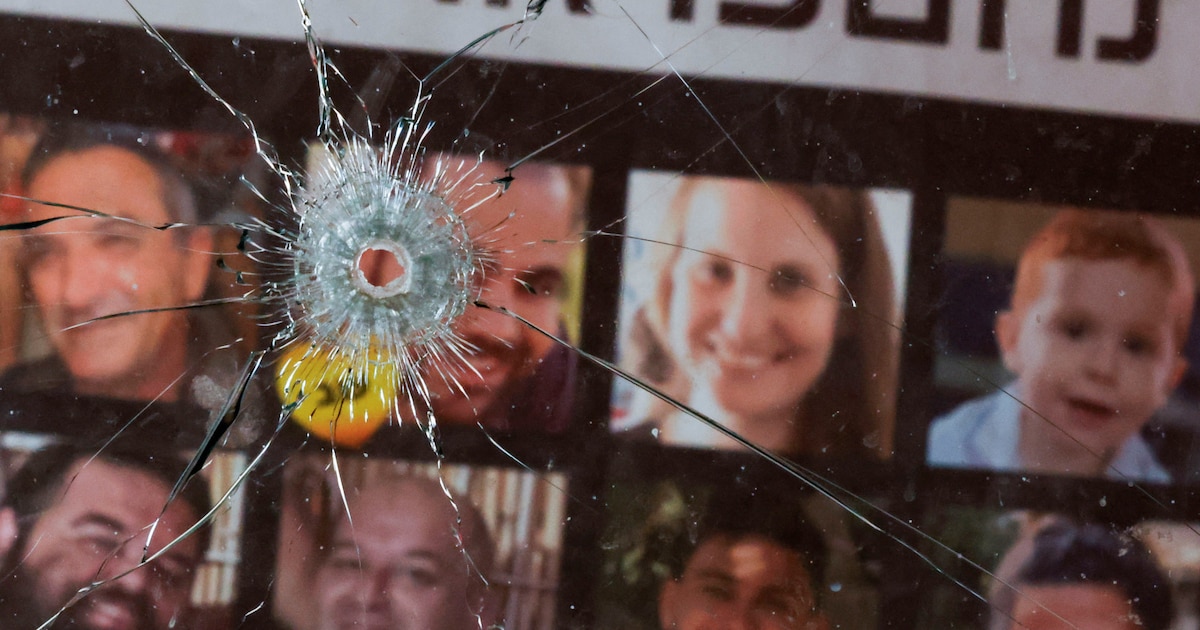
A punto de entrar en un recinto que se usaba como comedor, me frenó en seco un olor intenso que, tres años después, aún está grabado en mis sentidos. “¿Qué es ese olor tan punzante y penetrante?”, le pregunté al amigo Rony Kaplan, que me acompañaba en ese desgarrador viaje que Combat Antisemitism Movement había organizado. Y así, un 9 de noviembre de 2023, a un mes de la masacre del 7 de octubre, conocí a qué huele la carne humana quemada.
En ese lugar preciso habían sido amontonados y quemados los cuerpos de algunas de las 47 personas del kibbutz Nir Oz que fueron asesinadas. “Cuidado, no pises eso, que…”, y montoncitos de cenizas humanas marcaban los pasos. Muy cerca de donde nos encontrábamos, Shiri Bibas había protagonizado la terrible imagen de su cuerpo aterrorizado cubriendo a su bebito Kfir, de apenas nueve meses. Ella y sus dos hijos fueron tres de las 76 personas que fueron secuestradas en Nir Oz. Tiempo después supimos que un terrorista había ahogado con sus propias manos al pequeño Kfir. Junto con Kfir, su mamá Shiri, su hermano Ariel y sus abuelos Yossi y Margit Silberman, fueron 1.200 las personas asesinadas en el progrom más cruento y brutal que ha sufrido el pueblo judío desde el Holocausto. Después vendría la guerra, el viacrucis de los secuestrados, el drama de los habitantes de Gaza, la banalización del terrorismo, el tsunami antiisraelí, el odio antisemita, la violencia contra judíos… Pero antes de todo, lo primero fue la marabunta de miles de miembros de las Nukhba de Hamás, de la Yihad Islámica y de otros grupos terroristas entrando con todo tipo de armas en los kibbutz y en los pueblos cercanos. Y fue la muerte desbocada, quebrando huesos, violando a todo tipo de niñas, jóvenes, mujeres mayores, también niños, torturando de maneras indecibles, cazando a cualquier ser humano que respirara, desmembrando cadáveres, paseando cuerpos rotos por los vídeos virales de su júbilo macabro. Todo eso pasó antes de la guerra que se desató para frenar al terrorismo y rescatar a los secuestrados. Antes de todo, fue el imperio de la muerte.
A tres años del 7 de octubre, cabe recordar quienes idearon y protagonizaron la masacre, quienes motivaron una guerra y quienes son los responsables del sufrimiento de ambos pueblos, el israelí y el palestino. Y cabe recordarlo porque uno de los fenómenos más perversos que han sucedido después de una masacre reconocida (tanto, que fue filmada y viralizada por los propios asesinos), es la negación de las víctimas y el enaltecimiento desaforado de los verdugos. Y ello no solo pasó durante los meses posteriores de la guerra, sinó desde el minuto uno, cuando aún había moribundos en las cunetas y gente desesperada buscando a sus familiares en los rincones del miedo. El mismo 8 de octubre, en plena desesperación y horror en Israel, las redes ya se movilizaban en contra del estado hebreo, ignoraban la brutalidad del terrorismo y levantaban la bandera de Palestina, como si la muerte masiva de los grupos terroristas dignificara a su causa. Todo estuvo planificado, no solo la matanza, sino la propaganda coordinada posterior, con miles de boots en X que culpaban a Israel de la muerte de su propia gente cuando aún no se había movido ni un solo tanque, y con Irán y Rusia (campeones de las fábricas de boots), a la cabeza de la desinformación. Después ya fue fácil activar a los grupos de izquierdas (la mayoría ferozmente antiisraelíes), a los miles de grupúsculos y entidades propalestinas que hay en el mundo (muchos de ellos con financiación directa de Hamás), y a la ignorancia supina de la masa, que tiende a deglutir la propaganda antes de masticar la información confiable.
Por supuesto, la crítica a la guerra, al gobierno y al propio primer ministro israelí no solo era pertinente, sino que era necesaria, como lo es en todo conflicto. Pero no es la crítica democrática y racional, la que hemos vivido. Hemos vivido una descompensación aterradora entre el ataque sistemático y desaforado a Israel, cuya imagen se ha arrastrado a niveles indecibles, como si nunca hubiera sufrido una matanza planificada y masiva -ni sufriera un intento permanente de exterminio-, y a la vez, un aplauso global, desacomplejado y entusiástico del terrorismo palestino. Las imágenes de las manifestaciones con banderas de Hamás en países democráticos, o de los campus universitarios persiguiendo a estudiantes judíos, o los miles de artículos comparando a los israelíes con los nazis, o el silencio de las feministas ante las violaciones masivas de mujeres israelíes, o las declaraciones de políticos irresponsables usando la guerra como puro oportunismo demagógico, todo lo vivido ha sido un atroz aplauso al mal. Al mal puro, el que es capaz de ahogar con sus propias manos a un bebé de nueves meses, en nombre de una causa.
No habrá tiempo en nuestro tiempo presente para pedir perdón al pueblo israelí, y al pueblo judío en general, por la maldad con la que los hemos tratado en el peor momento de su historia después del Holocausto. La solidaridad con el pueblo palestino es noble, como todas las causas que merecen ser escuchadas. Pero no lo es el aplauso a una ideología del mal que ha secuestrado la voz de los palestinos y los ha condenado a un futuro incierto. Hoy, 7 de octubre, no olvidemos quién empezó todo y qué quería provocar, al empezarlo. La ideología de la muerte solo tiene un pálpito: la muerte.
@RaholaOficial
Web:
Instagram: pilar_rahola/

INTERNACIONAL
French school riots deepen as experts point to far-left alliance fueling ‘broader confrontation’
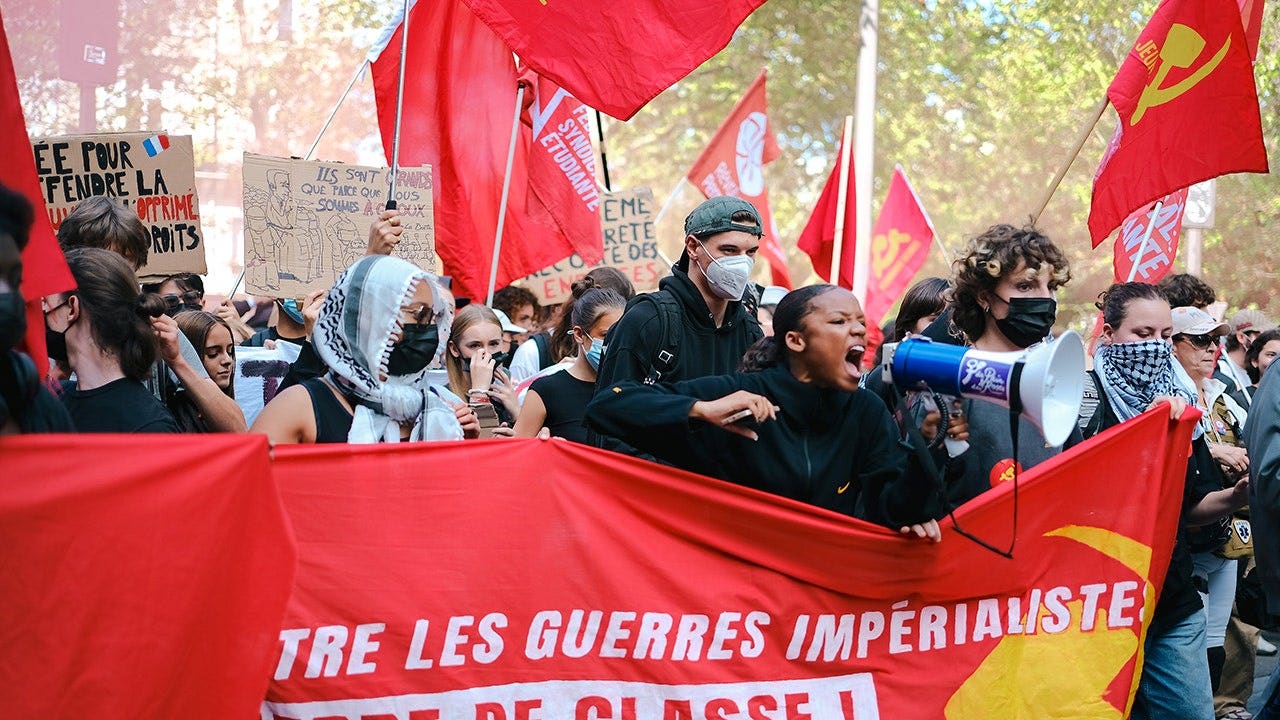
Violent student protests erupt across France as left-wing groups seize on chaos
Massive student demonstrations throw France into chaos as left-wing factions exploit ongoing anger over crumbling classrooms. Host Harris Faulkner analyzes the civil unrest with Fox News foreign correspondent Jeff Paul in Paris, where authorities have arrested over 5,000 people and nearly 200 have been injured. Heritage Foundation’s Nile Gardiner discusses how far-left groups are acting on the chaos.
NEWYou can now listen to Fox News articles!
An unholy alliance is being blamed for instigating the violence seen across France as experts point to a bond between extreme left and radical Islamic groups.
What began as protests over school conditions and funding is entering its third week, and the factors behind the widespread, more violent protests are being debated.
«The protests started in an apparently spontaneous way in the disadvantaged, immigrant suburbs of Paris,» Nathalie Szerman, researcher in radicalization and extremism in France at MEMRI, told Fox News Digital, but «it quickly became clear that the violence demonstrated in these protests conveyed a huge amount of hate towards the ‘system’ and not much concern for better material conditions in schools, as dozens of schools across France have suffered vandalism and blockades, and many were even set on fire.»
FRANCE ROCKED BY STUDENT RIOTS AS HUNDREDS ARRESTED, VIOLENCE SPREADS NATIONWIDE
Protesters hold Palestinian and Antifa flags as French high school and university students attend a demonstration in Strasbourg, France, on Thursday, Oct. 6, 2026. (Kai Pfaffenbach/Reuters)
Szerman said that while demonstrations over school conditions at the beginning of an academic year in France «is not a new phenomenon,» the «scope of these demonstrations and their character should raise concerns.» She points to protestors taking to the streets carrying Palestinian flags. «Pro-Palestinian organizations, such as Urgence Palestine, have declared the month of October to be a month of revolt, and these groups are supporting and fueling these demonstrations.»
«I think at the very heart of this, is the far-left and the Islamists combining forces to undermine France itself,» Nile Gardiner said.
«The French are notorious for strikes, labor shortages and street demonstrations,» former U.S. Assistant Attorney General Theo Wold told Fox News Digital, but these protests are «a consequence of mass immigration. The rioters are not of French culture, and they don’t respect the rule of law… France is learning that importing an underclass of foreigners causes broader societal damage.»
ISRAELI AMBASSADOR COMPARES FRANCE’S FAR-LEFT LEADER’S RHETORIC TO HITLER AS ANTISEMITISM SURGES
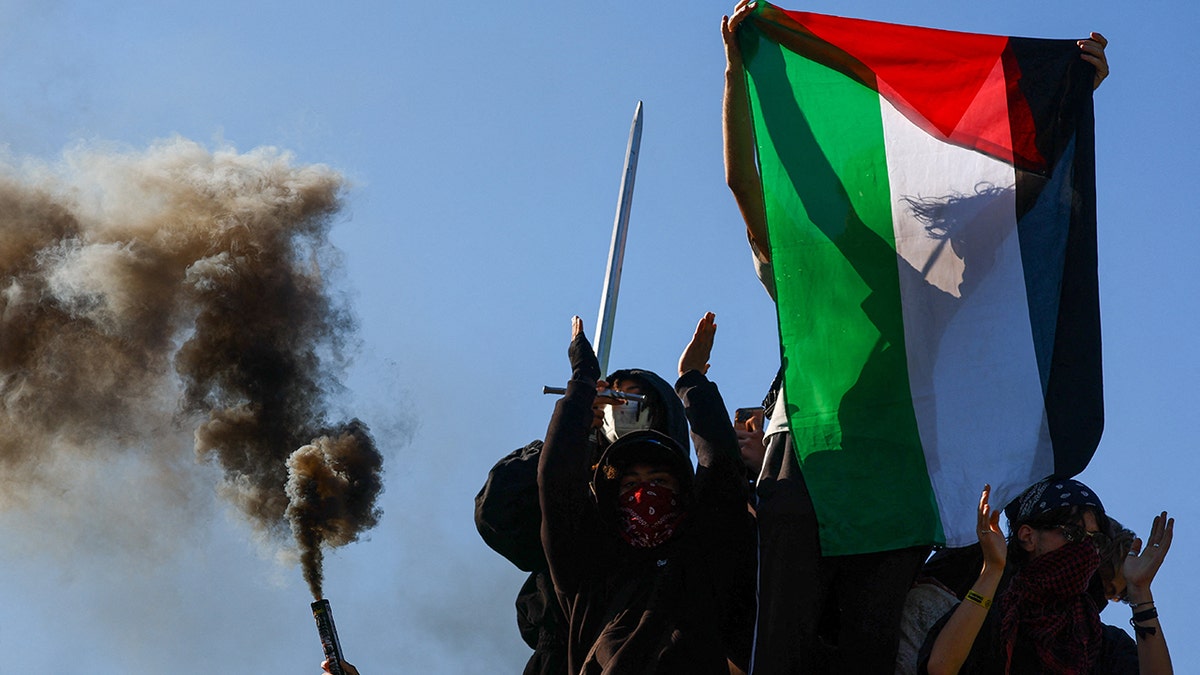
Protesters hold a Palestinian flag on the day French high school and university students attend a demonstration in Strasbourg as part of a nationwide day of protests and blockades, voicing anger over overcrowded classrooms, teacher shortages and dilapidated school buildings, which students blame on years of underinvestment, France, October 6, 2026. REUTERS/Kai Pfaffenbach ( )
Nile Gardiner, director of The Heritage Foundation’s Margaret Thatcher Center for Freedom, told Fox News’ Outnumbered on Tuesday, «I think at the very heart of this, is the far-left and the Islamists combining forces to undermine France itself… This is a form of uprising, frankly, by far left wing forces together with second, third generation migrants. And also, at the same time, France is in real economic trouble.»
Simone Rodan-Benzaquen, senior envoy to Europe at the Foundation for Defense of Democracies told Fox News Digital that, «Students have reason to be angry about overcrowded classrooms and absent teachers.» She added but «What does Gaza have to do with a shortage of teachers in France? I’ll tell you what: [the far-left La France Insoumise party] has spent years making hostility to Israel a central part of its appeal to young voters. Bringing that cause into the school protests helps fuel the racial dynamics and turn a demand for better classrooms into a much broader confrontation with the government,» she said.
EUROPE’S LEFT COURTS MUSLIM VOTERS AS ANTI-ISRAEL POLITICS RESHAPE CONTINENT
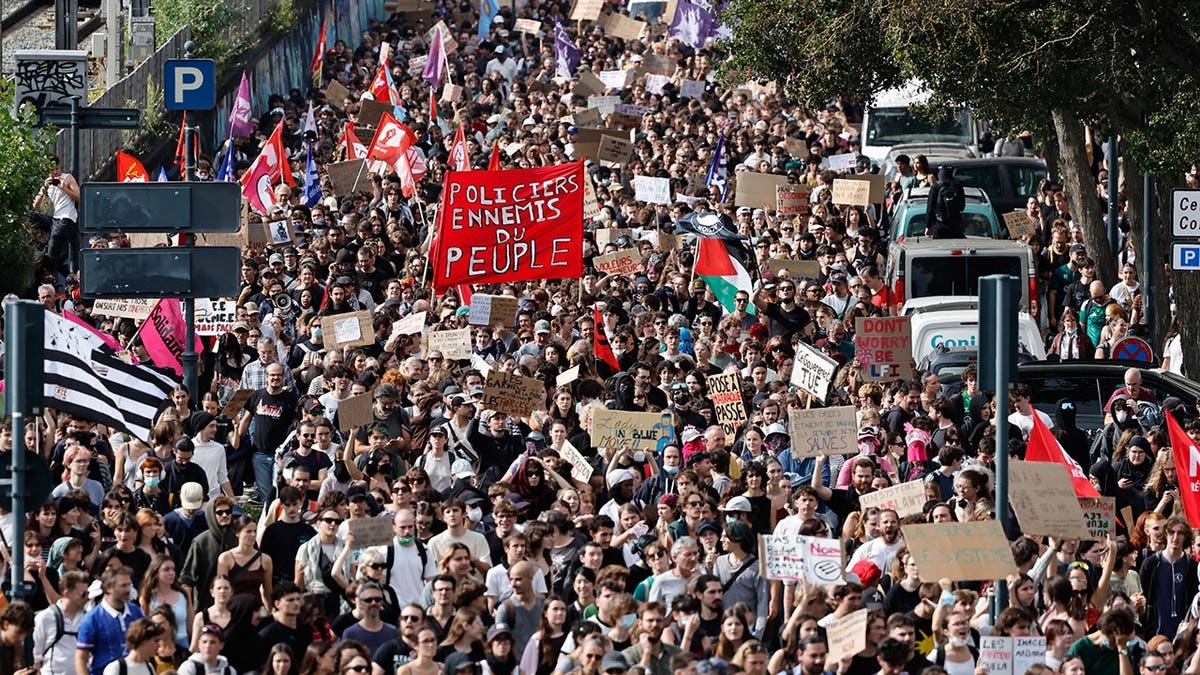
Students march with a large red banner reading «Police officers, enemy of the people» during a protest against under-resourced schools in Rennes, western France, on Tuesday, Oct. 6, 2026. (Jeremias Gonzalez/AP)
«LFI is the perfect embodiment of the Red-Green alliance – the alliance between leftists and Islamists,» adds Szerman. «LFI rallies Islamist and pro-Palestinian groups on the one hand, and other French anti-system leftists who accuse the elite of enriching itself at the expense of the poor on the other. It is a revolutionary party using Islam as an inner drive. Politicized Muslims are aware of this and are also using LFI to promote their own agenda.
«They are fueling and empowering each other, the common ground being the claim that they are the people,» Szerman continues. «The people are seen as the enemy of the ‘elite’ running the country, which therefore has to be overthrown.»
Rodan-Benzaquen said, «French students need their teachers to show up to class, and their parents need to know they will be safe at school. But [LFI leader Jean-Luc Mélenchon] is not interested in these goals.» She says he is «encouraging the citizens to see their schools as a front in a larger political battle, one whose real prize is the presidency.»
FRANCE’S TEEN RIOTS TAKE EXPLOSIVE NEW TURN AS GOVERNMENT POINTS FINGER AT HARD LEFT
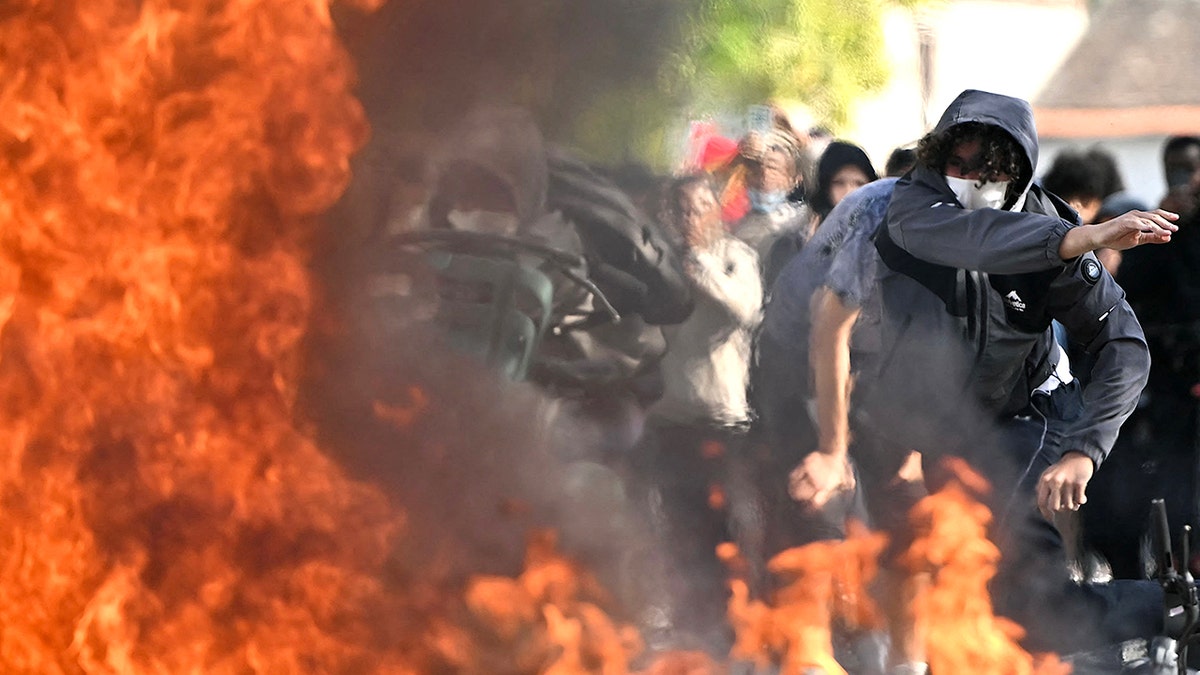
A protesting student feeds a burnt barrier during a blockading action outside the secondary school Le Corbusier, in Aubervilliers, northern Paris on October 1, 2026. Since late September, students have staged protests outside schools over grievances ranging from timetables, class sizes and a shortage of teachers to overheated classrooms during this year’s heatwaves. The protests started in the Ile-de-France region around Paris but have now spread to other cities nationwide. (Photo by LOU BENOIST / AFP via Getty Images) ( )
French President Emmanuel Macron is term-limited and cannot run for a third consecutive term in elections this coming Spring. Many observers believe a runoff match-up between the far-left Mélenchon and right-wing populist Marine Le Pen of the National Rally party could be on the horizon.
«No matter how the protests play out, Mélenchon will likely benefit,» said Rodan-Benzaquen. «If the unrest drives voters toward the far right, he can hope to emerge as the leader of the opposition. If he succeeds in mobilizing enough voters himself, he could reach the presidency. Either prospect gives him a reason to keep the confrontation going. Neither gives him much incentive to lower the temperature.»
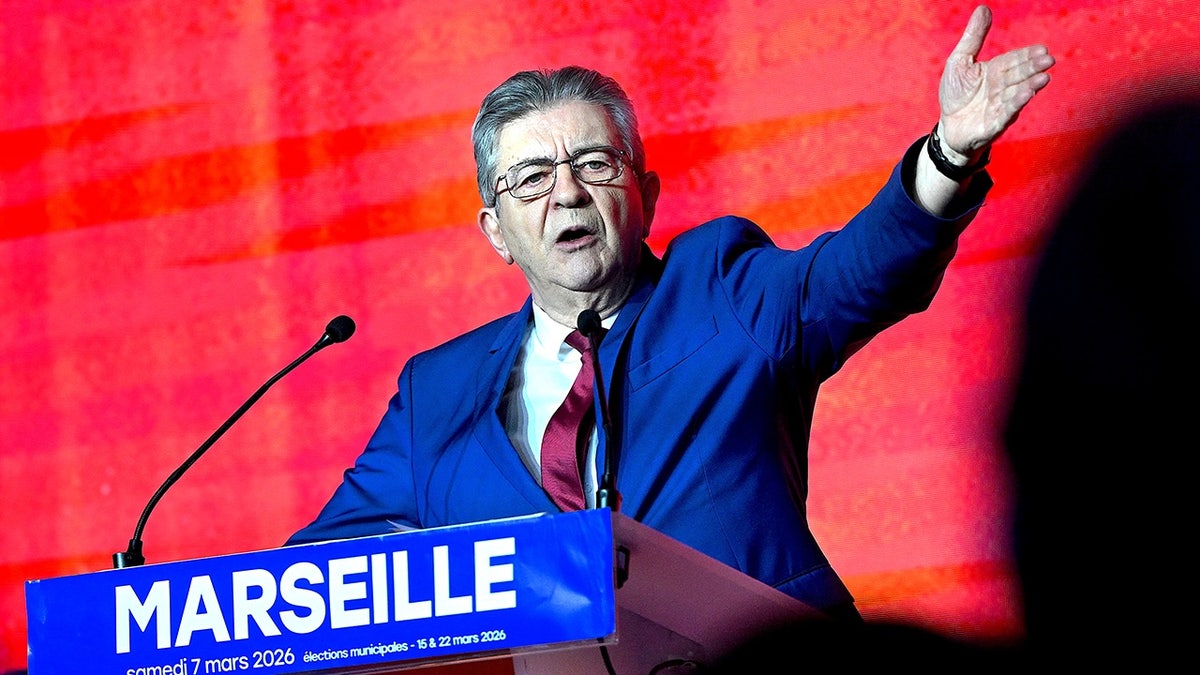
Leader of French left-wing La France Insoumise (LFI) party Jean-Luc Melenchon delivers a speech during an electoral campaign meeting of the local LFI candidate for French municipal elections in Marseille, southern France, on March 7, 2026. (Miguel Medina / AFP via Getty Images)
«I do not think that the LFI leadership made a conscious decision to trigger destructive demonstrations all over France,» adds Szerman, «but once the movement was launched, LFI did provide a backbone for the violence, as it will never blame any of its followers.»
FRANCE EXPLODES AGAIN AS STUDENTS RIOT OVER EDUCATION
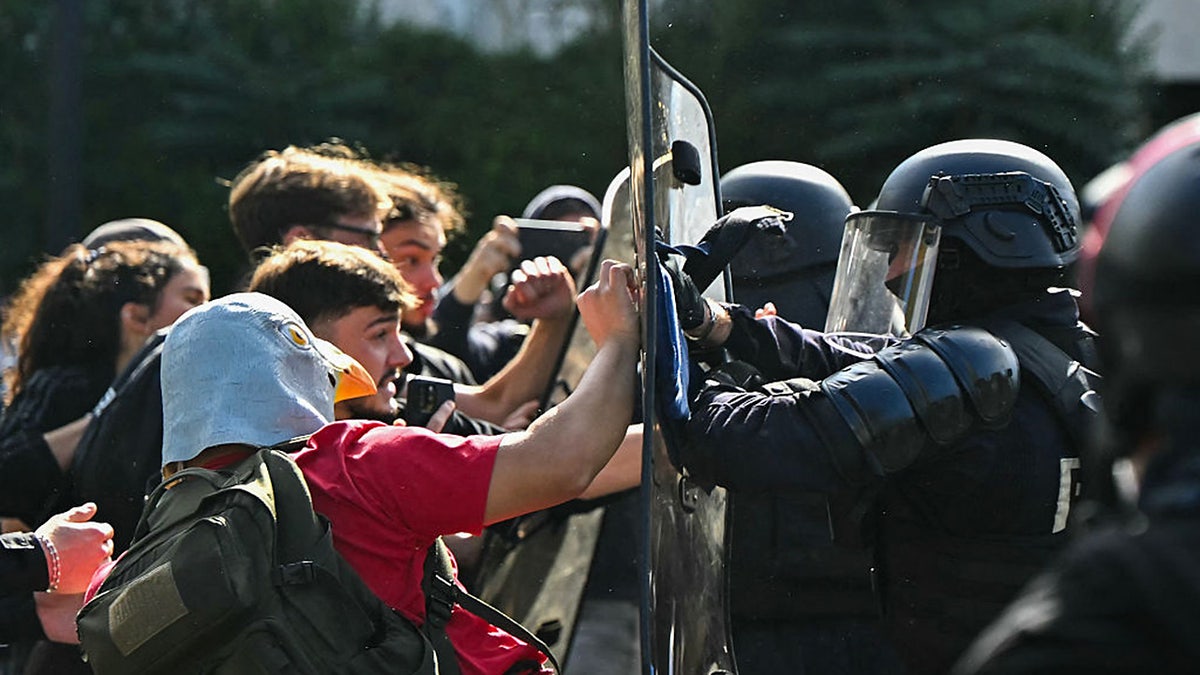
TOPSHOT – Anti-riot police officers face protesting students carrying out blockading action outside the secondary school Le Corbusier, in Aubervilliers, northern Paris on October 1, 2026. Since late September, students have staged protests outside schools over grievances ranging from timetables, class sizes and a shortage of teachers to overheated classrooms during this year’s heatwaves. The protests started in the Ile-de-France region around Paris but have now spread to other cities nationwide. ( )
So far, the protests have not spread across the continent even as spending on education seems close between countries.
According to the latest available figures from Eurostat, the European Union’s official statistical office, in 2024 France spent over 5% of its GDP on education, more than it spent on defense. In that same year, neighboring Germany spent only 4.5% of its GDP on education.
In Macron’s latest proposed budget, about $74 billion is earmarked for French schools, more than proposed for defense, but both are cuts from the last official budget narrowly approved by Parliament over the winter. Germany’s Federal Statistical Office reports spending on education was up to 7% of GDP at over $340 billion when including federal, state and local government spending. Meanwhile, in the U.K., Department for Education spending for the 2025/26 school year was estimated at around $142 billion.
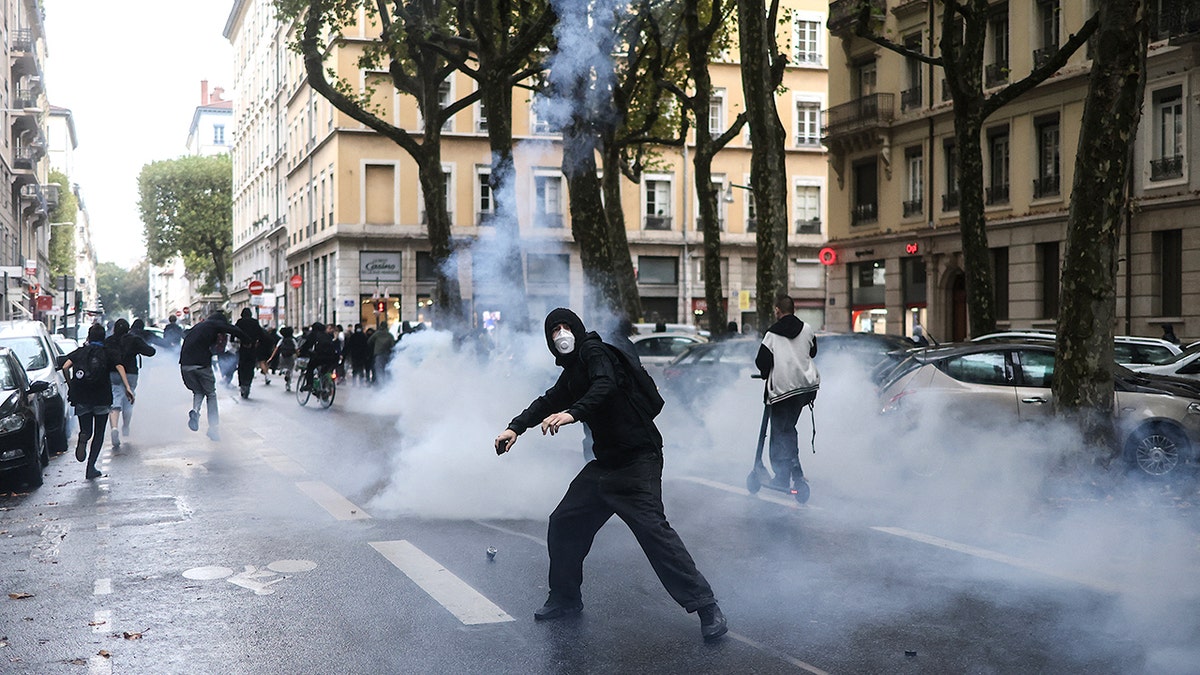
Students clash with police during ongoing student protest action, in Lyon, central eastern France, on Oct. 1, 2026. Since late September, students have staged protests outside schools over grievances ranging from timetables, class sizes and a shortage of teachers to overheated classrooms during this year’s heatwaves. The protests started in the Ile-de-France region around Paris but have now spread to other cities nationwide. (Alex Martin AFP via Getty Images)
When comparing the latest figures for expenditures per student, France’s ministry of education says in the 2024/25 school year, it spent $9,950 per student, Germany’s Federal Statistical Office says $12,000 was spent per student in 2025, and the U.K. spent about $10,100 per student in 2024/25. Meanwhile, the Organization for European Economic Co-operation says the Europe-wide average is around $12,000 per student per year.
Some 500 high schools are closed in France on Wednesday, down from 891 on Tuesday. The schools have been ordered by the ministry of education to replace normal lessons through Friday with structured dialogue and staff crisis management meetings in an effort to calm tensions, to avoid confrontations at school gates and to give staff time to reorganize.
The Associated Press reports more than 6,100 people have been arrested since the protests began, with the Interior Ministry saying 715 police officers have been injured.
france, world protests, emmanuel macron, europe, controversies education
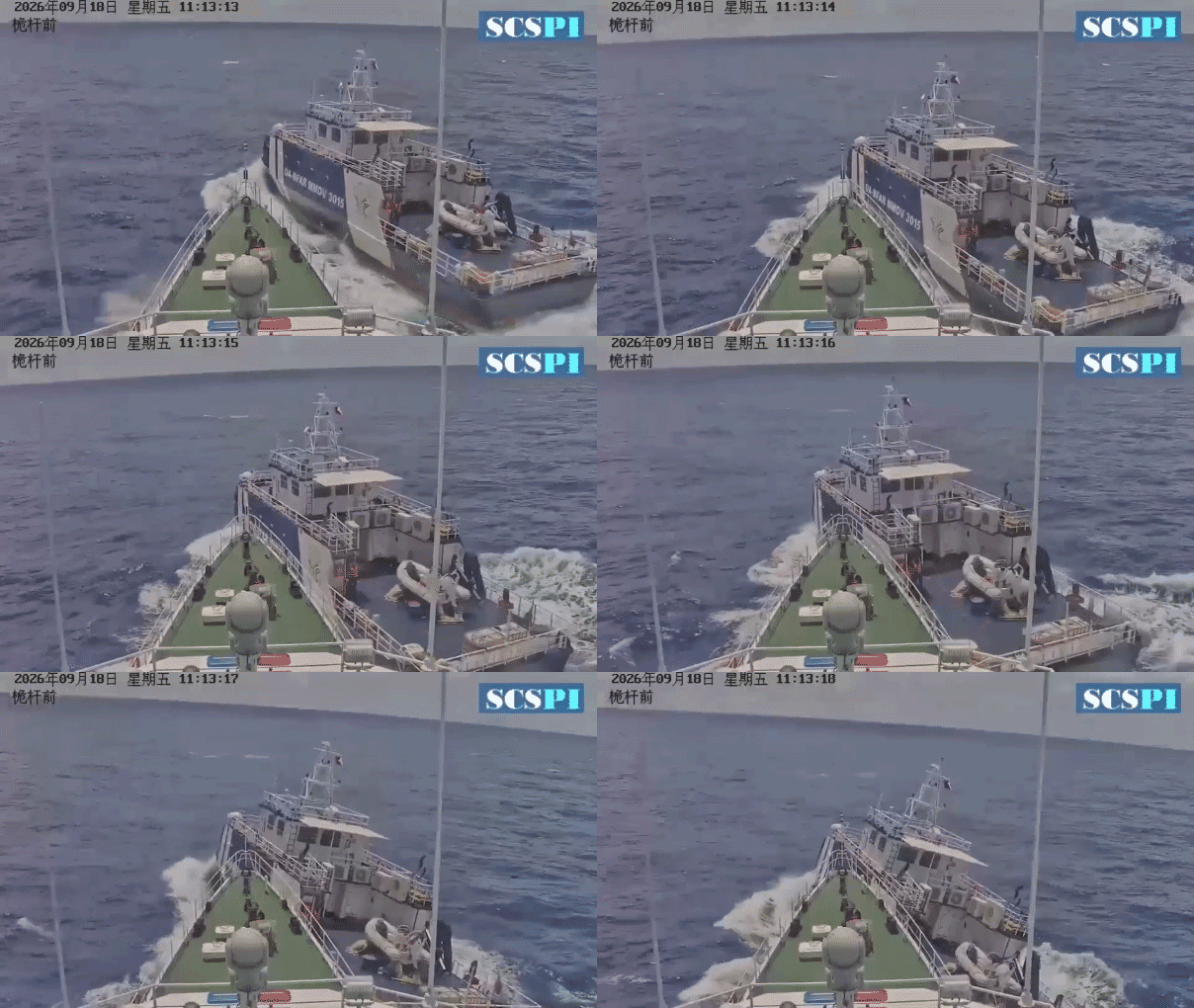
China nearly doubled the number of military and coast guard ships it sent to a key flashpoint in the South China Sea last month, according to Manila’s military.
It comes as a series of increasingly tense encounters raises the risk of confrontation with a U.S. treaty ally located in the disputed waters. The Armed Forces of the Philippines said it tracked 101 different Chinese navy and coast guard vessels around four disputed areas over the course of September, up from 56 in August and 48 in July.
The sharp increase comes as Chinese and Philippine forces have faced off both at sea and in the air, including an encounter over the weekend in which Manila accused a Chinese fighter jet of repeatedly maneuvering dangerously close to an unarmed Philippine patrol plane.
China claims sovereignty over most of the South China Sea, including waters that fall within the Philippines’ exclusive economic zone, and uses coast guard ships, naval vessels and aircraft to assert those claims. Manila has continued patrolling the waters and resupplying Philippine positions, bringing forces from the two countries into repeated close contact.
US, CHINA STRIKE DEAL TO LOWER TARIFFS ON $30B IN GOODS AFTER TRUMP-XI WASHINGTON SUMMIT
The confrontations carry particular stakes for Washington: the Philippines is a U.S. treaty ally, and the U.S. has repeatedly said its Mutual Defense Treaty with Manila applies to armed attacks on Philippine armed forces, public vessels and aircraft — including in the South China Sea.
The latest Philippine count showed the largest number of Chinese vessels around Scarborough Shoal, where 39 different Chinese coast guard and People’s Liberation Army Navy ships were observed during September.
Another 28 were tracked around Thitu Island, known in the Philippines as Pag-asa; 23 around Second Thomas Shoal; and 11 around Sabina Shoal.
Rear Adm. Roy Vincent Trinidad, an Armed Forces of the Philippines spokesperson for the West Philippine Sea, said the figures showed China’s continued «illegal, coercive, aggressive and deceptive» activities in the region.
But Philippine officials stopped short of concluding that the jump represented a broader shift in China’s strategy. Asked why the number had nearly doubled from August, Trinidad said the military wanted to examine a longer period before drawing conclusions about the trend.
The increase comes as the two sides have repeatedly confronted each other around some of the same contested waters.
On Saturday, a Philippine C-208 maritime patrol aircraft was flying near Scarborough Shoal when it encountered two Chinese military aircraft, according to the Philippine military.
Manila said one of the aircraft, a Chinese J-16 fighter, repeatedly approached the unarmed Philippine plane and maneuvered in front of and behind it at what the military described as an unsafe distance.
«This incident is part of a recurring pattern of unsafe and coercive behavior against Philippine government vessels and aircraft conducting lawful operations,» the Philippine military said.
The Philippine aircraft completed its mission and returned safely to base.
TRUMP ENVOY WARNS CHINA’S POWER MOVE AT SEA IS THREAT ‘WE CANNOT AFFORD TO IGNORE’
Beijing offered a sharply different account, saying the Philippine aircraft had entered airspace over Huangyan Dao, China’s name for Scarborough Shoal, without permission and that Chinese forces took «necessary measures» in response.
Scarborough Shoal sits about 120 miles west of the Philippine island of Luzon and has become one of the most persistent flashpoints between Beijing and Manila. China has effectively controlled access to the shoal since a 2012 standoff, while the Philippines maintains that it falls within its exclusive economic zone.
China claims sovereignty over Scarborough and much of the South China Sea, overlapping claims by the Philippines and several other Southeast Asian nations. An international tribunal ruled in 2016 that China’s sweeping historic-rights claims in the South China Sea had no legal basis, a ruling Beijing rejects.
The encounters have continued despite a recent diplomatic thaw between Washington and Beijing, with President Donald Trump and Chinese President Xi Jinping emphasizing stability in the relationship during Xi’s state visit to Washington.
Days before the latest air encounter, Chinese coast guard and naval vessels moved to block a Philippine resupply mission to Second Thomas Shoal, another major flashpoint in the dispute.
The Philippines deliberately grounded the aging BRP Sierra Madre at Second Thomas in 1999 and keeps a small contingent of troops aboard the rusting ship to maintain its presence. Chinese vessels have repeatedly tried to block missions carrying food, water and other supplies to those troops.
The latest incidents put renewed attention on Washington’s defense commitment to Manila. The two countries have been bound by their Mutual Defense Treaty since 1951, and the U.S. has said an armed attack on Philippine armed forces, aircraft or public vessels anywhere in the South China Sea would invoke U.S. obligations under the treaty.
china, national security, coast guard, military, asia
INTERNACIONAL
Byung-Chul Han y el ghosting como síntoma de una sociedad rota: algoritmos, narcisismo y la muerte del respeto

En Sin respeto, Byung-Chul Han examina cómo el ghosting, la competencia extrema y la búsqueda de atención erosionan el respeto entre las personas y debilitan los vínculos que sostienen la convivencia. El filósofo sitúa estas conductas en sociedades dominadas por el neoliberalismo, el narcisismo y la comunicación digital.
Dejar un mensaje sin respuesta implica tratar al otro como alguien prescindible y reemplazable. Para Han, esa práctica desliga a quien la ejerce de su responsabilidad hacia los demás y expresa una relación utilitaria con los vínculos personales.
Una sociedad sana protege a sus miembros y ofrece valores capaces de generar seguridad y justicia. Cuando desaparecen esos puntos de referencia, las costumbres dejan de ordenar la vida colectiva y la falta de vergüenza se convierte, a la vez, en causa y consecuencia de la pérdida de valores.
La competencia, la desinhibición digital y la concentración en el propio interés han convertido el respeto en un valor amenazado. La atención ocupa el lugar que antes tenía la consideración por los demás: despertar interés puede otorgar visibilidad, pero no garantiza reconocimiento.

La cortesía ha cedido terreno ante la humillación pública, convertida en una práctica frecuente. Han describe ese desplazamiento como el paso de una sociedad del respeto a una sociedad del rendimiento, donde cada persona percibe a las demás como rivales.
Esa competencia generalizada provoca una caída de la autoestima y erosiona los lazos sociales. El ensayo sostiene que el egoísmo reduce la empatía, la comprensión y la consideración hacia otros, pero también puede afectar el respeto que cada individuo conserva por sí mismo.
El filósofo retoma a John Rawls y su obra Una teoría de la justicia, publicada en 1971, para vincular la autoestima con el trato hacia los demás. Han afirma: “Quien no se respeta a sí mismo, no tiene autoestima o incluso llega a odiarse, acabará menospreciando también a los otros. El respeto por uno mismo y el respeto por los demás van de la mano”.
El respeto propio exige, según esa reflexión, dos condiciones: “Un firme convencimiento sobre la concepción del bien que tenemos y que nuestro proyecto de vida merece la pena de realizarse”, junto con “confianza en la propia capacidad, en la medida que sea posible, de llevar a término los propios propósitos”. Esa confianza sostiene la integridad personal y el propósito vital.

Han cuestiona un sistema neocapitalista que, a su juicio, limita la autonomía individual y transforma a las personas en combatientes aislados. “La sociedad bien ordenada no es una sociedad del rendimiento, sino una sociedad del respeto”, plantea el autor.
La lógica neoliberal, sostiene, desplaza la idea del bien común ante el materialismo de la propiedad. En ese escenario, “todos se enfrentan a todos” y ya no existe solidaridad “ni tan siquiera entre los perdedores”.
Redes sociales, identidad y dominación tecnológica
Las redes sociales intensifican la competencia por reconocimiento y convierten el respeto en una disputa por atención. Han advierte que quien no recibe interacción o respuesta en línea puede interpretar esa ausencia como un insulto, una humillación, un rechazo o una forma de exclusión social.
El resultado es una mayor distancia entre las personas y un incremento de los recelos. La búsqueda de una identidad influenciable y frágil desplaza la atención sobre la alteridad, entendida como la capacidad de reconocer al otro como diferente y establecer con él un intercambio de ideas.

Esa pérdida de apertura favorece que los diálogos deriven en confrontaciones entre personas que vinculan sus opiniones con su identidad. Para Han, un debate requiere disposición a revisar las propias posiciones o incluso adoptar las del interlocutor sin sentir que ello amenaza quién se es.
“El debate ideal” distingue con claridad entre opinión e identidad, sostiene el filósofo. Quien convierte los hechos o una forma de pensar en una cuestión identitaria queda incapacitado para debatir, porque cualquier cuestionamiento se vive como una impugnación personal.
La ética de Immanuel Kant ocupa un lugar central en esa defensa del respeto. Han retoma el imperativo categórico para afirmar que el ser humano no puede ser utilizado únicamente como un medio, ni siquiera por sí mismo, sino que debe ser tratado siempre como un fin.

Esa idea funda la dignidad humana y se opone a un imperativo capitalista que atribuye a las personas un valor de mercado. El autor advierte que la autodeterminación puede degradarse en autoexplotación cuando todo adquiere un precio y la identidad queda sometida a vigilancia.
La tecnología participa de ese proceso mediante formas de dominio que no se presentan como represivas, sino como atractivas y adictivas. Han sostiene que el algoritmo estimula “una ilusión de libertad”, aunque mantiene mecanismos de control capaces de orientar el comportamiento.
El arte tampoco queda al margen de la presión por la aprobación inmediata. Han afirma que podría ser un refugio para lo sublime y un antídoto contra la cultura del consumo, pero la exigencia de nivelarlo todo lo mantiene cautivo como un “arte del Me gusta”.
Al final del ensayo, Han extiende su advertencia a la inteligencia artificial: “Como ha pasado a menudo, el ser humano se convierte en esclavo de sus propias creaciones”.
ghosting,desconexión,soledad,relaciones digitales,mensajes de texto,teléfonos móviles

La IA y la religión digital en Argentina

El comunicado del Grupo Cali luego de su show fallido en la despedida de Lionel Messi

Santa Fe separará las elecciones a gobernador de la votación nacional y mantendrá las PASO

French school riots deepen as experts point to far-left alliance fueling ‘broader confrontation’

Emotivo mensaje de Luis Suárez a Leo Messi en su despedida: ‘Eternamente agradecido por haber sido contemporáneo’

Chinese military activity nearly doubles around key US ally in disputed waters

DHS exposes dilemma behind SCOTUS deportation fight: ‘We have two choices’

El Reino Unido anunció que las nuevas licencias de hidrocarburos en las Islas Malvinas requerirán su autorización final

El pedido de Abel Pintos que sorprendió a Guido Kaczka: “Necesito renovarlos”

Elecciones en Brasil: el Gobierno prevé que Lula gane la primera vuelta y que Bolsonaro tenga ventaja en un balotaje

 POLITICA2 días ago
¡Precios de Manhattan con sueldos de Argentina! Cómo los créditos hipotecarios inflaron las propiedades y congelaron el sueño de la casa propia
- INTERNACIONAL3 días ago
La Casa Blanca monitorea un posible brote de peste en Rusia tras la muerte de una trabajadora de un laboratorio
- POLITICA2 días ago
La Argentina se sumó a un acuerdo liderado por EE.UU. para impulsar el uso de la inteligencia artificial en la ciencia