INTERNACIONAL
El expresidente uruguayo Julio Sanguinetti recibe al vicepresidente salvadoreño y valora la aprobación del gobierno de Bukele

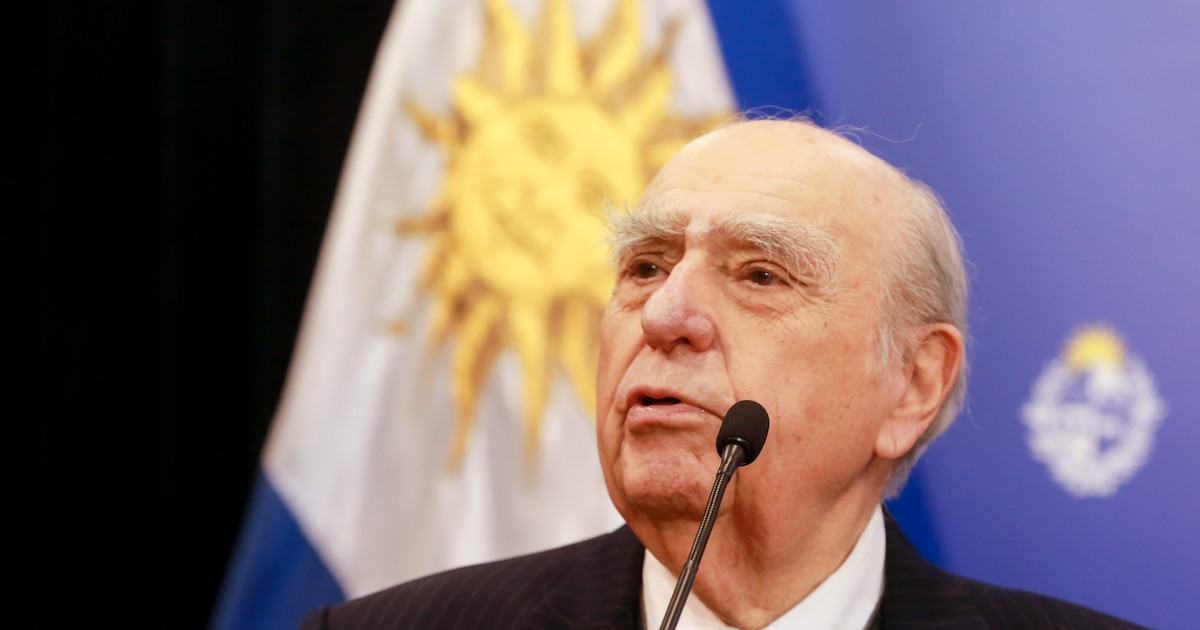

Julio María Sanguinetti, expresidente uruguayo, recibió este jueves en Montevideo al vicepresidente de El Salvador, Félix Ulloa, en un encuentro en el que elogió la aprobación que mantiene el gobierno de Nayib Bukele y manifestó interés por la evolución política, económica y social del país centroamericano.
La reunión contó también con la participación del secretario general del Partido Colorado, Andrés Ojeda, quien puso el foco en los efectos que, a su juicio, tuvo la mejora de la seguridad sobre otras áreas de la vida pública salvadoreña, como la educación, la salud y el crecimiento económico.
Tras el encuentro, Sanguinetti dijo que recibió a Ulloa con “gran alegría e interés”. El exmandatario recordó que, durante su extensa trayectoria política, siguió distintos momentos del proceso salvadoreño y conoció de cerca “el largo periplo de El Salvador” en asuntos de relevancia regional.
El intercambio, en el marco de la visita de Ulloa a Uruguay
El encuentro se produjo durante una visita de Ulloa a Uruguay que incluyó contactos con autoridades del Gobierno y referentes políticos del país. Sanguinetti, dos veces presidente de Uruguay y una de las figuras históricas del Partido Colorado, se refirió de manera favorable a la valoración que conserva el Ejecutivo salvadoreño, luego de una conversación con Ulloa, quien integra el Gobierno de Bukele desde el inicio de su gestión.
El expresidente remarcó su conocimiento de la historia reciente del país. El Salvador atravesó durante décadas conflictos políticos, violencia criminal y dificultades institucionales que marcaron el debate regional sobre seguridad y gobernabilidad.
Ojeda: la seguridad abrió paso a avances en educación, economía y salud
Ojeda sostuvo que el análisis sobre El Salvador suele concentrarse de forma casi exclusiva en las estrategias contra la criminalidad. Para el dirigente uruguayo, esa mirada deja en un segundo plano otros indicadores y políticas públicas que surgieron, según planteó, a partir de la mejora de las condiciones de seguridad.
“A veces yo creo que, erróneamente, [la experiencia] está reducida a la cuestión de seguridad, pero la seguridad ha permitido otros avances”, afirmó tras participar de la reunión.
El secretario general del Partido Colorado señaló que la reducción de la violencia permitió que el país avanzara en materia económica, educativa, tecnológica y sanitaria. También citó la difusión de datos sobre la evolución del producto interno bruto y mencionó las iniciativas vinculadas con el uso de tecnología en el sistema educativo y en la atención de salud.
“Hoy se publica en tapa de algunos diarios del mundo el crecimiento del PIB, el desarrollo en términos de educación, las políticas vinculadas a tecnología en educación y en salud. Hay mucho para aprender de la experiencia salvadoreña”, expresó.
Las declaraciones de Ojeda ubicaron el encuentro en un debate más amplio sobre el modelo implementado por el Gobierno de Bukele. El Ejecutivo salvadoreño ganó notoriedad internacional a partir de su política de seguridad, en particular por el régimen de excepción que generó detenciones masivas en el marco de la lucha contra las pandillas.
Reuniones con Orsi y Lubetkin antes del encuentro con Sanguinetti
Antes de reunirse con Sanguinetti y Ojeda, Ulloa mantuvo encuentros con el presidente uruguayo, Yamandú Orsi, y con el canciller Mario Lubetkin.
Luego de esas conversaciones, el vicepresidente salvadoreño destacó la relevancia de la relación bilateral y expresó la disposición de su país a acompañar las iniciativas de Uruguay en la Comunidad de Estados Latinoamericanos y Caribeños, conocida como CELAC. “Teniendo Uruguay la Presidencia, nosotros queremos fortalecer, apoyar y acompañar sus iniciativas”, declaró a la prensa.
Lubetkin aludió a la cooperación entre ambos países y valoró el apoyo de El Salvador a Uruguay en asuntos de carácter regional. El canciller habló de un “respaldo enorme” por parte del país centroamericano para afrontar distintos desafíos en los foros multilaterales.
políticos













NEWYou can now listen to Fox News articles!
When young adults stormed France’s Bastille on Thursday, a little-known media outlet called BreakThrough News sent followers a «BREAKING» alert: «French students flood Bastille Square in Paris.»
But that isn’t the full story.
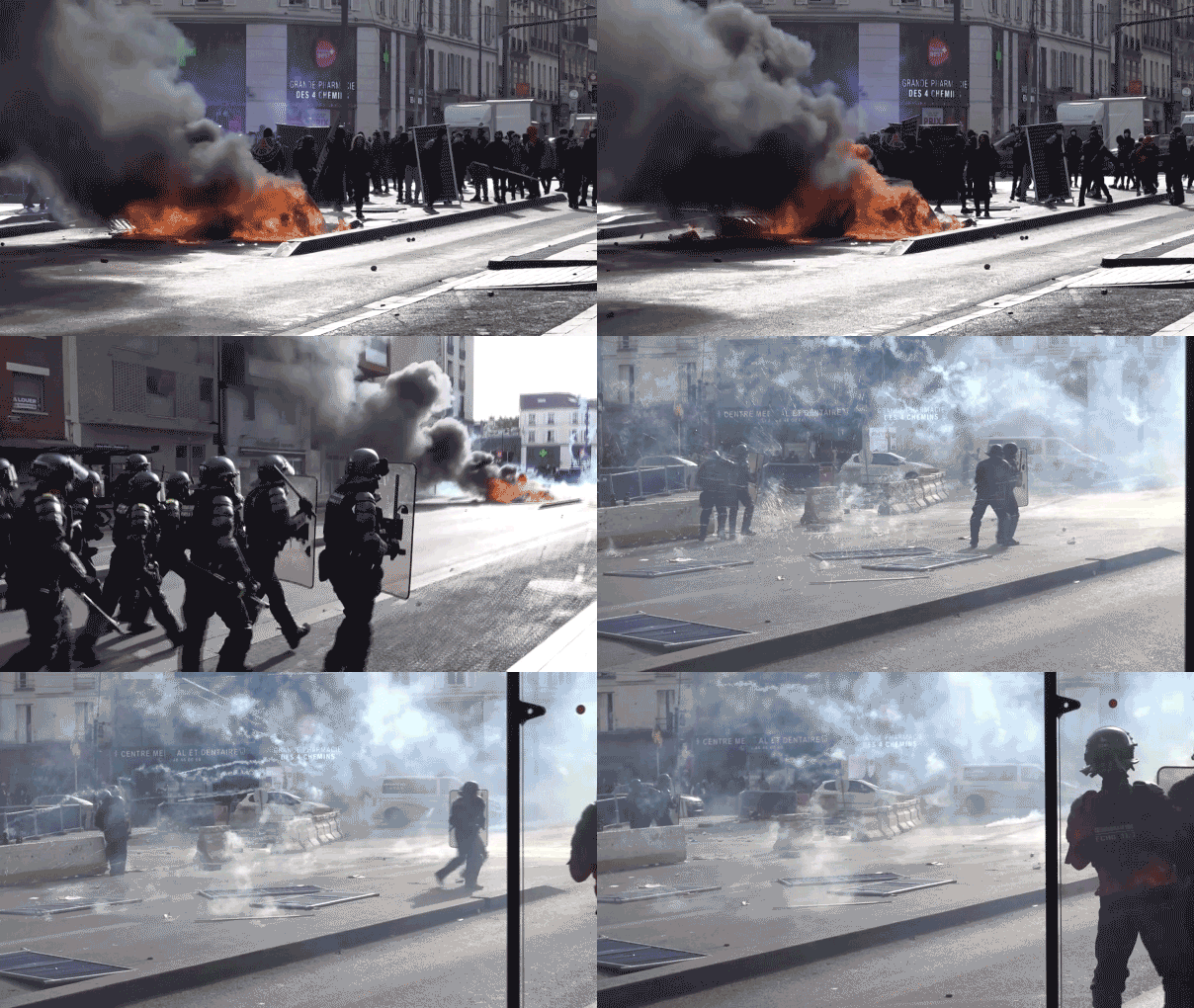
A Fox News Digital investigation has found that a transnational network of far-left communist and socialist organizations is seizing on France’s fiery student protests to advance a wider political and ideological agenda, using tactics deployed in the United States over the past decade to amplify unrest, deepen divisions and project an image of chaos.
Earlier in the week, BreakThrough News splashed another headline across the front of its website: «French students shut down schools in historic strike against austerity,» mobilizing «with support from unions and progressive forces.»
But those «progressive forces» aren’t limited to students demanding education reform as part of their «Lycéenne Mobilisation,» or high school student mobilization.
Protestors gather around the Monument à la République in Place de la République in Paris on Oct. 4, 2026, during nationwide demonstrations against an overcrowded, ill-equipped and understaffed education system. A masked protestor holds a red flag of the Soviet Union with the communist hammer and sickle. (Veronique de Viguerie/Getty Images)
Only 1 of 3 is a Student or Youth Group
From France to the United States, the United Kingdom, Brazil, Greece and India, adults with deep pockets are tapping France’s school protests and turning a domestic education dispute into a platform for broader political and ideological confrontation. BreakThrough News is a pro-communist propaganda outlet based in New York City, funded by an American-born, Shanghai-based communist tech tycoon, Neville Roy Singham, who has financed a network of communist and far-left groups in the U.S. that have capitalized on grievances to stoke similar street unrest for almost a decade.
A Fox News Digital investigation traces how a movement that the media is mostly framing as students protesting deteriorating school conditions is actually part of an extensive infrastructure of unions, communist activists, far-left political parties and international media organizations that are organizing demonstrations, calling strikes, mobilizing supporters and broadcasting the unrest around the world with «BREAKING» alerts.
In a digital analysis of scores of news articles, social media posts and public statements, Fox News Digital has identified 50 organizations in the French student protest movement and its wider network of supporters and international amplifiers, revealing an activist ecosystem extending far beyond the students who launched the demonstrations.
Of the network of 50 groups, 15 are student or youth groups, including several communist youth movements and a Muslim student association.
The remaining 35 adult groups include a dozen labor unions; eight communist or socialist organizations; five groups spanning other issues from taxes to parental advocacy, environmental activism, economic justice, international media and diaspora organizing; five civil-rights or human-rights groups; four political parties, including La France Insoumise, or France Unbowed, and the French Communist Party; one Palestinian advocacy group that complete the «red-green» alliance of leftists with Muslims.
FRANCE’S TEEN RIOTS TAKE EXPLOSIVE NEW TURN AS GOVERNMENT POINTS FINGER AT HARD LEFT
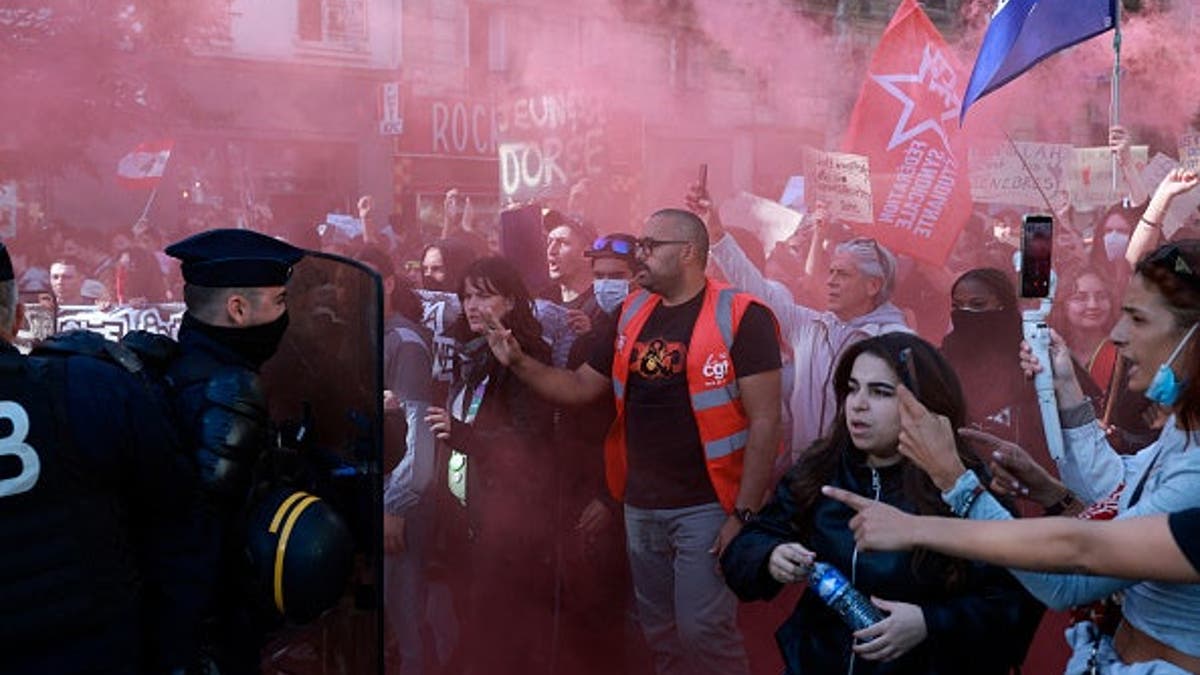
Smoke billows around protesters as they march toward the Place de la Bastille in Paris on Oct. 8, 2026, as part of a nationwide protest movement over learning conditions. The orange vest carries the acronym «CGT» for the Confédération générale du travail, a trade union. Protestors carry a purple flag of La France insoumise, a political party, and a red flag of Fédération Syndicale Étudiante, a student group. (Kenzo Tribouillard/AFP via Getty Images)
‘Red-Green Ecosystem’ of Socialists and Islamists
The network stretches from French classrooms and labor federations to communist organizations in Greece and Britain and international socialist media outlets, such as BreakThrough News, demonstrating how a domestic education dispute has attracted organizations advancing broader political agendas involving capitalism, «austerity,» policing, military spending and Israel.
«What we’re seeing here is the same Red-Green ecosystem that disrupts infrastructure choke holds in our country such as the Brooklyn Bridge, college campuses and congressional hearings,» Mike Gonzalez, a senior fellow at the Heritage Foundation, told Fox News Digital. «And in the case of BreakThrough News, the same sugar daddy — Neville Roy Singham.»
The case offers a revealing look at the ambitions of France’s revolutionary left. Even in a country with powerful labor unions, an established Communist Party, a substantial parliamentary left and a long tradition of street protest, these organizations are demanding political and economic changes that go well beyond the existing left-wing establishment.
As one far-left environmental group, Les Soulèvements de la Terre, or «Earth Uprisings,» declared in the midst of the riots, «Glory to the rebellious high school students.»
The statement invoked a call for broader political subversion: «Pour un soulèvement antifasciste» – «For an antifascist uprising.»
The network’s amplification of France’s protests illustrates how a local confrontation can be presented to international audiences as part of a broader struggle against Western governments and institutions.
«The communist Red and the Islamist Greens have nothing in common but a common enemy, the Judeo-Christian, capitalist, free West, led by the U.S.,» Gonzalez said. «Their goal is to dismantle us.»
The situation in France is potentially even more dangerous, according to Gonzalez, who cited the European nation’s well-established and active communist parties and a history of government changing by street violence. He noted the fall of the Fourth Republic in 1958 after large protests over Algeria, and that the government nearly fell in 1968 over student protests.
«And of course, there was the blood-drenched violence of the 1789 French Revolution,» Gonzalez added.
FRANCE ROCKED BY STUDENT RIOTS AS HUNDREDS ARRESTED, VIOLENCE SPREADS NATIONWIDE
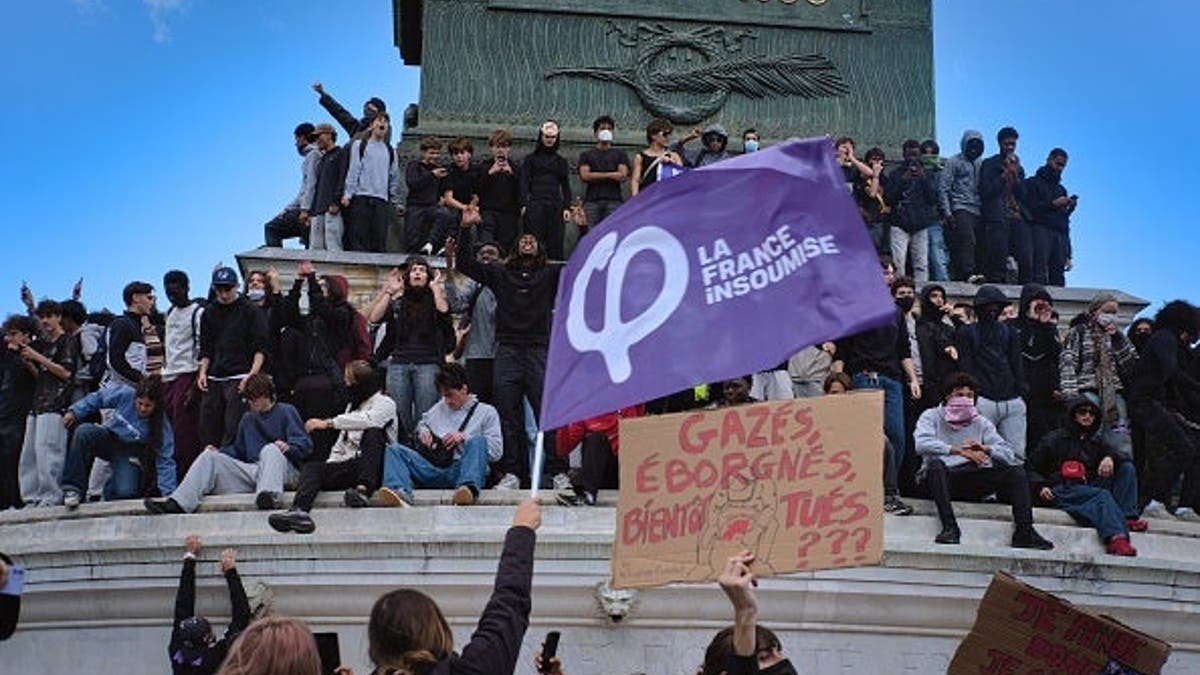
High school students gather at Place de la Bastille in Paris on Oct. 8, 2026, with one waving a flag of the La France Insoumise political party, known by its acronym LFI. (Hans Lucas/AFP via Getty Images)
‘Right to Revolt’
Since late September, politicians from the far-left political party, La France insoumise, were seen working with students organizing blockades in Seine-Saint-Denis, a low-income suburb northeast of Paris. French-Moroccan journalist Nora Bussigny wrote that «many elected officials» from La France Insoumise «have indeed worked to co-opt the student protests, at the risk of seeing them spiral out of control: by fanning the flames, discrediting institutions like the police, and legitimizing the principle of political violence.»
Soon after, a wide network of far-left groups put out the call for tens of thousands of secondary school students and supporters to march through Paris on Oct. 6, while demonstrations spread across France.
Student organizations in the network of 50 include the Union Syndicale Lycéenne, or High School Students’ Union; Union Étudiante, or Student Union; Fédération des Associations Générales Étudiantes, or Federation of General Student Associations; and Union Nationale des Étudiants de France, or National Union of Students of France, helped mobilize students for the Oct. 6 demonstrations.
Other student organizations, including Solidaires Étudiantes, or Solidaires Students, have joined the broader campaign.
The organizational machinery supporting the mobilization extends beyond the teenagers who first took to the streets. National labor federations and professional education unions have called on adult workers to join the mobilization, bringing the institutional reach of organized labor into the student movement.
The Confédération nationale du travail, or National Confederation of Labour, declared: «The demands of high school students are also ours. They are right to revolt.»
The adult-led labor organizations in the network of 50 include: the Confédération générale du travail, or General Confederation of Labour; Force Ouvrière, or Workers’ Force; and Union nationale des syndicats autonomes, or National Union of Autonomous Trade Unions.
Several education-sector unions called for a strike and demonstration in support of the high school movement.
The organizations include the CFDT Public Education, Training and Research; CGT Éduc’action; the National Federation of Education, Culture and Vocational Training–Workers’ Force; SUD Éducation; and Syndicat National des Enseignements de Second Degré, the National Union of Secondary Education, affiliated with the Unitary Trade Union Federation.
The support extends beyond teachers and students into a wider collection of organizations, including parents’ associations, civil-rights groups, antiracist organizations and political movements.
Among them are the Fédération des Conseils de Parents d’Élèves, or Federation of Parents’ Councils; Ligue des Droits de l’Homme, or Human Rights League; Mouvement Contre le Racisme et Pour L’amitié entre Les Peuples, or Movement Against Racism and for Friendship Between Peoples; and SOS Racisme, or SOS Racism.
TRUMP, WALTZ LINK FRANCE RIOTS TO MASS IMMIGRATION AS THOUSANDS ARE ARRESTED
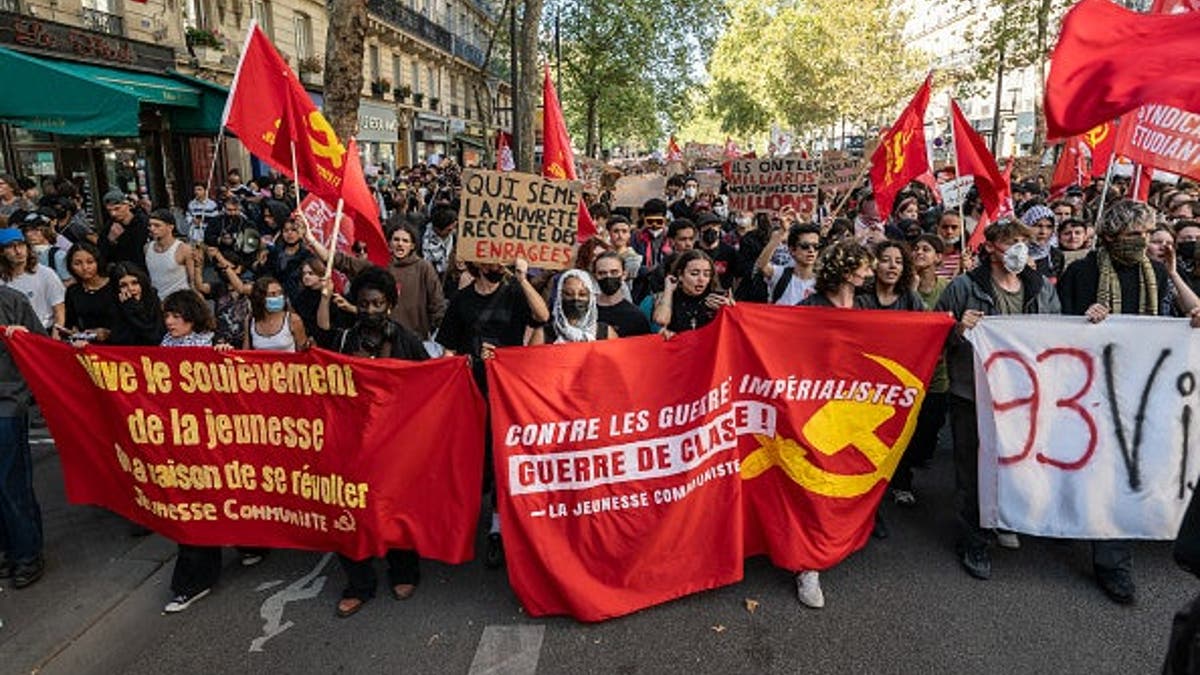
Tens of thousands of secondary school students and their supporters march from Republic to Nation square on Oct. 6, 2026, in Paris, France. Nationwide student protests and violent school riots have disrupted over 700 secondary schools and led to roughly 5,000 arrests across France. What began in late September 2026 as peaceful blockades in the low-income Paris suburb of Seine-Saint-Denis has rapidly escalated into a major public order crisis for President Emmanuel Macron’s government. (Guy Smallman/Getty Images)
Communist Flags and Calls for ‘Class War’
In Paris on Tuesday, the big day of the protests, the ideological character of the mobilization was visible on the streets.
In Paris, activists waved red flags of the far-left Fédération Syndicale Étudiante, or Student Trade Union Federation. Some demonstrators wore Palestinian keffiyeh scarves covering parts of their faces as they marched behind a bright red banner bearing the words «Contre Les Guerres Impérialistes,» French for «Against Imperialist Wars.»
The slogan is a recurring political message among anti-war, feminist and revolutionary-left organizations.
The message on the red banner continued, «Guerre De Clasee !» or «Class War!» over a bright yellow image of the hammer and sickle.
The banner identified the Young Communists, associated with the Mouvement Jeunes Communistes de France, or Young Communists Movement of France, which works closely with the French Communist Party.
Activists carried flags bearing the communist hammer and sickle.
On Instagram, the organization announced the launch of «Democratic and Antifascist Vigilance Committees.»
«High school students neglected, pro-Palestinian activists persecuted, unionists fired. State repression against our democratic rights has intensified in recent years,» the group declared.
FRENCH SCHOOL RIOTS DEEPEN AS EXPERTS POINT TO FAR-LEFT ALLIANCE FUELING ‘BROADER CONFRONTATION’
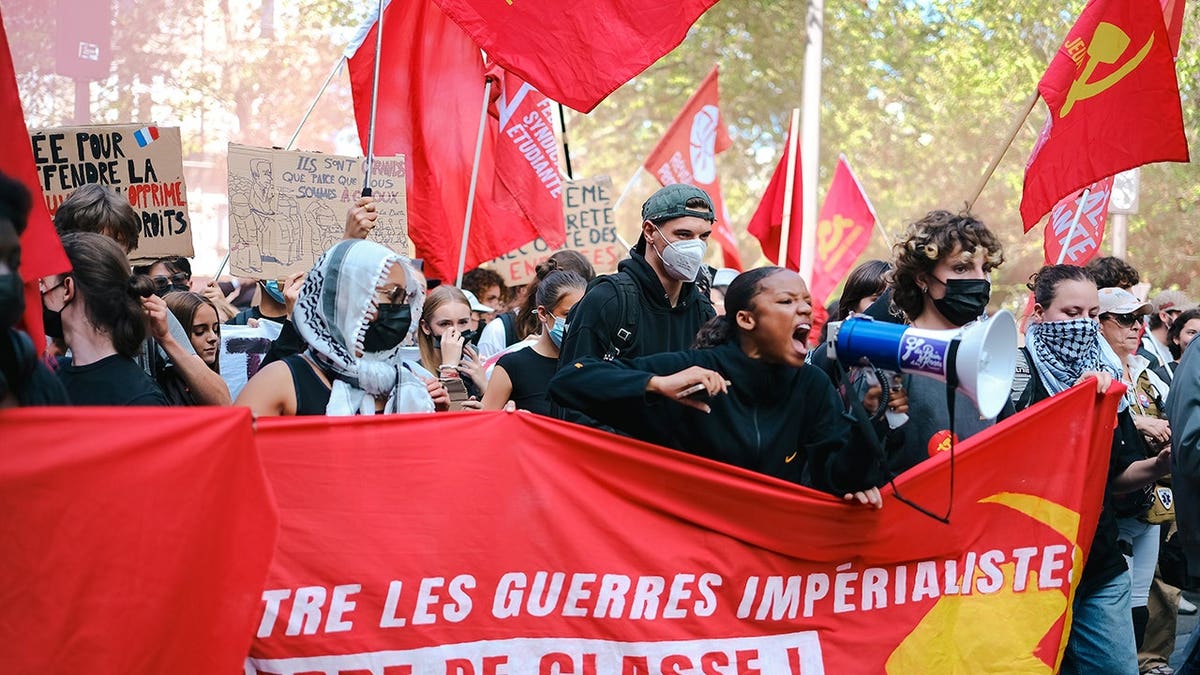
Young communists carry a banner that says «Contre Les Guerres Impérialistes,» protesting «imperialist wars» as part of the student protests in France on Oct. 6, 2026. (Vincent Koebel/NurPhoto via Getty Images)
‘Parti Communiste Français’
At the protest, Fabien Roussel, national secretary of the French Communist Party, took photos with protesters and later posted a message on X: «Standing alongside high school students in Paris, together with Communist elected officials and activists.»
Red flags with white stars and the message «Parti Communiste Français» flapped around him.
Online the French Communist Party has continued advancing other political campaigns, including a demand to stop supplying arms to Israel, under the slogan «Stop arming the Palestinian genocide!»
On Wednesday, after the peak protests, the Nouveau Parti anticapitaliste – L’Anticapitaliste, «The New Anticapitalist Party,» rallied supporters, declaring there are «always more reasons to mobilize.»
Other revolutionary-left groups, including Le Poing Levé, or The Raised Fist, and Révolution Permanente, or Permanent Revolution, have promoted solidarity between high school students and university activists.
FRANCE EXPLODES AGAIN AS STUDENTS RIOT OVER EDUCATION
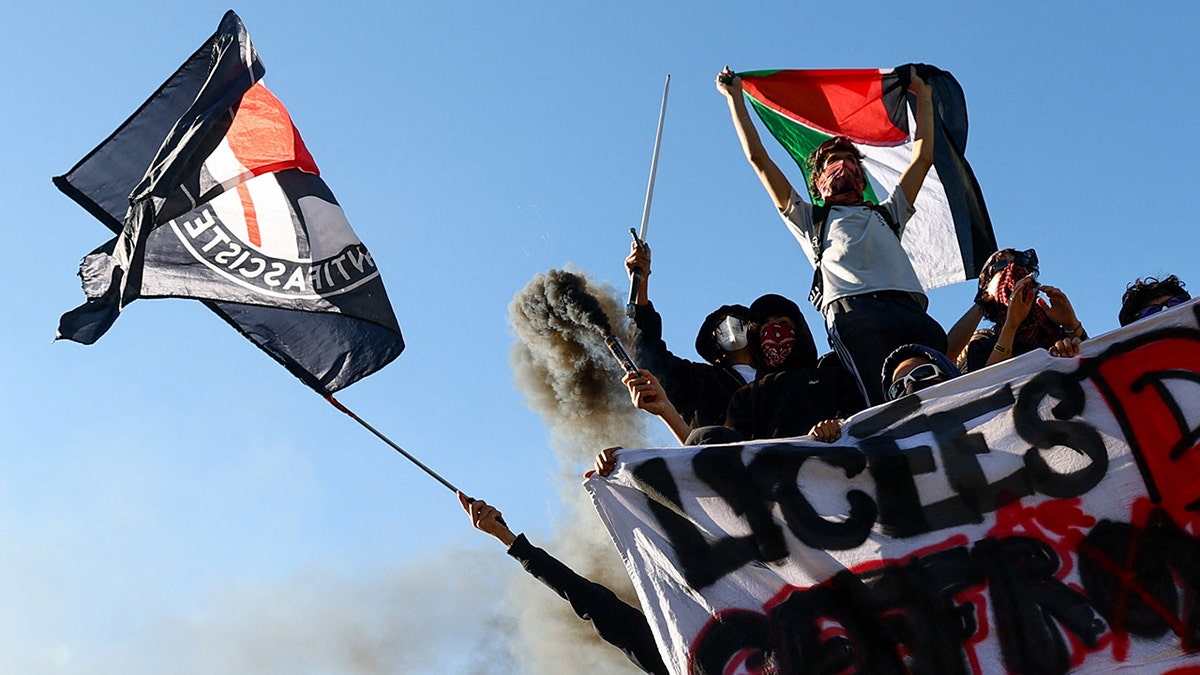
Protesters hold Palestinian and Antifa flags as French high school and university students attend a demonstration in Strasbourg, France, on Thursday, Oct. 6, 2026. (Kai Pfaffenbach/Reuters)
Palestine Flags
In Saint-Denis, where the protests began, the Parti des Indigènes de la République, or Party of the Indigenous of the Republic, shared a photograph of young men standing outside Lycée Paul Éluard, a high school that has become a symbol of the unrest.
As red smoke billowed above them, the students stood in front of large gray letters spelling out the school’s name, holding a Palestinian flag. The school was later featured in the New York Times under the headline, «The School Near Paris That Shows Why French Students Are Protesting.»
In the network of 50 groups, Étudiants Musulmans de France, or Muslim Students of France, rallied followers to protest for the right of youth to «study with dignity.» And members of Urgence Palestine, or «Palestine Emergency,» marched proudly in the student protests with the Palestinian flag.
Elsewhere, French lawmaker Louis Boyard of the far-left party, La France Insoumise waved a Palestinian flag while standing at Paris-Est-Créteil University with students as they blocked their campus. In marches, their activists wave trademark purple flags that flutter with the group’s acronym «FI» and a white φ symbol for the Greek word «phi.»
POWER COUPLE OF CHAOS: HOW A TYCOON AND ACTIVIST BUILT A ‘REVOLUTIONARY BASE’ AT THE HOUSE OF SINGHAM
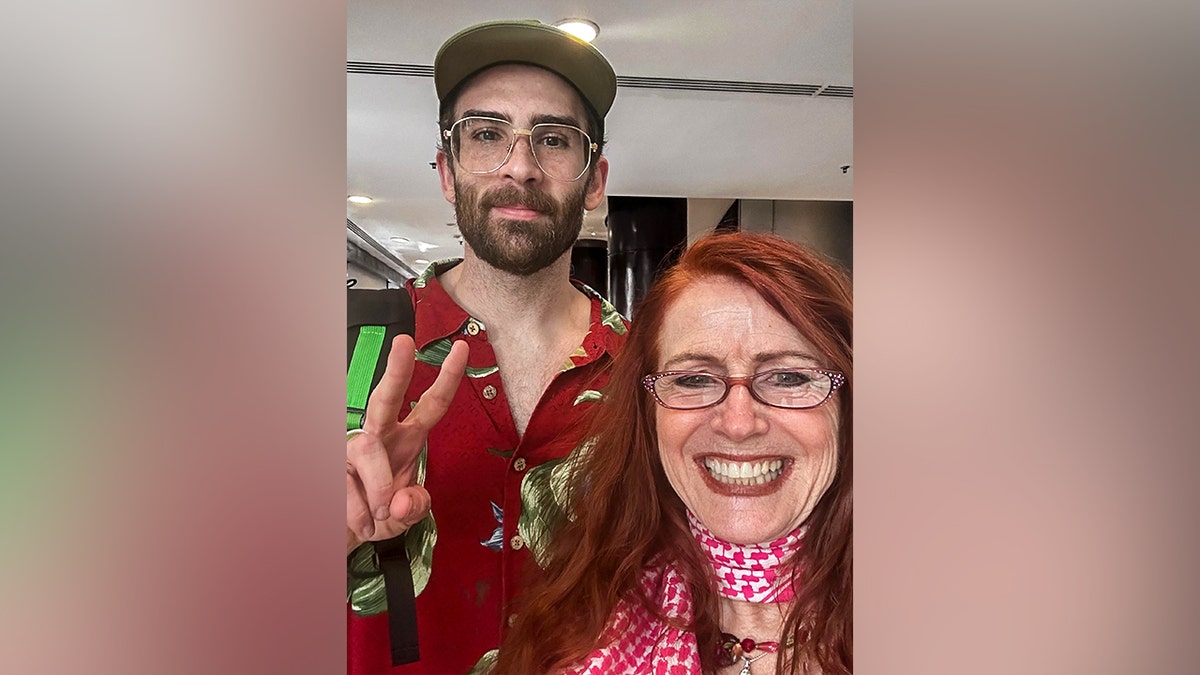
Democratic Socialists of America member Hasan Piker and CodePink co-founder Jodie Evans of CodePink meet in Cuba, as part of «United Front» to support the communist regime. (CodePink via Storyful)
Singham Network Broadcasts France’s Unrest
On Wednesday, BreakThrough News published an article portraying the demonstrations as a «historic strike against austerity.»
It also published a dramatic Instagram video of Bally Bagayoko, the far-left mayor of Saint-Denis and a politician with La France insoumise, sliding in front of students during a confrontation with police.
BreakThrough News described the scene as Bagayoko protecting «a line of French students from police as they attack the protesters.»
The anti-policing video received about 346,000 likes in one day.
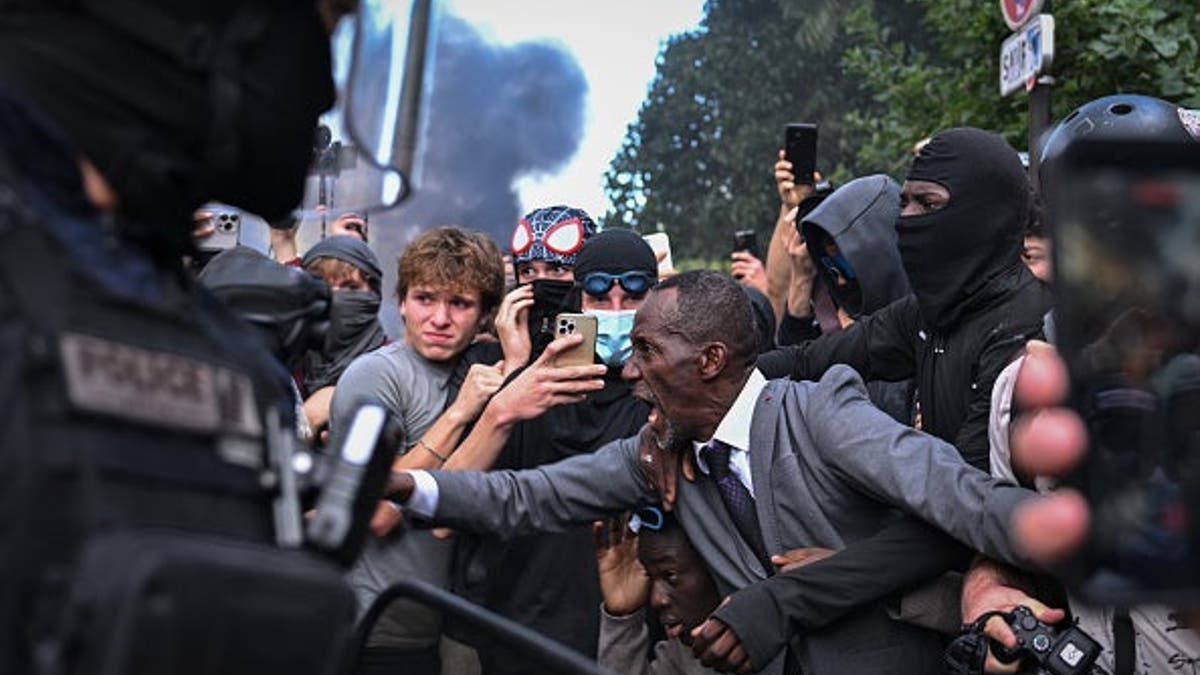
Mayor of Saint-Denis Bally Bagayoko, a member of the leftist party La France Insoumise, reacts as clashes occur between demonstrators and riot police during a protest against education conditions and to highlight the lack of resources and staff in high schools in Paris, France, on Oct. 6, 2026. (Anadolu via Getty Images)
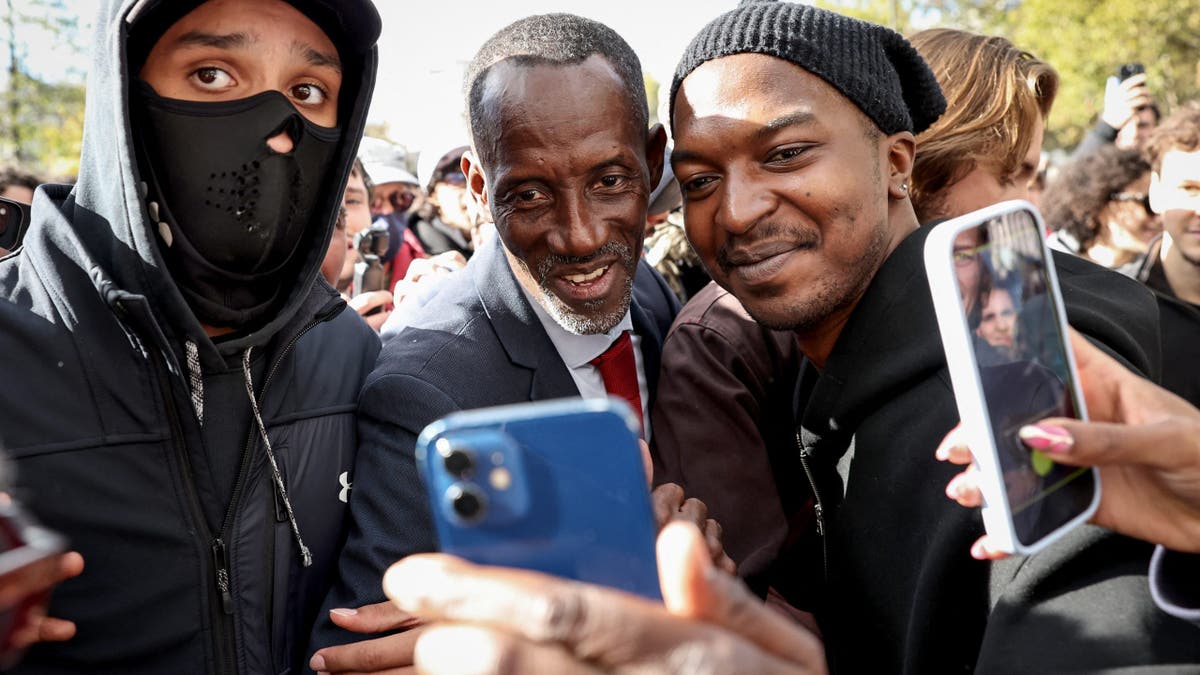
Bally Bagayoko, mayor of Saint-Denis and a member of the leftist party La France Insoumise, poses for photographs as he arrives on Bastille square at the start of a nationwide demonstration called by high-school students demanding better learning conditions in Paris on Oct. 8, 2026. (AFP via Getty Images)
Among the accounts that liked the video were Twitch influencer Hasan Piker, a self-described Marxist; BreakThrough News editor Zoe Alexandra; the Houston chapter of the Party for Socialism and Liberation, the Pittsburgh chapter of Jewish Voice for Peace and other groups in the Singham network.
Earlier this year, Piker traveled to Cuba as part of a far-left «caravan» supporting the island nation’s communist government. There, he took a photo with Jodie Evans, Singham’s wife and co-founder of CodePink, which has received $1.33 million from Singham.
From Latin America, teleSUR, an international television network in the Singham network, frequently circulates material from left-wing media outlets, including BreakThrough News, and it shared footage of French students clashing with police.
The video featured a dramatic soundtrack and the headline: «TENSIONS ESCALATE….»
FRANCE’S VIOLENT STUDENT PROTESTS RAISE WARNING FOR AMERICA: ‘A CAUTIONARY TALE’
From France to Greece, India and the US
As French students stormed the streets, the Communist Youth of Greece publicly expressed solidarity with their movement. «Victory for the struggle of the school students in France!» the group said in a statement.
BreakThrough News quoted the Greek communist organization in its France coverage, describing the developments as «foreshadowing more student struggles to follow.»
Another international connection runs through Indian Alliance Paris, a small France-based organization of students, researchers and professionals who describe themselves as committed to a «democratic and egalitarian» India.
In mid-January 2023, Indian Alliance Paris co-sponsored a teach-in in Manhattan, opposing the expansion of the North Atlantic Treaty Organization. The venue: the People’s Forum Inc., a midtown Manhattan hub for communist organizing that Singham launched in 2017 with $22.44 million in funding. Over the past near decade, leaders of the People’s Forum have coordinated hundreds of protests across America’s streets.
The People’s Forum co-sponsored the event with Democratic Socialists of America and other organizations in the Singham-funded activist ecosystem, including CodePink and the Party for Socialism and Liberation.
In mid-May 2024, the People’s Forum hosted a screening of a 1967 French film «La Chinoise,» and described the film as a story about a small group of French students studying Chinese communist leader Mao Zedong, «trying to find out their position in the world and how to change the world to a Maoistic community using terrorism.»
Mao unleashed mass political persecution, violence, imprisonment and social upheaval in China.
Attendees were invited to purchase an $8 «solidarity ticket.»
On Tuesday, Indian Alliance Paris promoted the French student agitation while drawing parallels with student demonstrations in India. It posted a message on X, sending a heart emoji «to Gen Z: In France. In India. Bravo for today.»
The result is a self-reinforcing cycle: far-left activist networks amplify protests around the world, then package the unrest as evidence of a growing global uprising.
On Thursday, after the French students had headed home after their siege on Bastille, BreakThrough News posted a collage on Instagram of short video clips from the U.S., Spain, India, France, Brazil, Belgium, Chile and Germany with youth waving communist flags, clashing with police and flooding the streets.
It posted a headline in bold capital letters over the videos: «YOUTH RISE UP AROUND THE WORLD.»
politics, france, fox news investigates, us protests, world
INTERNACIONAL
Autism providers warn foster kids at risk from unintended consequences of Trump’s Medicaid fraud crackdown
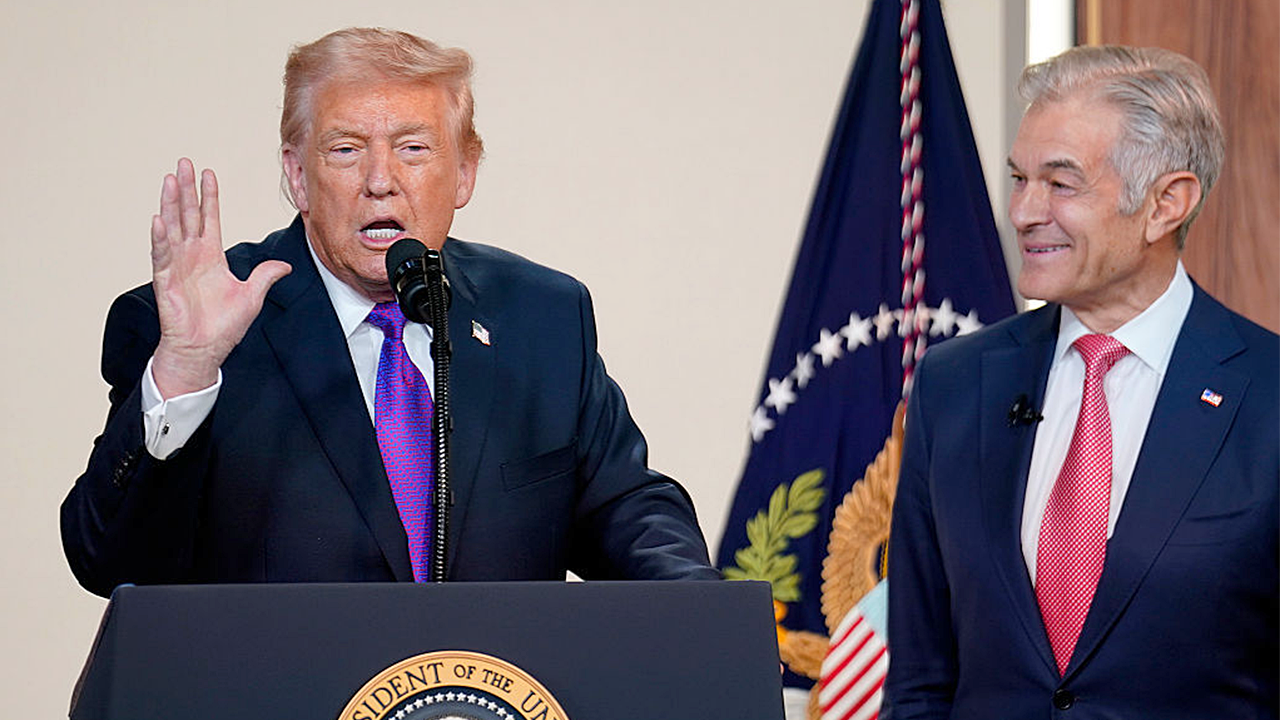
EXCLUSIVE: American autism care providers who backed the Trump administration’s crackdown on Medicaid fraud are now sounding the alarm, warning that efforts to root out abuse could have unintended consequences after reimbursement cuts put therapy for Georgia foster children at risk.
The Autism Families Alliance, which describes itself as a national advocacy organization dedicated to supporting Applied Behavior Analysis providers and the families who rely on their services, said that efforts by the Trump administration and state leaders to fight fraud have gone too far, potentially leaving many of Georgia’s children with autism in foster care without the care they need.
This warning is in response to a move by Amerigroup, the insurer that covers Georgia’s foster children through Medicaid, to cut what it pays autism therapy providers by 30%. Providers caution that they may no longer be able to afford to treat vulnerable children and that many foster families will be unable to switch them to another insurer.
«It’s scary to see that so many different things are being slashed in terms of Medicaid, and that we’re seeing this drastic outcome,» Taylor Sanders, a family advocate at the Autism Families Alliance, told Digital. «It’s so important that we keep in mind that children with autism are in a very vulnerable place where they’re still needing to learn safety skills. There are some children who have extremely aggressive behaviors, challenging behaviors. So, when we’re seeing some of these cuts, we’re seeing it affect the providers who are able to provide access to these services.»
AUTISM PROVIDERS CHEER TRUMP CRACKDOWN AFTER MILLIONS ALLEGEDLY STOLEN THROUGH MEDICAID FRAUD
«If we’re not able to provide a good amount of pay to our providers, we’re not able to make sure they’re set up for success to be able to give some of these services, and we’re going to see less and less children being able to access services at all,» she added.
Sanders said 75% of clinics will have to close their doors or stop serving foster kids due to the massive cuts.
The 30% cut will not only affect providers’ ability to provide access to these families, but it will also limit foster children’s opportunities to learn essential skills, according to Sanders. Foster children with autism depend on regular therapy to develop everyday skills, but a sudden loss of that support could set them back.
«If they don’t learn these school skills at an early intervention or an early age, it’ll be a lot more costly later on,» she said.
In August, the Autism Families Alliance put its support behind the Trump administration’s crackdown on Medicaid fraud, arguing that the alleged theft of millions of federal funds has hurt both taxpayers and children with autism who rely on those services. Some states, including Georgia, have also taken steps to enhance oversight of autism services.
The group backed eliminating fraud and prosecuting suspected criminals, but also feared that broad federal and state efforts to root out fraud could unintentionally make it more difficult for legitimate providers to care for children with autism. The coalition called on policymakers to ensure fraudsters are removed from the system without creating what they described as unnecessary barriers for families of vulnerable children seeking care.
RFK JR ANNOUNCES ‘LARGEST AUTISM FRAUD BUST IN AMERICAN HISTORY’ WITH $46.6M MEDICAID SCHEME INDICTMENT
Now, the group says Georgia’s foster families face the risk that they had previously raised concerns about.
«I think fraud should be prosecuted by all means,» Sanders said. «Anybody who is engaging in fraudulent behavior should be prosecuted to the highest extent of the law. Are we able to not only tackle the fraud, but still give access to services for our children? Why can’t we do both at the same time?»
«What’s really happening here is we’re going in with a sledgehammer when really we should be going in with a scalpel,» she continued, adding that officials need to be «approaching this in a way where it’s not going to totally obliterate the care to our families.»
One Georgia foster mother has already been told her nearly 3-year-old son’s provider may be forced to stop treating him after he started making progress, according to the Georgia Recorder.
«Reforms that improve care, increase efficiency and prevent abuse are something we all support, but when those efforts make it harder for children with autism to get the care they need, something has gone terribly wrong,» Kelsey Bennett, a family advocate with the Autism Families Alliance, told Digital.
«No one wants to eliminate waste, fraud and abuse more than the providers who dedicate their lives to caring for these children. Every taxpayer dollar should go toward helping the people it was intended to serve. But you can’t fix a system by making it harder for vulnerable children to get help. Reforms that end up hurting the very children the system is supposed to protect are not in Georgia’s best interests,» she continued.
Bennett urged Georgia’s lawmakers «to bring everyone to the table, including the Medicaid managed care companies and the providers who care for these children every day.»
«By listening to those on the front lines and working together, they can find a better way forward that improves efficiency without putting children’s access to care at risk,» she said.
«Children with autism, especially those in foster care and those welcomed into loving foster families, already face enough challenges. Their families shouldn’t have to worry about whether the care they depend on will suddenly disappear. Georgia’s leaders need to step in, address these cuts and make sure these children aren’t the ones paying the price for efforts to save money,» she added.
politics, autism, childrens health, georgia, health care executive, donald trump, health
INTERNACIONAL
Un modelo de IA podría anticipar el desarrollo de inundaciones repentinas: cómo funciona

La inteligencia artificial dejó de ser una herramienta limitada a los laboratorios tecnológicos. Sus sistemas intervienen en tareas cotidianas, organizan información, automatizan procesos y amplían capacidades en áreas como la medicina, la industria, la educación, el transporte y la investigación científica. También comienza a aplicarse en problemas vinculados con el clima, donde anticipar cambios rápidos puede resultar decisivo.
En ese campo, un equipo de la Penn State University desarrolló un modelo destinado a estimar, hora por hora, el riesgo de inundaciones repentinas. La propuesta adapta un método de IA utilizado para crear imágenes y busca reconocer con mayor precisión los aumentos súbitos del caudal de los ríos, que pueden aparecer y desaparecer en poco tiempo.
Un modelo de IA estimará inundaciones repentinas

El trabajo fue detallado en un estudio publicado en la revista Water Resources Research. Allí, los investigadores presentaron h-Diffusion, un modelo de difusión, una técnica de inteligencia artificial que aprende a eliminar información aleatoria para reconstruir patrones reconocibles a partir de datos complejos.
En la generación de imágenes, este sistema puede partir de una imagen con ruido, es decir, con información visual alterada, y recuperar una versión coherente. El equipo trasladó ese principio al pronóstico de inundaciones: en vez de reconstruir una fotografía, el modelo analiza registros de lluvia y caudal para estimar cómo variará el agua de un río durante las siguientes horas.
La escala temporal es central para el problema. Las inundaciones repentinas pueden provocar picos de caudal muy altos en pocas horas, aunque el promedio diario no parezca excepcional. “Los niveles de agua pueden subir y bajar rápidamente en cuestión de horas, lo que significa que, a escala diaria, pueden parecer altos, pero no catastróficos”, afirmó Chaopeng Shen, autor principal y profesor de ingeniería civil y ambiental en un comunicado de Penn State.
Para entrenar h-Diffusion, el grupo utilizó registros horarios de caudal de 516 cuencas fluviales de Estados Unidos recopilados entre 1990 y 2003. Luego, probó el sistema con datos de un período posterior, comprendido entre 2009 y 2014, que el modelo no había utilizado durante su aprendizaje.

El paper indica que la herramienta superó a otros modelos avanzados de aprendizaje profundo empleados como referencia. Su ventaja no se limitó a la estimación de caudales: también pudo integrar mediciones recientes procedentes de estaciones de monitoreo sin requerir un nuevo entrenamiento completo. Esa capacidad, denominada asimilación de datos, permite que el sistema incorpore información observada poco antes de emitir un pronóstico.
Según la casa de estudios, la técnica reduce parte de la incertidumbre asociada a las precipitaciones, cuyos cambios horarios son difíciles de anticipar. El modelo puede usar, por ejemplo, datos recientes sobre la lluvia y el caudal para estimar cuál será el pico de agua de ese día. Además, los autores mostraron que el sistema puede realizar una operación inversa y estimar la precipitación horaria probable a partir del caudal medido.
“En definitiva, nuestro objetivo final es ofrecer un sistema robusto, fiable y que pueda ayudar a salvar vidas”, sostuvo Shen, también afiliado al Instituto de Energía y Medio Ambiente de Penn State, según el comunicado. El equipo planea analizar modelos híbridos e incorporar más variables físicas a sus predicciones.
La IA puede mejorar la gestión del clima

El avance se inscribe en un campo que busca aprovechar la inteligencia artificial para mejorar la gestión del riesgo de inundaciones. Una revisión publicada en Climate Risk Management, que examinó más de 300 investigaciones, identificó aplicaciones en la evaluación de riesgos, los sistemas de alerta temprana y la respuesta ante emergencias.
Ese análisis sostiene que los algoritmos pueden procesar grandes volúmenes de información, desde registros hidrológicos y pronósticos meteorológicos hasta imágenes satelitales y datos de sensores. La combinación de esas fuentes puede aportar estimaciones más rápidas sobre áreas expuestas a inundaciones y ayudar a organizar recursos durante una emergencia.
Sin embargo, la revisión advierte que su implementación enfrenta obstáculos. Entre ellos figuran los sesgos en los datos, la falta de transparencia de algunos modelos y las exigencias de capacidad informática. Los autores plantearon que las herramientas deben ser accesibles y adaptables a distintos contextos, en particular en comunidades con menos recursos o con sistemas de monitoreo limitados.
Los fenómenos inéditos siguen siendo una prueba difícil para la IA

Otro estudio, publicado en Science Advances, introdujo una advertencia relevante para el uso de estos sistemas en alertas meteorológicas. La investigación comparó modelos de IA con HRES, un modelo de pronóstico basado en principios físicos del Centro Europeo de Previsiones Meteorológicas a Medio Plazo.
Los autores evaluaron la capacidad de los sistemas para anticipar récords de calor, frío y viento, es decir, eventos que superaban los valores observados durante el período de entrenamiento de las herramientas de IA. En esos casos, HRES obtuvo mejores resultados que los modelos de inteligencia artificial analizados en la mayoría de los plazos de pronóstico.
El trabajo concluye que los modelos de IA tendieron a subestimar tanto la intensidad como la frecuencia de los eventos extremos sin precedentes. Cuanto mayor era el margen por el que se superaba un récord, mayor resultaba el sesgo de las predicciones automatizadas.
La diferencia puede estar vinculada al modo en que funcionan ambos enfoques. Los modelos de inteligencia artificial aprenden de patrones presentes en datos históricos, mientras que los sistemas basados en la física emplean ecuaciones que describen la evolución de la atmósfera. Por eso, los autores señalan que aún se necesitan evaluaciones rigurosas antes de utilizar herramientas de IA de manera exclusiva en sistemas críticos de alerta temprana y gestión de desastres.
monitoreo hídrico,red de datos,caudal,hidrología

Boca Juniors visitará a Instituto en un duelo clave por la cima de su zona y la Tabla Anual: hora, TV y probables formaciones

Un alto funcionario de la diplomacia de EE.UU. llegará a la Argentina con la seguridad y el programa de visas como temas centrales

Luck Ra confesó cuál es la estrategia que usa cuando se olvida la letra en medio de un show

A dos años del RIGI, el Gobierno aprobó proyectos por u$s50.000 millones

El Europeo sub-21 de 2027 ya conoce sus eliminatorias de play-offs

Behind France’s student riots: Communists, unions and a global propaganda network

Escándalo total en la AFA: reventa millonaria, un homenaje paupérrimo a Messi y el pedido urgente de renuncia a Chiqui Tapia

El gobernador de la provincia que más ATN recibió de la Casa Rosada no integró la comitiva de Milei en París

Israeli medical workers who treated Oct 7 wounded relive day terror hit home

Bolsonaro o Lula: un exembajador argentino anticipó cómo puede cambiar la relación con Argentina después del balotaje

 DEPORTE1 día ago
Escándalo total en la AFA: reventa millonaria, un homenaje paupérrimo a Messi y el pedido urgente de renuncia a Chiqui Tapia
- INTERNACIONAL3 días ago
Después de su prohibición, las plataformas de apuestas deportivas y los casinos en línea ya están fuera de servicio en Brasil
- POLITICA3 días ago
Marcha contra la Corte: sectores del PJ, la izquierda, gremios y piqueteros protestan por el fallo que libera la venta de tierras para extranjeros