INTERNACIONAL
Incluso bajo el populismo, el fracaso de las élites sigue siendo un problema



INTERNACIONAL
The hidden left-wing network powering a ‘conservative’ rebellion against a major Trump priority
The AI data center backlash
Paul Gigot, Kim Strassel, Allyssia Finley, and Jason Riley discuss the growing progressive backlash against AI data centers. Citing environmental concerns, increased electricity prices, and potential job displacement, Bernie Sanders and AOC introduced legislation for a nationwide moratorium on new data center construction. The panel explores the economic implications and highlights the lack of clear evidence supporting claims of rising energy costs directly tied to data centers.
NEWYou can now listen to Fox News articles!
A group billing itself as a grassroots conservative movement against new data centers carried out a series of nationwide protests enlisting the help of Green Party figures and Democratic-aligned activists, a Fox News Digital review found.
Though initially launched as a bipartisan project, Humans First has since become — in its own words — a «conservative social movement that is dedicated to ensuring that the future of AI is in the hands of everyday people.» Humans First’s nascent movement was supposed to build up to mass protests on July 18, when the organization says it sought to rally conservatives against the construction of new data centers.
The push put Humans First in tension with one of President Donald Trump’s major economic priorities — accelerating the data-center buildout needed to power America’s AI race.
TOP ENERGY GROUP WARNS WEALTHY FOREIGNERS ARE POTENTIALLY BANKROLLING ANTI-DATA CENTER CAMPAIGNS ACROSS US
Nevada Big Blind center. (Zanskar)
While right-wing activist Amy Kremer is the public face of Humans First, the group’s paper trail shows that the organization didn’t start with her or even another conservative. Incorporation records reviewed by Fox News Digital list staffers from the Center for AI Safety, a San Francisco-based nonprofit, as Humans First’s initial employees. The Center for AI Safety also provided a loan to Humans First to serve as start-up capital, NBC News previously reported.
In a similar vein, several of the local organizers named on Humans First’s website as planning the July 18 protests had backgrounds in left-of-center politics.
«I was one of the earliest leaders of the Tea Party movement in 2009, and I can tell you that the disconnect between the elites and the base that gave rise to the Tea Party movement can be seen today in the battle over AI data centers,» Kremer, chair of Humans First, told Axios in June.
During the Obama administration, Kremer was a top Tea Party activist and, more recently, she was one of the organizers of the «Save America» rally that preceded the Jan. 6 attack on the U.S. Capitol — a role that later became a focal point during her unsuccessful 2022 run for a Georgia congressional seat.
Her group says the July 18 protests were meant to «give grassroots Americans, particularly grassroots conservatives, a voice in the critical debate over policies relating to the building of massive AI data centers.»
Despite Kremer’s GOP bona fides and her stated goal of mobilizing conservatives, Fox News Digital found that several listed protest organizers had left-wing, Green Party or Democratic-aligned backgrounds, including a transgender Green Party House candidate, local progressive activists and a Democratic state legislative candidate.
FIRST ON FOX: POWERFUL HOUSE WAYS AND MEANS CHAIR THROWS HAMMER DOWN ON ‘FOREIGN-ALIGNED INFLUENCE NETWORK’

The program offers paid training, travel support, lodging and a job offer for qualified graduates entering AI infrastructure work. (Meta)
At the bottom of the Humans First webpage advertising the protests, the organization stated that the events it is promoting have not «necessarily» been «fully vetted or endorsed by Humans First.»
Humans First’s website listed a chapter of the Illinois Green Party as organizers for a protest just outside Chicago.
Among other causes, the Illinois Green Party supports solidarity with Cuba, divesting from Israel, expanding abortion access, decriminalizing prostitution, restricting gun laws and impeaching Trump.
Also affiliated with the Illinois Green Party is Alexandria Keating-Sofiakis, a transgender activist and congressional candidate who organized a separate Humans First protest about 50 miles north-west of Chicago.
Kremer has repeatedly posted critical social media messages about transgender issues, Fox News Digital found.
Keating-Sofiakis’s campaign website lists support for the Green New Deal, expanded abortion rights, ending American support for Israel and Medicare-for-all. Though the two disagree on much, Keating-Sofiakis told Fox News Digital that opposition to data centers transcends traditional ideological boundaries and made working with Kremer feasible.
«Data centers are a cross-partisan problem,» Keating-Sofiakis said. «From a conservative worldview, the drop in property values, increase in water costs, as well as increase in electrical costs that are affiliated with data centers are all antithetical to conservative values. Likewise, from a progressive worldview, the ecological damage alone associated with data centers is more than enough justification to oppose them.»
Keating-Sofiakis also pointed out that local Green Party activists received support from prominent conservatives such as Tomi Lahren and Lara Trump in a recent effort to free dogs from a medical facility.
«I am no longer hesitant to work with conservative figures and organizations on issues we share in common,» Keating-Sofiakis told Fox News Digital.
600 GROUPS WITH $2B IN REVENUE MOBILIZE 3,000 MAY DAY PROTESTS IN A ‘RED-BLUE’ ALLIANCE, PROBE FINDS
Humans First defended its conservative credentials when reached by Fox News Digital.
«First off, we are happy to put our grassroots conservative and America First credentials up against anyone. I was one of the founders of the Tea Party movement back in 2009, and I was one of the earliest and most high profile Trump supporters back in 2015,» Kremer told Fox News Digital. «The men and women on our team are long-time conservative activists who have dedicated their lives to electing conservatives and fighting for conservative policies.»
Most of the official staff listed on Humans First’s website have spent a significant portion of their careers working in conservative politics.
«This line of attack is preposterous but not surprising. This is exactly the same line of attack we saw during the early days of the Tea Party. The establishment and their handmaidens in the media were willing to smear Tea Party activists as racists and bigots in their effort to defend the big interests of their corporate masters,» Kremer continued. «Instead of questioning our conservative credentials, how about asking how any so-called conservative can take money from the same big tech and big AI billionaires who have worked tirelessly to destroy the conservative movement over the last ten years.»
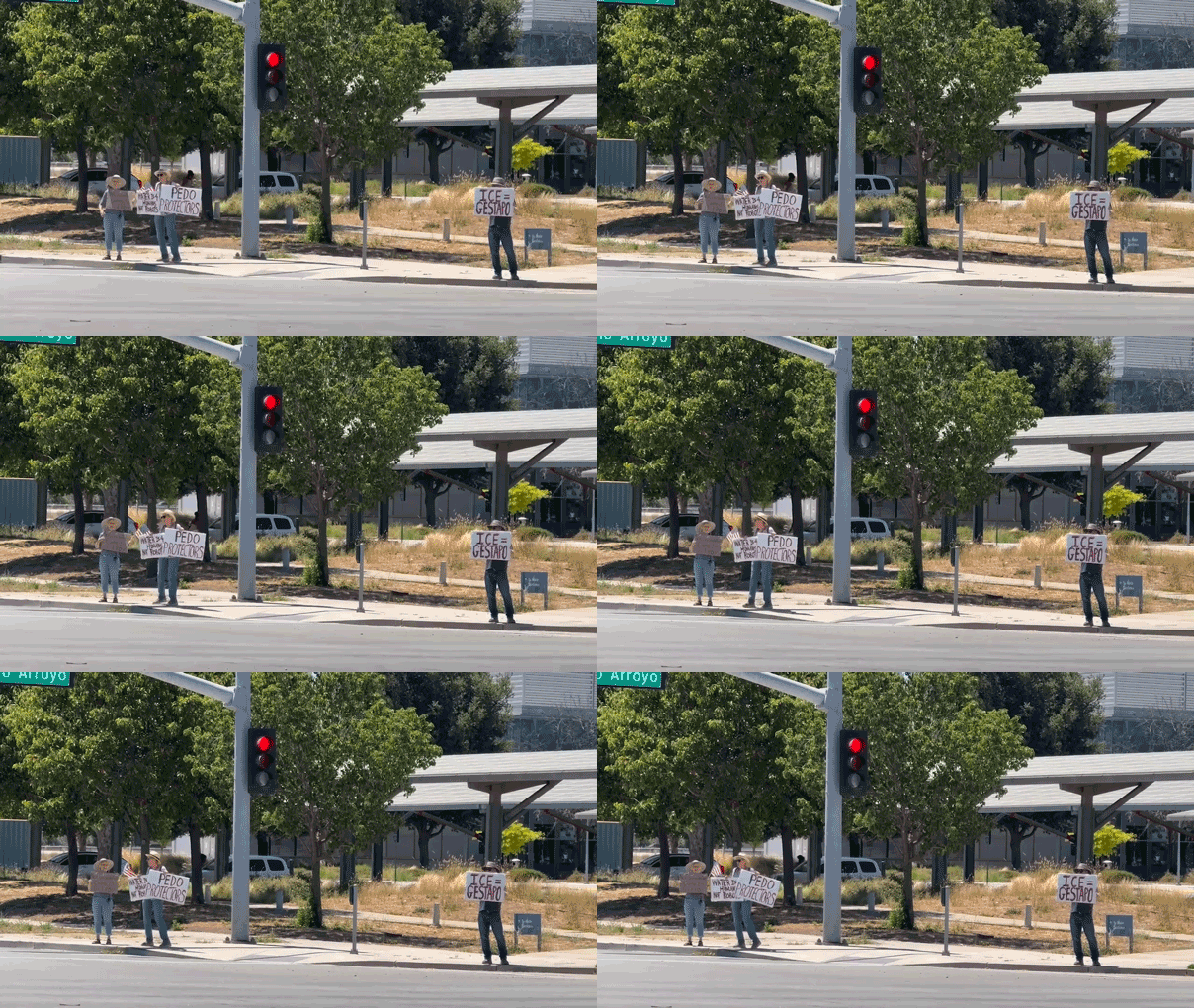
Fox News Digital obtained footage of five Humans First protests across California, Georgia, Missouri and South Carolina. Multiple demonstrators at the event in Gilroy, California, had signs protesting Immigration and Customs Enforcement — a common antagonist for those on the left. Some of the protests were sparsely attended.
Nearly 1,000 miles south of its Green Party-linked protests in Illinois, Humans First’s protest page listed a Georgia activist group called People for Progress as the organizer of a local demonstration. The group was founded after the 2024 election to resist Trump’s agenda and protect «diversity, equity & justice.»
In Missouri, Humans First’s protest page listed the founder of CleanEarth4Kids as an organizer for a Springfield protest. CleanEarth4Kids has publicly urged followers to oppose several Republican-backed measures and support Democratic-backed bills. Ferguson Advocates for Civic Transparency (FACT), another group run by left-of-center individuals, organized an additional Humans First demonstration just outside of St. Louis.
MARXIST ORGANIZER LEADS CAMPAIGN AGAINST VIRGINIA AI DATA CENTER AS FOREIGN INFLUENCE CONCERNS MOUNT
A press release obtained by Fox News Digital shows that the featured speakers at the event included a former Democratic state lawmaker, a current Democratic candidate for the state legislature and a member of the Party for Socialism and Liberation.
Lady Huston, one of the organizers leading FACT, told Fox News Digital that Humans First hosted weekly Zoom meetings for its organizers and sent out regular mass emails with directions and suggestions for them. She, like the other left-of-center organizers working with Humans First, also stressed the opposition to data centers should be a nonpartisan issue.
«[Sen. Josh Hawley] is making statements and saying we need to do something about [data centers]. So, I never thought I’d care about anything this man had to say. But he is in tune with what’s happening with AI … and that we need some better understanding about the effects of data centers,» Huston told Fox News Digital. «So, I’m with him on that. You know, so it doesn’t matter to me what political party you are, but the subject is what matters.»
Back north in Michigan, Humans First listed Mitchell Distin, a Democrat running for state House, as an organizer for a protest, but has since removed that demonstration from its webpage. Fox News Digital reviewed a prior version of the page listing Distin before the demonstration was removed.
«While you are correct in your assessment that I am, by no means, conservative, the data center issue isn’t a left-right issue,» Distin told Fox News Digital. «It’s an issue without precedent, as it transcends party boundaries. And for that reason alone, I believe it’s showing that every day, common Americans actually have far more in common than they realize. We actually agree on the futures we want, not the futures that Big Tech execs want for us.»
TOP ENERGY GROUP WARNS WEALTHY FOREIGNERS ARE POTENTIALLY BANKROLLING ANTI-DATA CENTER CAMPAIGNS ACROSS US

On what was recently farmland, Amazon data centers have been built as close as 50 feet from residential houses in the Loudoun Meadows neighborhood on January 20, 2023, in Aldie, VA. A Microsoft data center is under construction in at top right. As the data center industry expands its footprint in Northern Virginia, often building massive commercial structures near residential neighborhoods, communities push back with their concerns. (Photo by Jahi Chikwendiu/The Washington Post via Getty Images)
Not all the organizers who have signed up to facilitate Humans First’s nationwide protests are political liberals.
Cathy Latham, for example, is a longtime Georgia GOP official who is now working as a staffer with Humans First. She organized a July 18 protest in Waco, Texas. Latham was among the 18 defendants, including Trump, indicted in Georgia’s 2020 election-interference case.
Humans First claimed after July 18 that it had helped organize 142 protests across 42 states.
CLICK HERE TO DOWNLOAD THE FOX NEWS APP
Kremer, speaking to the Washington Examiner in May, expressed disgust with how AI companies have spent millions on lobbying and messaging campaigns to influence policy.
«I’m not for sale,» she told the Washington Examiner. «When I do something, I pour my whole heart and soul into it.»
big tech backlash, politics, artificial intelligence, technology, democratic party
NEWYou can now listen to Fox News articles!
Speaker Mike Johnson’s plan to bypass Democratic opposition on a key election integrity bill took a major step forward in the House of Representatives on Wednesday.
It’s a major victory for Johnson, R-La., who had to overcome a wall of left-wing opposition and threats of a rebellion within his own GOP ranks.
House Republicans are working to move the Safeguarding American Voter Eligibility (SAVE) America Act as part of a larger $95 billion budget bill that, if successful, would completely sideline Democrats to implement election reforms sought by President Donald Trump.
They’re using a mechanism called budget reconciliation, which allows the party in power to pass sweeping fiscal policy by lowering the Senate’s threshold for advancement from 60 votes to a simple majority. In exchange, however, the legislation is subject to intense scrutiny under a strict set of guidelines about what actually counts as true fiscal policy.
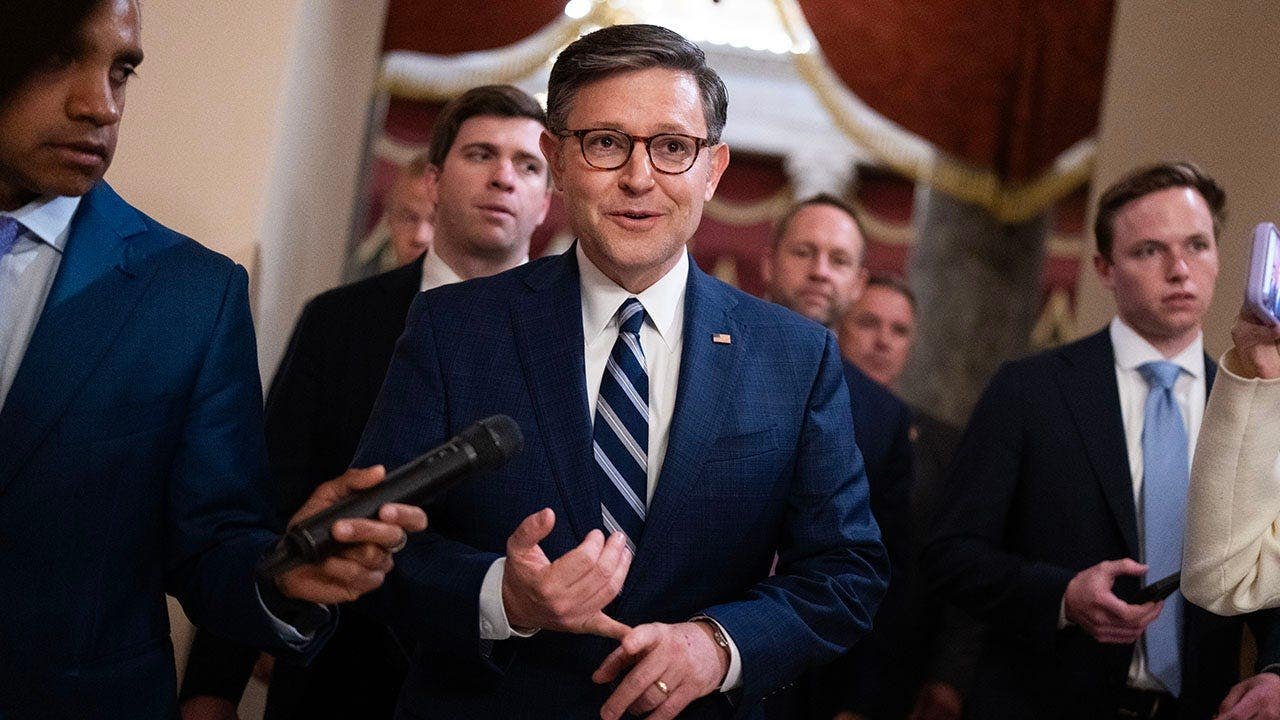
Speaker of the House Mike Johnson, R-La., talks with reporters in the U.S. Capitol on June 10, 2026. (Tom Williams/CQ-Roll Call, Inc via Getty Images)
The bill up for consideration on Wednesday was just the first House-wide step in passing a reconciliation package, which is adopting a framework with spending instructions for relevant committees who will then cobble individual portions together into a massive piece of legislation. Both the House and Senate must pass identical versions before it goes to the president’s desk.
All but three members of the House Republican Conference supported the measure: Reps. Thomas Massie, R-Ky., Warren Davidson, R-Ohio, and Kevin Kiley, I-Calif., voted against it.
The framework was adopted in a narrow 216 to 214 vote, with all Democrats opposed.
REPORTER’S NOTEBOOK: HOUSE’S FINAL SPRINT PUTS SAVE AMERICA ACT AND IRAN FUNDING IN PLAY
It comes after fiscal hawks warned for days that they are uneasy with the lack of budget cuts in the framework to offset the $95 billion in new spending.
Rep. Chip Roy, R-Texas, said he was leaning in support but still undecided.

Donald Trump speaks to members of the media outside the Oval Office of the White House in Washington, D.C., U.S., on Monday, April 13, 2026. (Salwan Georges/Bloomberg via Getty Images)
«People wonder why the so-called 3AM caucus exists and why we hold our votes to the last minute to put pressure on Republicans in Congress to deliver? It’s because they revert to the mean — which is spending, amnesty, unlimited immigration and political show votes. I want FULL SAVE. I want this unpaid-for spending to be paid for in the 4th reconciliation bill. I want clarity on our war mission while we are backfilling munitions,» he told Fox News Digital.
TOP TRUMP OFFICIAL MAKES NEW SAVE ACT CASE TO REPUBLICANS BEHIND CLOSED DOORS
Rep. Eric Burlison, R-Mo., had told reporters, «I just wanted to let them know if you’re doing a whip count right now, I wouldn’t put me in the yes column…I’m not 100% convinced that the SAVE language is going to be held solid through the Senate. In fact, I would bet against it. I just, I don’t have any confidence that the Senate will keep that language tight.»
Both voted in favor of adopting the framework, however.
With just a razor-thin majority, Johnson could lose no more than than two Republicans to still pass anything on partisan lines.
The budget plans for for $73 billion aimed at the U.S. war with Iran, $12 billion for aid to American farmers, and $10 billion for states to implement election integrity measures in the SAVE America Act — namely federal voter ID rules and a proof of citizenship mandate to register to vote.
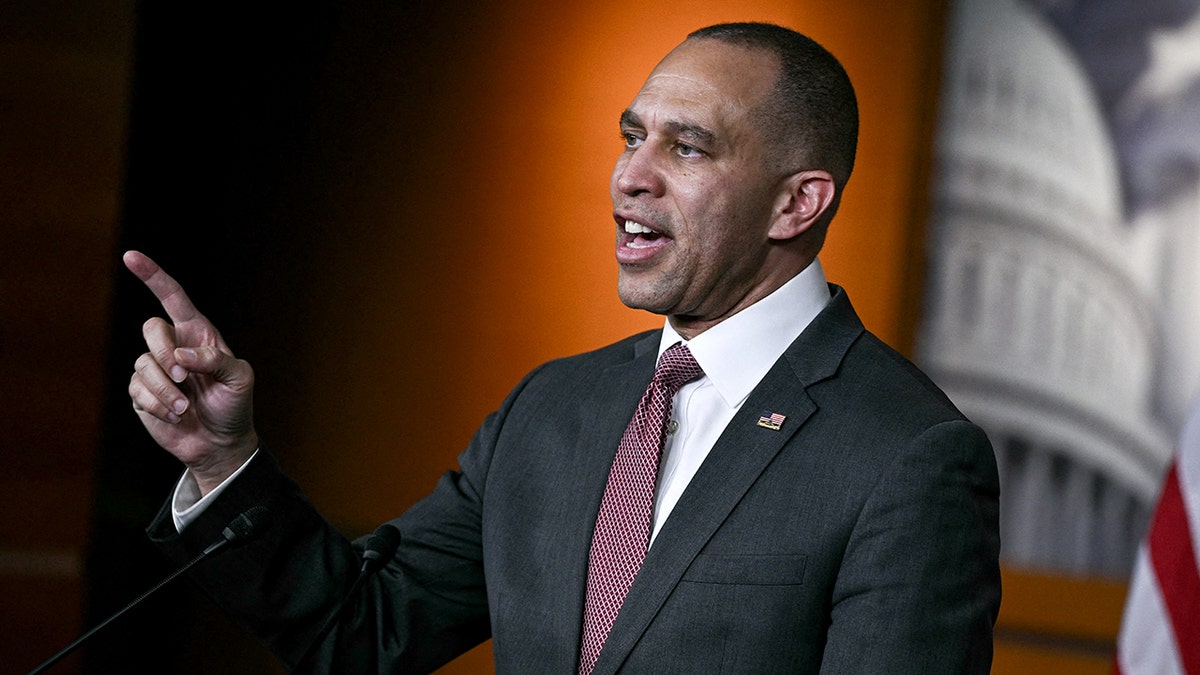
U.S. House Minority Leader Hakeem Jeffries, Democrat from New York, speaks before an upcoming House vote on funding for the US Department of Homeland Security, on Capitol Hill in Washington, D.C., on March 5, 2026. (Brendan Smialowski / AFP via Getty Images)
Democrats and some Republicans have been wary about funding the Iran war without additional oversight from Congress. And Democrats in both the House and Senate have been vehemently opposed to the SAVE America Act, calling it tantamount to voter suppression.
CLICK HERE TO DOWNLOAD THE FOX NEWS APP
But Republicans have near-uniformly argued that it is aimed at enhancing confidence in American elections.
Trump posted on Truth Social on Tuesday, «Thank you to all of the House Republicans who are supporting the first step towards getting as much of THE SAVE AMERICA ACT, as possible, in the Budget Bill, and to our Great Speaker, Mike Johnson. I am asking all House Republicans to VOTE YES on this very important Budget Resolution. I am watching the vote very closely, and hope Republicans can UNIFY to secure Elections against all forms of Foreign Country Interference, and Illegal Alien voting.»
domestic policies, republicans elections, voting, mike johnson, politics

La investigación por el asesinato del ingeniero argentino Facundo Rico en Madrid logró reconstruir en pocos días cómo se desencadenó el ataque. Para los investigadores, el acusado, a un hombre de 65 años, creía que la víctima era el amante de su esposa. Eso lo llevó a presentarse en su departamento donde lo apuñaló 13 veces y, menos de 24 horas después, se quitó la vida.
El crimen ocurrió el martes 14 de julio, cerca de las 10 de la mañana, en un departamento alquilado del barrio Las Tablas, en el distrito madrileño de Fuencarral. Hasta allí llegó el presunto agresor, también ingeniero, quien ingresó a la vivienda y mantuvo un violento enfrentamiento con Facundo.
La pelea terminó en la cocina de la casa. Según la reconstrucción policial, la víctima recibió 13 puñaladas, varias de ellas en la espalda y en la zona del omóplato. El cuchillo quedó abandonado en el piso y en una de las paredes se hallaron restos de gas pimienta, que el atacante llevaba consigo y utilizó durante la agresión.
Para los investigadores, la violencia desplegada durante el ataque demuestra que el hombre contemplaba la posibilidad de matar. De hecho, consideran que el hecho de haber llevado un aerosol de gas pimienta refuerza esa hipótesis, aunque todavía se analiza si había planificado el homicidio desde un principio. La principal hipótesis de la Policía sostiene que el ataque fue cometido por un hombre de 65 años que estaba convencido de que Rico era el amante de su esposa. (Foto: AP)
Tras el crimen, el agresor escapó rápidamente del edificio. En el hall se cruzó con el encargado, que había sido alertado por una vecina luego de escuchar los gritos de la víctima y percibir un fuerte “olor químico”.
Después subió a un auto rojo, estacionado frente a una clínica, y emprendió viaje hacia la provincia de Ávila. Parte de ese recorrido quedó registrado por cámaras de tránsito.
La obsesión que habría motivado el ataque
Las primeras declaraciones de familiares y allegados de Facundo orientaron la investigación hacia un posible móvil sentimental.
La principal hipótesis sostiene que el agresor estaba convencido de que el ingeniero mantenía una relación con su esposa. Esa sospecha, según la investigación, derivó en una obsesión que terminó desencadenando el ataque, indicaron fuentes de la investigación a El País.
Los detectives establecieron que la mujer, de unos 50 años, y la víctima asistían al mismo gimnasio, ubicado a pocos metros de la casa donde vivía Facundo.
Además, fuentes cercanas al caso señalaron que ella pretendía separarse de su marido, quien habría comenzado a investigar si existía una tercera persona en su vida.

Facundo Rico era oriundo de San Juan y vivía en Madrid hacía al menos una década. (Foto: Facebook / Facundo Rico)
Después del homicidio, el hombre llegó a una segunda residencia que el matrimonio poseía desde hacía dos años en La Adrada, un pueblo de casi 3.000 habitantes ubicado a menos de dos horas de Madrid, donde habían remodelado un antiguo chalet.
Según la reconstrucción de los investigadores, el agresor le dijo a su esposa que durante ese día había estado realizando distintos trámites, sin dar mayores explicaciones. Mientras tanto, la noticia del crimen ya ocupaba los principales medios españoles.
Al día siguiente, cuando comenzaron a difundirse la identidad de la víctima y los detalles del brutal ataque, el hombre se dirigió hasta el paraje conocido como Charco de la Olla y se arrojó a una garganta, donde murió. Antes de suicidarse fue visto por una pareja que caminaba por el lugar, cuyos integrantes luego declararon que lo habían notado con “muy mala cara”.
Una investigación cerrada
Con la muerte del presunto autor, la causa quedó prácticamente concluida desde el punto de vista penal, ya que no existe la posibilidad de continuar el proceso judicial.
De todos modos, los investigadores del Grupo V de Homicidios de la Policía Nacional ya habían reunido una importante cantidad de pruebas.
Leé también: Quién era el ingeniero argentino asesinado de 13 puñaladas en España por una sospecha de infidelidad
Las cámaras de seguridad de la urbanización registraron el ingreso del sospechoso, cuya contextura física resultaba fácilmente reconocible, mientras que el encargado del edificio confirmó haberlo visto salir poco después de escuchar los gritos provenientes del departamento.
La esposa del agresor quedó en estado de shock cuando la Policía le comunicó las sospechas sobre la participación de su marido en el crimen. Incluso, según fuentes cercanas a la investigación, en un primer momento se negó a creer que pudiera haber cometido el asesinato.
España, Crimen, Infidelidad

Maldini suelta la bomba: Italia ha contactado con Guardiola… ¡y con Ancelotti!
Marc Stanley destacó el potencial de Vaca Muerta para “estabilizar la economía” y evitó hablar de política interna

The hidden left-wing network powering a ‘conservative’ rebellion against a major Trump priority

La tensión en los mercados globales y el salto del petróleo hicieron subir al riesgo país, que se aleja de los 400 puntos

¡Enojo y reproches! Diego Latorre confirmó todo sobre el escándalo de Messi y su arenga: “El tiempo es sabio y ya falta poco para que hablen Messi y los demás futbolistas”

Hernán Lombardi: “Está abierta la negociación para acompañar a Milei o presentar un candidato propio del PRO”

Sin la Copa y sin Messi en el avión, vuelve Tapia y deberá enfrentar tres frentes de tormenta tras la pausa del Mundial

Escándalo Mundial: Las presiones secretas, la amenaza de la FIFA por Malvinas y la verdad detrás del partido contra España

Samuel L. Jackson llamó a Argentina “el país más racista del mundo”: la contundente respuesta que le dejó Bárbara Lombardo

Le ganan a la inflación: los senadores pasarán a cobrar $12 millones brutos a partir de agosto

 DEPORTE2 días ago
Escándalo Mundial: Las presiones secretas, la amenaza de la FIFA por Malvinas y la verdad detrás del partido contra España
- CHIMENTOS3 días ago
Samuel L. Jackson llamó a Argentina “el país más racista del mundo”: la contundente respuesta que le dejó Bárbara Lombardo
- POLITICA3 días ago
Le ganan a la inflación: los senadores pasarán a cobrar $12 millones brutos a partir de agosto