INTERNACIONAL
La belleza de la semana: por qué nos atrapan tanto los personajes que nos dan la espalda


Por definición, el retrato en la historia del arte nació para buscarnos la cara. El rostro es el espejo del alma, el mapa de las emociones y el centro de gravedad de cualquier lienzo. Sin embargo, existe un puñado de obras maestras que deciden activar el mecanismo inverso: ocultarnos el rostro del protagonista y obligarnos a mirarlo por detrás.
En la tradición pictórica alemana esto se conoce como Rückenfigur (literalmente, “figura de espaldas”). Cuando un pintor decide darnos la espalda, no nos está rechazando; al contrario, nos está invitando a entrar al cuadro. Al no poder descifrar los ojos del personaje, nos vemos obligados a ponernos en sus zapatos y mirar el mundo a través de su mirada oculta. Dejamos de ser simples espectadores para convertirnos en sus cómplices silenciosos. A continuación, recorremos cuatro pinturas inolvidables donde un único personaje solitario, de espaldas al mundo, nos demuestra que a veces el mayor misterio del arte se esconde justo detrás de la mirada.
El manifiesto del abismo
En el año 1818, el pintor Caspar David Friedrich dio vida a Caminante sobre el mar de nubes, el punto de partida obligatorio y el ícono absoluto del Romanticismo alemán. Friedrich creó esta obra en una época marcada por el fin de las guerras napoleónicas, un momento histórico donde el ser humano buscaba reconectar con la espiritualidad y la inmensidad de la naturaleza tras la devastación. El lienzo nos muestra a un viajero solitario que, subido a una roca escarpada, contempla un indómito océano de niebla que cubre los picos montañosos.

Si el artista hubiera pintado a este hombre de frente, estaríamos atrapados analizando sus facciones, su edad o la épica de su expresión. Al ocultarnos su rostro, el caminante deja de ser un individuo específico para convertirse en un símbolo de toda la humanidad. Esa espalda rígida y esa melena al viento nos interpelan directamente: somos nosotros los que estamos parados frente al abismo de la existencia, proyectando nuestros propios miedos, dudas y asombros sobre ese paisaje infinito.
La melancolía azul
Mucho antes de convertirse en el excéntrico líder del surrealismo, un joven Salvador Dalí de apenas 21 años pintó Muchacha en la ventana en 1925 durante unas vacaciones familiares en Cadaqués. La modelo es su hermana Ana María, quien fue su musa más importante antes de la llegada de Gala. El cuadro captura un instante doméstico y suspendido en el tiempo: una adolescente que asoma su cuerpo hacia la luz del Mediterráneo, rodeada por los tonos azules y grises de una habitación austera.

La obra nos atrapa porque la espalda de Ana María funciona como una barrera de intimidad que el espectador viola silenciosamente. No podemos ver si sonríe, si llora o si simplemente sueña despierta, pero la sutil tensión física de sus hombros y la caída de su cabello nos contagian inmediatamente una calma nostálgica. Al darnos la espalda, ella no nos mira; nos obliga a mirar con ella, convirtiéndonos en compañeros de su añoranza por el mar abierto.
El misterio de la fragilidad
En 1948, el pintor Andrew Wyeth concibió El mundo de Christina, una de las cumbres del realismo estadounidense del siglo XX, ambientada en su granja de Maine. La protagonista está inspirada en Christina Olson, una vecina de Wyeth que padecía una enfermedad neuromuscular degenerativa y se negaba a usar silla de ruedas, prefiriendo arrastrarse por los campos. El cuadro nos ubica a ras del suelo, mostrando a una mujer delgada, vestida de rosa, que mira hacia una casa gris y distante en el horizonte.

La genialidad del artista radica en que no necesitamos ver el rostro demacrado por el esfuerzo para entender el drama de la escena. Su espalda, tensa y arqueada sobre la hierba seca, transmite una fuerza y una vulnerabilidad sobrecogedoras. Esta postura interpela al espectador desde la intriga y la empatía: la silueta nos oculta su dolor físico para enfocarse en su meta, transformando una pose de aparente derrota en una batalla monumental por alcanzar su hogar.
El silencio de las habitaciones vacías
Vilhelm Hammershøi, el maestro absoluto de la luz grisácea y el realismo danés, pintó en 1898 su célebre Interior con mujer de espaldas, construyendo su carrera al retratar los rincones silenciosos de su propia casa en Copenhague. En esta pintura, la protagonista es su esposa, Ida Ilsted, quien aparece sola en un salón de estética minimalista, rodeada de paredes desnudas y una sobria vajilla. La luz invernal entra de lado, recortando la silueta de la mujer, que nos da la espalda de forma impecable y matemática.

Esta obra provoca una fascinación casi magnética porque nos convierte en voyeurs de una soledad radical. La nuca expuesta de Ida y su figura inmóvil generan una atmósfera densa, casi fantasmal, donde el tiempo parece haberse detenido. Al negarnos su rostro, Hammershøi transforma la espalda de su mujer en un enigma psicológico: nos interpela dejándonos afuera de sus pensamientos, obligándonos a habitar ese vacío y a escuchar el silencio absoluto que inunda la habitación.
Caspar David Friedrich,Salvador Dalí,Andrew Wyeth,Vilhelm Hammershøi,pintura





INTERNACIONAL
Diez ciudadanos cubanos son buscados en Estados Unidos por asaltos, delitos contra menores y fraudes sanitarios

Diez ciudadanos cubanos buscados por autoridades federales de Estados Unidos figuran en expedientes relacionados con asaltos, delitos contra menores y fraudes contra el sistema de salud. Algunos de los casos permanecen abiertos desde hace varias décadas y, en distintos registros, las autoridades han incluido a Cuba entre los posibles paraderos de los acusados.
La recopilación publicada por Periódico Cubano reúne nombres que aparecen en registros del FBI y de la Oficina del Inspector General del Departamento de Salud y Servicios Humanos de Estados Unidos (HHS-OIG). Las causas incluyen desde un robo armado a una joyería de Florida hasta presuntos esquemas de facturación falsa al Medicare por decenas de millones de dólares.
Entre los casos más recientes se encuentra el de Alberto Pérez Elías, ciudadano cubano de 57 años acusado de participar en el asalto a Tio Jewelers, en Cape Coral, Florida, el 6 de enero de 2026. Según la información reunida por Periódico Cubano, los responsables habrían perforado una pared, amenazado al gerente con un arma y sustraído joyas valoradas en más de USD 1 millón.
Una orden federal contra Pérez Elías fue emitida el 24 de junio. El FBI ofrece una recompensa de hasta USD 50,000 por información que permita encontrarlo y detenerlo, mientras que otros tres acusados en la misma causa ya fueron arrestados. Las autoridades advierten que debe ser considerado armado y peligroso.
Otro de los nombres incluidos en la página de fugitivos de la oficina del FBI en Tampa es el de Alejandro T. Pena Lam, de 25 años y vinculado a Miami. El expediente federal citado lo relaciona con la presunta inducción de una menor de 13 años para producir y enviar imágenes ilegales por internet.
Los hermanos Benítez siguen prófugos por un presunto fraude sanitario
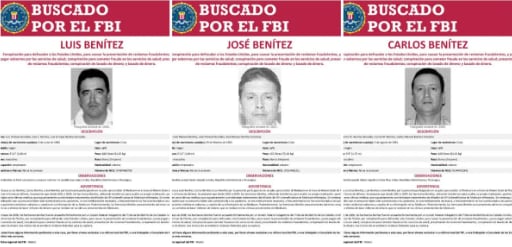
Carlos, José y Luis Benítez figuran como fugitivos en una investigación por fraude sanitario. Según los datos de la HHS-OIG citados por la publicación, los tres hermanos habrían operado clínicas de infusión para pacientes con VIH en Miami y presentado reclamaciones falsas al Medicare.
La acusación federal sostiene que el presunto esquema obtuvo aproximadamente USD 110 millones. Los tres continúan clasificados como prófugos en los registros federales mencionados.
La HHS-OIG es una entidad distinta del FBI, aunque ambas pueden colaborar en investigaciones de fraude sanitario y en operaciones coordinadas con el Departamento de Justicia. En este tipo de causas, la oficina del Departamento de Salud y Servicios Humanos mantiene registros de personas prófugas y solicita información que ayude a localizarlas.
El listado incluye a Amaury Pérez, acusado en 2015 de conspiración para cometer fraude sanitario y lavado de dinero. Los investigadores calcularon que él y sus cómplices habrían facturado de forma fraudulenta alrededor de USD 2.5 millones al Medicare.
El registro federal de Pérez señala a Cuba como uno de sus posibles paraderos. Esa referencia no confirma que se encuentre en la Isla, sino que figura entre las ubicaciones consideradas por las autoridades dentro de la búsqueda.
Las causas incluyen reclamaciones por equipos médicos y uso de identidades
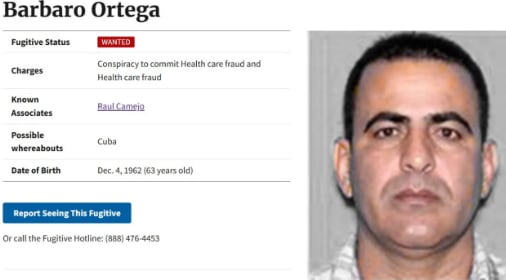
Bárbaro Ortega y Raúl Camejo fueron acusados en 2009 por un supuesto esquema de reclamaciones falsas relacionadas con equipos médicos. La operación habría generado aproximadamente USD 3.3 millones en solicitudes de pago.
Medicare desembolsó USD 972,413 en esa causa, según los datos incluidos en la recopilación. Ambos permanecen registrados como fugitivos y, en el expediente de Ortega, las autoridades mencionaron a Cuba como posible ubicación.
También continúa prófugo Jorge Caro, acusado de utilizar información personal de personas fallecidas para presentar reclamaciones fraudulentas al Medicare. Las solicitudes vinculadas al expediente habrían alcanzado cerca de USD 5.2 millones.
La clínica asociada al caso recibió aproximadamente USD 1.63 millones del programa federal. La HHS-OIG incluye igualmente a Cuba entre los posibles paraderos de Caro, sin que el registro permita establecer su ubicación actual.
Jorge Iglesias-Vázquez aparece en reportes anteriores del FBI
El décimo nombre incorporado en el recuento es el de Jorge Iglesias-Vázquez, nacido en Cuba y acusado en 2008 de fraude sanitario. De acuerdo con los reportes mencionados por la publicación, su empresa recibió cerca de USD 1.1 millones del Medicare.
Los informes anteriores del FBI lo identificaban como fugitivo y señalaban a Cuba como posible destino. Su perfil, no obstante, ya no aparece entre los fugitivos publicados actualmente por la oficina del FBI en Tampa.
Los expedientes reunidos abarcan cerca de dos décadas y corresponden a acusaciones de distinta naturaleza. En varios casos de fraude sanitario, las autoridades estadounidenses incorporaron a Cuba como posible lugar de residencia o fuga de los acusados.
La mención de la Isla en esos registros no equivale a una confirmación sobre la presencia de los requeridos en territorio cubano.
INTERNACIONAL
America’s Arctic war machine roars to life as commander reveals chilling new reality on Russia’s doorstep
NEWYou can now listen to Fox News articles!
Across one of the coldest, most remote and strategically exposed corners of the United States, American forces are practicing how to fight on land, at sea and in the air — rapidly moving rocket systems into western Alaska, sending F-35s and F-16s toward simulated threats, and coordinating U.S. and Canadian warships in the Bering Sea.
The operations are part of Tundra Merlin, an enduring U.S. military campaign aimed at proving that even across Alaska’s vast distances and extreme Arctic conditions, American and allied forces can rapidly assemble combat power to defend the northern approaches to the homeland.
And behind that show of force is a changing security environment increasingly shaped by Russia and China.
TWO ICEBREAKERS HEADED TO ALASKA AS US COMBATS RUSSIAN, CHINESE INFLUENCE IN ARCTIC
U.S. Army Spcs. Cole Garretson, left, and Kori Cook, assigned to 1st Battalion, 5th Infantry Regiment, 1st Mobile Brigade Combat Team (Air Assault), 11th Airborne Division, during Operation Tundra Merlin near Nome, Alaska, Aug. 4, 2026. (Christopher Chen/U.S. Air Force)
«I think what’s changed is primarily two things,» Lt. Gen. Robert Davis, commander of Alaskan Command, told Fox News Digital. «One is that the melting sea ice has made the Arctic more accessible. And we’re seeing increased activity both commercially and militarily in the Arctic, particularly during the summer months.»
«The other factor is that China and Russia and others are continuing to advance their military capabilities and capacity with an interest in showing that they can use them in the Arctic as well,» Davis said.
The Pentagon has reached a similar conclusion. Its 2024 Arctic Strategy warned that growing Russia-China cooperation could «alter the Arctic’s stability and threat picture,» and called for greater U.S. presence, exercises and military preparedness in a region becoming increasingly accessible. Defense officials have said forces operating there must be able not merely to train in extreme conditions, but survive them.
RUSSIA PULLED BACK FROM THE ARCTIC, FOR NOW. NATO MUST ACT BEFORE THOSE TROOPS RETURN
Few places illustrate the stakes better than Alaska.
The state sits at the intersection of the Arctic and Pacific and serves as a critical hub for homeland defense and a platform for projecting U.S. military power toward the Indo-Pacific and beyond. The Russian and American mainlands are only about 55 miles apart at their closest points across the Bering Strait, while Russia’s Big Diomede Island and Alaska’s Little Diomede Island are separated by roughly 2.5 miles.
Alaska also hosts major air bases, early-warning and missile-defense infrastructure, and tens of thousands of military personnel. U.S. Northern Command says Alaskan Command has more than 22,000 active-duty personnel from across the services, along with approximately 4,700 Guard and Reserve members.
Air Force officials have described Alaska as the «crossroads of the Arctic and the Pacific,» providing U.S. forces with reach and domain awareness for both homeland defense and global power projection.
Davis put that geography in even starker terms.
Pointing to the fifth-generation fighters positioned in Alaska, he told Fox News Digital that U.S. forces can «project from the Arctic to almost anywhere in the Northern Hemisphere in about 10 hours of flight time.»
RUSSIA’S QUIETER NUCLEAR SUBMARINES THREATEN NATO, FORMER COMMANDER WARNS
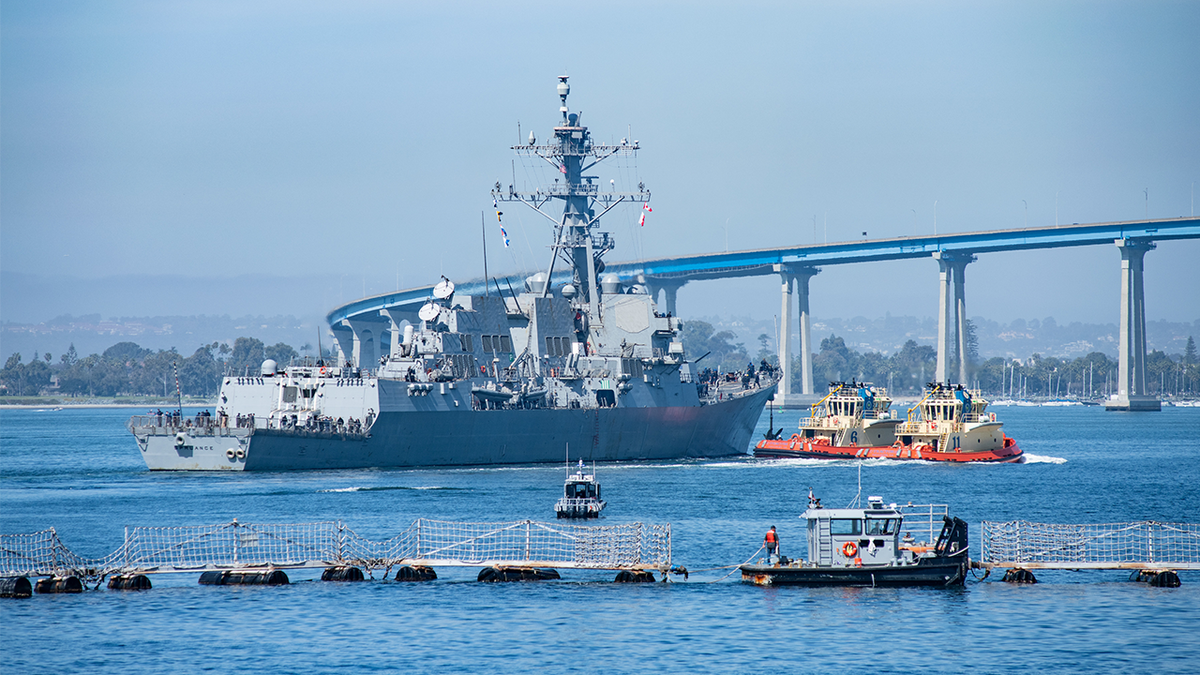
USS Spruance deploys to U.S. Northern Command Area of Responsibility. (U.S. Navy)
Tundra Merlin is designed to turn that geographic advantage into combat capability.
Davis described the operation as a collection of military options — essentially «plays in a playbook» — that can be activated either to deter an adversary or respond if one begins acting aggressively.
«Our hope is that we don’t have any adversarial activity because we’ve effectively deterred it,» Davis said. «But if we do see it and we have kind of a play in the playbook ready to go. For a response.»
One of the most striking demonstrations came recently, on Alaska’s western edge.
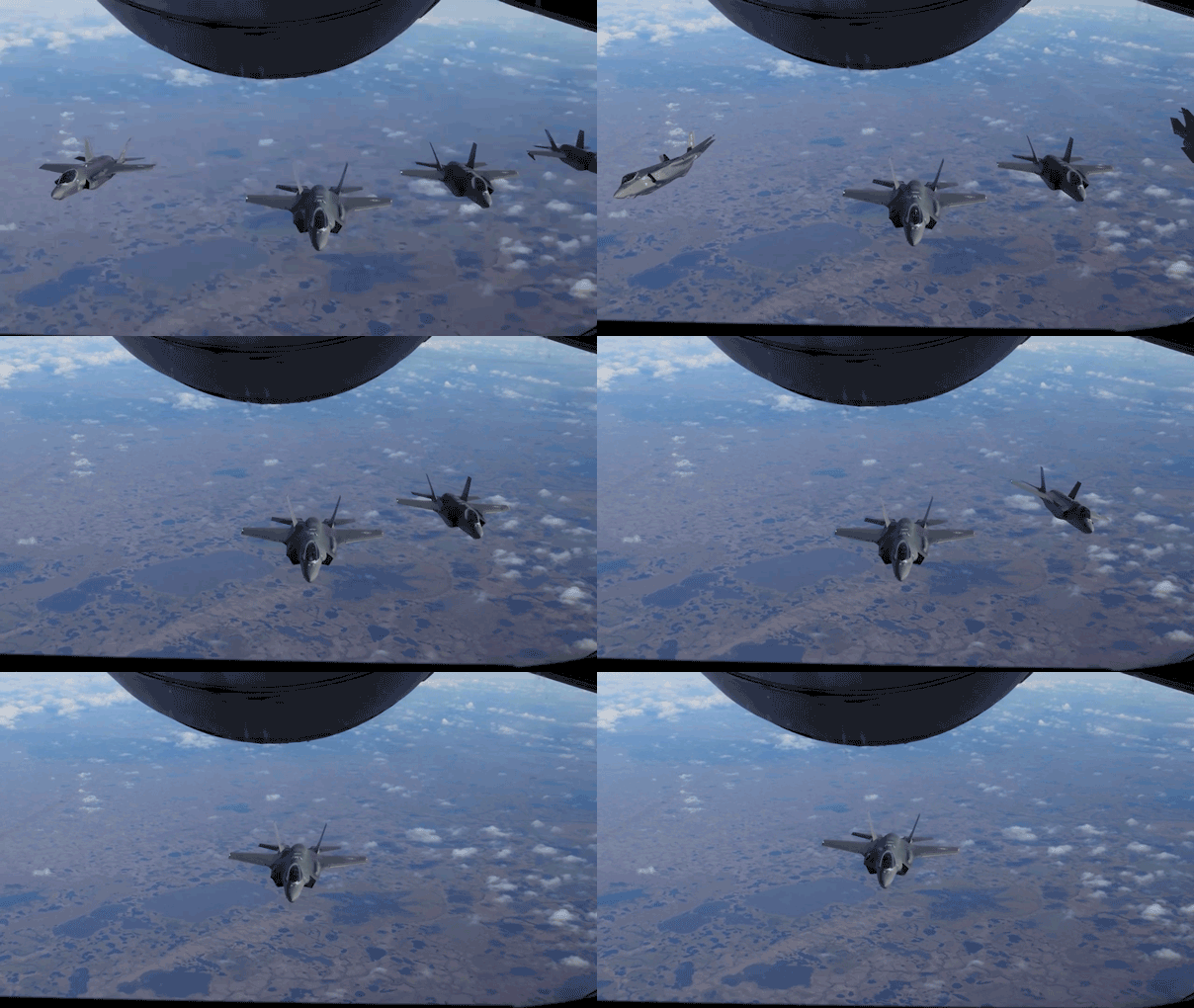
U.S. and Canadian forces rapidly moved a U.S. Army HIMARS mobile rocket system and an AN/TPQ-53 radar into western Alaska aboard a Royal Canadian Air Force C-17, then connected those ground forces with American F-35s, F-16s and a KC-135 tanker operating overhead.
CHINA, RUSSIA, IRAN AND NORTH KOREA FORM ‘AXIS OF AGGRESSORS’ THAT COULD OVERWHELM US, BOOK WARNS
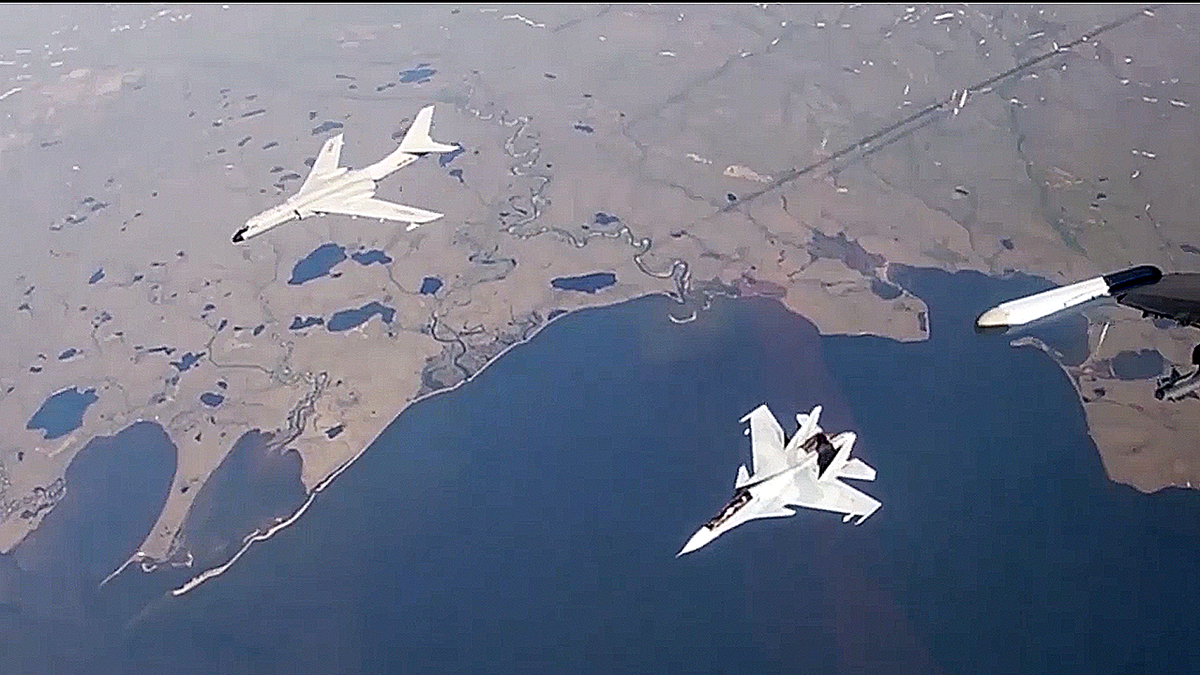
Russia and China make joint air patrols near Alaska. (Russian Defense Ministry/Getty Images)
The mission brought air defense and long-range offensive firepower together in a single operation. F-35s and HIMARS synchronized against a simulated ground target approximately 135 miles away, while F-16s simultaneously intercepted F-35s acting as simulated incoming aerial threats, according to U.S. Northern Command.
Davis said the point was not simply to prove the individual weapons worked, but to show how quickly forces could be moved into a remote part of Alaska and linked together.
The operation demonstrated that U.S. forces can rapidly move capabilities into Alaska «both to defend Alaska, but also, if necessary, to put other adversary targets at risk,» he told Fox News Digital.
Tundra Merlin pushed that same concept out to sea in September.
From Sept. 18–22, U.S. and Canadian forces conducted a joint maritime strike scenario roughly 100 nautical miles north of Dutch Harbor, integrating U.S. Coast Guard and Royal Canadian Navy surface and subsurface vessels with Canadian maritime patrol aircraft and Alaska-based U.S. Air Force F-35 fighters and E-3 airborne warning and control aircraft.
The forces practiced multiple simulated maritime target engagements, testing whether information collected by different ships and aircraft could be rapidly passed across the force and used to identify, track and engage a potential threat.
«The most impressive part to me was seeing the high degree of cooperation and integration among units that day in and day out don’t necessarily operate together,» Davis said.
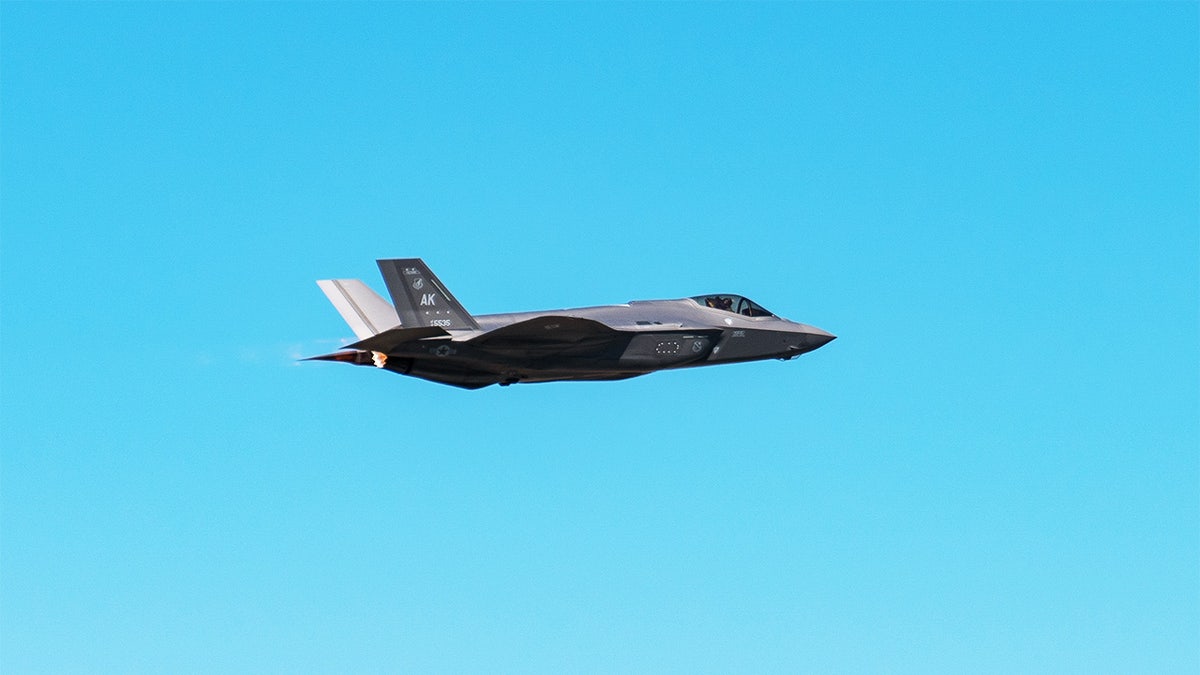
Arctic Thunder Air Show is performed at Joint Base Elmendorf-Richardson in Anchorage, Alaska, on July 22, 2024. (Hasan Akbas/Anadolu via Getty Images)
«To see the joint nature on the U.S. side integrated together with the inter-agency of the U.S. Coast Guard and with our allies, with Canada as an example, was just an amazing thing to see,» he added.
That ability to operate at scale is complicated by Alaska itself.
Extreme cold can affect equipment and personnel, while the enormous distances and limited infrastructure of the North American Arctic make moving and sustaining forces unusually difficult. The Pentagon’s Arctic Strategy specifically identifies those distances and the region’s infrastructure limitations as obstacles to military operations and says maintaining infrastructure in Alaska is essential for missile defense, surveillance and rapid power projection.
Davis said military equipment brought into Alaska cannot simply be expected to function as it would elsewhere.
«It needs to be conditioned. It needs to be properly outfitted to operate in sub-zero temperatures for a long period of time,» he said, adding that troops also require specialized clothing, training and procedures to avoid cold-weather injuries and continue fighting in Arctic conditions.
The pressure to master that environment comes as Russia and China increasingly demonstrate their own ability to operate near North America.
In July 2024, the North American Aerospace Defense Command, or NORAD, detected and intercepted two Russian Tu-95 bombers and two Chinese H-6 bombers flying together in the Alaskan Air Defense Identification Zone. It was the first time NORAD had intercepted Russian and Chinese military aircraft operating together in the zone. The aircraft remained in international airspace and did not enter U.S. or Canadian sovereign territory, and NORAD said the flight itself was not considered a threat.
The episode nevertheless highlighted the very kind of cooperation U.S. defense planners are watching.
For now, Davis said Alaska is positioned to deal with the military threats commanders expect under normal conditions.
«We’re postured very well for any of the anticipated threats that we think would come our way in the very near term,» he said. But if commanders saw indications of a significant escalation, Davis said Alaskan Command would likely request additional forces and capabilities.
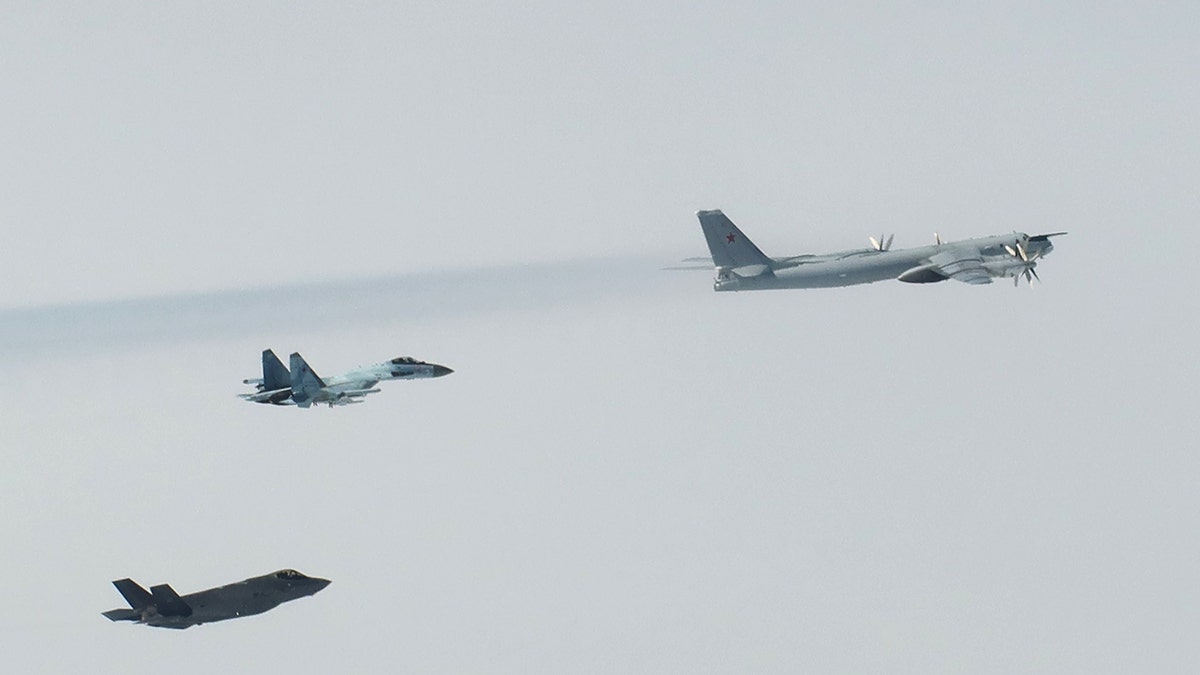
In July, NORAD said U.S. fighter jets intercepted Russian aircraft that were flying in the Alaskan Air Defense Identification Zone. (North American Aerospace Defense Command)
That, ultimately, is what Tundra Merlin is intended to prove: that in a theater defined by enormous distances, punishing weather and growing Russian and Chinese activity, the United States can move forces across Alaska, connect them across land, sea and air, and have combat power ready before a potential adversary decides to test the northern edge of the homeland.
us army, us navy, russia, military, world, alaska

DALLAS — The question hanging over the Texas Senate race is not simply whether Democrat James Talarico can win over voters in one of the nation’s reddest states. It is whether Black voters will turn out in numbers large enough to help him break the GOP’s decadeslong statewide winning streak.
Voters interviewed at the Texas State Fair broadly agreed that Black turnout could be crucial to Talarico’s chances against Republican Ken Paxton.
«I definitely do think, if there’s any time for Texas to get a Democrat elected, this is the time to strike,» Mike, a military veteran from Dallas, told Digital. «I think it depends on whether the Black and Brown voters come out for Talarico.»
Talarico is seeking to become the first Democrat in more than 30 years to win a statewide race in the Lone Star State.
POLL: TALARICO TIES PAXTON IN TEXAS SENATE RACE, THREATENING GOP STRONGHOLD
«Everyone says, ‘Hey, we are Texas and we want change here, we want change there,’» Mike added. «Well, this is an opportunity for you guys to get change. Are you going to come out and show up at the polls? He’s got all the momentum in the world. He’s got everything going for him.»
Mike’s comments reflect the challenge facing Talarico as he works to build support among Black and Hispanic voters and motivate them to turn out in November.
Texas has more Black eligible voters than any other state, with roughly 2.7 million. That puts voters in Houston, Dallas-Fort Worth and East Texas in a potentially decisive position in any Democrat’s bid to win statewide.
Former President Barack Obama’s appearance with Talarico at a May campaign stop in Austin underscored the stakes for Democrats to leverage a massive voting bloc in Texas. The party’s effort to win over Black voters could help determine whether Texas remains reliably red or becomes more competitive for Democrats in future elections.
TEXAS VOTERS HAVE PLENTY TO SAY ABOUT WHETHER LONE STAR STATE COULD TURN BLUE
But Talarico faces an uphill battle in uniting Democrats behind his campaign after a divisive primary against Rep. Jasmine Crockett, D-Texas. Talarico defeated Crockett in the Democratic primary earlier this year, and the outgoing congresswoman has not endorsed his Senate campaign.
Crockett has said she supports the Democratic ticket in Texas, but her political action committee has not endorsed Talarico or campaigned for him.
Rashaun, of Forney, Texas, said the primary loss may have left some Black voters frustrated.
«Everyone was behind Jasmine,» Rashaun said. «So that’s what’s blocking, I’m going to say for my people, that was blocking their minds.»
Still, Rashaun said she plans to vote for Talarico and hopes Texas will turn blue in November.
«Yes, we are voting in November and it’s going to be Talarico,» she said. «We need Texas to flip. We can wish and hope and pray. But we need to get out and vote.»
TEXAS VOTERS HAVE PLENTY TO SAY ABOUT WHETHER LONE STAR STATE COULD TURN BLUE
Mike said the election may ultimately come down to whether voters are willing to act.
«Right now it is on the Texas voters to get out and support James Talarico or sit at home if you don’t want to see that change,» he said.
Bryant, of Coppell, Texas, likewise pointed to frustration with Gov. Greg Abbott and Attorney General Ken Paxton, both Republicans, as a potential motivator for people to support Talarico’s candidacy.
«This is a critical election,» Bryant said. «I think we all can feel it in Texas, the need to get Greg Abbott out.»
REPUBLICANS JUST GOT A POWERFUL NEW PLAYBOOK FOR THE BATTLE FOR CONGRESS. HERE’S WHAT’S INSIDE
«It’s time for a change,» he added. «Plus, on the other side, you see how bad Ken Paxton is and his track record and just some of the things that he’s done. It’s no longer working and we need to do something different.»
Ava, a college student from Denton, said Talarico’s outreach to younger voters has helped him connect with a generation that often feels overlooked.
«I do think he’s going to pull through,» she said. «He engages with the younger community, which is important because we feel like we’re not represented.»
She added that his social media presence has also helped younger voters connect with his campaign. She first learned about Talarico after meeting him at the Texas State Fair last year and later followed him online.
«I think he’s going to flip the state.»
While Ava focused on Talarico’s appeal among younger voters, Kiara, of Dallas, said supporters must turn that enthusiasm into votes.
«I live in Texas, and I’ve been here for a really long time, and it’s time for a change, a positive change,» she said. «And I think Talarico is definitely going to bring that.»
«We just have to vote,» Kiara added. «We can’t complain about the problems if you don’t want to vote to fix them.»
midterm elections, politics, texas, elections, elections state and local, greg abbott, republicans elections

Diez ciudadanos cubanos son buscados en Estados Unidos por asaltos, delitos contra menores y fraudes sanitarios

Pablo Quirno a los empresarios de IDEA: “Pedían previsibilidad, Milei devolvió años al cálculo empresario”

Se conocieron en 2019, él le hizo firmar un acuerdo para quedarse con todos los bienes y ella lo demandó después de 20 años de relación

Causa Malvinas: el Gobierno rechazó las críticas de Reino Unido y desafía a las autoridades británicas a dirimir el caso Sea Lion en la justicia internacional

El llanto de Nelson Castro en TN por la reacción de la gente al verlo en la Peregrinación a Luján: “Es muy difícil”

America’s Arctic war machine roars to life as commander reveals chilling new reality on Russia’s doorstep

Ley de Tierras: la CGT repudió el fallo de la Corte Suprema y le exigió a Diputados que rechace el DNU de Milei

Milei volvió a dar un discurso en la Argentina Week de París y se emocionó en el cierre

Capcom ha admitido su destino con los remakes de Resident Evil y muchos jugadores se hacen la misma pregunta: ¿Qué pasa con Resident Evil 5 y 6?

Caso Mariaca: un ministro paraguayo acusó a funcionarios bolivianos de proteger al narco Sebastián Marset

 POLITICA2 días ago
Milei volvió a dar un discurso en la Argentina Week de París y se emocionó en el cierre
- INTERNACIONAL3 días ago
Caso Mariaca: un ministro paraguayo acusó a funcionarios bolivianos de proteger al narco Sebastián Marset
- POLITICA3 días ago
Desde San Juan y en modo campaña, Máximo Kirchner dijo que los jueces de la Corte “desconocen la soberanía”