INTERNACIONAL
La extrema derecha europea se reúne en Milán para pedir la deportación de millones de migrantes

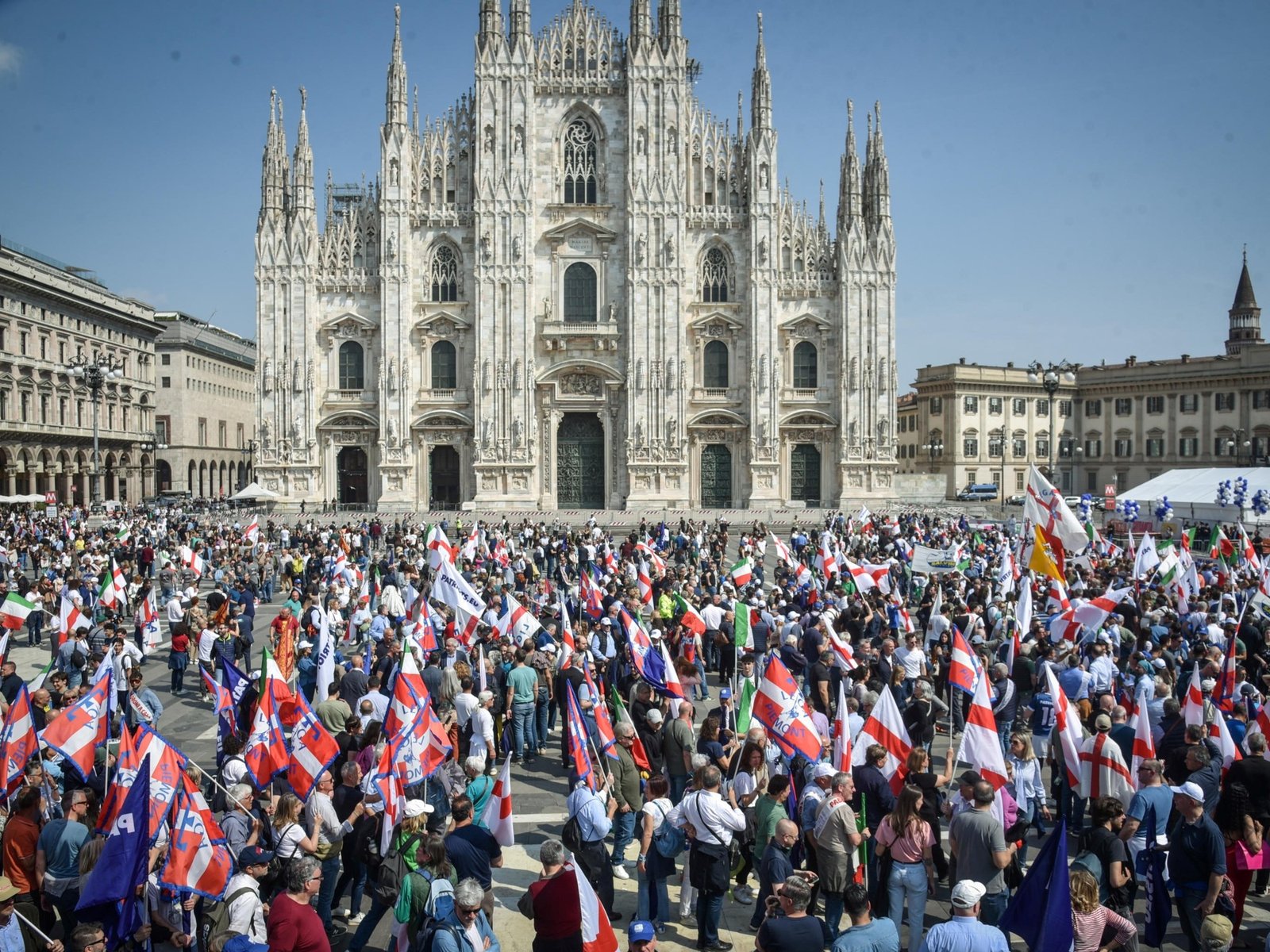
Dirigentes de varios partidos europeos de extrema derecha se reunieron este sábado en la ciudad italiana de Milán bajo el lema “Sin miedo: en Europa, somos los jefes en casa”, para promover el concepto de “remigración”.
Se trata de una idea, equivalente a una masiva limpieza étnica, que pide deportar a su supuesto lugar de origen racial a todos los migrantes no blancos y a sus descendientes, sin distinguir su lugar de nacimiento o su nacionalidad. Equivaldría a deportar a decenas de millones de personas, muchas de ellas nacidas en el continente europeo y con nacionalidad de algún país europeo.
A la cumbre, una especie de manifestación en la Piazza del Duomo con discursos de dirigentes de extrema derecha, asistieron en persona o a través de videoconferencia los principales dirigentes de los partidos que forman el grupo ‘Patriotas’ en el Parlamento Europeo, la tercera fuerza de la Eurocámara.
Figuras como el francés Jordan Bardella (probable candidato de la extrema derecha a la presidencial de abril de 2027 si definitivamente Marine Le Pen es inhabilitada por la Justicia), el holandés Geert Wilders o representantes de la formación alemana AfD. El maestro de ceremonias fue el italiano Matteo Salvini. El español Santiago Abascal entró por videoconferencia. La semana pasada perdieron al húngaro Viktor Orban.
Desde el escenario, Wilders dijo: “La tragedia que había predicho es hoy una realidad: nuestro pueblo, los habitantes originarios de Europa, es golpeado por la marea de la inmigración en masa, por la inmigración ilegal, principalmente llegada desde países islámicos”. Europa recibe menos migrantes, con o sin papeles, que hace una década.
Bardella dijo que había ido a Milán para asegurar que la extrema derecha francesa ganará las elecciones del próximo año y que, “con Marine Le Pen, llevamos a cabo un combate existencial para hacer de Francia de nuevo una gran potencia”. Aunque copien algunos de sus eslóganes, estos partidos empiezan a alejarse de Donald Trump porque su cercanía se ha demostrado contraproducente en las urnas.
Quienes defienden la “remigración” aseguran que hay una conspiración de los grandes poderes financieros, políticos, culturales o mediáticos europeos para sustituir a la población blanca y cristiana de Europa por población negra y árabe, de confesión musulmana y de origen en África y Oriente Medio. Los partidos de extrema derecha europeos creen que la población europea está siendo “étnicamente reemplazada” y que hay que revertir ese proceso.
Estos partidos y dirigentes intentan hacer políticamente aceptable ese concepto de “remigración”, hasta ahora aislado en foros de internet de conspiracionistas y de partidos incluso más a la derecha, defendidos por pseudomedios de comunicación financiados por esos partidos, en los márgenes del sistema parlamentario y sin apenas representación política. Eran hasta hace poco ideas demasiado extremas incluso para dirigentes como Marine Le Pen o Santiago Abascal.
Detrás de la organización y la promoción de la cumbre estaba La Lega, el partido del italiano Matteo Salvini, en la coalición de gobierno de Giorgia Meloni. Salvini intenta volver a las esencias de estos partidos y a los que les une: racismo y rechazo a la inmigración.
El año pasado se intentó organizar una cumbre similar en Milán, que acabó sin hacerse y con la organización envuelta en un caos cuando los lugares que debían acogerla empezaron a cancelar las reservas e incluso los hoteles que debían alojar a los participantes se negaron a reservarles habitaciones.
El 30 de mayo se celebrará otra cumbre similar y con el mismo nombre (‘Cumbre Remigración’) en la ciudad portuguesa de Oporto. En esa cumbre participarán dirigentes aún más a la derecha del espectro político, ya en los márgenes, pero que empujan con sus conceptos a toda la extrema derecha. Como el austríaco Martin Sellner, neonazi a quien el Reino Unido prohíbe pisar su territorio. Sellner fue quien popularizó el concepto de “remigración” e incluso creó un ‘Instituto para la Remigración’.
Una de las participantes es la diputada española Rocío de Meer, de VOX, quien ha llegado a defender que España deporte a siete millones de extranjeros y a sus hijos. Es nieta de Carlos de Meer, alto cargo militar del franquismo. En 2020 pidió al Ejército que diera un golpe de Estado para derribar a Pedro Sánchez y el mismo año compartió en sus redes sociales videos de propaganda nazi.

INTERNACIONAL
A horas del quinto aniversario del 11J, Cuba batió su récord de represión con 1.306 presos políticos y 40 menores detenidos
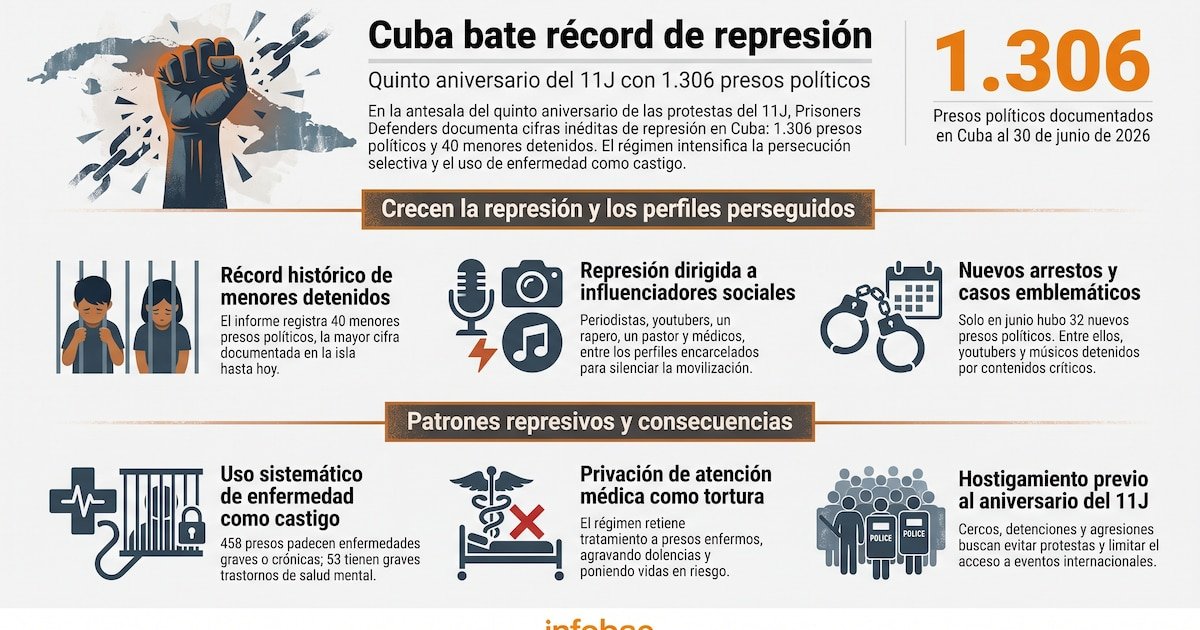
La organización de derechos humanos Prisoners Defenders publicó este jueves su informe mensual sobre presos políticos en Cuba con dos cifras sin precedentes en sus registros: 1.306 personas privadas de libertad por motivos políticos al cierre de junio y 40 de ellas detenidas cuando eran menores de edad, el número más alto documentado hasta la fecha.
El reporte llega dos días antes del quinto aniversario de las protestas del 11 de julio de 2021 -más conocidas como 11J-, la mayor movilización ciudadana registrada en la isla desde 1959.
“El régimen cubano acaba de marcar dos siniestros nuevos récords de represión a las puertas del quinto aniversario del 11J: 1.306 prisioneros políticos y 40 de ellos detenidos siendo menores de edad”, afirmó Javier Larrondo, presidente de Prisoners Defenders, en conversación con Infobae.
Solo en junio, la organización verificó 32 nuevos casos, con otros 21 aún en proceso de investigación. De los 40 menores registrados en la lista total, 16 permanecen recluidos en prisiones y centros penitenciarios destinados a población adulta.

El informe documentó un cambio en el perfil de las víctimas. La represión ya no apunta únicamente a quienes participan en manifestaciones o ejercen activismo político, sino a personas con capacidad para informar, movilizar o influir en distintos sectores de la sociedad.
“El régimen está encarcelando de forma selectiva a personas con capacidad de influencia social: periodistas, youtubers, un rapero, un pastor evangélico, médicos, ex presos del 11J y numerosos jóvenes”, señaló Larrondo; al tiempo que acotó: “Todo ello con el objetivo de desactivar cualquier posibilidad de movilización ciudadana en el quinto aniversario del 11J”.
Entre los casos documentados en junio figuran los de Eduardo Ceballos Pérez, conocido como “Eddy Jones”, y Christian Rodríguez Riverón, creadores del canal de YouTube Despingovery Channel, arrestados por publicar videos sobre instalaciones militares abandonadas y en ruinas. Las autoridades los procesaron por presuntos delitos de “Espionaje” o “Revelación de secretos concernientes a la Seguridad del Estado”, cargos que en el Código Penal cubano se castigan con entre 10 y 30 años de prisión, cadena perpetua o muerte.
Ceballos fue detenido el 1 de junio y trasladado a la prisión Combinado del Este, donde permaneció incomunicado; mientras que Rodríguez Riverón fue arrestado el 14 de junio al acudir a una citación policial, sin orden judicial.

Las protestas registradas en el reparto Barbosa, en La Habana, durante la segunda quincena de junio, motivadas por prolongados apagones y la crisis económica, desencadenaron una nueva ola de detenciones. Entre los arrestados figura el rapero y activista Andrés Matos Alcántara, conocido como “MC K-LIBRE”, detenido el 25 de junio tras acudir a una citación policial.
Las autoridades le atribuyen falsamente el liderazgo de los cacerolazos, pese a que su familia y testigos afirman que solo pasó por el lugar durante unos minutos. Durante los primeros días de su detención, el régimen ocultó su paradero, lo que llevó al Comité contra la Desaparición Forzada de Naciones Unidas a activar una Acción Urgente. El 4 de julio fue trasladado a la prisión de Valle Grande pese a padecer Enfermedad Pulmonar Obstructiva Crónica (EPOC) y diabetes tipo 1.
En la misma protesta, los hermanos Yoan Arévalo Álvarez y Yosban Arévalo Álvarez fueron detenidos el 21 de junio sin orden de arresto. Según testimonios de allegados, ambos sufrieron golpes durante la detención. En el caso de Yoan, las agresiones le provocaron múltiples fracturas en las costillas, una herida en el pecho y lesiones en los pies, sin que las autoridades le proporcionaran atención médica.
Una redada masiva en los barrios La Cuba y Maffo de Contramaestre (Santiago de Cuba), el 22 de junio, añadió 10 nuevos presos políticos muy jóvenes, seis de ellos menores de entre 15 y 17 años: Ander Magdiel del Toro Suárez (15 años), Dian Daniel Mora Acuña (15 años), José Ángel Borrero Zorrilla (17 años), José Jorge Menéndez Vázquez (17 años) y Ángel Luis Leyva (17 años), junto a Cristian Fernández Sarmiento (15 años), detenido el 19 de junio durante las manifestaciones de Altamira.

Prisoners Defenders documentó que 458 presos políticos padecen patologías médicas graves o crónicas, y 53 presentan trastornos de salud mental severos previos a su detención. “La privación deliberada de la atención médica se utiliza de forma sistemática como un instrumento de represión y de tortura”, advirtió Larrondo a este medio.
Tres casos concentran la mayor gravedad. Carlos Alberto MacDonald Ennis fue excarcelado el 12 de junio tras más de dos años en prisión provisional, aunque continúa sometido a proceso penal. Durante su encarcelamiento desarrolló un tumor maxilar que crece hacia estructuras internas de la cabeza sin recibir tratamiento, y al salir pesaba apenas 48 kilogramos, con hipertensión y diabetes agravadas.
En tanto, Juan Enrique Pérez Sánchez, condenado a ocho años de prisión por el 11J, contrajo tuberculosis en prisión y presenta desnutrición severa, trastornos neurológicos y crisis recurrentes de asma. La Comisión Interamericana de Derechos Humanos (CIDH) le otorgó medidas cautelares por el riesgo para su vida, pero continúa recluido. Prisoners Defenders lo incluyó entre los 33 presos políticos con riesgo gravísimo para su vida e integridad física.
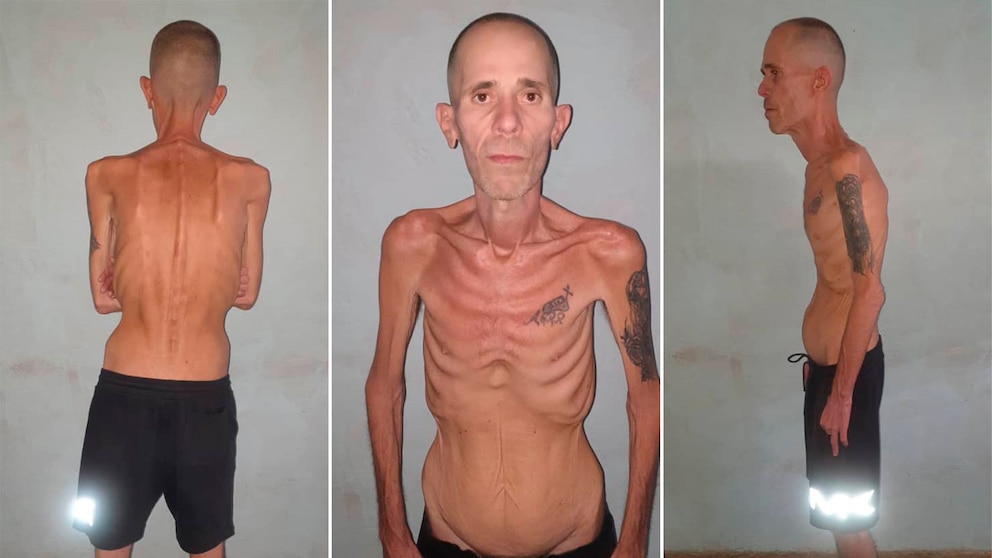
Por su parte, Rolando Yusef Pérez Morera, activista del Movimiento Opositores por una Nueva República (MONR) y también condenado a ocho años, mostró en imágenes obtenidas durante un permiso penitenciario temporal un deterioro físico extremo producto de la desnutrición severa.

A escasos días del quinto aniversario, las autoridades cubanas desplegaron una operación de hostigamiento contra activistas de distintas organizaciones. El 2 de julio, decenas de ellos fueron impedidos de asistir a la recepción organizada por la Embajada de Estados Unidos en La Habana con motivo del 250 aniversario de la independencia estadounidense, mediante cercos domiciliarios, detenciones arbitrarias, agresiones físicas y traslados forzosos.
José Elías González Agüero, coordinador nacional del Partido Unión por Cuba Libre (PUNCLI), y el ex preso político Alexander Díaz Rodríguez fueron trasladados esposados a una zona boscosa en las afueras de La Habana, donde fueron obligados a desnudarse y fotografiados en esa situación. Según el testimonio de González Agüero, uno de los agentes le colocó una pistola en la cabeza mientras le decía “se acabó tu historia y te vamos a matar aquí”, y los represores realizaron disparos simulando ejecuciones.
Díaz Rodríguez —cuya fotografía al salir de prisión tras cumplir una condena de cinco años por el 11J recorrió el mundo por su parecido con imágenes de campos de concentración— fue golpeado repetidamente y tuvo un papel introducido en la boca por la fuerza mientras permanecía esposado. En prisión había adquirido un cáncer de garganta y tiroides en fase terminal, hepatitis B, anemia severa y un cuadro de desnutrición severa terminal.
Los hermanos Amanda Beatriz y Abel Alejandro Andrés Navarro, del colectivo juvenil Fuera de la Caja Cuba, fueron retenidos por la Seguridad del Estado durante cerca de 11 horas para impedir su asistencia al mismo evento. Tras recuperar la libertad, denunciaron que el objetivo era silenciarlos y amedrentarlos.
En paralelo, las autoridades reabrieron un proceso penal previamente archivado contra la influencer y activista Anna Sofía Benítez Silvente (“Anna Bensi”), sometiéndola junto a su madre a nuevos interrogatorios de más de ocho horas.
El informe señaló también el caso del pastor evangélico Alexis Padrón Lorenzo, de 58 años, detenido el 11 de junio en el municipio de Regla tras increpar verbalmente a funcionarios que dispersaban una protesta vecinal contra los apagones y la escasez de agua. Al ser visitado por su esposa el 26 de junio, apenas nueve días después de su detención, presentaba pérdida considerable de peso, pies hinchados y dolores agravados por una artritis reumatoide sin tratamiento.
El informe de Prisoners Defenders apuntó directamente a la inacción pública de gobiernos democráticos como factor que permite al régimen cubano sostener la escalada represiva sin consecuencias políticas.
La organización mencionó a España —con referencia expresa al gobierno de Pedro Sánchez—, la Comisión Europea y Canadá entre los actores que no se pronuncian ni defienden públicamente, de forma sostenida, a las nuevas víctimas de la represión.
En los últimos 12 meses —de julio de 2025 a junio de 2026—, la lista de Prisoners Defenders sumó 264 nuevos presos políticos, un promedio de 22 por mes. Cuba ocupa además el primer lugar mundial en desapariciones forzadas ejecutadas por el propio gobierno, con 193 de las 194 Acciones Urgentes presentadas ante el Comité contra la Desaparición Forzada de Naciones Unidas promovidas por la propia organización.
Cuba,presos políticos,represión,Prisoners Defenders,11J,derechos humanos

NEWYou can now listen to Fox News articles!
President Donald Trump is turning the stalled SAVE America Act into a leverage fight on Capitol Hill, tying the bill to unrelated Republican priorities as the party races to use its congressional majorities before the midterms.
The fight now stretches across defense spending, housing legislation, Senate primary politics and the filibuster, as Trump pushes Republicans to move the stalled elections bill before the party’s midterm window narrows.
The latest pressure point came Tuesday, when Trump tied the stalled elections bill to a proposed «Reconciliation 3.0» package seeking $350 billion in new defense spending.
«The SAVE AMERICA ACT, which everyone is asking for, paired with the full funding of our Great Department of War, can be passed, very quickly, ensuring that the United States of America stays FREE for Generations to come,» Trump wrote on Truth Social Tuesday.
TRUMP’S SAVE AMERICA ACT SHOWS SIGNS OF LIFE IN THE SENATE DESPITE REPUBLICAN REVOLT
President Donald Trump in the Oval Office of the White House in Washington, D.C., on Aug. 6, 2025. (Bonnie Cash/UPI/Bloomberg via Getty Images)
The SAVE America Act includes Trump’s long-sought voter ID and citizenship verification, which has faced obstacles in the Senate. Trump has warned about the need for voter ID laws for years, including from the 2016 campaign trail.
In late June, Trump announced a last-minute cancellation of the signing of the 21st Century ROAD Act of Housing, while issuing an ultimatum to get the SAVE Act passed.
The housing bill had bipartisan support and would have expanded the supply of homes and lower costs while also giving individual buyers a leg up by banning large institutional investors from purchasing single-family homes.
The cancellation came as a shock to members on both sides of the aisle, with Republican Maine Sen. Susan Collins saying the decision «made no sense,» while Democratic Massachusetts Sen. Elizabeth Warren said Trump refused to sign at the «11th hour.»
«The SAVE America Act has always been a top priority for President Trump, and it remains one. This is commonsense legislation, supported by the vast majority of Americans, that will secure our elections for generations to come,» White House spokesperson Abigail Jackson told Fox News Digital.
«The president knows how critical this issue is for the American people, and he will not stop fighting until it is passed,» Jackson added.
Democratic lawmakers have argued the SAVE Act would create unnecessary barriers for eligible voters, disenfranchising them.
«In fact, he won’t sign our bipartisan bill to finally bring relief to the housing market until he gets his SAVE Act to rig the midterms and kick millions of American citizens off the voter rolls. America First,» said New York Sen. Chuck Schumer, referencing the housing act.
«Donald Trump thinks that passing a voter suppression law is the most important thing for our country,» posted House Minority Leader Hakeem Jeffries on X.
TRUMP SUFFERS MAJOR SUPREME COURT DEFEAT AS JUSTICES UPHOLD BIRTHRIGHT CITIZENSHIP
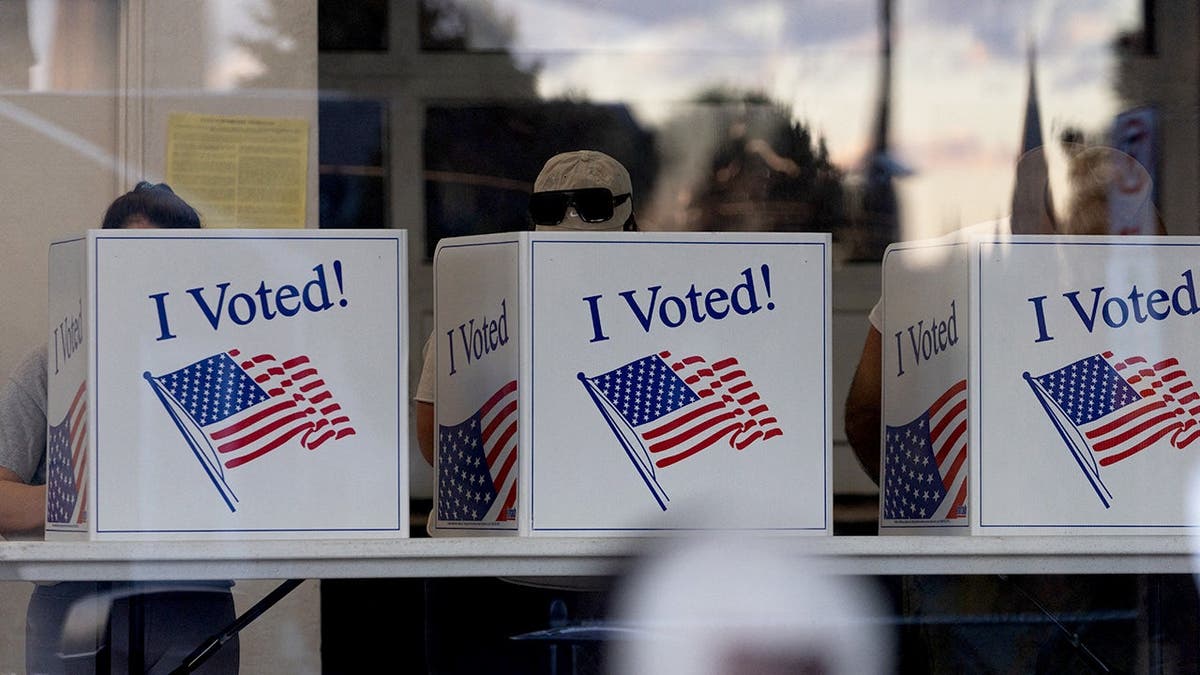
People complete their ballots. (REBECCA DROKE/AFP via Getty Images)
The SAVE Act also became entangled in the Texas Senate fight between Attorney General Ken Paxton and incumbent Sen. John Cornyn, where the filibuster and Trump’s endorsement became part of the same pressure campaign.
Texas Republican Senate nominee Ken Paxton previously sounded the alarm on the importance of getting the bill passed during his campaign in March.
«I would consider dropping out of this race if Senate Leadership agrees to lift the filibuster and passes the SAVE America Act,» he wrote on X at the time.
Cornyn declined to back the SAVE Act even as he signaled he could reconsider his longtime support for the filibuster, sharpening the Texas primary pressure before Trump ultimately endorsed Paxton.
Trump also diverted his attention back to the SAVE Act in another move to push his immigration agenda after a Supreme Court ruling on birthright citizenship.
After the Supreme Court ruled that children born in the United States to parents unlawfully or temporarily present are citizens at birth under the 14th Amendment, Trump turned back to the SAVE Act as part of his broader immigration and elections push.
«The Supreme Court upheld Birthright Citizenship, which is too bad for our Country, but we can easily make it up in Congress through Legislation, with the support of the President, that has now been determined during this process,» Trump wrote on Truth Social at the time.
CONGRESS EYES RARE BIPARTISAN HOUSING WIN WITH OR WITHOUT TRUMP’S HELP
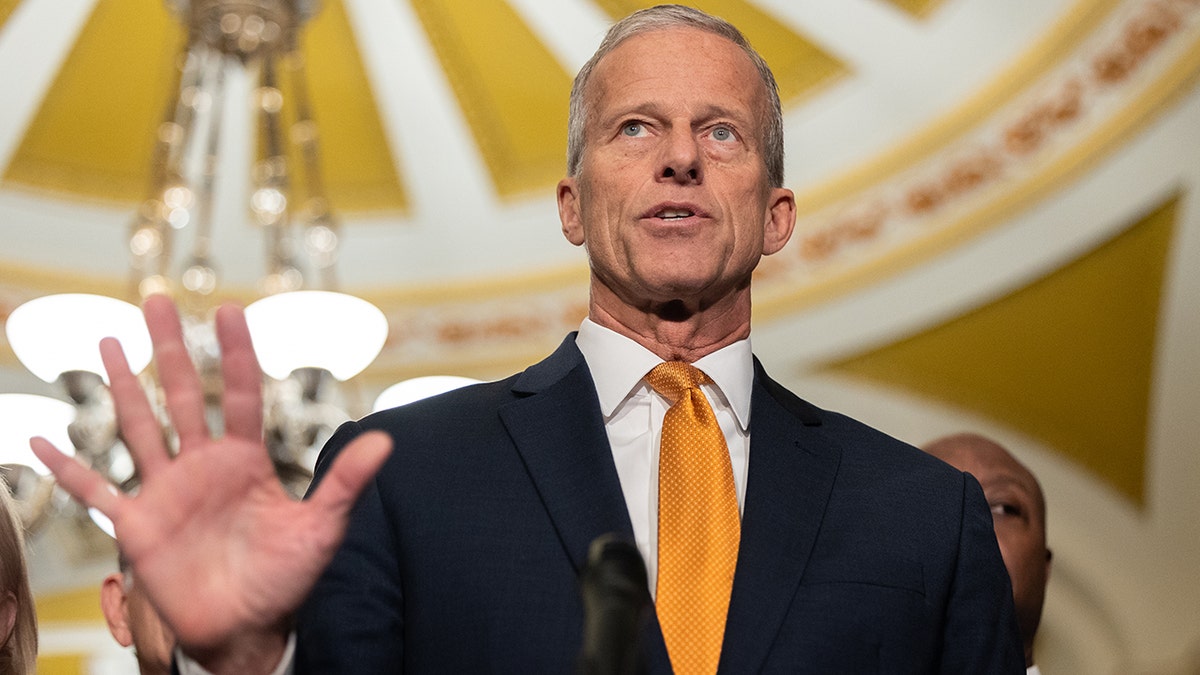
Senate Majority Leader John Thune (R-SD) speaks at a press conference with other members of Senate Republican leadership following a policy luncheon in Washington, D.C., on October 28, 2025. (Nathan Posner/Anadolu via Getty Images)
Senate Majority Leader John Thune has cast doubt on the bill’s path forward, saying Republicans do not have the 60 votes needed to overcome a Democratic filibuster.
Trump has pushed Senate Republicans to change the rules and pass the bill by a simple majority, while pressing Democrats to publicly defend their reliance on the filibuster.
Trump has sounded the alarm that the SAVE Act may never pass if it doesn’t cross the finish line before November.
CLICK HERE TO DOWNLOAD THE FOX NEWS APP
Republicans and administration officials have joined Trump’s crusade by using their speaking engagements to help push the SAVE Act.
Vice President JD Vance said by passing the legislation to get voter ID, Republicans will stop talking about election fraud.
«We are the only advanced democracy anywhere in the entire world that doesn’t require you to show a voter ID to vote. It’s simple. Just give us election integrity laws, give us voter ID, and then we will have the confidence to say the American people, there’s no cheating,» said Vance. «So stop it and give the American people voter ID.»
The Senate is scheduled to return from its Independence Day recess the week of July 13.
politics, senate elections, donald trump, midterm elections, congress
INTERNACIONAL
Pitones birmanas invasoras bajo la lupa: científicos extraen huevos para salvar el ecosistema de los Everglades en Florida

Un grupo de especialistas de la Universidad de Florida realizó la extracción de una puesta de huevos de pitón birmana en los Everglades el 30 de junio de 2026.
La acción, informada por el Miami Herald, tuvo como objetivo impedir la eclosión de decenas de serpientes invasoras y obtener datos clave sobre la reproducción, selección de nidos y comportamiento de esta especie, considerada una amenaza grave para el ecosistema local.
La operación se llevó a cabo cerca de Weston, en el sur de Florida. Participaron científicos del programa Croc Docs y del South Florida Water Management District.

El éxito del operativo dependió de un rastreador GPS implantado previamente en la hembra. Desde que el programa de monitoreo comenzó en 2022, el equipo confió en la tecnología para localizar nidos en zonas inaccesibles, una táctica que transformó la gestión de esta plaga.
Brandon Welty, biólogo y coordinador de investigación sobre especies invasoras, relató que el nido no se distinguía entre la vegetación, pero el dispositivo permitió al equipo llegar justo al sitio necesario.
La expedición involucró a Jenna Cole, científica del South Florida Water Management District, y a su pasante Sophia Buller.

El acceso no fue sencillo: sin senderos, los investigadores avanzaron entre árboles bajos y matorrales, siguiendo únicamente las coordenadas del rastreador.
Una vez localizado el nido, procedieron a extraer la puesta para su estudio en laboratorio y posterior eliminación, con el fin de evitar que la población de pitones siga creciendo de manera descontrolada.
Welty detalló que “el seguimiento nos permite saber cuándo una hembra llega al sitio y estimar con precisión cuándo depositó los huevos. Retiramos la puesta antes de que eclosione y así obtenemos datos ambientales y reproductivos que ayudan a entender las condiciones que favorecen la expansión de la especie”.

La pitón birmana, originaria del sudeste asiático, alteró gravemente la cadena alimentaria de los Everglades tras décadas de expansión.
Su reproducción acelerada y la falta de depredadores naturales en la región facilitaron su proliferación. El trabajo de campo de la Universidad de Florida aspira a detener este avance y a la vez generar información útil para futuras políticas públicas.
Eric Suarez, coordinador del programa Croc Docs, afirmó que la captura manual sigue siendo el método más eficiente para retirar estos reptiles. El uso de rastreadores y la recolección de datos ambientales permite a cazadores y agencias perfeccionar sus intervenciones.

A esta labor se sumó la toma de muestras de sangre de la hembra, una línea de investigación destinada a analizar la presencia de microplásticos en las pitones, según publicó el Miami Herald.
El rastreo implementado en la serpiente posibilita observar patrones de apareamiento, movimientos y conducta, información esencial para anticipar la expansión de la invasora.
Welty reconoció que uno de los puntos de sutura del rastreador se soltó durante la revisión, pero optó por no intervenir de inmediato, considerando el estado de la serpiente tras la incubación: “Están deshidratadas y con el sistema inmunitario debilitado, así que preferimos dejarla y que cicatrice por sí sola”.

El operativo no contempló el sacrificio de la serpiente madre. Tal y como explicó Welty, la hembra fue devuelta a su hábitat tras el retiro de la puesta. De acuerdo con Miami Herald, las imágenes del procedimiento muestran todas las etapas: extracción del nido, toma de muestras y liberación del animal.
La intervención perseguía dos metas principales: impedir el nacimiento de nuevos ejemplares y aportar información relevante para el diseño de estrategias de manejo ambiental en Florida.
El análisis de los huevos y las condiciones del nido permitirá identificar factores que favorecen la reproducción y supervivencia de la pitón birmana. El programa Croc Docs perfeccionó el uso de rastreadores y técnicas de captura desde 2022, consolidando estos métodos como herramientas esenciales en la lucha contra una de las especies invasoras más problemáticas del estado.
La puesta retirada representa un paso concreto para frenar el aumento de la pitón birmana en los Everglades, una de las reservas naturales más emblemáticas de Estados Unidos. El trabajo científico continúa, con el propósito de desarrollar medidas más precisas y eficaces para restaurar el equilibrio ecológico de la región.
pitón birmana,huevos,Everglades,reptiles,serpientes,nido,especie invasora,fauna,Florida,conservación

Cuánto cobra un cajero de supermercado en julio 2026

Qué pasó el 9 de julio de 1816

Luis Suárez repasa su carrera: ‘Lo que más admiro de Messi es su humildad y constancia’

A horas del quinto aniversario del 11J, Cuba batió su récord de represión con 1.306 presos políticos y 40 menores detenidos

Berenjenas al horno fáciles, económicas y riquísimas: la receta liviana que resuelve la cena sin gastar de más

La fuerte frase con la que Victoria Villarruel reconoció que quiere ser candidata a presidenta

La producción textil aceleró su caída y la capacidad instalada siguió entre las más bajas de la industria

Ojo con las multas de tránsito: las más caras llegan a $3.8 millones

Portugal vs España: formaciones, hora y dónde ver por tv