INTERNACIONAL
Corte Constitucional admitió demandas contra dos leyes económicas urgentes de Daniel Noboa


La Corte Constitucional de Ecuador admitió a trámite dos demandas de inconstitucionalidad presentadas contra leyes aprobadas por la Asamblea Nacional a partir de proyectos calificados como urgentes en materia económica por el presidente Daniel Noboa. Se trata de las causas 118-25-IN, relacionada con la Ley Orgánica de Transparencia Social, y 160-25-IN, respecto de la Ley de Fortalecimiento y Sostenibilidad Crediticia, ambas publicadas en 2025 y remitidas por el Ejecutivo bajo el procedimiento abreviado previsto en la Constitución.
En el caso 118-25-IN, la Sala de Admisión avocó conocimiento el 4 de febrero de 2026 y resolvió admitir la acción pública de inconstitucionalidad por la forma contra la Ley Orgánica de Transparencia Social. El accionante sostiene que la norma vulnera el principio de unidad de materia al incluir disposiciones reformatorias en ámbitos tributarios y mineros que, a su criterio, no guardan conexidad con el objeto principal de la ley. En su demanda, argumenta que la incorporación de reformas sobre dividendos, utilidades no distribuidas y fases de exploración minera habría desbordado el eje temático del proyecto original, afectando los artículos 82, 136, 137 y 424 de la Constitución.
El tribunal de admisión consideró que los cargos expuestos cumplen con los requisitos formales y argumentativos previstos en la Ley Orgánica de Garantías Jurisdiccionales y Control Constitucional (LOGJCC), en particular en cuanto a la claridad y pertinencia de los argumentos sobre la supuesta infracción constitucional. En consecuencia, dispuso correr traslado a la Presidencia de la República, a la Asamblea Nacional y a la Procuraduría General del Estado para que, en el término de quince días, intervengan defendiendo o impugnando la constitucionalidad de la norma.

Por su parte, en la causa 160-25-IN, la Corte admitió a trámite la acción pública de inconstitucionalidad presentada por la Fundación Regional de Asesoría en Derechos Humanos (INREDH) contra disposiciones específicas de la Ley de Fortalecimiento y Sostenibilidad Crediticia. La demanda se dirige, por el fondo, contra reformas introducidas a la Ley del Banco del Instituto Ecuatoriano de Seguridad Social (BIESS) y a la Ley de Seguridad Social.
Entre los puntos cuestionados se encuentran las disposiciones que permiten al BIESS realizar operaciones de reporto, gestionar créditos con entidades financieras nacionales o extranjeras y pignorar parte de su portafolio de inversiones, así como la posibilidad de vender cartera vencida. La accionante sostiene que estas medidas podrían afectar la intangibilidad de los fondos y reservas de la seguridad social, protegidos por el artículo 372 de la Constitución, y comprometer el derecho a la seguridad social reconocido en el artículo 34. Asimismo, impugna la reforma que modifica el mecanismo de designación del vocal representante de la Función Ejecutiva en el Consejo Directivo del IESS y la norma que atribuye al propio IESS la determinación del presupuesto para el proceso electoral de sus representantes.
La Sala de Admisión verificó que la demanda cumple con los requisitos del artículo 79 de la LOGJCC y que los cargos formulados permiten, en la fase de sustanciación, plantear problemas jurídicos sobre la compatibilidad de las normas impugnadas con la Constitución. Por ello, resolvió admitir la causa sin que ello implique un pronunciamiento sobre el fondo. En ambos casos, la Corte enfatizó que la admisión a trámite no constituye prejuzgamiento.

En la causa 160-25-IN, el tribunal negó además la solicitud de medidas cautelares que buscaba suspender provisionalmente las disposiciones impugnadas, al considerar que la argumentación presentada no acreditaba de manera suficiente los requisitos de verosimilitud, inminencia y gravedad exigidos por la LOGJCC.
Con estas decisiones, la Corte Constitucional abre la fase de sustanciación de dos procesos que cuestionan la validez formal y material de leyes tramitadas bajo el mecanismo de urgencia económica, lo que reabre el debate sobre los límites del procedimiento legislativo abreviado y el alcance de las reformas en materia financiera y de seguridad social impulsadas por el Ejecutivo.
edificio,exterior,gente,gesto,grupo,policías,protesta,trabajando











Cambio
Resultado

NEWYou can now listen to Fox News articles!
A partial government shutdown affecting the Department of Homeland Security (DHS) is all but guaranteed unless the Senate rams through a short-term extension of current funding levels sometime on Thursday.
But avoiding a DHS shutdown means the same measure must also pass the House of Representatives, where success will depend on delicate political maneuvering by Speaker Mike Johnson, R-La., to persuade a House Republican Conference with varying ideas of what a path forward should look like.
«It would have to be for 60 or 90 days, I would think,» said Rep. Ralph Norman, R-S.C., a member of the conservative House Freedom Caucus. «I don’t know what’s going to happen in 30 days, I don’t know what’s going to change.»
Senate Majority Leader John Thune, R-S.D., is expected to unveil a stopgap funding measure for DHS called a continuing resolution (CR), which would extend the department’s current budget for a yet-unknown amount of time.
ICE SHUTDOWN FIGHT MIGHT RESTRICT FEMA, COAST GUARD TO ‘LIFE-THREATENING’ EMERGENCIES
Speaker of the House Mike Johnson, R-La., gestures as he meets with reporters ahead of a key procedural vote to end the partial government shutdown, at the Capitol in Washington, Tuesday, Feb. 3, 2026. (J. Scott Applewhite/AP Photo)
It comes after Democrats walked away en masse from a bipartisan deal to fund DHS through the end of fiscal year (FY) 2026 over what they saw as insufficient guardrails on agencies responsible for President Donald Trump’s immigration crackdown in Minneapolis and elsewhere.
Congress has funded 97% of the federal government through FY2026 at this point. But DHS is a vast department with a broad jurisdiction that includes the U.S. Coast Guard, the Secret Service, the Federal Emergency Management Agency (FEMA), and the Transportation Security Administration (TSA) — all of which will see varying levels of disruptions if a shutdown happens.
Republicans largely want to avoid such a situation but have made clear they believe that its effects would fall squarely on Democrats’ shoulders.
DEMOCRATS SPLIT ON SHIELDING COAST GUARD, SECRET SERVICE AS DHS SHUTDOWN THREAT NEARS
Conservatives like Norman favor an extended CR, arguing that it would fund Immigrations and Customs Enforcement (ICE) at a higher level than the initial bipartisan funding deal would have while removing Democrats’ negotiating leverage for more guardrails on those agents.
House Freedom Caucus Chairman Andy Harris, R-Md., told Fox News Digital last week that he would support a full-year CR for DHS to «make sure that FEMA is funded and TSA is funded, and stop the drama.»
Rep. Eli Crane, R-Ariz., similarly said on Wednesday, «I think we’d like to push it out as far as we can so we can avoid the constant uncertainty for the agency.»
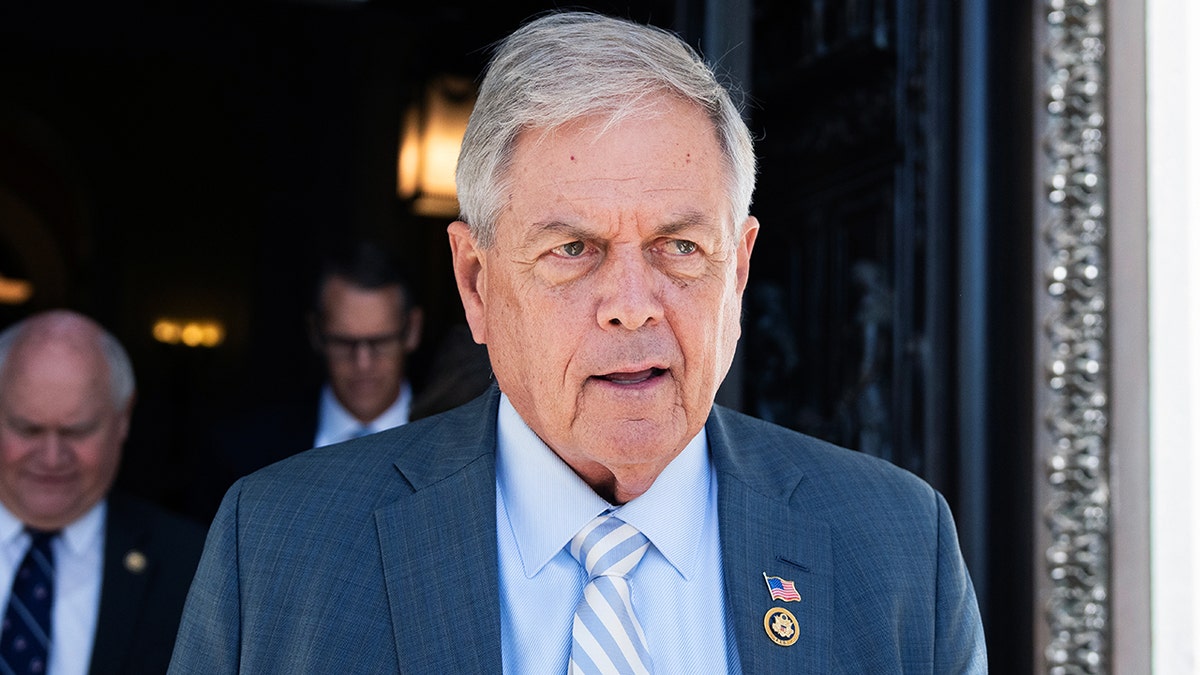
Rep. Ralph Norman, R-S.C., leaves the U.S. Capitol after the last votes of the week on Thursday, Sept. 4, 2025. (Tom Williams/CQ-Roll Call, Inc via Getty Images)
THUNE BLASTS JEFFRIES, SCHUMER AS ‘AFRAID OF THEIR SHADOWS’ AS DHS FUNDING FIGHT HEATS UP
«As long as this hangs up in the air, let’s say you do it for three, four months, the Democrats are gonna want a pound of flesh to help pass whatever it is. And I think that’s gonna weaken the efforts of … immigration enforcement,» Crane told Fox News Digital.
House Appropriations Committee Chairman Tom Cole, R-Okla., told reporters earlier this week that he would favor a mid-length CR over something shorter.
«If we do two weeks and they leave for a week, it’s really a one-week CR. Nothing’s going to happen when that many important people are gone. So I think four weeks makes a lot more sense,» Cole said.
But committee member Rep. John Rutherford, R-Fla., panned the idea of a CR altogether.
«CRs don’t work. CRs are not without pain. It disrupts a lot of your supply chain and purchasing and acquisition,» he told Fox News Digital. «I can’t believe they’re even thinking about it.»
Rutherford, a former sheriff, argued that a shutdown or CR would harm critical national security operations during a year that’s expected to see a host of high-security events in the U.S. like America’s 250th anniversary celebration, the FIFA World Cup, and others.
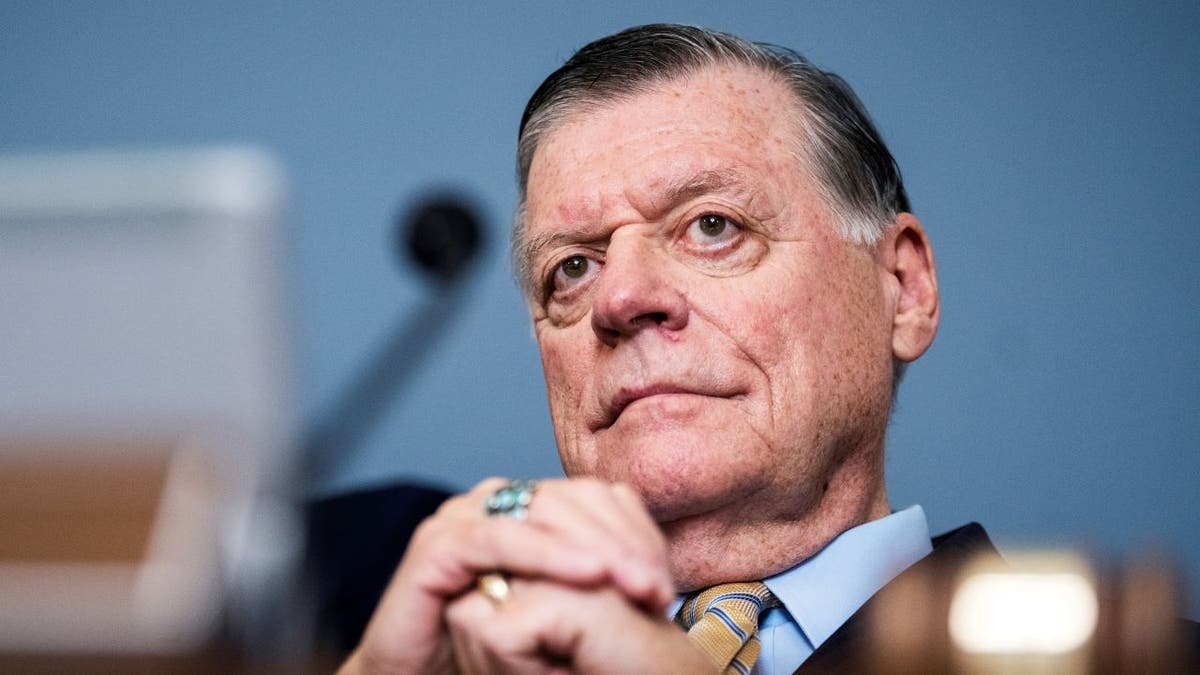
House Appropriations Committee Chairman Rep. Tom Cole, R-Okla., prepares for a hearing in the U.S. Capitol on Tuesday, Jan. 31, 2023. (Tom Williams/CQ-Roll Call, Inc via Getty Images)
Johnson declined to share his thoughts on CR length when asked by Fox News Digital on Tuesday, but emphasized the House GOP’s position that the Senate should take up the bipartisan bill that Democrats initially walked away from.
«I’m not going to prejudge the length of it or what it should be. I’m very hopeful. I mean, we still have time on the clock. When there’s a will, there’s a way. And if they can come to an agreement on this and get it done, that will behoove the whole country,» Johnson said.
CLICK HERE TO DOWNLOAD THE FOX NEWS APP
House GOP leaders will likely need nearly all Republicans on board to pass a CR for DHS, with many Democrats warning they will not support any funding for the department without seeing proof of critical reform.
Jeffries would not go into specifics about what he would support or oppose in terms of DHS funding during his weekly press conference on Monday, but he suggested to reporters that a simple stopgap funding bill with no changes to ICE funding was out of the question.
«ICE is out of control right now. The American people know it, and ICE clearly needs to be reined in,» Jeffries said. «Our position has been clear. Dramatic changes are needed at the Department of Homeland Security before a DHS funding bill moves forward. Period. Full stop.»
house of representatives politics,politics,government shutdown,homeland security
INTERNACIONAL
Biden admin skirted rules to deliver massive contract to nonprofit run by ex-official, IG report reveals

NEWYou can now listen to Fox News articles!
EXCLUSIVE: A new Inspector General’s report released Thursday morning accuses the former Biden administration of bypassing federal rules when issuing a more than half-a-billion dollar «sole source contract» to a nonprofit led by a former Biden official to deal with the unaccompanied minor crisis in 2021.
The Administration of Children and Families (ACF), which is under HHS and manages unaccompanied minors, awarded $529 million for a 1-year contract in March 2021 to a nonprofit called Family Endeavors, Inc. to help establish and manage a new emergency intake site in Texas (EIS) with 2,000 extra beds. However, according to the OIG’s new report, Biden’s ACF failed to follow federal procurement requirements that require full and open competition due to their own «insufficient planning,» rather than the COVID induced emergency the Biden administration cited.
Furthermore, the inspector general’s report found that the contract price was more than double the agency’s own cost estimate of $244 million, and indicated that the agency «subsequently modified» the award 15 times, extending the period until May 2022 and increasing the value to more than three times the original estimate from ACF.
DOGE SAYS TEXAS NONPROFIT WITH FORMER BIDEN TRANSITION MEMBER REAPED MILLIONS OPERATING EMPTY FACILITY
A family seen walking towards a barrier blocking passage across the U.S. border. (Department of Health and Human Services)
«ACF knew well in advance of March 2021 that it was projected to need more shelter beds than existing sites could provide and should have begun contract planning at that time,» the report states. «ACF failed to reasonably conduct the necessary advanced planning to execute a contract for procurement of those beds and related services using full and open competition.»
The report says ACF made only a limited attempt to do the necessary research for the contract, and did not even follow the findings it came up with.
«On March 5, 2021, Endeavors emailed ORR offering emergency assistance for the care of unaccompanied alien children. On March 13, 2021, Endeavors emailed ORR again with an unsolicited proposal, which included a statement of capabilities and concept of operations for an emergency shelter to serve unaccompanied alien children. Three days later, on March 16, 2021, ACF awarded a firm-fixed-price sole source contract to Endeavors to provide and operate an EIS facility in Pecos, Texas,» the report states.

Images of the emergency intake site in Pecos, Texas operated by Family Endeavors, Inc. The nonprofit received $529 million to build out 2,000 beds. (Department of Health and Human Services)
The contract beginning March 2021 was «by far the largest ever» for Endeavors Family, Inc., and came months after the company hired Andrew Lorenzen-Strait, who served as an adviser to the Biden-Harris transition team. The contract was also the second largest ever awarded by the agency, according to Axios.
«Despite multiple requests, ACF could not provide support for its review of the Endeavors quote, the price analysis techniques used to analyze the quote, or an [independent Government cost estimate] for an EIS dated before the contract was awarded,» the new inspector general’s report states. «When we asked for documentation, ACF told us that it was under significant time constraints to award contracts.»
WHITE HOUSE, DHS PUSH BACK ON CLAIMS ICE TARGETED 5-YEAR-OLD IN MINNESOTA, SAY CHILD WAS ‘ABANDONED’
Family Endeavors Inc. told Axios that its work on the border was a «continuation of services» that it has conducted for the migrant population since 2012. By April 2021, a month after the contract began, federal procurement records showed ACF had already paid $255 million of the no-bid contract to the nonprofit, which had already dwarfed the nonprofit’s total $43 million budget in 2018.
Family Endeavors, Inc. did not immediately respond to an after-hours email from Fox News seeking comment.
In September 2023, then-Chairman of the House Homeland Security Committee, former Rep. Mark Green, R-Tenn., and then-Chairman of the House Subcommittee On Oversight, Investigations and Accountability, former-Rep. Dan Bishop, R-N.C., sent a letter to Lorenzen-Strait about his ties to both the Biden administration and Endeavors. The letter requested him to both reach out to the committee for an interview and mandated he preserve records on his communications with leaders involved in granting other «sole source» contracts.
«On January 20, 2021, Family Endeavors, Inc. (Endeavors) named you the Senior Director for Migrant Services and Federal Affairs. Immediately preceding your position with Endeavors, you served on the Biden-Harris transition team, and previously was an Immigration and Customs Enforcement (ICE) official,» the letter said. «In March 2021, just two months after you joined Endeavors, ICE awarded an $86.9 million sole source contract to Endeavors to provide beds and services in hotels for migrants who illegally crossed the Southwest border.»
The letter cites an undercover video recording from Project Veritas of Lorenzen-Strait «boasting» about his participation in government contracts related to migrant services.
CLICK HERE TO DOWNLOAD THE FOX NEWS APP
«Specifically, you refer to the Endeavors contract as a ‘corrupt bargain.’ You further discuss ‘brokering’ a deal that won Cherokee Federal, a team of tribally owned federal contracting companies, a nearly $2 billion contract with the Department of Health and Human Services (HHS) to provide services to unaccompanied alien children,» the letter continues with its claims. «In the video, you admit that Cherokee Federal is not equipped to handle the contract. You also admit that while you are publicly involved with the company Deep Water Point & Associates, you hid participation in government contracts through the entities, VerdinPoint and The Tanager Group.»
A HHS spokesperson said that under President Donald Trump the ACF is implementing stricter accountability measures and strengthening oversight.
«The previous administration wasted more than $1.8 billion dollars on a facility intended to house illegal aliens that was not even used in the last year of the previous administration, and that kind of fiscal mismanagement is exactly what Secretary Kennedy is working to correct,» the spokesperson said. «In fact, this contract was cancelled in the early months of the Trump administration as soon as this mismanagement was discovered. HHS and ORR remain fully committed to protecting children, restoring accountability at every level of the system, and putting Americans first.»
Edmund DeMarche contributed to this report.
immigration,joe biden,homeland security,deportation,politics,banking finance

Escándalo en la concesión que entregó a capitales brasileños el control de un estadio emblemático

El Argentina Open sigue con Sebastián Báez, Luciano Darderi y un cruce argentino que promete: hora y cómo ver los partidos en vivo

Leila Gianni habló de su posteo viral: “Es una foto en bikini, no tiene nada de malo”

¿Quiénes reemplazan a los trabajadores inmigrantes deportados? No los estadounidenses.

Reforma laboral: cómo funcionará el fondo para financiar las indemnizaciones

Confirmado: a partir de marzo, las Patentes bonaerenses comenzarán a pagarse todos los meses

Acuartelamiento policial en Santa Fe: reclamo salarial y temor a un conflicto nacional de seguridad

La advertencia de ATE a los gobernadores que apoyan la reforma laboral: “Firmarán su sentencia de muerte”

Cuánto le cuesta a la clase media llenar el changuito y cómo varían los precios de los alimentos entre provincias

Pago al FMI: se usaron reservas del BCRA y se redujo a USD 651 millones la acumulación neta de dólares en lo que va del año

 POLITICA2 días ago
Acuartelamiento policial en Santa Fe: reclamo salarial y temor a un conflicto nacional de seguridad
- POLITICA2 días ago
La advertencia de ATE a los gobernadores que apoyan la reforma laboral: “Firmarán su sentencia de muerte”
- ECONOMIA2 días ago
Cuánto le cuesta a la clase media llenar el changuito y cómo varían los precios de los alimentos entre provincias