INTERNACIONAL
Temporal, inundaciones, vehículos arrastrados por el agua y múltiples llamados de emergencia en Quito


Una intensa tormenta acompañada de granizo y descargas eléctricas golpeó a Quito la tarde del jueves 22 de octubre y dejó al menos 41 eventos de emergencia en distintos sectores de la capital ecuatoriana. Las precipitaciones provocaron inundaciones en calles y viviendas, arrastraron vehículos estacionados, ocasionaron daños estructurales y obligaron a suspender temporalmente las operaciones del Metro, uno de los principales sistemas de transporte público de la ciudad.
Según el balance difundido este viernes por el Comité de Operaciones de Emergencia (COE) Metropolitano, las autoridades contabilizaron 32 inundaciones, cinco árboles caídos, dos colapsos estructurales, un movimiento en masa y un hundimiento. Del total de incidentes registrados, 23 habían sido atendidos y otros 18 permanecían bajo seguimiento de los organismos municipales.
La emergencia comenzó alrededor de las 14:40, cuando una fuerte precipitación sorprendió a los habitantes del centro y norte de Quito. En cuestión de minutos, varias calles quedaron cubiertas de agua y granizo, mientras las corrientes alcanzaron suficiente intensidad para desplazar automóviles y dificultar el tránsito de peatones.
Uno de los episodios más graves ocurrió en el sector de Las Casas, donde cuatro vehículos estacionados fueron arrastrados por la fuerza del agua en la calle Versalles. Las imágenes difundidas durante la emergencia mostraron automóviles desplazándose por vías convertidas en corrientes, mientras los vecinos intentaban proteger sus viviendas del ingreso de agua y lodo.
La administración zonal La Mariscal concentró 22 eventos, seguida de Eugenio Espejo, con 13. En Tumbaco se registraron cuatro incidentes, mientras Calderón y Manuela Sáenz reportaron uno cada una. Esta distribución evidenció que las mayores afectaciones se concentraron en sectores urbanos densamente poblados del centro y norte de la ciudad.
En La Gasca y Pambachupa se reportó el colapso de dos muros, mientras que en la avenida Cristóbal Colón, especialmente en su intersección con Diego de Almagro, la acumulación de agua complicó la circulación. También se registraron anegamientos en la avenida 10 de Agosto y acumulaciones de granizo en la avenida Mariscal Sucre.
El temporal también afectó al Metro de Quito. La estación La Pradera registró ingreso de agua, lo que obligó a modificar temporalmente el servicio y dividir las operaciones en dos tramos: Quitumbe–Universidad Central y La Carolina–El Labrador. La Secretaría Nacional de Gestión de Riesgos también identificó afectaciones en la estación Universidad Central.
Las autoridades municipales informaron que una pareja de adultos mayores resultó afectada por el ingreso de agua a su vivienda en Belisario Quevedo y recibió asistencia humanitaria. En Cumbayá, los equipos de respuesta extrajeron aproximadamente 14 metros cúbicos de agua de un establecimiento educativo, sin necesidad de evacuar a sus estudiantes.
La magnitud de las precipitaciones quedó reflejada en los registros meteorológicos. Según el Municipio, la estación de Bellavista registró una lluvia que superó en un 39% el anterior máximo documentado el 21 de abril de 2023, una referencia que permite dimensionar la intensidad del episodio en esa zona de Quito.
El Instituto Nacional de Meteorología e Hidrología había advertido sobre la posibilidad de lluvias intensas y tormentas eléctricas en Pichincha. Durante octubre, la capital ya había experimentado varios episodios de precipitaciones extraordinarias, asociados con condiciones de humedad atmosférica, calentamiento diurno y elevada radiación solar.
Las inundaciones volvieron a poner bajo atención la capacidad del sistema de drenaje urbano para responder a lluvias de elevada intensidad, particularmente en sectores donde el agua se acumula sobre vías principales y accesos al transporte público. Mientras continuaban las labores de evaluación, las autoridades mantenían el seguimiento de los incidentes pendientes y la revisión de los daños ocasionados por el temporal.
corresponsal:Desde Quito




INTERNACIONAL
Chicago’s 12-language ballots make elections ‘harder to monitor,’ Illinois GOP chair warns
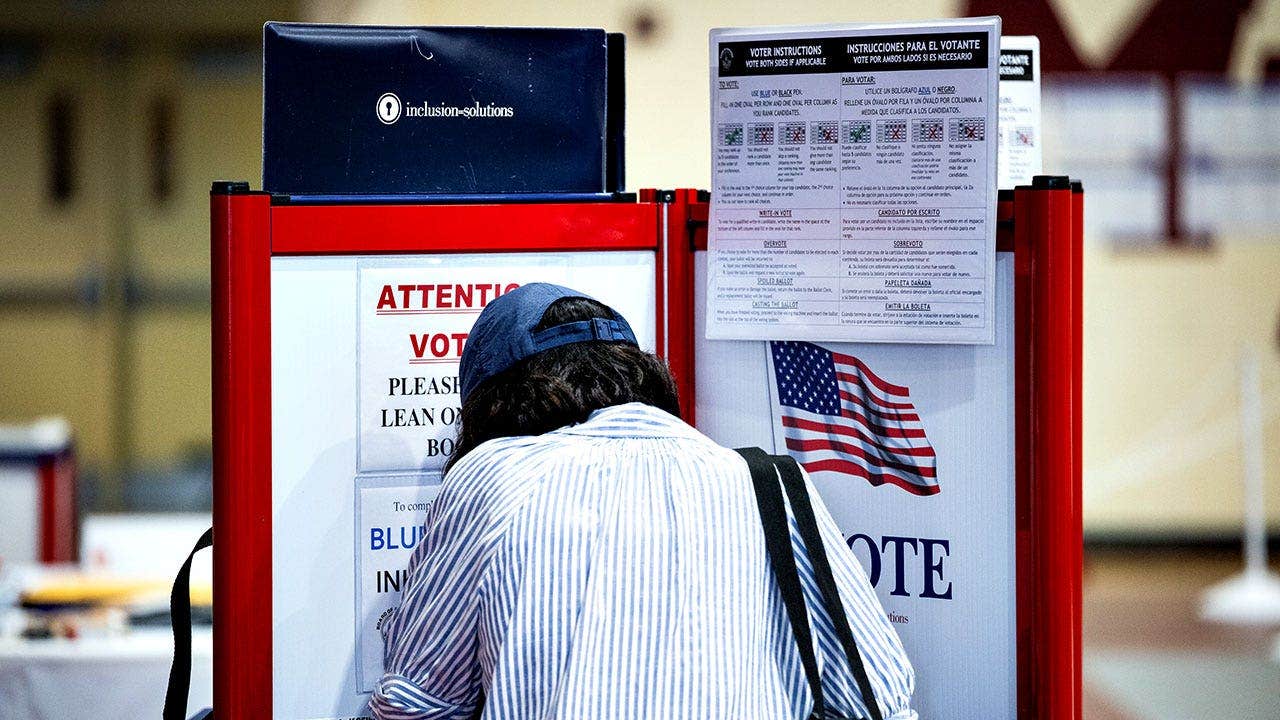
Chicago voters can cast ballots in 12 different languages this election, an expansion that Illinois Republican Party Chairman Bob Grogan warns is making an already complicated election system harder to independently monitor.
Grogan told Digital the proliferation of versions in languages such as Tagalog, Gujarati and Urdu creates additional challenges for election judges and party observers tasked with ensuring voters receive accurate ballots. He also questioned how many voters need some of the translations, arguing that many immigrants who speak those languages also speak English.
«It’s a solution in search of a problem,» Grogan told Digital. «It’s big city virtue signaling.»
TRUMP ADMIN SUED OVER ALLEGED ILLEGAL COLLECTION OF SENSITIVE VOTER DATA FROM 47 STATES
Chicago voters can cast ballots in 12 different languages: English, Spanish, Chinese, Hindi, Korean, Tagalog, Polish, Gujarati, Urdu, Ukrainian, Arabic and Russian.
Section 203 of the U.S. Voting Rights Act requires the Chicago Board of Elections to make materials and ballots available in certain precincts for Spanish, Chinese and Hindi speakers, a spokesperson for the elections agency told Digital. The Board includes the other non-English languages to «maintain uniformity with the languages used by the Cook County Clerk’s office under a county ordinance, so that all voters throughout Cook County are afforded equal voting opportunities,» the spokesperson added.
But Grogan, a former DuPage County auditor for 12 years, said he has «a fair number of Gujarati friends … and everyone in their family speaks English.»
«Gujarati — it’s from India, and English is an official language in India,» Grogan added.
TRUMP ADMIN’S PROPOSED ‘ENGLISH-ONLY’ HEAD START RULE DRAWS FIRE FROM LOS ANGELES MAYORAL CANDIDATE
Data provided to Digital by the Chicago Board of Elections shows that some of the less commonly used language options accounted for only a handful of ballots cast during the March primary. Just nine ballots were cast using the English-Gujarati option, while 15 used English-Urdu, 10 used English-Arabic and 25 each used English-Russian and English-Ukrainian, according to the Board’s figures.
Other translations were used more frequently, including 4,474 English-Polish ballots, 2,183 English-Chinese ballots, 664 English-Hindi ballots, 352 English-Korean ballots and 100 English-Tagalog ballots.
Grogan also questioned why language requirements can change substantially across county lines, noting that Chicago offers touchscreen ballots in 12 languages while nearby DuPage County offers fewer language options.
«You can have a Gujarati population in Peoria,» Grogan said. «You would think that there would be some more uniformity to all of that as well.»
SIGN UP TO GET THE POLITICS NEWSLETTER
Beyond questioning the need for some of the translations, Grogan raised a broader concern about oversight, arguing that election judges and party observers cannot independently scrutinize ballots written in languages they do not understand.
However, the Chicago Board of Elections pushed back, telling Digital that it has in-house staff who help translate ballots and signs and assist multilingual media ahead of elections. It also said voters are allowed to bring «interpreter[s] to assist them in understanding and casting their ballot» under certain conditions.
When asked about multilingual judges, the Board noted that of the 7,218 election judges assigned for November’s general election as of Thursday, 810 are multilingual candidates. Those multilingual judges include speakers of Spanish, Chinese, Hindi, Urdu, Gujarati, Polish, Korean and Tagalog, according to the Board.
Pressed on whether he believes the additional languages create an election security vulnerability, Grogan said the risk depends in part on how widely the translated ballots are used.
Overall, the Board’s figures show 7,857 multilingual ballots were cast during the March primary, representing about 1.85% of the 424,564 ballots cast citywide.
«I think it certainly makes it harder to monitor,» Grogan said. «If there is one ballot cast in that language, that’s a very small vulnerability you have. If all of a sudden we have 10,000 in some very small, poorly understood language, then that increases the risk.»
Digital asked the Chicago Board of Elections how many languages are available for mail-in ballots but did not receive a response in time for publication.
chicago, voter fraud concerns, elections, elections state and local, illinois, politics, elections disputes
INTERNACIONAL
43 years after Beirut terror attack killed 241 Americans, rabbi recalls chaplains’ extraordinary response
NEWYou can now listen to Fox News articles!
Rabbi Arnold Resnicoff never intended to be in Beirut in Lebanon, on Oct. 23, 1983, when suicide bombers drove explosive-laden trucks into Marine Corps barracks, killing 241 American service members. But as Resnicoff told Fox News Digital, his presence during that event and advocacy thereafter would bring solace and support for a multitude of American service members, leading to his strong belief that «a coincidence is just God acting anonymously.»
Tasked to the U.S. Navy’s 6th Fleet, Resnicoff was part of a three-chaplain team supporting service members across 40 ships stationed in the Mediterranean. On Friday, Oct. 21, Resnicoff arrived in Beirut to perform a memorial service for a Jewish Marine who had been killed in the line of duty. Navy leadership wanted to send him back to the boat the following day, but as an observant Jew, he refused to travel on the Sabbath.
IRAN OFFICIAL ADMITS COUNTRY’S ROLE IN TERROR BOMBING THAT KILLED 241 US MILITARY MEMBERS: REPORT
From left to right, Protestant chaplain Danny Wheeler, Rabbi Arnold Resnicoff and Catholic chaplain George Pucciarelli attend the Oct. 21, 1983, memorial service for Jewish Marine Staff Sgt. Allen Soifert two days prior to the terrorist bombing. (Courtesy of Rabbi Arnold Resnicoff)
Resnicoff woke early on the morning of Oct. 23 and was brushing his teeth at 6:22 a.m. when his building began to shake violently. As doors came off their hinges and windows exploded, Resnicoff and others took cover on the floor, believing their building had been hit by a rocket or mortars.
When the ruckus stopped, the men began to hear «these terrible, terrible screams» coming from the building 50 yards away from where Protestant minister Danny Wheeler lived with a host of Marines.
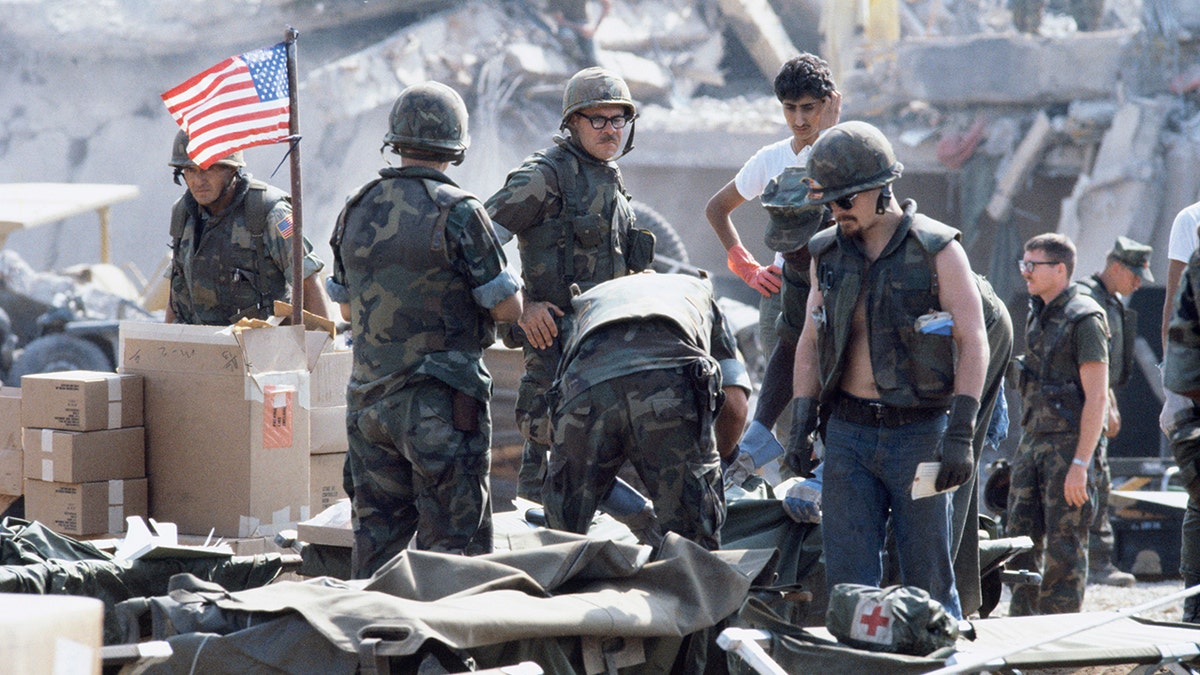
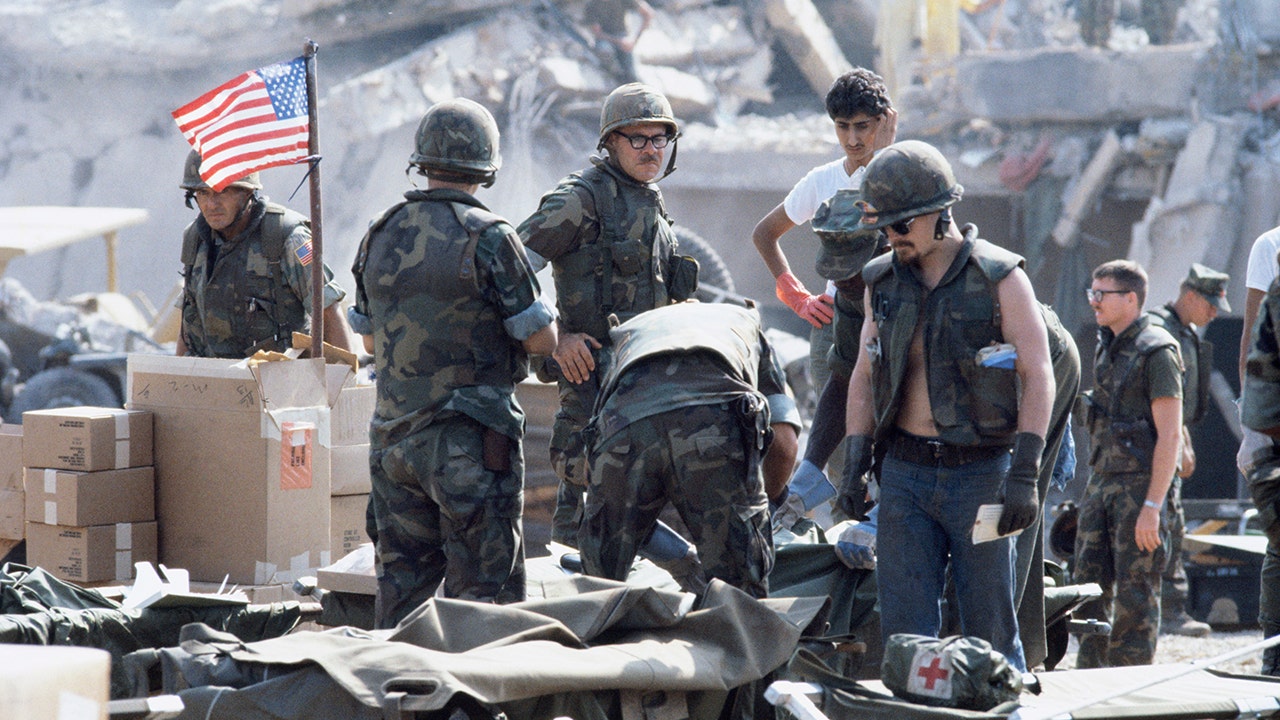
American Marines search for survivors and bodies in the rubble, all that was left of their barracks headquarters in Beirut, after a terrorist suicide car bomb was driven into the building and detonated, killing 241 U.S. servicemen and wounding over 60. The American military was in Beirut as part of a multinational peacekeeping force. (Peter Charlesworth/LightRocket via Getty Images)
Whenever Resnicoff visited Beirut, he alternated staying with a Catholic chaplain, George Pucciarelli, and Wheeler. Based on his schedule, Resnicoff ought to have stayed at Wheeler’s residence on Friday, but chose instead to stay with Pucciarelli, who had something to discuss with the rabbi. «Who knows what it was we talked about,» Resnicoff reminisced. «But that probably saved my life.»
As recognition dawned on those around him, Resnicoff watched Pucciarelli put his purple stole around his neck, «probably because he knew he was going to have to say many last rites.» Pucciarelli looked at Resnicoff and said, «Follow me.»
Outside, Resnicoff said that «the big, four-story building was gone with the smoke.» Buried under the rubble were 241 American service members, including 220 Marines, 18 Navy sailors and three Army soldiers. The Navy casualties included «a complete medical detachment,» leaving no one «trained medically to help those left alive.»
Resnicoff, Pucciarelli and other first responders began working their way through the debris looking for survivors. He said, Pucciarelli «went to one body on the ground, I went to another. We just cradled these wounded men and said, ‘Help is coming.’» Each attended to the men as best they could, ripping apart their clothes to wipe the blood, dirt and dust from their faces. When Resnicoff had torn apart his shirt, he used his Jewish head covering, called a kippah, which soon «got bloody and dirty and lost.»
FROM HOSTAGE CRISIS TO ASSASSINATION PLOTS: IRAN’S NEAR HALF-CENTURY WAR ON AMERICANS
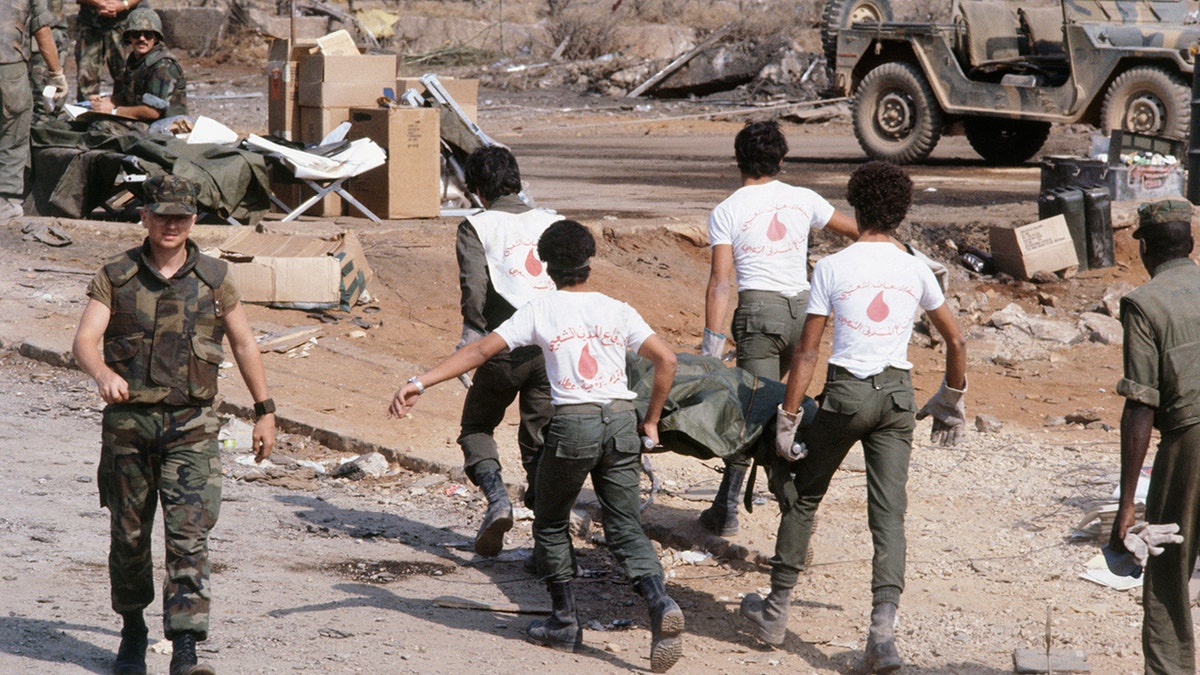
Lebanese volunteer rescue workers carry the body of an American Marine from the rubble of the American Marines Barracks that was attacked by a terrorist truck bomb on Oct. 23, 1983. (Peter Charlesworth/LightRocket via Getty Images)
Eventually, ambulances and helicopters arrived on scene, allowing Pucciarelli and Resnicoff to catch their breaths. Pucciarelli remarked that he had never seen Resnicoff without his head covered. «I told him what happened to my kippah, so he tore a piece of his camouflage uniform and put it on my head.»
Pucciarelli told Resnicoff that, «In this country where every religion is killing every other religion, I want everyone here to remember not only that you and I, the chaplains, were helping everyone regardless of whether they had a religion or what religion they had, but that you and I had different religions [and were] standing together.»
Wheeler was the last living service member to be pulled from the wreckage five hours after the explosion. Resnicoff said that it took four days to dig out the hundreds of bodies buried in the rubble. «These tough Marines were crying, helping their fellow military personnel,» Resnicoff said.
Resnicoff pulled from an element of his own Jewish tradition as he ministered to the Marines mourning and laboring in the wreckage. «After the death, we have a week of family gathering around and telling stories about the person who died,» he explained. «The tradition is if you visit the family during that period, you don’t initiate the conversation, just show your concern and love through your presence, and if the mourners talk to you, then you have a conversation. So, when I would go from Marine to Marine, they were digging up the bodies of their comrades, I used that Jewish approach. I didn’t start the conversation, I just stood next to them to show them I was there, and then if they wanted to talk, I talked.»
Resnicoff said that the tradition hearkened on the words of Catholic friar St. Francis of Assisi, who taught his followers to «preach the gospel everywhere. Use words only if absolutely necessary.»
The Legacy of the Camouflage Kippah
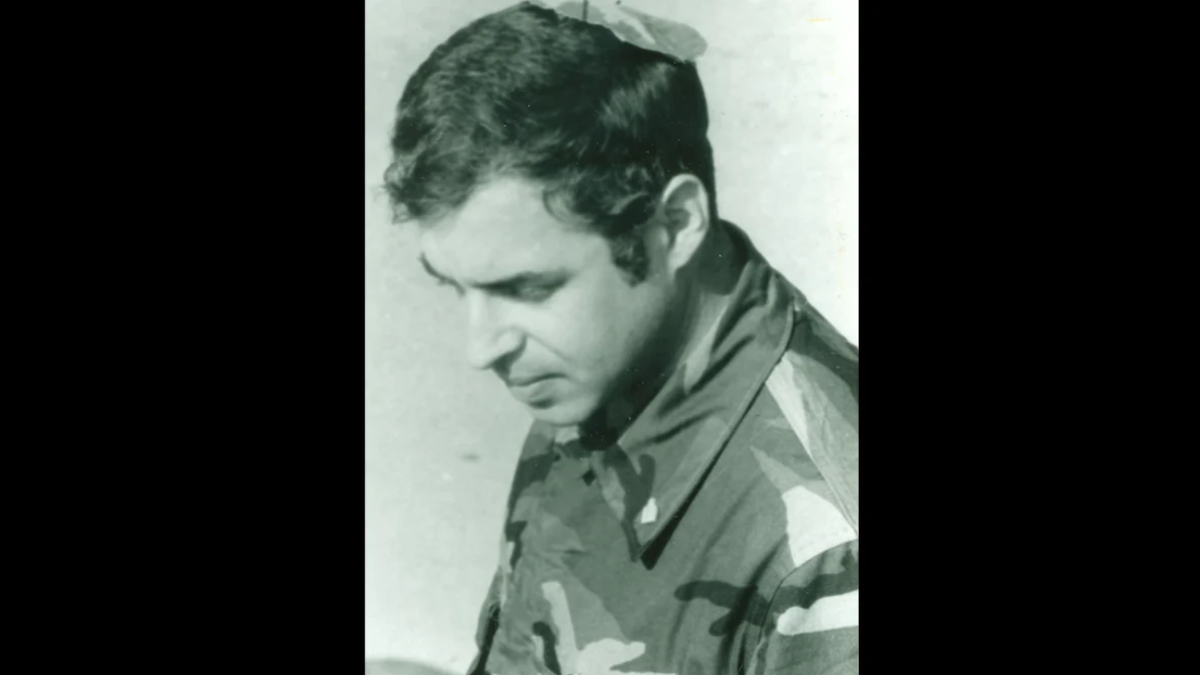
Rabbi Arnold Resnicoff, pictured in his camouflage kippah. (Courtesy of Rabbi Arnold Resnicoff)
Before the Beirut bombing, Resnicoff reported that gaining permission to wear the kippah «was always a struggle» for Jewish service members.
In the early 1980s, Resnicoff says that Congress was debating the Religious Apparel Amendment, which would have allowed Jews serving in the military to cover their heads. «For two years, this amendment had failed. And then, in the Congressional Record, they told the story of this priest making this head covering for me,» Resnicoff said. «The amendment passed. They understood that it was a matter of pride that we could work side by side from different religions. Then-Vice President George H. W. Bush asked Resnicoff to write a report on his experience. Former President Ronald Reagan would share that report with a group of 20,000 Baptists, «who evidently appreciated it,» Resnicoff recalled.
SIGN UP FOR ANTISEMITISM EXPOSED NEWSLETTER
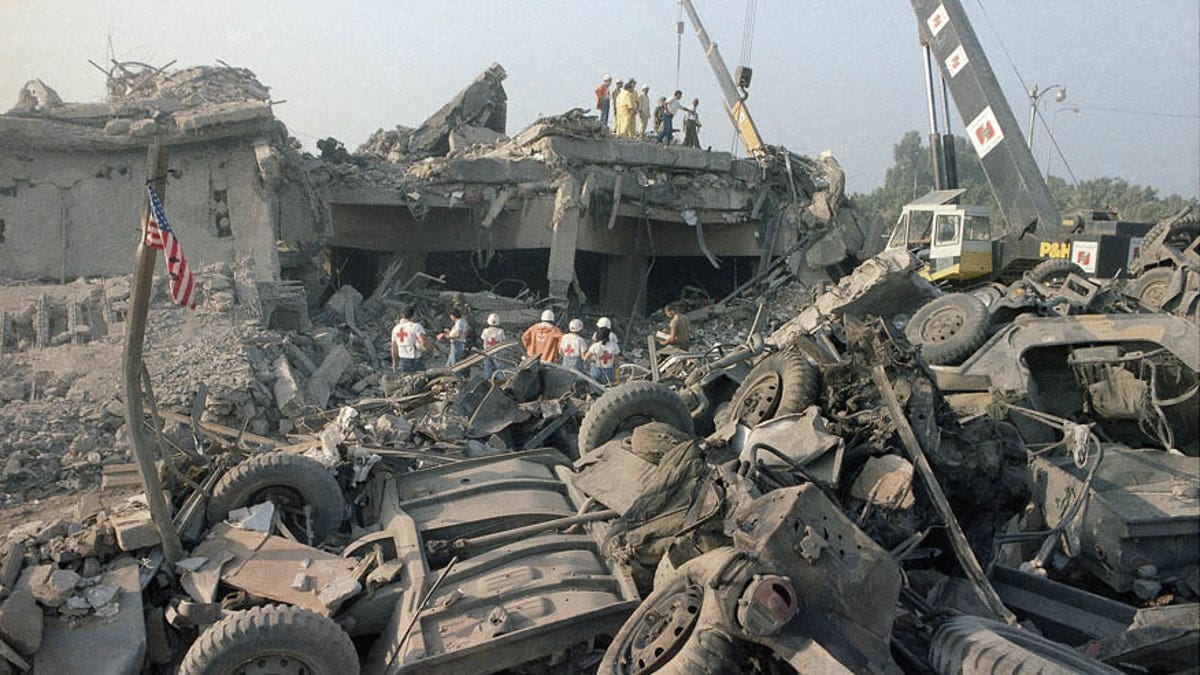
In this Oct. 23, 1983 file photo, the aftermath of the bombing of the U.S. Marines barracks in Beirut, Lebanon. (AP)
In chaplain school, Resnicoff said that chaplains were trained to attend to severely wounded personnel from different religious backgrounds than their own. «But it turned out none of the people I comforted in Beirut asked me a religious question. It was just ‘if I die, tell my mother I love her.’ Most of those Marines were too young to have their own children.» He says that «I was reminded that the role of the chaplain is so much broader and bigger than just being a religious representative.»
«I always used to believe that the military was ahead of the civilian world when it came to understanding and working together. And when you’re in a foxhole or a bunker, you don’t really care if the guy next to you is a Democrat or Republican or independent, you don’t really care what their religion is. You just care that they’re going to protect you like you’re going to protect them and we’re all in this together.»
Resnicoff says that the Beirut bombing showed him that «if the world had more interfaith foxholes, we would have less need for foxholes and more room for faith.»
terrorism, anti semitism, opinion, lebanon
INTERNACIONAL
EXCLUSIVE: Fed timeline challenges reports of migrant baby facing immigration judge alone
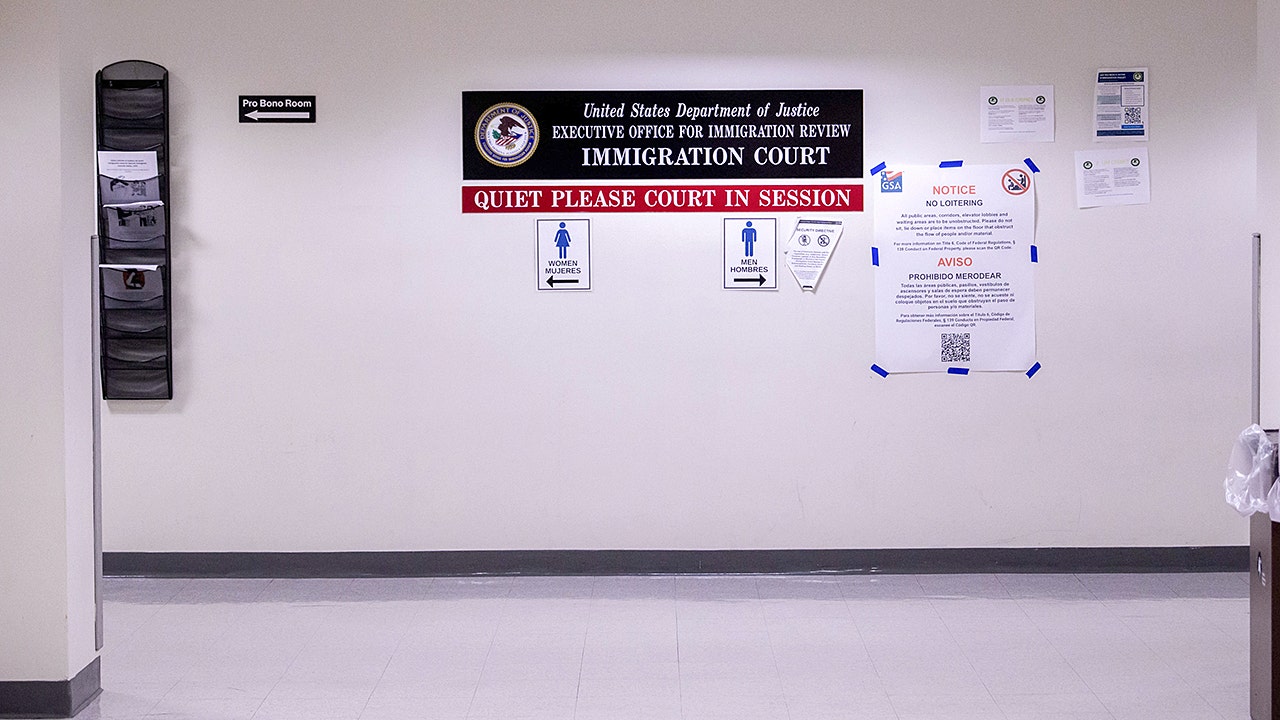
FIRST ON FOX: A federal timeline provided by officials overseeing unaccompanied migrant children challenges reports that a 1-year-old boy was left to navigate immigration court without counsel, showing that legal service providers intervened to secure representation following an initial hearing.
Addressing media reports highlighting toddlers appearing before immigration judges, Office of Refugee Resettlement (ORR) Acting Director Angie Salazar and Senior Advisor John Fabbricatore pushed back on headlines alleging systemic gaps in child legal representation, arguing that contractor failures and lack of invoice oversight created the initial court lapses.
«We don’t have this big movement where we have a bunch of 1-year-olds who are going to court,» Fabbricatore told Digital.
SEX CRIMINALS, GANG MEMBERS ABUSED CHILD IMMIGRATION PROGRAM TO ENTER US, DHS REVEALS
According to ORR timeline records obtained by Digital, U.S. Customs and Border Protection (CBP) officers first encountered the 1-year-old boy and his 17-year-old mother near Naco, Arizona, on June 25. The child was accompanied by his mother at all court proceedings.
The critical gap occurred in July under the agency’s former contractor, the Acacia Center for Justice, records show.
On July 1, Acacia completed legal orientation and consultation for the mother and child, but failed to file an E28 notice of appearance before the immigration court.
Consequently, during the child’s first scheduled court hearing on July 8, no attorney was present — not even as a friend of the court — despite Acacia holding an active federal legal services contract at the time. The federal legal services contract with Acacia officially ended July 31.
FORMER USCIS OFFICIAL, ACCOMPLICE CHARGED IN ALLEGED $960K CITIZENSHIP BRIBERY SCHEME
Following the end of the Acacia contract, the agency transitioned legal service oversight to the U.S. Committee for Refugees and Immigrants (USCRI), which officially initiated legal services Aug. 5. During an Aug. 7 appearance, the mother and child were granted additional time to obtain counsel, while USCRI representatives attended subsequent hearings on Aug. 17 and Aug. 28 as a friend of the court.
On Aug. 31, a motion was filed by the friend of the court and mother requesting court-appointed counsel at government expense, which was later denied by the immigration judge.
Progress continued into September as child advocates were officially appointed on Sept. 23, and USCRI filed a formal E28 notice of appearance on Sept. 25 to become the attorney of record. On Sept. 29, USCRI officially represented both mother and child in immigration court. The judge subsequently granted a continuance on Oct. 2, leading into a follow-up hearing scheduled for Friday.
Officials explained that the July breakdowns highlighted the core reason the administration terminated Acacia’s multimillion-dollar contract, which was awarded under the Biden administration in November 2023. According to federal contract records on USAspending.gov, the Department of Health and Human Services had awarded the Acacia Center for Justice a $356.3 million bridge contract for legal services for unaccompanied children. Of that total award, more than $236.9 million had been outlaid prior to the contract’s dissolution.
The network previously provided counsel to roughly 20,000 migrant children across the U.S., according to its website.
«I knew we were signing off on every invoice that we were receiving for legal services to the tune of $20-plus million sometimes each month,» she told Digital. «So it made no sense to me that legal service providers were saying kids were unrepresented for a lack of funding.»
«I tried to understand who was represented before,» she added. «I tried to understand what we were paying for under this direct representation, but the invoices we received were completely redacted. There is no way I could ever know exactly what service was provided during the month.»
Digital has reached out to the Acacia Center for Justice for comment. The contract funded a slew of services, including legal screenings, representations and presentations on the rights of migrant children in detention.
Following the dissolution of the Acacia contract, the ORR entered into a $20 million contract with USCRI, which expires Dec. 31.
«So USCRI was showing up in court as a friend of the court to ensure that there was at least somebody present in case Acacia did not show up,» Fabbricatore said. «Now, as those cases are being looked at, USCRI is able to go in and actually meet with these children and then represent them in a follow-up hearing. So there may be some hearings where a child shows up, and initially they don’t have representation, but USCRI will be there, identify that child, and then be able to move forward in the future as a representative for that child.»
WOMAN EXPOSED RUNNING VISA FRAUD SCHEME SPANNING YEARS, POSING AS IMMIGRATION OFFICER
Salazar emphasized that ORR officials track which children are represented by which lawyers on specific dates, noting that the agency respects attorney-client privilege.
«The former provider refused to give us those measurables,» Fabbricatore said. «They refused to give us the alien registration number so we could determine what cases they were actually representing. They didn’t want to give that. They refused to give that, and that was a holdup for us because we needed to know who was actually being represented so we can ensure that every kid at least had their legal orientation and had a legal representative that was talking to them.»
HUNDREDS OF JAILED ILLEGAL ALIENS RELEASED BACK ONTO BLUE-STATE STREETS DESPITE ICE DETAINERS, RECORDS SHOW
Salazar noted that about 2% of migrant children in ORR custody are under the age of 5. Another 85% are ages 13 to 17, with 62% falling into the 16-to-17 bracket.
«What we said to our new grantee (USCRI): ‘We want you in 100% of the hearings where kids in our care are showing up to their immigration hearings,’» she said. «That is happening. I think we’re at like 98%.»
Fabbricatore added there are currently 1,690 migrant children in ORR custody.
«Under Biden, they had 22,000 in care a day. So it’s a very vast difference,» he said. «We’ve been able to lower that census, get kids through the court process quicker, and get them back with their parents if possible.»
immigration, illegal immigrants, us, in court, immigrant rights

Milei recibió al vicesecretario de Estado de EE.UU., que había mencionado la preocupación de las empresas por la ley Malvinas

Chicago’s 12-language ballots make elections ‘harder to monitor,’ Illinois GOP chair warns

43 years after Beirut terror attack killed 241 Americans, rabbi recalls chaplains’ extraordinary response

Plan económico de Milei, bajo presión por inflación, empleo y consumo, según Financial Times

Preocupación en Alemania: el entrenador del Bayern Múnich Vincent Kompany se desplomó en la práctica y fue trasladado de urgencia al hospital

Escándalo con Sancor Salud: Cuotas millonarias por un servicio nefasto que abandona a los pacientes en urgencias

El Gobierno pone en marcha un nuevo plan de retiros voluntarios y busca que haya 20.000 empleados menos en el Estado

El Gobierno reconoció que “está bajo análisis” la postura argentina en el Comité de Descolonización de la ONU

Contratar pensando en el futuro: qué cambia en la selección y el liderazgo con la IA en el mercado silver

La joven cantante que provocó la separación de Julieta Prandi y Ortega contó detalles muy íntimos: “Es una persona amorosa y muy…”

 POLITICA10 horas ago
Javier Milei y sus medidas, en vivo: el mandatario dijo que piensa un proyecto a “100 años” para la Argentina
- ECONOMIA2 días ago
Cuáles son las condiciones que enfrentan las pymes para financiarse en el mercado de capitales
- INTERNACIONAL2 días ago
Honduras: DAET niega detenciones de policías tras operativo en San Pedro Sula y alerta sobre posible atentado