INTERNACIONAL
Un jubilado encontró una colección de cartas Pokémon olvidada en el altillo, la subastó y se volvió millonario


Un pintor profesional jubilado se convirtió en millonario después de vender una colección de cartas Pokémon en una subasta que rompió récords en el Reino Unido.
El hombre, que prefirió mantener su identidad en reserva, había guardado los mazos en el altillo de su casa durante 15 años, sin imaginar el tesoro que tenía.
La historia comenzó cuando leyó en el diario local que una sola carta Pokémon se había vendido por más de £6.000 (unos 8000 dólares). Intrigado, decidió revisar la propia colección familiar, que había empezado a reunir a fines de los años 90, cuando su hijo intercambiaba cartas en la escuela. “Sé que siempre se habla de encontrar un tesoro en el altillo, pero en mi caso fue literalmente así”, contó.
El miércoles, la casa de subastas Ewbank’s vendió el lote completo por £1,56 millones (más de dos millones de dólares), en lo que describieron como la subasta de cartas coleccionables más valiosa de la historia británica y posiblemente un récord europeo.
Cartas intactas y sets completos: el secreto del éxito
El hombre había comprado varios sets completos a un vendedor de Malasia a través de eBay, y los conservó en carpetas especiales, selladas y en perfecto estado. Uno de esos sets, que le costó £300 (400 dólares) en su momento, se vendió por £75.000 (US$100.000) en la subasta.
“Pensé que sería más barato comprar la colección completa que seguir comprando sobres sellados con cartas al azar con la esperanza de completarla al abrirlos”, explicó-
Su hijo nunca llegó a tocar esas cartas: “Él tenía las suyas, pero estas las guardé aparte, y por suerte fue así”, comentó el jubilado.
La colección incluía 42 sets en total, todos en condiciones impecables. El lote más destacado fue el Legendary Collection Complete Master Set, que tenía una carta de Charizard casi nueva. Aunque se esperaba que alcanzara entre £15.000 y £20.000, finalmente se vendió por £100.000 (US$134.000).
Un fenómeno global y la fiebre de la nostalgia
La subasta generó un “increíble” entusiasmo, según James Spooner, jefe de trading cards de la caa de subasta Ewbank’s. “Cuando vimos lo que tenía, todo en estado impecable, no lo podíamos creer”, aseguró.
“Cuando descubrimos que tenía 42 juegos de esos, nos quedamos boquiabiertos. Vendimos 41 y él se quedó con uno”, agregó.
El evento atrajo a compradores de todo el mundo y se convirtió en la venta más exitosa de la casa en más de 30 años. Andrew Ewbank, responsable de la subasta, confesó que después del remate necesitó “irse a dormir una siesta” por la intensidad del momento.
“Pensábamos que podría llegar a las 270.000 libras, pero cuando empezaron a llegar las pujas previas a la subasta nos dimos cuenta de que teníamos entre manos algo mucho más importante”, sostuvo Spooner. “El día antes de la subasta ya teníamos 825.000 libras en pujas por encargo”, detalló.
Ewbank explicó que el furor por Pokémon está en auge porque quienes crecieron con la franquicia en los 90 ahora tienen entre 30 y 40 años y mayor poder adquisitivo. “La nostalgia es una parte fundamental. Se trata de revivir esos recuerdos de la infancia”, afirmó.
El récord anterior para una colección de Pokémon en el Reino Unido era de £872.000 (US$1.167.00), alcanzado en octubre en Londres, pero la venta de Woking lo superó ampliamente.
El consejo del subastador: revisar el altillo puede cambiar la vida
El propio Ewbank animó a quienes tengan objetos guardados a revisarlos: “Si compraste algo para tu hijo y no lo quiso, quizás convenga guardarlo, porque nunca se sabe el valor que puede tener en el futuro”.
La historia del jubilado de Woking es un ejemplo de cómo un simple hobby puede transformarse en una fortuna inesperada, gracias a la pasión de los coleccionistas y el poder de la nostalgia.
Reino Unido, pokemón, cartas, Subasta, millonario












INTERNACIONAL
EXCLUSIVE: Fed timeline challenges reports of migrant baby facing immigration judge alone

FIRST ON FOX: A federal timeline provided by officials overseeing unaccompanied migrant children challenges reports that a 1-year-old boy was left to navigate immigration court without counsel, showing that legal service providers intervened to secure representation following an initial hearing.
Addressing media reports highlighting toddlers appearing before immigration judges, Office of Refugee Resettlement (ORR) Acting Director Angie Salazar and Senior Advisor John Fabbricatore pushed back on headlines alleging systemic gaps in child legal representation, arguing that contractor failures and lack of invoice oversight created the initial court lapses.
«We don’t have this big movement where we have a bunch of 1-year-olds who are going to court,» Fabbricatore told Digital.
SEX CRIMINALS, GANG MEMBERS ABUSED CHILD IMMIGRATION PROGRAM TO ENTER US, DHS REVEALS
According to ORR timeline records obtained by Digital, U.S. Customs and Border Protection (CBP) officers first encountered the 1-year-old boy and his 17-year-old mother near Naco, Arizona, on June 25. The child was accompanied by his mother at all court proceedings.
The critical gap occurred in July under the agency’s former contractor, the Acacia Center for Justice, records show.
On July 1, Acacia completed legal orientation and consultation for the mother and child, but failed to file an E28 notice of appearance before the immigration court.
Consequently, during the child’s first scheduled court hearing on July 8, no attorney was present — not even as a friend of the court — despite Acacia holding an active federal legal services contract at the time. The federal legal services contract with Acacia officially ended July 31.
FORMER USCIS OFFICIAL, ACCOMPLICE CHARGED IN ALLEGED $960K CITIZENSHIP BRIBERY SCHEME
Following the end of the Acacia contract, the agency transitioned legal service oversight to the U.S. Committee for Refugees and Immigrants (USCRI), which officially initiated legal services Aug. 5. During an Aug. 7 appearance, the mother and child were granted additional time to obtain counsel, while USCRI representatives attended subsequent hearings on Aug. 17 and Aug. 28 as a friend of the court.
On Aug. 31, a motion was filed by the friend of the court and mother requesting court-appointed counsel at government expense, which was later denied by the immigration judge.
Progress continued into September as child advocates were officially appointed on Sept. 23, and USCRI filed a formal E28 notice of appearance on Sept. 25 to become the attorney of record. On Sept. 29, USCRI officially represented both mother and child in immigration court. The judge subsequently granted a continuance on Oct. 2, leading into a follow-up hearing scheduled for Friday.
Officials explained that the July breakdowns highlighted the core reason the administration terminated Acacia’s multimillion-dollar contract, which was awarded under the Biden administration in November 2023. According to federal contract records on USAspending.gov, the Department of Health and Human Services had awarded the Acacia Center for Justice a $356.3 million bridge contract for legal services for unaccompanied children. Of that total award, more than $236.9 million had been outlaid prior to the contract’s dissolution.
The network previously provided counsel to roughly 20,000 migrant children across the U.S., according to its website.
«I knew we were signing off on every invoice that we were receiving for legal services to the tune of $20-plus million sometimes each month,» she told Digital. «So it made no sense to me that legal service providers were saying kids were unrepresented for a lack of funding.»
«I tried to understand who was represented before,» she added. «I tried to understand what we were paying for under this direct representation, but the invoices we received were completely redacted. There is no way I could ever know exactly what service was provided during the month.»
Digital has reached out to the Acacia Center for Justice for comment. The contract funded a slew of services, including legal screenings, representations and presentations on the rights of migrant children in detention.
Following the dissolution of the Acacia contract, the ORR entered into a $20 million contract with USCRI, which expires Dec. 31.
«So USCRI was showing up in court as a friend of the court to ensure that there was at least somebody present in case Acacia did not show up,» Fabbricatore said. «Now, as those cases are being looked at, USCRI is able to go in and actually meet with these children and then represent them in a follow-up hearing. So there may be some hearings where a child shows up, and initially they don’t have representation, but USCRI will be there, identify that child, and then be able to move forward in the future as a representative for that child.»
WOMAN EXPOSED RUNNING VISA FRAUD SCHEME SPANNING YEARS, POSING AS IMMIGRATION OFFICER
Salazar emphasized that ORR officials track which children are represented by which lawyers on specific dates, noting that the agency respects attorney-client privilege.
«The former provider refused to give us those measurables,» Fabbricatore said. «They refused to give us the alien registration number so we could determine what cases they were actually representing. They didn’t want to give that. They refused to give that, and that was a holdup for us because we needed to know who was actually being represented so we can ensure that every kid at least had their legal orientation and had a legal representative that was talking to them.»
HUNDREDS OF JAILED ILLEGAL ALIENS RELEASED BACK ONTO BLUE-STATE STREETS DESPITE ICE DETAINERS, RECORDS SHOW
Salazar noted that about 2% of migrant children in ORR custody are under the age of 5. Another 85% are ages 13 to 17, with 62% falling into the 16-to-17 bracket.
«What we said to our new grantee (USCRI): ‘We want you in 100% of the hearings where kids in our care are showing up to their immigration hearings,’» she said. «That is happening. I think we’re at like 98%.»
Fabbricatore added there are currently 1,690 migrant children in ORR custody.
«Under Biden, they had 22,000 in care a day. So it’s a very vast difference,» he said. «We’ve been able to lower that census, get kids through the court process quicker, and get them back with their parents if possible.»
immigration, illegal immigrants, us, in court, immigrant rights
INTERNACIONAL
Serbia’s longtime leader faces biggest political test as students mount election challenge

NEWYou can now listen to Fox News articles!
Serbian President Aleksandar Vucic resigned from the presidency in September and is running for prime minister in parliamentary elections considered to be one of the most competitive elections for Serbia in recent memory.
«I think this is certainly the biggest challenge for the former President in his 14-year rule,» Helena Ivanov, associate fellow at the Henry Jackson Society, told Fox News Digital.
«The student protesters have been able to capture the hearts and minds of people and keep the momentum going in a way that the established opposition was never able to do,» Ivanov added.
ANTI‑CORRUPTION PROTESTS HIT EUROPEAN NATION AS CALLS FOR NEW ELECTIONS GROW
Serbia’s former president and the ruling Serbian Progressive Party (SNS) candidate for prime minister, Aleksandar Vucic, gestures during a pre-election rally at King Milan Square in Nis, Serbia, Oct. 21, 2026. (Djordje Kojadinovic/Reuters)
Serbian Foreign Minister Marko Djuric told Fox News Digital that he believes the student opposition is highly unlikely to win.
«The people of Serbia have seen through them: years of criticism have not persuaded the public that they have a credible program or a serious plan for the country’s future,» the foreign minister said.
Djuric touted Serbia’s economy under Vucic and the Strategic Dialogue with the U.S., which he said will foster greater cooperation and new opportunities for Serbs.
In an exclusive interview with Fox News Digital in June when he was still president, Vucic pointed to the country’s economic growth as evidence of its transformation. «Our GDP was 32 billion (euros) when I became the prime minister,» Vucic said. «This year it’s going to be over 100 billion euros, which is $120 billion.» Vucic first became prime minister in 2014 and president in 2017.
In that same interview, he said the improving relationship between Washington and Belgrade was increasingly centered on economics, investment and technological cooperation and mutual conservative values.
A bipartisan group of senators led by Sen. Chuck Grassley, R-Iowa., and Sen. Richard Blumenthal, D-Conn., introduced the Supporting the Rule of Law, Building Institutional Justice, and Accountability Act (SRBIJA) to address democratic backsliding in Serbia, promote the rule of law and accountability and improve the treatment of student-led civic protests.
Most importantly, the legislation would condition future aid on a presidential certification that Serbia made «significant and sustained» efforts toward judicial accountability, press freedom and alignment with the EU and NATO.
The bipartisan group of lawmakers, which also included Rep. Joe Wilson, R-S.C., and Rep. William Keating, D-Mass., took aim at President Vucic and his time in power.
EXCLUSIVE: SERBIAN PRESIDENT VUČIĆ SAYS SUPPORT FOR US ‘SURGED’ UNDER TRUMP, INVITES HIM TO VISIT BELGRADE

People walk on a bridge with a huge poster of Serbia’s former president and the ruling Serbian Progressive Party (SNS) candidate for prime minister, Aleksandar Vucic, on it in Nis, Serbia, Oct. 10, 2026. (Marko Djurica/Reuters)
There are growing concerns from Congress and observers that the election will take place in a hostile environment and efforts to discredit and undermine the election are already underway.
Others fear the current government might not respect the outcome of the election if the Student List were to win.
Vucic had served as president of Serbia since 2017 and previously as prime minister from 2014 to 2017, but was term limited under the constitution. His exit from the presidency created the opportunity for him to remain in power by returning as prime minister.
Vucic resigned from the presidency and dissolved parliament in September, setting the stage for the snap election on Oct. 25.
As president, analysts say he has always straddled the geopolitical line between East and West, seeking European legitimacy and launching EU accession talks in 2014 while also maintaining close ties with Russian President Vladimir Putin even after the full-scale invasion of Ukraine in 2022.
Unlike previous elections, the student-led opposition garnered significant attention to their cause and mobilized popular support, becoming a legitimate political contender out of a spontaneous protest movement.
Serbia has been roiled by student-led anti-corruption protests since November 2024, demanding justice and accountability after the deaths of 16 people following the collapse of a railway station in the town of Novi Sad. One of the largest protests in Serbia’s history took place on March 15, 2025, with nearly 350,000 people gathered in Slavija Square in central Belgrade.
ZELENSKYY WARNS RUSSIA WANTS TO CAUSE ‘EXPLOSION’ IN THE BALKANS

Students walk on the road towards the northern city of Novi Sad, where they will participate in a 24-hour block of three bridges to protest the deaths of 15 people killed in the November collapse of a train station canopy, near the Belgrade suburb of Batajnica, Serbia, Thursday, Jan. 30, 2025. (AP Photo/Darko Vojinovic)
The protesters criticized the Vucic government for failing to hold anyone accountable for the canopy disaster as the government continued its heavy-handed crackdown on demonstrators. None of the original demands of the protesters were met, so the students turned to electoral politics to enact change the Serbian political opposition was never able to achieve.
The Student List, as the opposition is known, consists of a wide swath of civil society actors, many of whom come from the ranks of academia, but does not include anyone from Serbia’s traditional opposition parties that struggled to challenge Vucic and his ruling Serbian Progressive Party in the past.
The group operates in a decentralized manner and does not have an official leader. Their main priorities are to tackle corruption and promote transparency and the rule of law.
Filip Ubović, a student from the University of Belgrade and protest participant on the ground in Belgrade, has spoken with Fox News Digital over the course of the year-long protests.
SERBIA, CAUGHT BETWEEN EUROPE AND RUSSIA, COULD MOVE ONE STEP CLOSER TO NORMALIZING RELATIONS WITH KOSOVO

Ilija Srdanovic, first on the electoral list «Student List — Students Win» waves to citizens as they welcome students who walked to the capital from different parts of the country a day before their final campaign rally in Belgrade, Serbia, Oct. 21, 2026. (Marko Djurica/Reuters)
Ubović said he joined the protests because he was fed up with the current state of his country. This was the first opportunity, Ubovic said, to do something tangible, instead of just complaining.
«People had enough for quite some time but decided to fully embrace us because we are ‘their kids’, we are young, we are not professional politicians, we do not have a single face representing us, and we are very professional and principled,» Ubovic said.
Ivana Stradner of the Foundation for Defense of Democracies told Fox News Digital that corruption has held back democracy in the Balkans and progress for its people for a while.
«Corruption doesn’t just steal public money; it steals an entire generation’s future. Young people in Serbia and Albania are taking to the streets demanding accountability and a better future. The U.S. should pay attention, not out of charity, but strategic self-interest,» Stradner said.
‘VOTERS GET TO CHOOSE — JUST NOT THE RESULT’: RUSSIA’S PARLIAMENTARY ELECTION REACHES OCCUPIED UKRAINE

Parliamentary candidates on the «Student List — Students Win» student list attend a final campaign rally in Belgrade, Serbia, Oct. 22, 2026. (Djordje Kojadinovic/Reuters)
The test will be whether the Student List can transition their popular mobilization in the streets into a viable political option that can win an election and govern a country that hasn’t undergone a political transition in over a decade.
It’s also unclear, if the Student List were to win, how they might reorient Serbia’s foreign policy and its relations with the U.S.
«So far, the students have been remarkably reluctant to define foreign policy goals that would depart from the current government’s course. For now, the most realistic expectation is continuity,» Sinisa Vukovic, director of the Global Policy Program at the School of Advanced International Studies at Johns Hopkins University, told Fox News Digital.
Vuković said that Serbia’s foreign policy has remained mostly consistent dating back to Slobodan Milosevic, the former leader of Yugoslavia, and the Vucic government has left hot-button issues including the crisis over Kosovo and EU membership mostly unresolved.
While much might change in Serbia domestically, any resolution to the conflict with Kosovo or any substantial reorientation of foreign policy that shifts Serbia away from Russia and moves it much closer to the U.S. and EU remains unclear.
«Another period of pseudo-hedging is likely, with Russia keeping a deep presence in the most vital sectors and dominating most of them,» Vukovic added.
world elections, the balkans, world protests, europe, russia

La imagen clásica de la Tierra como una esfera casi perfecta es apenas una aproximación. El planeta está achatado en los polos y ensanchado en el ecuador por efecto de su rotación. Ahora, un estudio basado en mediciones satelitales detectó que el cambio climático está modificando lentamente la forma de la Tierra sólida: los polos se elevan, mientras que la región ecuatorial registra un hundimiento relativo.
La variación es imperceptible para la vida cotidiana y se mide en milímetros por año. Sin embargo, permite observar desde el espacio cómo el deshielo de Groenlandia y la Antártida, junto con el desplazamiento de enormes masas de agua, afecta a la estructura física del planeta.
Para un país como Argentina, con una extensa costa atlántica, territorios australes y una presencia histórica en la Antártida, el hallazgo suma una nueva dimensión al impacto global de la crisis climática.
La investigación fue elaborada por Christoforos Kotsakis, profesor de Geodesia de la Universidad Aristóteles de Tesalónica, en Grecia, y publicada en la revista científica Journal of Geophysical Research: Solid Earth. El trabajo reconstruyó cambios en la geometría terrestre a partir de registros obtenidos entre 1997 y 2015.
Los polos se elevaron y el ecuador se contrajo a un ritmo de milímetros

La Tierra no es una esfera: su diámetro ecuatorial es mayor que el que une ambos polos. Esa diferencia responde, entre otros factores, a la fuerza centrífuga generada por la rotación planetaria. Pero esa configuración no permanece fija. La distribución de masas de hielo, agua, océanos y rocas puede alterar muy lentamente la forma del planeta.
El estudio analizó la velocidad vertical de cientos de estaciones del Sistema Global de Navegación por Satélite, conocido como GNSS, distribuidas en distintas regiones del mundo. Con esos datos, el investigador estimó cuánto se mueve hacia arriba o hacia abajo la superficie de la Tierra sólida a gran escala.
Los resultados mostraron que la elevación de las zonas polares pasó de unos 0,5 milímetros por año a casi 1 milímetro anual entre fines de la década de 1990 y el período 2011-2015. En paralelo, las regiones cercanas al ecuador exhibieron una subsidencia, o descenso, de una magnitud similar.
La combinación de ambos procesos indica que la parte sólida del planeta pierde parte de su achatamiento polar. Se vuelve levemente más redonda. El trabajo calculó que el cambio se aceleró a un ritmo cercano a 0,4 milímetros por año por década.
Se trata de un efecto diminuto frente a los 12.756 kilómetros de diámetro ecuatorial terrestre. Aun así, las mediciones permiten identificar una señal global consistente, que supera la esperada solamente por procesos geológicos de largo plazo vinculados al final de la última glaciación.
El deshielo polar redistribuye peso sobre la corteza terrestre
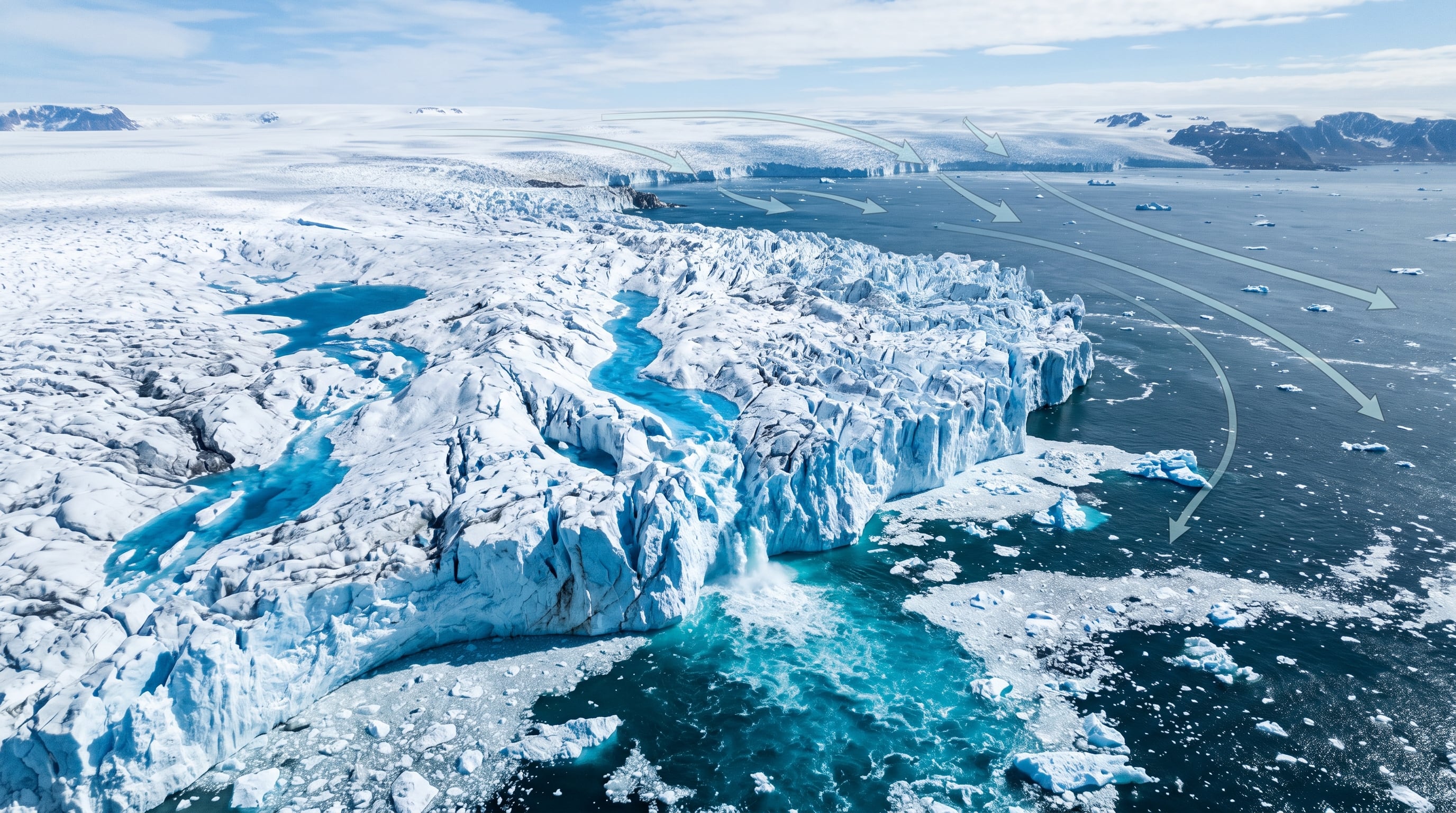
La explicación central está en la pérdida de hielo de Groenlandia y la Antártida. Cuando las capas de hielo se derriten, disminuye el peso que ejercían sobre la corteza en las altas latitudes. Como respuesta, el terreno puede elevarse gradualmente, un fenómeno comparable a la recuperación de un colchón después de retirar un objeto pesado.
A la vez, el agua procedente del deshielo se redistribuye en los océanos. Una parte de esa masa se desplaza hacia latitudes más bajas, donde incrementa la presión sobre el fondo oceánico y favorece el descenso de la superficie sólida en la zona ecuatorial.
El estudio señala que el levantamiento polar y la contracción ecuatorial registrados por las estaciones GNSS son mayores que los que cabría esperar solo por el denominado ajuste isostático glacial. Ese proceso describe la recuperación lenta de la corteza tras el retroceso de las grandes masas de hielo que cubrieron parte del hemisferio norte durante la última edad de hielo.
Por eso, Kotsakis atribuye una parte relevante de la aceleración detectada a procesos contemporáneos, en especial a la pérdida de masa helada y al traslado del agua desde las regiones polares. De todos modos, aclara que también pueden intervenir otros factores de escala planetaria, como movimientos internos del manto, variaciones en el almacenamiento de agua continental y cambios en la rotación terrestre.
La Tierra sólida y los océanos no cambian de forma de la misma manera

El hallazgo puede generar una aparente contradicción. Si la Tierra sólida se vuelve menos achatada, ¿por qué algunas mediciones del campo gravitatorio indican que el planeta se aplana más en conjunto?
La respuesta está en distinguir entre la forma de la superficie rocosa y la distribución total de la masa terrestre. La investigación se concentró en la deformación de la corteza y el manto. En ese componente, los polos se elevan y la zona ecuatorial se contrae, lo que reduce el achatamiento.
Pero cuando se incorporan los océanos, la situación cambia. El agua que sale de las capas de hielo polares se redistribuye y tiende a aumentar el abultamiento ecuatorial. En consecuencia, el planeta considerado como un sistema completo, con océanos incluidos, puede mostrar una evolución distinta a la observada en la Tierra sólida.
El estudio no plantea que la Tierra se haya transformado en una esfera perfecta ni que esa metamorfosis vaya a ser visible en el corto plazo. Lo que detecta es una modificación gradual en la relación entre las zonas polares y ecuatoriales, suficiente para ser medida con instrumentos geodésicos de alta precisión.
Los científicos contrastaron las observaciones de GNSS con estimaciones del campo gravitatorio y con modelos de ajuste isostático glacial. Las diferentes técnicas no arrojan valores idénticos porque miden aspectos distintos: una sigue los desplazamientos físicos del suelo y otra registra cómo se reorganiza la masa del sistema terrestre.
Una medición que amplía el mapa de los efectos climáticos

El impacto del calentamiento global suele expresarse mediante imágenes de glaciares en retroceso, olas de calor, incendios, sequías e inundaciones. La nueva investigación incorpora una escala menos evidente: la respuesta de la estructura terrestre a la pérdida de hielo y al movimiento de agua alrededor del planeta.
En el caso argentino, la cuestión conecta con fenómenos que ya forman parte de la agenda climática y científica nacional. El retroceso de glaciares patagónicos, el monitoreo de las bases en la Antártida y la vulnerabilidad de las ciudades costeras ante el ascenso del nivel del mar forman parte de un mismo sistema global de redistribución de hielo y agua.
La evidencia disponible no permite usar esta variación de milímetros como un indicador aislado de los efectos que tendrá el cambio climático en cada región. Sí ofrece una herramienta adicional para seguir el comportamiento del planeta y mejorar los modelos que estudian la evolución de las masas de hielo, los océanos y el nivel del mar.
El trabajo analizó información hasta 2015 y plantea que una mayor cobertura de estaciones GNSS, en especial en áreas polares y oceánicas, permitirá precisar las estimaciones en los próximos años. Esa mejora será relevante para separar con mayor exactitud la influencia del deshielo actual de otros procesos geológicos y oceánicos que también moldean, milímetro a milímetro, la figura de la Tierra.
Tierra,Ártico,espacio exterior,hemisferio norte,ilustración científica

El día que Juan Román Riquelme jugó desgarrado la Copa Libertadores y le dio la clasificación a Boca Juniors

El sentido mensaje que Antonela Roccuzzo le dedicó a Lionel Messi tras ser distinguido con el Premio Princesa de Asturias: “Es un reconocimiento a tus valores”

Agustín Sullivan y el desafío de interpretar a Carlos Menem Jr. en dos series distintas: “Nunca busqué imitarlo”

El mercado alerta que solo un repunte extraordinario salvará a la economía de la recesión

¿Qué pasa si el Canal de Panamá se queda sin agua?

Javier Milei recibió a Christopher Landau en Casa Rosada tras acordar cambios en la ley sobre Malvinas

El Gobierno pone en marcha un nuevo plan de retiros voluntarios y busca que haya 20.000 empleados menos en el Estado

Alerta roja en Sudamérica por el Súper Niño: cambio climático, inundaciones extremas y el hallazgo de microplásticos y metales en el granizo

El Gobierno reconoció que “está bajo análisis” la postura argentina en el Comité de Descolonización de la ONU

Contratar pensando en el futuro: qué cambia en la selección y el liderazgo con la IA en el mercado silver

 POLITICA9 horas ago
Javier Milei y sus medidas, en vivo: el mandatario dijo que piensa un proyecto a “100 años” para la Argentina
- ECONOMIA2 días ago
Cuáles son las condiciones que enfrentan las pymes para financiarse en el mercado de capitales
- INTERNACIONAL2 días ago
Honduras: DAET niega detenciones de policías tras operativo en San Pedro Sula y alerta sobre posible atentado