INTERNACIONAL
Estados Unidos: la Fed mantiene las tasas de interés sin cambios, pero cuatro funcionarios discrepan

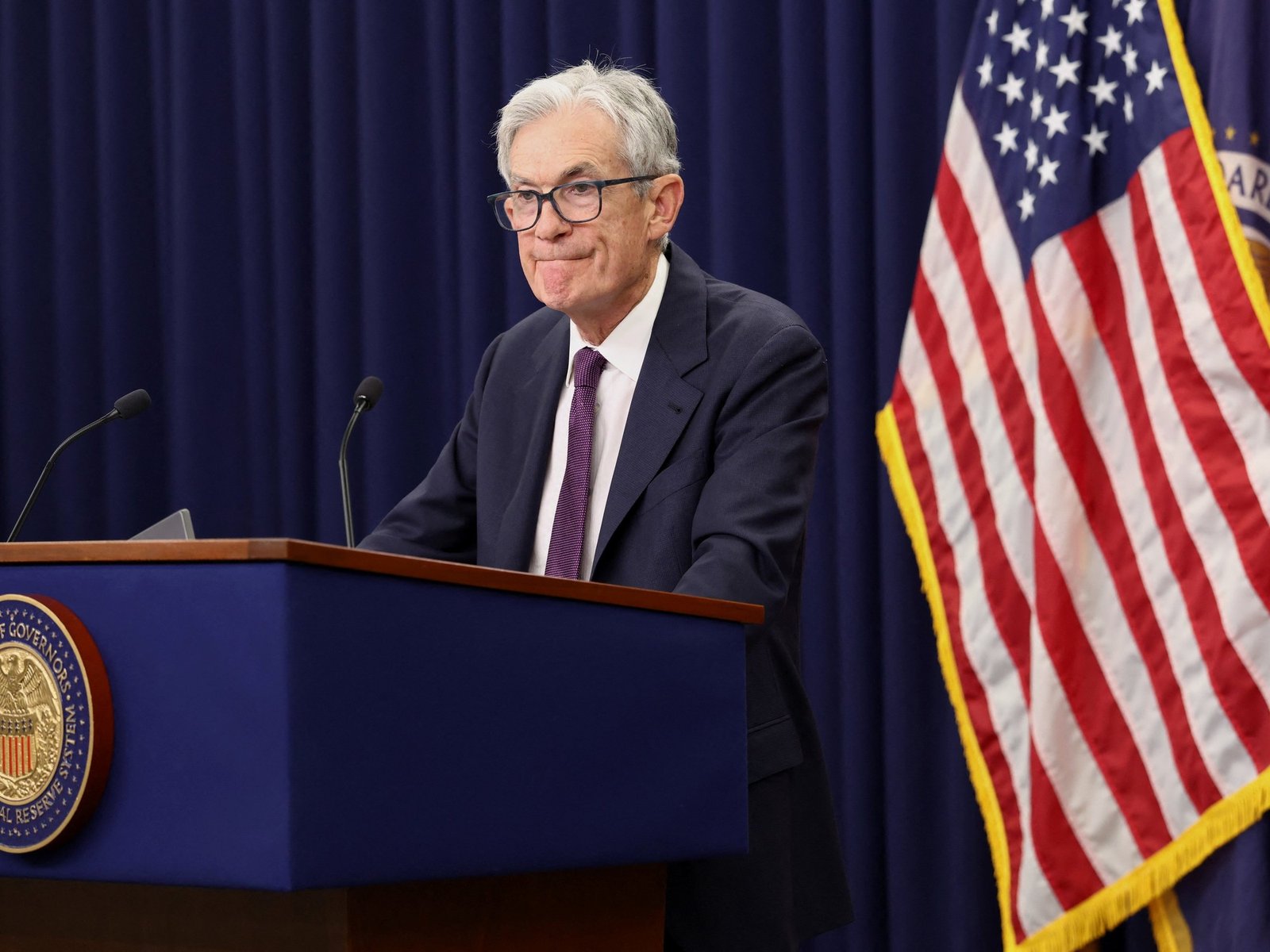
La Reserva Federal dejó este miércoles sin cambios su tasa de interés de referencia por tercera reunión consecutiva, pero señaló que aún podría recortar las tasas en los próximos meses, decisiones que atrajeron la mayor cantidad de disensos desde octubre de 1992.
Poco después del anuncio, presidente del banco central estadounidense, Jerome Powell, anunció que planea permanecer en la junta de la institución después de que su mandato termine el próximo mes “por un período de tiempo indeterminado”. Citó como motivo para quedarse las recientes acciones legales emprendidas por el gobierno de Trump contra la Fed.
El banco central mantuvo su tasa de corto plazo en 3,6% y conservó en su comunicado un lenguaje que sugiere que el próximo movimiento sería una reducción. Tres funcionarios discreparon a favor de eliminar la referencia a un recorte futuro, mientras que un cuarto, Stephen Miran, discrepó a favor de un recorte inmediato de tasas.
Los disensos subrayan el nivel de división en el comité de 12 miembros que fija las tasas, antes de la salida del presidente Jerome Powell, cuyo mandato termina el 15 de mayo. Horas antes el miércoles, una comisión del Senado había aprobado mandar al pleno de esa instancia la votación sobre si Kevin Warsh debe ser el próximo director de la institución.
“Los acontecimientos en Oriente Medio están contribuyendo a un alto nivel de incertidumbre sobre las perspectivas económicas”, señaló la institución en un comunicado tras su reunión de dos días. “La inflación está elevada, en parte reflejando el reciente aumento de los precios mundiales de la energía”.
Warsh ha prometido un “cambio de régimen” en el banco central y podría introducir cambios radicales en sus modelos económicos, sus estrategias de comunicación y su balance, pero probablemente le resulte más difícil implementar los recortes de tasas que busca el presidente Donald Trump con una inflación por encima de 3%, superior al objetivo de 2% de la Fed.
Los tres funcionarios que discreparon contra la posibilidad de reducir las tasas en el futuro fueron Beth Hammack, presidenta del Banco de la Reserva Federal de Cleveland; Neel Kashkari, presidente de la Fed de Minneapolis y Lorie Logan, presidenta de la Fed de Dallas. Miran fue nombrado para la junta de la Fed en Washington por Trump el pasado septiembre. Históricamente, los presidentes de los bancos regionales de la Fed han sido más propensos a discrepar, mientras que los gobernadores con sede en Washington suelen respaldar al director de la institución.
Los disensos podrían renovar la tensión entre la administración Trump y los dirigentes bancarios a quienes funcionarios de la Casa Blanca han criticado previamente.
Es probable que esta fue la última reunión de Powell como director del banco. En unas horas ofrecerá una conferencia de prensa y ahí podría decir si permanecerá en la junta de gobernadores incluso después de que su mandato como presidente termine el 15 de mayo. Powell cumple un mandato separado como gobernador que se extiende hasta enero de 2028. Los presidentes normalmente dejan la junta cuando terminan sus mandatos de liderazgo, pero Powell ha señalado que podría permanecer. Sería el primer presidente en hacerlo desde 1948.
Si Powell, quien ha hecho de proteger la independencia de la Fed una parte clave de su legado, elige quedarse, le impediría a Trump elegir a su reemplazo y llenar otro puesto en la junta de siete miembros. Tres de los siete gobernadores actuales son designados por Trump.
Al mismo tiempo, podría empeorar las tensiones con la administración Trump y crearía lo que algunos analistas denominan un escenario de “dos papas”, con un presidente y un expresidente ambos en la junta. En ese caso, las divisiones entre los responsables podrían aumentar, si algunos decidieran seguir el liderazgo de Powell en lugar del de Warsh.
La turbulencia en la Reserva Federal llega mientras la economía sigue bajo circunstancias difíciles, poniendo al banco central en una situación difícil. La inflación ha saltado a 3,3%, un máximo de dos años, mientras la guerra hace subir los precios de la gasolina. Eso le dificulta al banco central reducir las tasas. La Fed normalmente deja las tasas sin cambios, o incluso las eleva, si la inflación está empeorando.
Al mismo tiempo, la contratación se ha frenado casi totalmente, dejando a quienes no tienen empleo frustrados por la dificultad de encontrar nuevos trabajos. Por lo general, la Fed recorta las tasas cuando el mercado laboral es débil, para impulsar el gasto y el empleo.
Pero los despidos también siguen siendo bajos, mientras empleadores parecen estar siguiendo una estrategia de “ni contratamos ni despedimos». Muchos funcionarios de la Fed han sugerido que mientras el desempleo esté bajo, el banco central no necesita recortar las tasas para impulsar el gasto y la contratación. El desempleo bajó a 4,3% en marzo, desde 4,4%.

INTERNACIONAL
Los supermercados municipales de Zohran Mamdani con 30% de descuento están destinados al fracaso: la lección de MERCAL en Venezuela, los fantasmas de Detroit y la Nueva York de 1975

El presupuesto de los $125.800 millones de dólares: parches, recortes y la «herencia pesada»

El espejo de MERCAL y la anatomía del colapso venezolano


¿Por qué Nueva York no es Venezuela? Diferencias y la visión de la diáspora venezolana


Los antecedentes urbanos: la «Vía Detroit» y la crisis de Nueva York de 1975


De México a la India: el fracaso de los subsidios al abasto en modelos internacionales


Las señales de alerta financiera en el mercado de 2026 para Nueva York

INTERNACIONAL
Deadly French wildfires threaten missile plants, nuclear sites as fourth heatwave looms
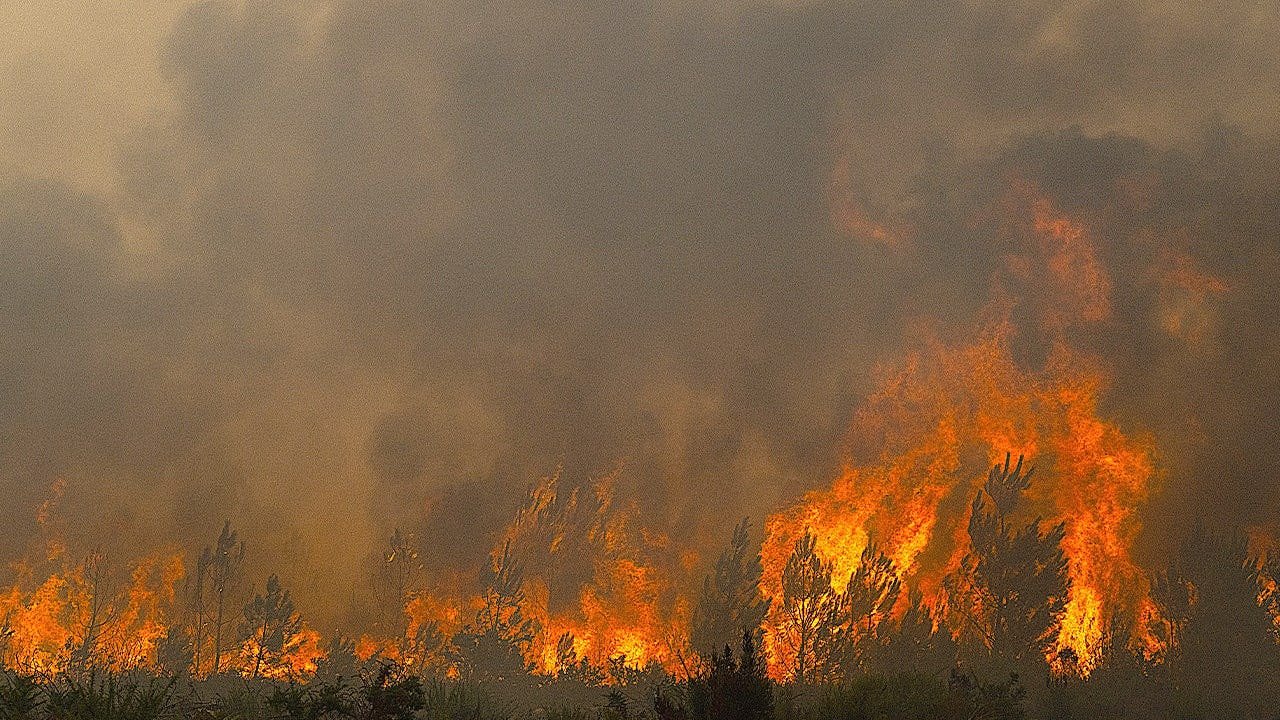
European wildfires force more than 250K evacuations across Spain, France
Wildfires are sweeping across Spain and France, forcing more than 250,000 people to evacuate. One blaze is threatening France’s famed Bordeaux wine region, while Spain has declared a national emergency. France has deployed the military, and the Tour de France has been shortened as firefighters battle the massive blazes.
NEWYou can now listen to Fox News articles!
Massive wildfires sweeping through southwestern France are threatening key defense and nuclear sites near Bordeaux, forcing evacuations and emergency measures at missile factories, military research facilities and aerospace plants, according to reports.
The escalating blazes come as France braces for its fourth major heat wave of the year Tuesday, with soaring temperatures and arid conditions increasing pressure on crews battling massive wildfires near Bordeaux, according to Reuters.
Temperatures in the French region were forecast to reach 91 degrees Fahrenheit (33 degrees Celsius), about 13 degrees (7 degrees Celsius) above normal, according to the Reuters Climate Monitor.
EUROPE’S FIRES REVEAL DEADLY MIX OF RECORD HEAT, HUMAN ERROR, ARSON AND LAND MISMANAGEMENT
Wildfires sweeping through southwestern France are threatening some of the country’s most sensitive defense and nuclear facilities. (JULIEN DE ROSA / AFP via Getty)
«The situation we are dealing with today is the most severe we have ever recorded, the toughest since the Second World War,» President Emmanuel Macron, who flew to the area, had said Sunday.
French Economy Minister Roland Lescure said the fires have disrupted more than 13,000 businesses in the Gironde region, with many forced to close or evacuate.
According to The Telegraph, the fires are closing in on missile and rocket factories that store explosive materials.
At least seven sites holding hazardous substances are within 12 miles of the blaze.
FRANCE RECORDS MORE THAN 5,700 EXCESS DEATHS DURING HISTORIC EARLY SUMMER HEAT WAVE
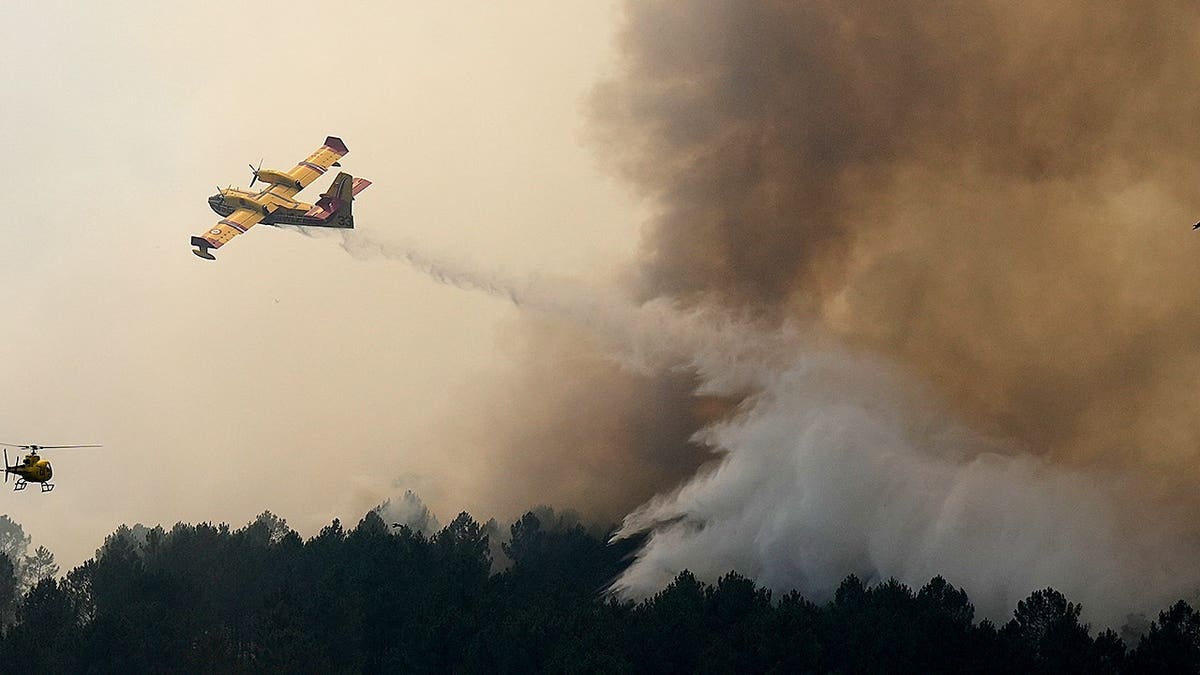
France’s Defense Ministry also said 1,500 military personnel have been deployed since July 25 to support firefighting operations and help secure strategic industrial sites. ((AP Photo/Baz Ratner, Pool))
Saint-Médard-en-Jalles, to the west-northwest, is one of the evacuated towns and is home to a large factory that produces propellants for Ariane space rockets and France’s strategic missiles.
A nearby plant in Sainte-Hélène also produces ammonium perchlorate, a key oxidizer used in solid rocket propellants.
According to Defense News, the fires are also threatening factories that make key parts for France’s nuclear missiles, Rafale fighter jets and military missiles.
ArianeGroup evacuated employees from sites in the fire zone, while France’s Alternative Energies and Atomic Energy Commission (CEA) closed its military research center in Le Barp as the wildfires first advanced toward Bordeaux.
Officials said there is no risk of radioactive leakage because the facility contains no nuclear materials, the outlet reported.
EUROPE’S FIRES REVEAL DEADLY MIX OF RECORD HEAT, HUMAN ERROR, ARSON AND LAND MISMANAGEMENT
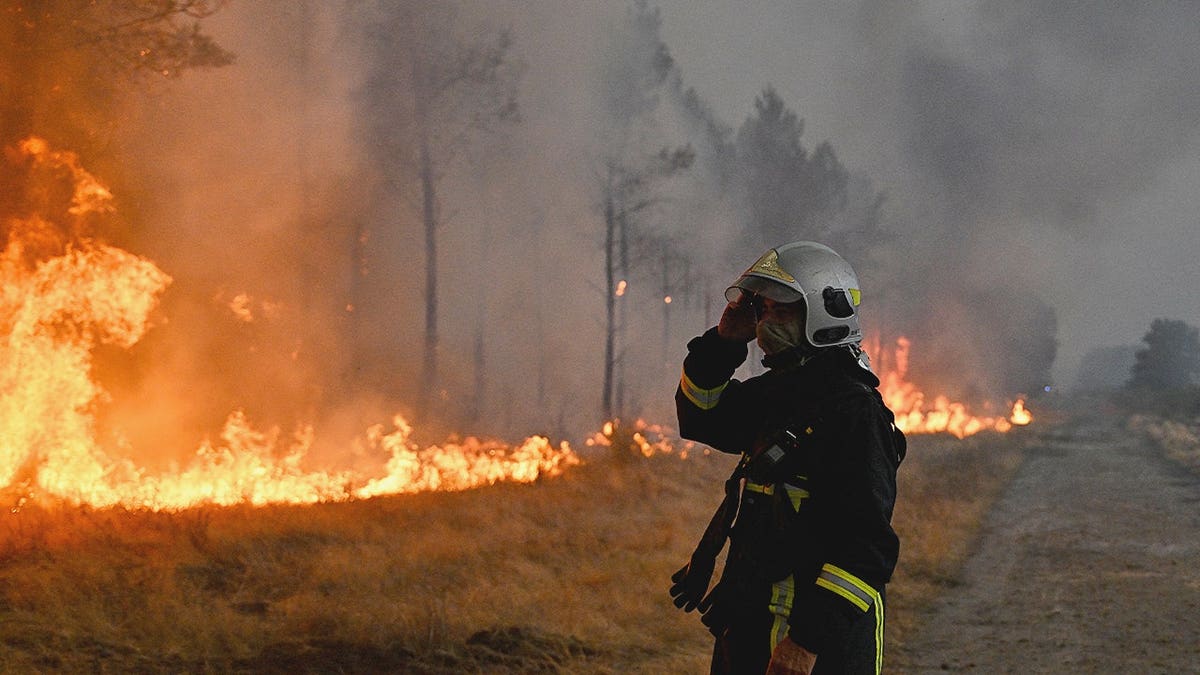
France and Spain battle one of Europe’s worst wildfire seasons in decades, roughly 360,000 people have been forced to evacuate in recent days, while nearly 100,000 hectares have burned. (Associated Press)
French Defense Minister Sébastien Lecornu said July 24 that protective measures had been deployed around the sites «given the nature of the products stored there,» Le Monde said.
Meanwhile, France’s Defense Ministry said 1,500 military personnel have been deployed since Friday to support firefighting operations and help secure strategic industrial sites.
So far, the fires have scorched more than 104,000 acres (42,000 hectares) in the Gironde region, making them among France’s largest wildfires on record.
CLICK HERE TO DOWNLOAD THE FOX NEWS APP
Authorities said about 240 homes have been destroyed, while nearly 4,000 holidaymakers have been evacuated from campsites, holiday villages and tourist resorts in Lacanau, about 35 miles west of Bordeaux.
As France and Spain battle one of Europe’s worst wildfire seasons in decades, roughly 360,000 people have been forced to evacuate in recent days.
france, europe, fires disasters, wildfire

NEWYou can now listen to Fox News articles!
Artificial intelligence is fundamentally transforming the global economy at breakneck speed, but Diogo Costa argues that the real threat to prosperity isn’t technological disruption; it’s the return of bad economic ideas.
As the president of FEE (the Foundation for Economic Education), America’s oldest free-market think tank, Costa is concerned that the affordability crisis is providing the perfect opportunity to tempt the next generation with the ideas of socialism, and argues that economic education is the antidote.
Recently, he sat down with Fox News Digital at Freedom Fest in Las Vegas for a discussion about the intellectual defense of free markets, the intersection of freedom and technology, and how his upbringing in Brazil brings a unique perspective to today’s economic policy debates.
GEN Z IS WORKING HARD, BUT THE ECONOMY IS PUTTING THE AMERICAN DREAM OUT OF REACH FOR MANY
«The biggest challenge today is the different ways that ‘anti-economics’ keeps reappearing. And this time, it’s reappearing through a new kind of socialism. So through the 20th century, we had different flavors of socialism, labor union socialism, environmental socialism, anti-globalization socialism. Now we see this cost-of-living socialism, affordability crisis socialism.»
While young people are aware that they are better off in a market economy, Costa argues, they still want heavy-handed intervention if they perceive it benefits them.
«Young people, they want to live in a market economy. They don’t want to move to Venezuela or Cuba, but they want price controls in everything. They want to freeze the rent, they want free rides in buses, they want to make sure that groceries are either run by the government or price controlled somehow. And this is not just a phenomenon in New York City or California. This is something that’s happening globally.
«And this is the new kind of ‘anti-economics.’ So, Leonard Read [founder of FEE] understood that economics is always one generation away from turning prosperity into poverty. The good ideas need to keep being recycled, they need to be reframed, and this is a challenge that we have right now, the rise of this Gen Z affordability socialism.»
He further argues that while the technology produced by vibrant market economies has incredible potential, the ideological foundation of capitalism is under attack like never before:
«We’re in a golden age for technology, not necessarily for the ideas behind it…the ideas behind the market economy are not as well understood. And when you talk about AI, people are thinking all the jobs are going to be gone. Humanity is on the verge of extinction.
«So there is a lot of pessimism at the same time that you have these wonderful technologies. So the ideas that help us explain and help us work with technology are what’s missing.»
Costa’s studies of the Austrian school of economics lead to separating the economic power of the free-market from its cultural power:

March 2, 2012: Traders crowd on the floor of the New York Stock Exchange. (AP)
«Joseph Schumpeter, the Austrian economist, said that capitalism would be economically powerful and at the same time culturally weak because you have companies that will be doing amazing things, but capitalism makes things more abstract…and at some point people stop seeing exactly how they are part of this amazing complexity.
DEMOCRATS LURE ‘POLITICALLY HOMELESS’ GEN Z TOWARD SOCIALISM — A COUNTERATTACK IS TAKING SHAPE
«That’s why with FEE we sometimes go back to a pencil. We just ask people ‘do you understand how a pencil is made?’ Because if you see the complexity, the network, the amazing, marvelous market system around… Just building a single pencil, you start to understand how you are part of the complexity and you benefit from it.»
Costa’s own experience growing up in Brazil during the economically chaotic 1990s was pivotal in shaping his outlook on policy and the need for economic education.
«I grew up in a country that had hyperinflation. When I was 10 years old, 11 years old, yearly inflation was above 1000%, 1200%, 1300%. That meant the prices were changing literally every day. And it’s hard to understand how if you live in a society that is that economically chaotic all your life is designed around those problems.
«So as a child, when I was going to the grocery store because my mom gave me a $1,000 bill to buy a bag of chips, I had to think, ‘Oh, I need to get there before the price tagger starts changing the prices’.»
«My parents had to turn a bedroom in our house into a pantry because when they got their paychecks the first thing they did was go to the grocery store and buy everything you can…So your life starts to be designed around these big issues. And this is something that some people take for granted.»

Rio de Janeiro, Brazil – December 28, 2013: Aerial view from a helicopter of Rio de Janeiro with the Corcovado mountain and the statue of Christ the Redeemer with Sugarloaf mountain in the background. (iStock)
But it was not only hyperinflation that opened Costa’s eyes about economic education; he also first hand the effects of a fundamentally protectionist economic system:
«It’s the same thing with protectionism…as a young boy in the early 90s, I wanted video games. Brazil had strict protectionism. So I could buy these dupe video games, but I couldn’t get the real deal. And this was something that people now take for granted, but this was how the Brazilian economy was being shaped.
CLICK HERE TO DOWNLOAD THE FOX NEWS APP
«And Milton Friedman has this saying that he thinks that we never actually learn economics as humanity, we learn as individuals, we learn maybe as generations, but now that we don’t live under hyperinflation people forget what that’s like, now that we don’t live under hyperprotectionism people forget what it’s like. So it’s very easy to drift towards inflation, to drift towards protectionism, to drift towards anti-economics and economics needs to be re-taught every generation.»
economic policy, economical rights, politics, education

Mauro Icardi compartió fotos subidas de tono de la China Suárez y le dejó una declaración de amor

Un estudio afirma que el peronismo retiene a más votantes jóvenes que La Libertad Avanza en barrios populares

Fue multicampeón en River, jugó el Mundial 2026 y podría seguir su carrera en Peñarol…

Juan Grabois dio detalles de su encuentro con Peter Thiel: “Perderse la oportunidad es una estupidez”

Jornada financiera: las oscilaciones de Wall Street y la caída del petróleo condicionaron a los activos argentinos

Garfield: Escape from Monday muestra en gameplay sus primeros 8 minutos – Nintenderos

Crisis entre Milei y Lula: la trama política, personal y geopolítica detrás del mayor choque diplomático entre Argentina y Brasil

Cuentapropismo emocional en lo profundo del conurbano

San Isidro: la ballena que quedó varada en un banco de arena murió pese al operativo de rescate

Joaquín Furriel contó cómo fue ver la final del Mundial con su novia española: “Una situación incómoda”

 POLITICA1 día ago
Crisis entre Milei y Lula: la trama política, personal y geopolítica detrás del mayor choque diplomático entre Argentina y Brasil
- POLITICA3 días ago
Cuentapropismo emocional en lo profundo del conurbano
- SOCIEDAD2 días ago
San Isidro: la ballena que quedó varada en un banco de arena murió pese al operativo de rescate