INTERNACIONAL
‘Preaching as resistance’: Dem minister behind Satanist wedding now linked to anti-Trump sermon guide


Iowa Democrats seek to flip US Senate seat
FOX Business correspondent Grady Trimble reports on state Rep. Josh Turek and state Sen. Zach Wahls competing for the chance to challenge the GOP U.S. Senate candidate in a key race on ‘Special Report.’
NEWYou can now listen to Fox News articles!
FIRST ON FOX: Democrat candidate Sarah Trone Garriott, a minister and state legislator running for one of the most competitive House seats in the nation, contributed to a «resistance preaching» guide that encouraged faith leaders to combat President Donald Trump and his supporters from the pulpit.
Trone Garriott authored a chapter in a 2018 collection titled, «Preaching as Resistance: Voices of Hope, Justice, and Solidarity,» in the aftermath of Trump’s 2016 presidential election victory — an event the book described as bringing the country «so closely to fascism.»
Responding to Trump’s presidency, «Many pastors find themselves drawn toward acts of resistance,» Phil Snider, a self-described «White male cishet pastor,» writes in the book’s introduction.
He argued that «pastors of the resistance» were working against a Trump-led coalition rooted in «White supremacy,» «exploitation,» «greed,» and «heteropatriarchy.»
State Sen. Sarah Trone Garriott, a Democrat from Iowa and U.S. congressional candidate, speaks with attendees during a primary election night event at The Loft DSM in Des Moines, Iowa, on June 2, 2026. (Scott Morgan/Bloomberg via Getty Images)
JOHN FETTERMAN DEFENDS TRUMP SUPPORTERS, CONDEMNS FELLOW DEMOCRATS’ ‘F— TRUMP’ STRATEGY
Trone Garriott, who was ordained in the Evangelical Lutheran Church of America in 2008, was among that cohort as an author of the collection.
Her contribution titled, «The Gospel of Resistance,» was described as the first sermon she delivered after the 2016 election and has not been previously reported.
Trone Garriott’s involvement comes as she faces mounting scrutiny from Republicans over her previous remarks on religion and cultural issues. The GOP views the Iowa House battleground held by Rep. Zach Nunn, R-Iowa, which incorporates the state capital of Des Moines, as critical to preserving its slim majority.
The nonpartisan Cook Political Report rates the contest as a «toss-up.» Trump carried the swing district by over four points in 2024, but a recent Fox News Poll showed his favorability is now underwater in the Hawkeye State.
Trone Garriott publicly discussed helping marry a Satanist couple as a minister-in-training during a love-themed storytelling event in 2023, Fox News Digital previously reported. She also defended a Wiccan-led prayer in the state legislature and tied public displays of Christianity to political violence in a 2023 sermon.
During that talk, she criticized private schools and parental rights in education while highlighting her efforts to seek out prayers in the state legislature that were not from the «White American Christian variety.»
The Republican National Committee (RNC) sharply criticized Trone Garriott’s participation in the «resistance» preaching collection.
«The Wicked Witch of Woke strikes again and admits what we all knew — she views the pulpit as a political weapon to advance her radical agenda,» RNC spokesman Zach Kraft said in a statement to Fox News Digital. «There isn’t a far-left cause Sarah Trone Garriott hasn’t claimed to have found in the Bible and attempted to force on Iowans.»
Trone Garriott did not respond to Fox News Digital’s request for comment about why she chose to contribute to the collection or whether she agreed with the book’s introduction, which described Trump and his tens of millions of voters as rooted in racism.

The book described Trump and his tens of millions of voters as rooted in racism. (David Cliff/SOPA Images/LightRocket via Getty Images)
IOWA DEM ADMITS BEING ‘UNCOMFORTABLE’ WITH WHITENESS AS SHE SEEKS TO FLIP COMPETITIVE HOUSE SEAT
The sermon collection, described as «provocative» by its publisher, includes 30 sermons under titles that include «Transgressing the Gender Binary,» «Encountering Pharaoh — and Climate Change,» and «Wake Up and Stay Woke!»
Beyond criticism of Trump, pastors also condemned immigration enforcement, deportation policies, transphobia, and what one author calls «the worship of military-grade weaponry among the populace.»
In «When to Break the Law,» a minister urges sanctuary cities to defy the federal government and harbor illegal aliens to avoid deportation. In «Take a Knee,» the author rails against the «militarized border.» In «Overcome Evil with Good,» police departments are associated with White supremacy. In «Beloved Resistance,» the president is described as an «unrepentant sexual predator.»
Trone Garriott’s own sermon closes the collection. While less overtly political than some of the others, it was identified as the first sermon she delivered after Trump’s election.
In the sermon, Trone Garriott appears to encourage listeners who were upset by recent events, without explicitly mentioning Trump’s election win. She discusses periods when Christians felt detachment throughout history and turned to Matthew 24:36–44, a passage about Christ’s return in which he tells believers to remain ready.
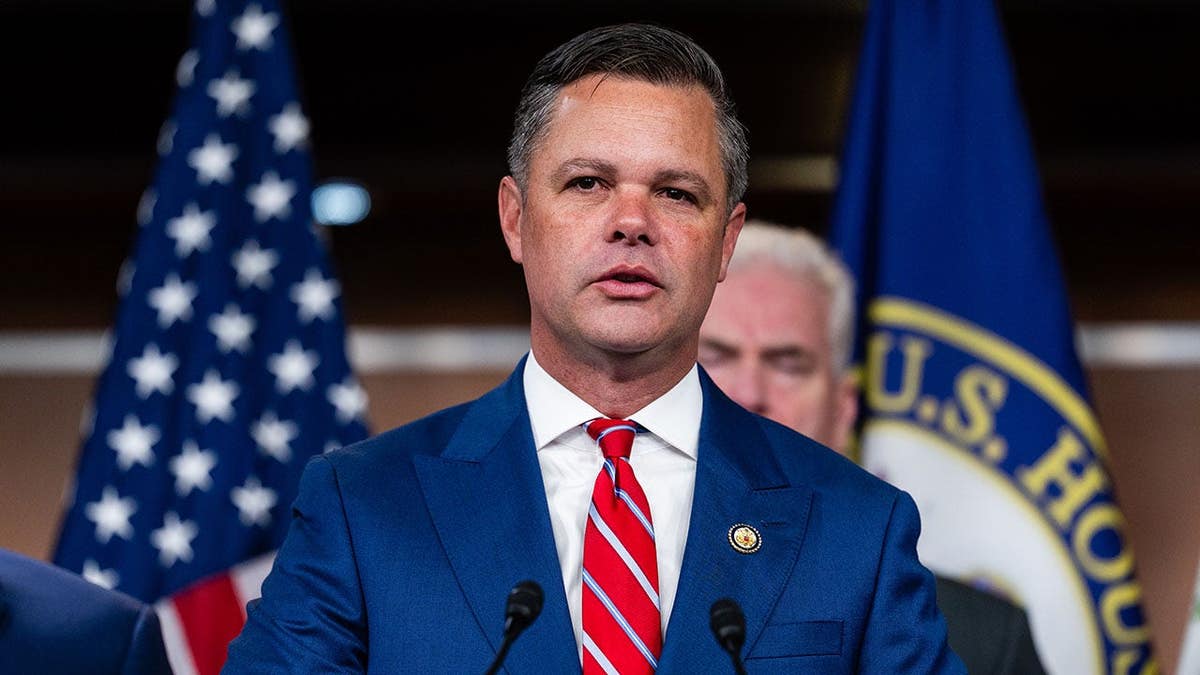
Rep. Zach Nunn, R-Iowa, speaks during a news conference at the U.S. Capitol in Washington, D.C., on Oct. 15, 2025. (Eric Lee/Bloomberg)
CLICK HERE TO DOWNLOAD THE FOX NEWS APP
«For those who are honestly praying for the kingdoms of this world to be destroyed and Christ’s kingdom to come…for those who are yearning to go with Christ wherever that may lead…for those hoping for new life…this is the good news,» she wrote.
politics, donald trump, religion us, faith values, midterm elections













INTERNACIONAL
Brasil: a menos de un mes de las elecciones, una inédita crisis en la Corte Suprema irrumpió en la campaña presidencial

Un juez de la corte suprema de Brasil reintegró este miércoles al director de la Policía Federal, suspendido el martes por un colega, en medio de una crisis inédita desatada en el máximo tribunal a menos de un mes de las elecciones presidenciales del 4 de octubre.
Desatado por una investigación sobre un enorme esquema de fraude, el pulso en la corte toca de lleno la campaña para octubre, cuando el presidente de izquierda Luiz Inácio Lula da Silva buscará la reelección ante el derechista Flávio Bolsonaro.
Lula pidió este miércoles transparencia para acabar con filtraciones que dijo buscan un impacto electoral.
Los jueces enfrentados fueron ambos ministros de Justicia, uno de Lula y otro de Jair Bolsonaro, padre del postulante presidencial.
¿Qué está pasando en la corte?
El magistrado Flávio Dino ordenó que el jefe policial Andrei Rodrigues vuelva a sus funciones contra una decisión de su colega André Mendonça, quien lo suspendió luego de acusar a la Policía Federal (PF) de haberlo espiado ilegalmente.
Rodrigues volvió este miércoles a trabajar en la sede policial en Brasilia, dijo la asesoría de prensa de la institución.
Tras la decisión de Dino, el presidente de la corte suspendió este miércoles el plenario que los jueces celebran semanalmente, una medida infrecuente según dijo una fuente del tribunal.
La crisis en la corte estalló la semana pasada con la publicación de un informe policial que reveló mensajes del banquero Daniel Vorcaro a un número atribuido a otro juez del máximo tribunal, Alexandre de Moraes.
Vorcaro pedía ayuda para eludir una investigación que poco después llevó a su arresto en noviembre, por sospechas de un multimillonario desfalco financiero que resultaría en la liquidación de su banco Master.
Cruce de acusaciones
El juez Moraes condujo el juicio que el año pasado llevó a la cárcel al expresidente de extrema derecha Jair Bolsonaro (2019-2022), padre de Flávio, por un intento de golpe de Estado en 2022.
Los mensajes de Vorcaro se divulgaron por orden de Mendonça, exministro de Justicia de Bolsonaro y designado en la corte por el exmandatario.
A partir de entonces se sucedieron decisiones hostiles entre los jueces.
Leé también: Un estudiante quedó atrapado en un derrumbe en India, logró mandarle un video de 10 segundos a un amigo y fue rescatado
En base a informes secretos de inteligencia policial, Moraes denunció a su colega por abuso de autoridad al apuntar en su contra.
Mendonça acusó el martes a la Policía Federal de espionaje ilegal y ordenó la suspensión preventiva de su director general.
Pero apenas un día más tarde, Flavio Dino, exministro de Justicia de Lula, ordenó que el presidente restituya a Rodrigues en sus funciones.
En su decisión, el juez adujo que la “medida inédita en la historia de la corporación” de Mendonça puede “paralizar investigaciones y los trabajos policiales” en casos bajo su órbita.
La orden de Dino corre en paralelo a un recurso de la Procuraduría General de la Unión para que el presidente de la corte, Edson Fachin, reincorpore definitivamente a Rodrigues.
“Filtraciones selectivas”
Lula pidió en X levantar el secreto de sumario de “las investigaciones de todos los involucrados en el caso Master, sea quien fuere”, para terminar con “filtraciones selectivas que impactan la disputa electoral”.
Tras respaldar la suspensión de Rodrigues, Flávio Bolsonaro dijo en un acto de campaña en Juiz de Fora (sureste) que Dino “dio un plumazo (…) intentando interferir en un proceso judicial” y que Lula “quiere ganar” fuera de las urnas.
El bolsonarismo también se vio sacudido por el caso Master.
Leé también: Fuerte advertencia del primer ministro británico tras el reclamo de Milei por las Malvinas: “Vamos a ser implacables”
La policía investiga giros millonarios solicitados por Flávio Bolsonaro a Vorcaro que, según el candidato derechista, se usarían para pagar una película biográfica sobre su padre.
El caso Master es un expediente “tóxico”, dijo una fuente del tribunal supremo, ya que la policía presume que el banquero “puso dinero en varios lugares para luego cobrarse favores”.
Unas tres mil entidades empresariales brasileñas divulgaron este miércoles un manifiesto a la nación en el que alertaron sobre una “crisis institucional de extrema gravedad” cuyo “epicentro” es la corte.
“Si la legitimidad (de los jueces) es cuestionada, todo lo demás se vuelve incierto: la seguridad jurídica, la confianza en las instituciones y la misma paz social”, señalaron.
(Con información de AFP)
Brasil

NEWYou can now listen to Fox News articles!
As opposition to artificial intelligence data centers spreads across rural America, one group is proposing «data center dividends» to counter the backlash by allowing residents to share directly in the wealth generated by the technology hubs.
A new report from the Bitcoin Policy Institute, a think tank based in Washington, D.C., proposes that data center dividends are a model that would return part of the property tax revenue generated by AI data centers directly to households living in the communities that host the data centers, potentially providing annual payments of between about $4,500 and $8,900 per household without creating new taxes or increasing costs for developers.
«Every American deserves to benefit from the AI boom,» Sam Lyman, head of research at the nonprofit, told Fox News Digital. «It can’t just be the developers in Silicon Valley who are becoming wealthy from this revolution. It needs to be the Americans who are building the county infrastructure that makes these data centers possible in the first place.»
The proposal comes as opposition to data centers intensifies nationwide, fomented over the past year by a network of socialists and communist nonprofits funded by a tech tycoon, Neville Roy Singham, living in Shanghai, supporting the Chinese Communist Party and a «new world order» promulgated by Chinese leader Xi Jinping. The opposition has widened to conservatives and centrists, with the report noting that Americans are now more likely to oppose a data center in their community than a nuclear power plant.
In a poll earlier this year, Gallup found that 71% of Americans oppose construction of an AI data center in their area, while only 53% oppose a nearby nuclear plant. The report says local data center moratoriums have exploded from six in 2024 to 59 last year and 294 last month.
Over the past year, groups in the Singham network – including the Party for Socialism and Liberation, the People’s Forum, CodePink and BreakThrough News – have opposed data centers and also Flock surveillance cameras with aggressive media campaigns, elevating China as a technological powerhouse and denigrating any developments by U.S. technology companies.
«These influence actions are cognitive warfare. Foreign actors don’t need Americans to become pro-China,» Rob Joyce, former director of cybersecurity at the National Security Agency, recently told Fox News Digital. «They need Americans to argue for the outcomes Beijing wants. And a free society that can’t build the power and govern the advanced technology is going to wind up renting it from the adversary, read the PRC, that doesn’t share its own values. And that scares me as an American.»
Sen Bernie Sanders and Rep. Alexandria Ocasio-Cortez hold a press conference to announce the Artificial Intelligence Data Center Moratorium Act at the U.S. Capitol on March 25, 2026, in Washington, D.C. (Tasos Katopodis/Getty Images)
Lyman said the political problem is that many Americans believe technology companies are reaping the benefits of the AI boom while local communities bear the costs. The propaganda campaigns by the pro-China groups are promoting that message by describing tech executives as «oligarchs» and «imperialists.» One constant message in the campaigns is «People Over Profits.»
«I really think that data center dividends will reverse the momentum in the data center debate, because suddenly every American who lives in these counties where data centers might be built recognizes that he or she can have a material stake in the AI economy,» said Lyman, a former senior advisor and speechwriter for Treasury Secretary Scott Bessent.
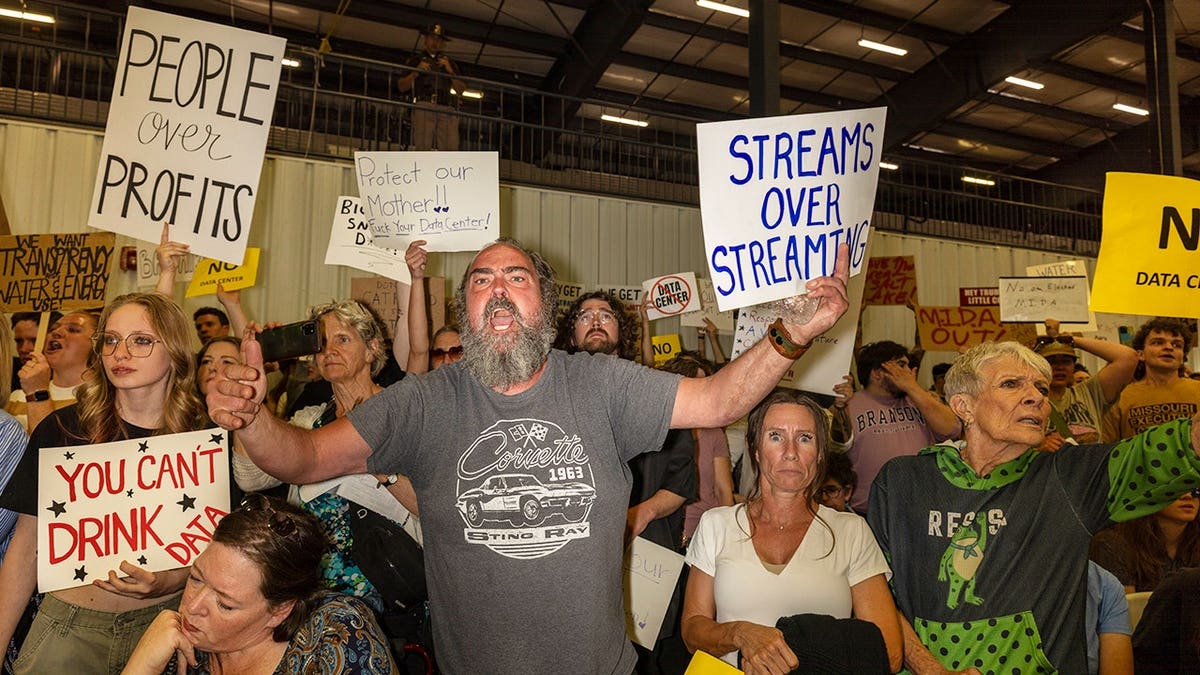
Protesters react as the Box Elder County Commission approves a large AI data center project in Tremonton, Utah, on May 4, 2026. Activists opposed the 40,000-acre development over concerns about water use, energy demand and environmental impact. (Natalie Behring/Getty Images)
Polling cited in the report found that 73% of Americans believe the costs of data center construction outweigh the benefits, while voters overwhelmingly believe AI will primarily enrich executives and business owners rather than workers.
Rather than creating a new tax, the proposal would redirect a portion of property tax revenue that counties already collect from data centers. «Data center dividends can ensure that rural Americans rise in the age of AI alongside the engineers developing this technology,» the report notes.
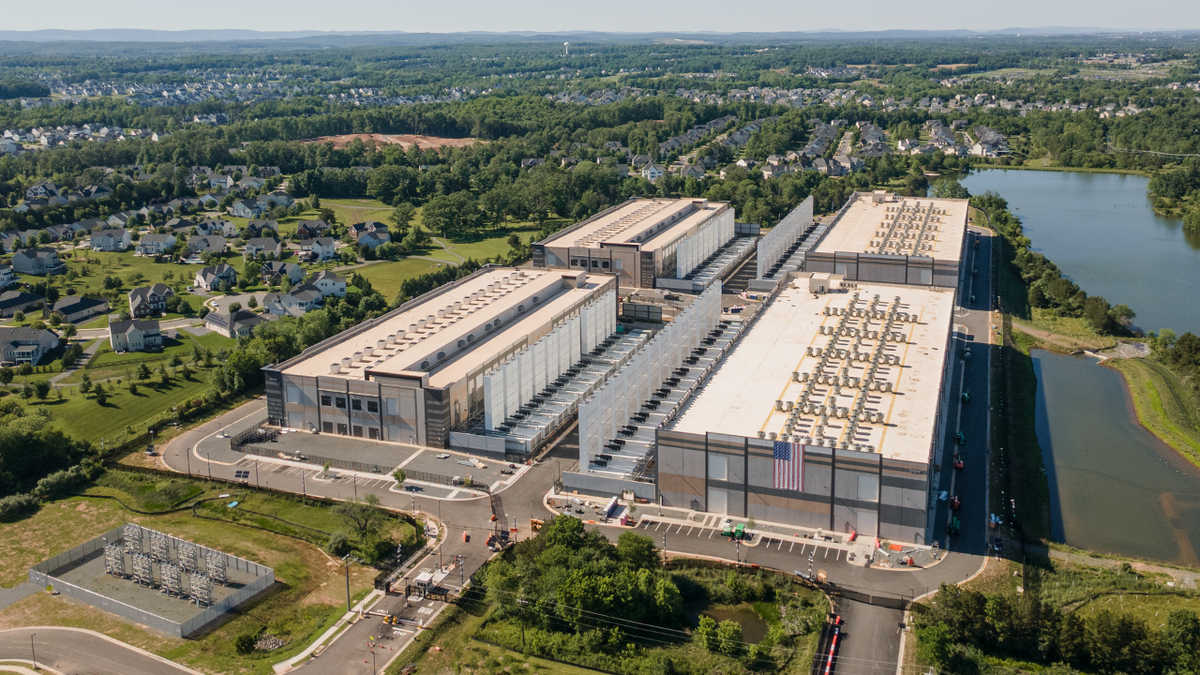
An Amazon Web Services data center in Aldie, Virginia, on May 31, 2026. (Lexi Critchett/Bloomberg via Getty Images)
Under the model, counties would first continue funding schools, roads, police and other essential services. After those obligations are met, local communities would return a portion of remaining revenue directly to residents through annual checks, direct deposits, tax credits, utility bill credits or permanent investment funds. The report emphasizes that the dividends would be financed entirely from existing tax revenue, meaning developers wouldn’t pay any additional taxes.
The report estimates that a single one-gigawatt AI data center could generate enough tax revenue to provide households in a typical rural county between $4,500 and $8,900 annually in a «data center dividend,» depending on how much revenue local governments dedicate to dividends after paying for public services.
The estimate is based on tax collections from Loudoun County, Va., one of the nation’s largest data center hubs. Loudoun collected about $685 million in personal property taxes on data center computer equipment in fiscal year 2024. Dividing those collections by the county’s data center electrical load produced an estimate of roughly $165 million in annual property tax revenue per gigawatt of AI infrastructure, researchers estimated.
The report cites new policies in West Feliciana Parish, La., where policymakers are attempting to spread new-found wealth. The parish expects a Hut 8 AI campus to generate about $90 million annually, more than tripling its current budget, according to estimates. Earlier this year, Louisiana lawmakers passed Act 434, allowing local officials to provide property tax credits funded by the new revenue, although lawmakers removed an earlier proposal that would have authorized direct cash payments.
If the cash provision had remained, the report estimates households could have received about $5,600 annually if one-quarter of the revenue were distributed, or $11,200 annually if half the revenue were shared with residents after funding government services.
In another example, Alaska has a «Permanent Fund,» or state-owned investment account that collects part of Alaska’s revenues from oil produced on state land, invests it in stocks, bonds and real estate, and disburses part of the returns to residents as an annual dividend.
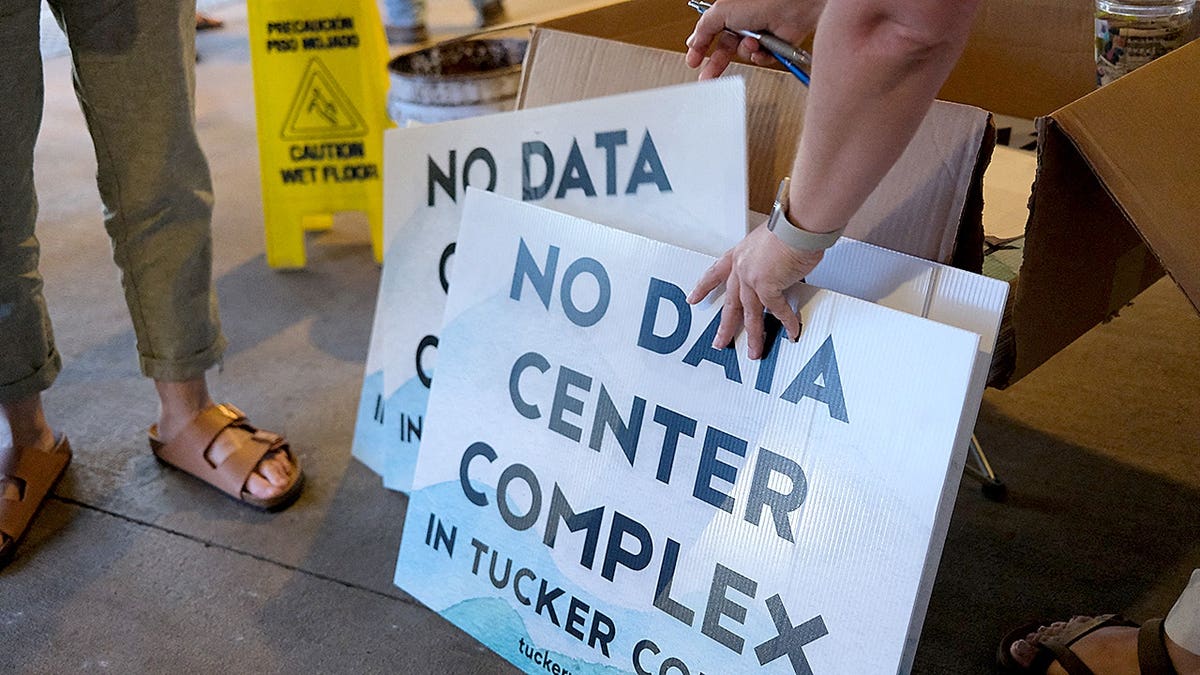
Volunteers hand out yard signs against a data center complex in Canaan Valley on June 30, 2025, after a public meeting organized by the state Department of Environmental Protection regarding an air quality permit application for a gas-fired power plant near Davis, W.Va. (Ulysse Bellier/AFP via Getty Images)
The report outlines several options communities could adopt.
- Cash payments. Residents could receive annual dividend checks or direct deposits similar to the payments from Alaska’s «Permanent Fund.»
- Property tax credits. Local governments could reduce residents’ property tax bills using data center revenue, similar to Louisiana’s approach.
- Utility bill credits. Counties could apply the money directly to electricity bills, benefiting both homeowners and renters while addressing concerns that data centers increase electricity costs. The report notes that a $4,500 dividend would cover the average American household’s electric bill for more than two years.
- Education funds. Communities could place the money into scholarship endowments guaranteeing college tuition for local graduates.
- Permanent investment funds. Counties could invest the tax revenue and distribute only investment earnings, creating an enduring source of local wealth similar to Alaska’s Permanent Fund even if the data center eventually closes.
Lyman argues that direct payments create stronger public support than simply lowering taxes or expanding government spending because residents would see the benefit. «I think a lot that opposition is born from the fact that many Americans feel left out of the AI boom. They feel like this economic revolution is taking place without them,» said Lyman, noting, «What data center dividends do… is they give every American in rural America a share in the material prosperity that is taking place with artificial intelligence.»
The report notes that rural counties possess two scarce assets essential for AI development – land and abundant power – and argues those communities should share directly in the economic gains generated by the AI buildout.
politics, artificial intelligence, technologies, taxes
INTERNACIONAL
El mar de Ecuador está hasta 4,1 grados más caliente y el nivel del océano sigue elevado

Ecuador enfrenta una combinación de señales oceánicas que ha colocado al fenómeno de El Niño en una fase decisiva. La temperatura del mar en la región Niño 1+2, ubicada frente a las costas de Ecuador y Perú, registra anomalías de hasta 4,1 grados Celsius por encima de los valores normales, mientras el nivel medio del océano en varias estaciones del país permanece decenas de centímetros por encima de su promedio.
El calentamiento no es un dato aislado. El Comité Nacional para el Estudio Regional del Fenómeno El Niño (ERFEN) mantiene al país bajo el estado de El Niño Activo, aunque sus boletines técnicos advierten que el fenómeno todavía se encuentra en una fase de desarrollo y que su evolución dependerá de lo que ocurra durante las próximas semanas. El boletín más reciente disponible, publicado el 4 de septiembre, mantiene esa caracterización.
La principal señal está en el Pacífico oriental. En la región Niño 1+2, una de las áreas oceánicas más relevantes para Ecuador por su cercanía con la costa continental, las anomalías térmicas han llegado a 4,1 grados. Las temperaturas del agua se han ubicado entre 26 y 28 grados Celsius, según información difundida por organismos vinculados al monitoreo del ERFEN.
Pero el calentamiento de la superficie es solo una parte del fenómeno. Las expediciones científicas realizadas frente a Ecuador durante este año encontraron que las aguas cálidas han penetrado a profundidades inusuales. El crucero oceanográfico del buque BAE Orión detectó en junio una anomalía cercana a los 2 grados Celsius en una columna de agua que se extendía hasta unos 100 metros de profundidad, cuando en condiciones normales el calentamiento superficial suele concentrarse mucho más cerca de la superficie.

Esa alteración modifica la estructura del océano y afecta procesos fundamentales para la productividad marina. El calentamiento y el hundimiento de la termoclina reducen el ascenso de aguas frías y ricas en nutrientes hacia la superficie, un fenómeno que puede repercutir en la distribución de especies y en la actividad pesquera.
A este escenario se suma otra variable: el aumento del nivel del mar. A finales de agosto, las mediciones de estaciones del Instituto Oceanográfico y Antártico de la Armada registraban incrementos de hasta 40 centímetros en puntos de la costa y Galápagos. El aumento está relacionado con la expansión térmica del agua y la acumulación de masas cálidas en el Pacífico.
La elevación del océano puede adquirir especial importancia cuando coincide con oleajes y aguajes. En las zonas costeras, un nivel del mar más alto reduce el margen disponible para el drenaje natural y puede aumentar la vulnerabilidad de sectores bajos frente a inundaciones costeras.

Sin embargo, los especialistas han insistido en una diferencia fundamental: un océano excepcionalmente cálido no significa automáticamente que Ecuador experimentará lluvias extremas. Para que los efectos atmosféricos asociados a El Niño se consoliden plenamente debe producirse un acoplamiento entre las condiciones del océano y la atmósfera.
Esa distinción es ahora uno de los puntos centrales del monitoreo científico. El Inocar había advertido durante los últimos meses que la evolución entre septiembre y los meses posteriores sería clave para determinar cómo responderá la atmósfera al calentamiento registrado en el Pacífico.
Las proyecciones del ERFEN apuntan a que el mayor impacto potencial del fenómeno en Ecuador podría concentrarse entre noviembre de 2026 y marzo de 2027, coincidiendo con la temporada lluviosa. Los escenarios técnicos contemplan un evento que podría alcanzar una intensidad fuerte o muy fuerte desde el punto de vista oceánico, aunque esa clasificación no determina por sí sola la magnitud de las inundaciones, las lluvias o el incremento de los caudales que podrían producirse en el país.
La diferencia es relevante porque Ecuador ya conoce las consecuencias de episodios extremos asociados a El Niño, pero los científicos evitan establecer comparaciones automáticas con eventos históricos como el de 1997 y 1998 únicamente a partir de la temperatura actual del océano.
coronavirus,covid-19

Chiche Gelblung: el cortejo fúnebre ya está en camino al cementerio de La Tablada, escenario del último adiós

Brasil: a menos de un mes de las elecciones, una inédita crisis en la Corte Suprema irrumpió en la campaña presidencial

Mauricio Macri cuestionó a la jueza que suspendió la aplicación de la baja de edad de imputabilidad en la provincia de Buenos Aires

El Gobierno evalúa ampliar las sanciones a las empresas pesqueras que operan en Malvinas

Scott Bessent aseguró EEUU va a usar los dólares del Tesoro para hacer política exterior en la región: “Argentina fue el primer ejemplo”

Fue campeón del mundo, jugó en el Liverpool y hoy busca equipo por LinkedIn: "Todas las consultas son bienvenidas"

1000 días de Milei: los logros, las crisis que lo marcaron y los déficits de su gestión

Martín Menem dijo que Milei será el primer no peronista en ser reelecto y llamó a invertir más

Franco Colapinto largará en el puesto 7 con su Alpine el Gran Premio de Italia de la Fórmula 1: hora, TV y todo lo que hay que saber

Multas millonarias, arrestos y trabajo comunitario: cómo se prepara una provincia para enfrentar el Súper Niño

 SOCIEDAD2 días ago
Femicidio brutal en Merlo: un jubilado de 64 discutió con su esposa y la asesinó a puñaladas
- POLITICA2 días ago
El gobierno de Kicillof retendrá un 2% en los premios de las apuestas online
- DEPORTE2 días ago
El rotundo cambio de Julián Álvarez en una foto presentación del Atlético de Madrid tras quedarse en el club