
INTERNACIONAL
Regulators allow Obama-era solar plant to kill thousands of birds annually, investigation finds


NEWYou can now listen to Fox News articles!
SAN BERNARDINO, Calif. – Regulators are allowing an Obama-era «clean energy» solar plant to continue operating even as its reflected solar beams kill thousands of birds each year, with no fines or enforcement action taken since it opened, a Fox News Digital investigation has found.
The Ivanpah Solar Power Plant, a sprawling facility built with taxpayer support in the Mojave Desert near the California–Nevada border, remains in compliance under existing regulations, even as birds are burned, injured or killed after flying through the beams which reflect sunlight onto the plant’s three central towers.
Regulators were aware of those risks before approving the project as part of a broader push to expand renewable energy. Today, it remains in compliance, meaning the wildlife deaths documented at the site fall within limits set under its environmental approvals. That framework allows the plant to continue operating even as thousands of birds are killed each year.
OBAMA-ERA ‘CLEAN ENERGY’ SOLAR POWER PLANT STILL USES FOSSIL FUELS – AND KILLS THOUSANDS OF BIRDS ANNUALLY
The Ivanpah Solar Power Facility near the California–Nevada border in the Mojave Desert. The solar thermal plant has faced scrutiny over environmental impacts, including bird deaths linked to its concentrated solar energy system. (Jeff Gritchen/MediaNews Group/Orange County Register via Getty Images)
«Staff is not aware of any formal enforcement actions or fines issued by either the U.S. Fish and Wildlife Service or the California Department of Fish and Wildlife related to avian or wildlife mortality at the Ivanpah Solar Electric Generating System,» the California Energy Commission, which oversees large energy projects in the state, told Fox News Digital.
The commission also said it knows of no special regulatory exemptions for renewable energy projects related to wildlife impacts. Instead, the project was approved as long as monitoring and mitigation requirements would be carried out, meaning some level of wildlife mortality was anticipated.
The futuristic-looking facility, known for its three large towers that glow brightly when powered on, was approved during the Obama-era push to rapidly expand renewable energy following the 2008 financial crisis — part of a broader effort to cut emissions and reduce reliance on fossil fuels in the name of climate change.
At the time, it was hailed as the future of «clean energy» technology, and the federal government provided a $539 million grant for its construction, along with a separate $1.6 billion loan.
But its technology quickly became outdated by conventional solar panels that absorb sunlight directly and convert it into electricity, making Ivanpah’s energy more expensive to produce. The plant also relies on natural gas to start up each day – producing tens of thousands of metric tons of carbon dioxide annually.
CALIFORNIA’S GREEN NEW SCAM COULD COST YOU $20,000
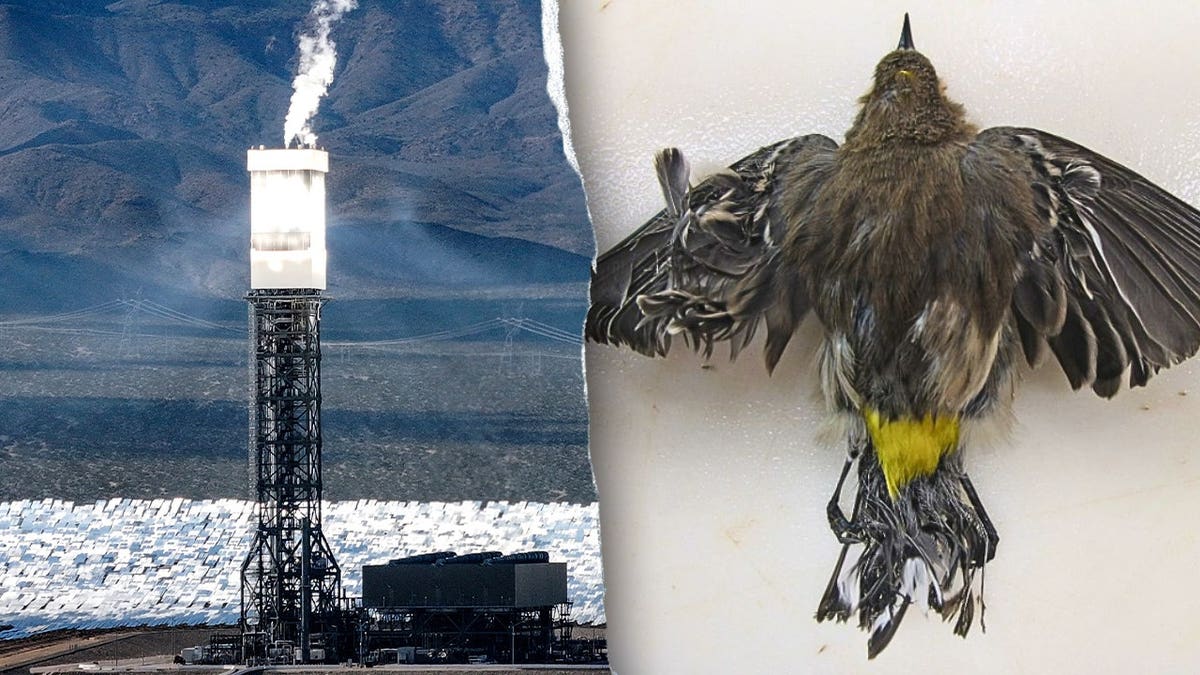
A composite image shows a tower at the Ivanpah Solar Power Plant alongside a bird found with burn injuries linked to concentrated solar heat exposure, according to federal wildlife research. (Jeff Gritchen/MediaNews Group/Orange County Register via Getty Images; U.S. Fish and Wildlife Service)
Researchers say birds are drawn to the bright towers, then fly through the plant’s concentrated solar beams — known as solar flux — where they can be injured or killed. Researchers dubbed the phenomenon «streamers,» and a video released by the U.S. Geological Survey shows a bird trailing smoke as its feathers burn. Songbirds, doves, warblers and other migratory species have been found dead at the plant.
What regulators knew before approval
Environmental reviews examined by Fox News Digital show that regulators were aware before construction that the project could kill birds, either by being burned by the plant’s concentrated sunlight or colliding with the tens of thousands of mirrors that surround the three towers like lakes. They also raised concerns about damage to the 4,000-acre physical desert habitat it was going to occupy, as well as to protected species that roam the barren terrain, such as the endangered desert tortoise, dozens of which went unaccounted for during early operations.
The project’s Final Environmental Impact Statement warned that climate efforts could come «at the expense of reducing the native biodiversity.»
Even with those warnings, regulators approved the project, allowing it to move forward on the basis that ongoing monitoring and mitigation requirements would be carried out, rather than requiring those risks to be resolved.
A 2016 congressional review raised similar concerns, finding no clear evidence that federal agencies had pursued penalties for bird deaths at Ivanpah — a pattern that appears to have continued.

A peregrine falcon wing shows severe feather damage consistent with exposure to concentrated solar heat, according to a U.S. Fish and Wildlife Service study of the Ivanpah solar plant. (U.S. Fish and Wildlife Service)

Burned feathers from a peregrine falcon show damage patterns linked to concentrated solar beams at the Ivanpah solar plant, according to federal research. (U.S. Fish and Wildlife Service)
No fines, no enforcement
The plant is regulated under a system that tracks wildlife deaths but does not automatically trigger fines or shutdowns.
Monitoring reports show hundreds of birds are found dead at the site each year, with some estimates putting the total in the thousands.
Responsibility for enforcement is shared across multiple agencies, including the U.S. Fish and Wildlife Service, the California Department of Fish and Wildlife and the Bureau of Land Management, each of which has authority over different aspects of the project, the CEC said.
The U.S. Fish and Wildlife Service said it reviews monitoring data and provides technical input but did not indicate enforcement action tied to bird deaths at the site.
NRG Energy, which operates the facility, said in a previous statement it remains committed to providing renewable electricity but declined to provide additional comment regarding environmental issues.
CLICK HERE TO DOWNLOAD THE FOX NEWS APP

The Ivanpah Solar Power Facility operates in the Mojave Desert near the California–Nevada border, using thousands of mirrors to focus sunlight onto a central tower to generate electricity. (MediaNews Group/Orange County Register via Getty Images)
A system that allows harm
Instead of being treated like a typical environmental violation, the project is governed through a permitting system that emphasizes monitoring and mitigation rather than penalties.
In practice, that means harm can be documented without triggering enforcement action even though federal authorities have pursued penalties for bird deaths in other industries.
Under federal law, violations involving protected migratory birds can carry fines of up to $15,000 per bird.
Such prosecutions of industry have become rare in the United States, however. In 2017, the Department of the Interior reinterpreted the Migratory Bird Treaty Act to apply only to intentional killings — not «incidental» deaths caused by industrial activity such as oil pits, power lines or wind turbines. Federal courts, including the Fifth Circuit, have since reinforced that narrower reading, limiting the government’s ability to penalize companies for equipment-related bird deaths.
But even efforts to reduce harm — including deterrents, lighting changes and operational adjustments — have not eliminated the problem at Ivanpah, with monitoring reports continuing to document annual wildlife deaths.
More than a decade later, Ivanpah shows what that system looks like in practice: a project approved as clean energy that kills wildlife, relies on fossil fuels and continues operating without penalties.
WATCH: Experts weigh in on future of $2.2B Obama-era Ivanpah solar plant as regulators keep it open
This is part 3 of a series on California’s troubled Ivanpah Solar Power Plant in the Mojave Desert
Part 1 – Obama-backed $2.2B green energy ‘boondoggle’ leaves taxpayers on the hook
Part 2 – Obama-era ‘clean energy’ solar power plant still uses fossil fuels – and kills thousands of birds annually
energy, environment regulation, california, climate change environment, birds, barack obama, energy in america, controversies environment, regulation














Investigación con resultados variados

Preocupaciones por la población más joven

¿Demasiado pronto?
Recibí en tu mail todas las noticias, historias y análisis de los periodistas de Clarín
QUIERO RECIBIRLO

NEWYou can now listen to Fox News articles!
President Donald Trump’s kingmaker status in Republican primaries was on the line Tuesday in Michigan’s GOP gubernatorial nomination showdown – and the president passed the test.
Republican Rep. John James, a two-time U.S. Senate nominee in the crucial Great Lakes battleground state who was endorsed by Trump in late June, topped multimillionaire businessman Perry Johnson to win the GOP primary, the Associated Press reported.
The West Point graduate and Army Ranger who served multiple combat tours as an Apache helicopter pilot in the Iraq war will face off in a high-stakes and expensive general election battle with two-term Michigan Secretary of State Jocelyn Benson, the Democrats’ gubernatorial nominee, in the race to succeed term-limited Gov. Gretchen Whitmer.
DEMOCRACY ’26: STAY UP TO DATE WITH THE FOX NEWS ELECTION HUB
Rep. John James of Michigan, a Republican candidate for governor, speaks to a voter at a campaign event in Harrison Township, Michigan, on August 3, 2026. (Luke Trevisan/Fox News)
James preached party unity in his victory speech.
«The primary is over now. We come together. One team, one fight, one mission to save Michigan. To those who supported me. Thank you. And for those who did not, I’m going to work every single day to earn your trust,» he told supporters.
The GOP primary between James and Johnson, a former gubernatorial and presidential candidate, turned combative. Johnson, who is White, referred to James, one of the few Black Republicans in Congress, as a «DEI candidate» and in a recent debate accused James of playing the «race card.» James, meanwhile, called Johnson «desperate.»
Johnson, who shelled out millions of his own money into his campaign, dramatically outspent James in the primary showdown.
CHECK OUT THE FOX NEWS POWER RANKINGS IN THE 2026 RACES FOR GOVERNOR

Republican gubernatorial candidate Perry Johnson campaigns on eve of the Michigan primary at a campaign event on August 3, 2026 in Novi, Michigan. (Luke Trevisan/Fox News)
But James told Fox News on the eve of the primary that «nobody outworks a ranger,» and «money isn’t the only thing. People want someone who resonates with them, someone who has the proven leadership capability to turn the state around.»
James and Johnson were the final two Republican candidates in a nomination race that previously included former Michigan Attorney General Mike Cox and state Senate Republican leader Aric Nesbitt. They both suspended their GOP gubernatorial campaigns, but their names remained on the primary ballot.
SIGN UP TO GET THE POLITICS NEWSLETTER

Michigan Secretary of State Jocelyn Benson, a Democrat, is running for governor in the 2026 race to succeed term-limited Gov. Gretchen Whitmer. (Bill Pugliano/Getty Images)
Trump gave James a boost last month as he campaigned with the congressman at a rally in Michigan.
The brute force of the president’s endorsement power has been on display in GOP primaries this spring and summer, with his candidates ousting incumbents he targeted in showdowns in Indiana, Kentucky and Texas, as well as the Louisiana primary.
But Trump’s endorsement streak in statewide and congressional Republican primaries was snapped in early June when his last-minute endorsement of Republican Rep. Randy Feenstra of Iowa in the race to succeed retiring GOP Gov. Kim Reynolds wasn’t enough to propel the three-term congressman to victory.
Feenstra was narrowly edged by Zach Lahn, a businessman, farmer and former political strategist who was backed by the political wings of MAHA — the acronym for the Make America Healthy Again movement aligned with Trump’s Health Secretary Robert F. Kennedy Jr. — and Turning Point USA, the powerful conservative organization co-founded by the late Charlie Kirk.
Trump-backed candidates won two of the three top races in key GOP primary runoff elections in Georgia and Alabama in June, with the one setback coming against billionaire businessman Rick Jackson, who shelled out over $100 million of his own money to boost his campaign.

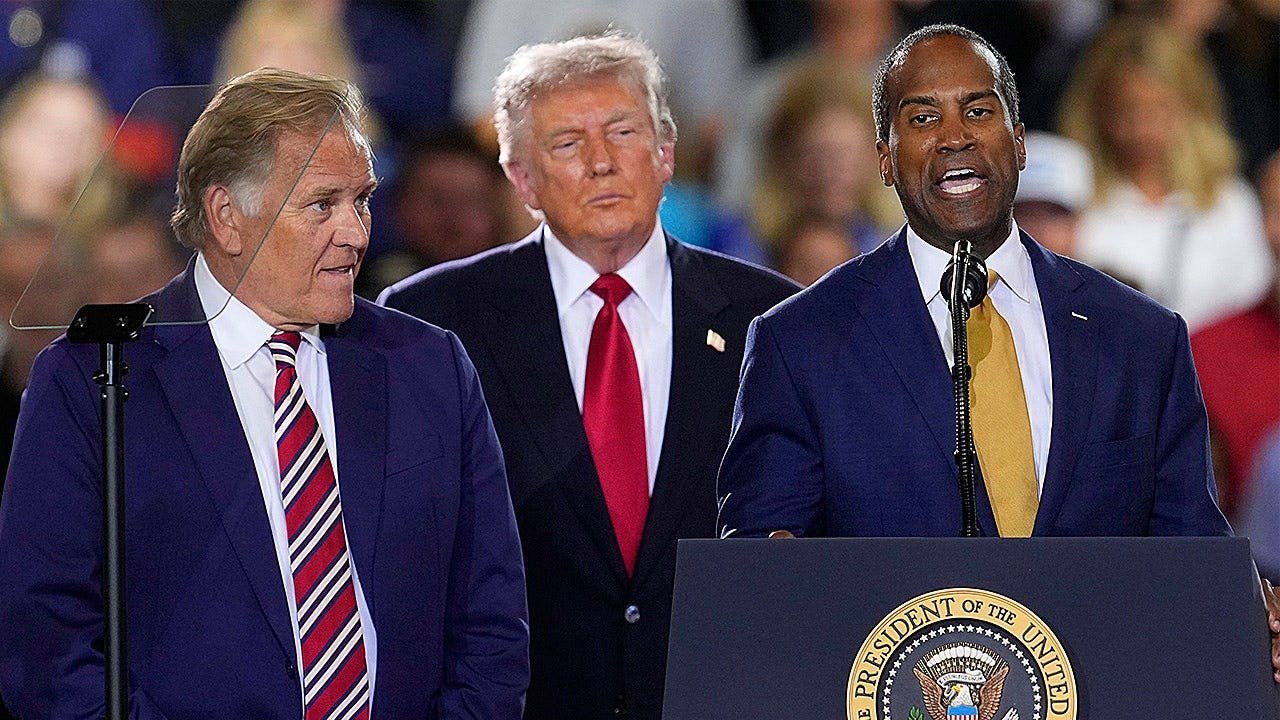
President Donald Trump, center, and GOP Senate candidate former Rep. Mike Rogers, left, listen as Rep. John James, a Republican gubernatorial candidate, speaks at an event at the General Motors Proving Ground Monday, July 27, 2026, in Milford, Mich. (Paul Sancya/AP Photo)
A week later, Trump-backed first-time candidate Anthony Constantino, a businessman and former boxer, defeated Robert Smullen, a retired Marine Corps colonel and New York assemblyman who had the backing of the state party, in the upstate New York race to succeed retiring GOP Rep. Elise Stefanik.
Meanwhile, in South Carolina’s Republican gubernatorial runoff, Trump couldn’t lose.
That’s because, besides backing Lt. Gov. Pamela Evette a few weeks earlier, he also gave a last-minute endorsement to state Attorney General Alan Wilson, who ended up winning the late June showdown in a landslide.
The president also enjoyed victory in Louisiana, where Sen. Bill Cassidy, who voted to convict Trump in his 2021 impeachment trial, was ousted as he sought renomination. Trump-backed Rep. Julia Letlow ended up winning the nomination in the runoff election.
And last month, Trump-backed Rep. Andy Biggs, a former House Freedom Caucus chair, won Arizona’s primary for governor in a landslide.
gubernatorial, state and local primaries, michigan, donald trump, politics, republicans, midterm elections
INTERNACIONAL
Panamá se sometió a una evaluación técnica de organismos internacionales para reforzar la seguridad de la navegación

En aras de contribuir a modernizar los servicios hidrográficos del país y reforzar la seguridad de la navegación, el sector marítimo de Panamá fue evaluado por la Organización Hidrográfica Internacional (OHI) y por la Asociación Internacional de Ayudas a la Navegación Marítima y Autoridades de Faros (IALA).
Ambas organizaciones prepararán un informe sobre la situación actual de la hidrografía y la cartografía náutica panameña, junto con recomendaciones técnicas orientadas a fortalecer las capacidades nacionales y ajustarlas a los estándares internacionales.
Entre los temas principales tratados figuró la adopción del estándar internacional S-100, identificado como la próxima generación de cartografía náutica digital.
Esta innovación permitirá integrar información marítima más precisa y actualizada, con el objetivo de mejorar la seguridad y la eficiencia en la navegación.
Asimismo, la agenda incluyó aspectos como la gestión de zonas costeras, la infraestructura geoespacial, la vigilancia marítima y los servicios hidrográficos existentes en el país.

La misión se realizó en el marco de la incorporación oficial de Panamá como Estado Miembro de la OHI, tras la aprobación de la Ley 479 de 2025.
Este proceso permitirá afianzar la cooperación técnica internacional, incorporar nuevas tecnologías y avanzar en la modernización de la infraestructura de información marítima panameña.
Durante cuatro jornadas, expertos de ambas organizaciones y de la Autoridad Marítima de Panamá (AMP) evaluaron las capacidades nacionales en hidrografía, cartografía náutica, ayudas a la navegación y gestión de información marítima.
Como parte de la agenda, mantuvieron reuniones técnicas y visitaron instituciones clave asociadas al desarrollo hidrográfico.
Con un registro mercante superior a 8,000 embarcaciones, lo que representa cerca del 13% de la flota mercante mundial, Panamá culminó esta evaluación técnica de alto nivel, que contribuirá a modernizar sus servicios hidrográficos y a reforzar la seguridad de la navegación.

Por otra parte, la entidad informó que el comportamiento del mercado laboral marítimo también mostró una tendencia positiva.
Entre el 1 de julio de 2024 y el 1 de julio de 2026, la Autoridad Marítima de Panamá registró 2,029 contratos de trabajo para gente de mar panameña.
Solo entre el 1 de julio de 2025 y el 1 de julio de 2026 se recibieron 1,096 contratos, lo que representa un incremento del 17.5 % respecto al mismo período del año anterior.
Asimismo, entre el 1 de julio de 2024 y el 1 de julio de 2025 se registraron 933 contratos, un 5.31 % más que en el período precedente, cuando se recibieron 886 contratos.
De acuerdo con la entidad gubernamental, estos resultados responden, en parte, al fortalecimiento de las inspecciones laborales y al acompañamiento brindado a las empresas del sector, lo que ha favorecido una mayor presentación de contratos para su revisión y registro conforme a la normativa vigente.

Durante ese período, la entidad igualmente tramitó 653 repatriaciones, atendió 788 quejas laborales marítimas, realizó 598 inspecciones laborales, brindó 407 consultas especializadas y concretó 39 conciliaciones, fortaleciendo los mecanismos de atención y defensa de los derechos de la gente de mar.
De acuerdo con la Autoridad Marítima de Panamá, estos resultados responden, en parte, al fortalecimiento de las inspecciones laborales y al acompañamiento brindado a las empresas del sector, lo que ha favorecido una mayor presentación de contratos para su revisión y registro conforme a la normativa vigente.
Como autoridad competente en materia laboral marítima, sostiene que una de sus dependencias verifica, registra y custodia los contratos de trabajo de la gente de mar, además de orientar a trabajadores y empleadores sobre el cumplimiento de la legislación laboral marítima aplicable.
Corresponsal:Desde Panamá

En el Senado bonaerense es habitual la participación virtual en sesiones, como solicita Sagasti a nivel nacional

Boca Juniors vs. Estudiantes: formaciones, hora y dónde ver por tv

Se conoció quién ganó la casa de esta temporada en Gran Hermano: “Para mi papá que jugaba a la timba”

¿Tendríamos que hacer permanente el horario de verano?

“Nobleza obliga”: el inesperado reconocimiento de Mayra Mendoza a Victoria Villarruel

Javier Milei: “Las reformas apuntan al corazón de la decadencia argentina de los últimos 91 años”

“Vamos a acelerar con todo”: el objetivo del Gobierno por las reformas y la agenda electoral de cara al 2027

Javier Milei cruzó a Victoria Villarruel y elevó la tensión: “Es una opositora, replica los argumentos kirchneristas”

Reelecciones indefinidas: el oficialismo bonaerense niega que busque ampliar la Legislatura como parte de una reforma política para beneficiar a los intendentes

¡Chau Luck Ra! La salida de soltera de La Joaqui, muy bien acompañada, a días de su separación
-
 POLITICA3 días ago
“Vamos a acelerar con todo”: el objetivo del Gobierno por las reformas y la agenda electoral de cara al 2027
-
 POLITICA1 día ago
Javier Milei cruzó a Victoria Villarruel y elevó la tensión: “Es una opositora, replica los argumentos kirchneristas”
-
 POLITICA2 días ago
Reelecciones indefinidas: el oficialismo bonaerense niega que busque ampliar la Legislatura como parte de una reforma política para beneficiar a los intendentes