Connect with us

INTERNACIONAL

Un operativo para levantar los piquetes en Bolivia terminó con enfrentamientos y pocos resultados

Published

on


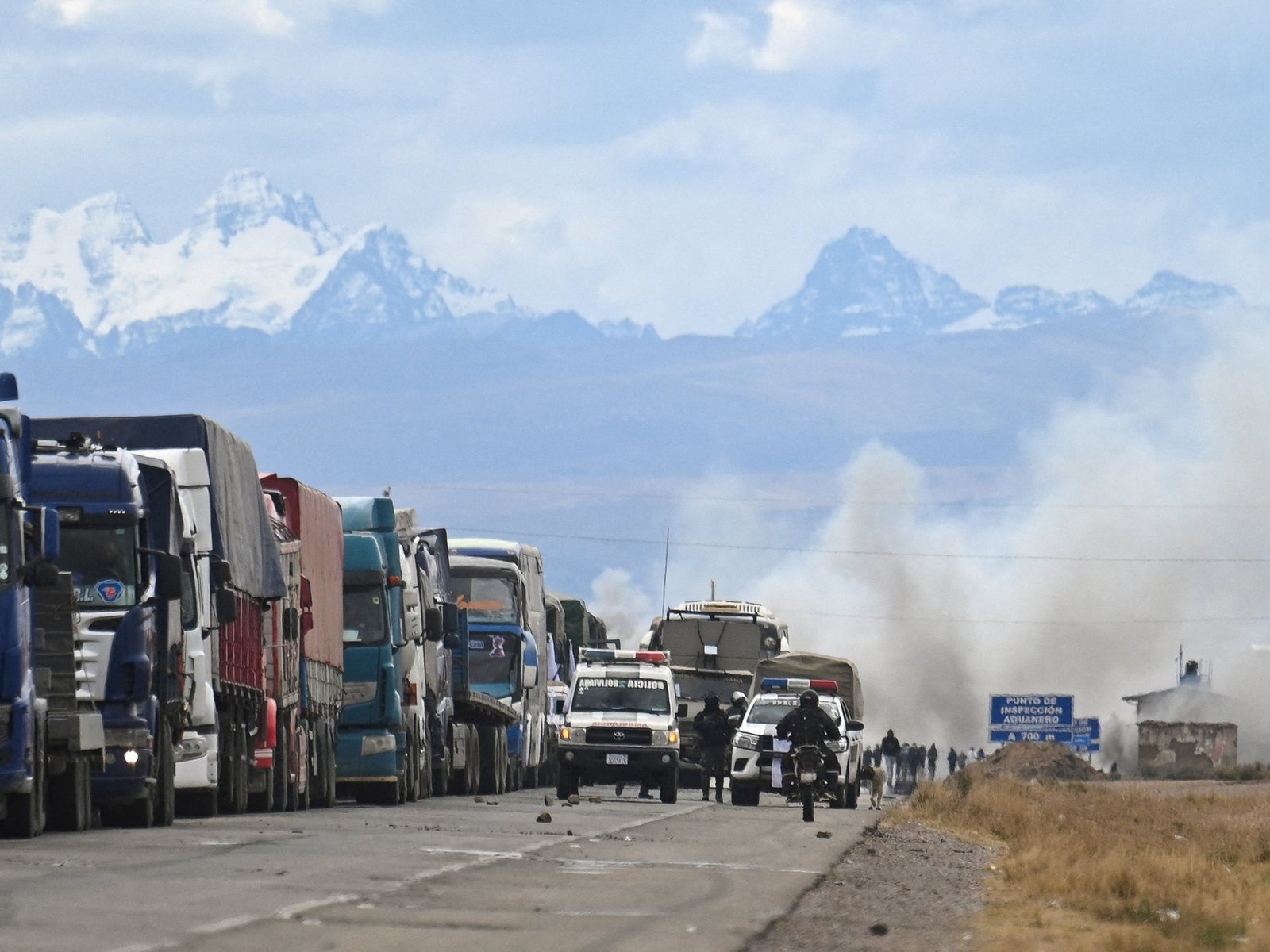
Con cientos de policías y militares, y topadoras para levantar los piquetes, el gobierno de Rodrigo Paz puso en marcha este sábado a primera hora el “Corredor humanitario de las Banderas Blancas”, el gran operativo para levantar los bloqueos en la principal ruta del occidente de Bolivia y tratar de resolver la grave crisis de desabastecimiento en La Paz.

Pero a última hora no estaba claro hasta qué punto el plan fue efectivo. En varias localidades los manifestantes recibieron a la caravana lanzando piedras, y la policía respondió con gases lacrimógenos. Una escena que se repite aquí desde hace semanas.

Advertisement

La caravana humanitaria, encabezada por el ministro de Obras Públicas, Mauricio Zamora, llegó antes de las 7 de la mañana a distintos puntos de la ruta que lleva desde Oruro a La Paz, donde desde hace más de tres semanas grupos de sindicalistas, campesinos y seguidores del ex presidente Evo Morales mantenían piquetes en rechazo al gobierno y para reclamar la renuncia de Rodrigo Paz.

El viernes a última hora, en una conferencia conjunta, el portavoz presidencial, José Luis Gálvez, y varios ministros, anunciaron el operativo y el inicio de un proceso de diálogo con los grupos movilizados, que comenzó este mismo fin de semana, con la mediación de la Iglesia católica y otras organizaciones.

El objetivo más urgente es restablecer el abastecimiento en la ciudad de La Paz, donde desde hace varios días es una odisea conseguir algunos alimentos básicos y los hospitales ya están suspendiendo cirugías y reduciendo su atención por la falta del oxígeno medicinal.

Advertisement

“Este operativo, que contará con la presencia de la Policía y será apoyado logísticamente por las Fuerzas Armadas, tiene el único objetivo de normalizar la vida de ciudadanos alteños y paceños que estamos sufriendo los rigores de la falta de oxígeno y de alimentos”, declaró el ministro de Gobierno (Interior), Marco Antonio Oviedo, el viernes a la noche, y aseguró que la operación sería “pacífica”.

La población de La Paz, y de muchas otras ciudades del país, comienza a mostrar su hartazgo con los bloqueos de rutas y un cierto malestar con el gobierno, que no ha logrado hasta ahora normalizar la circulación de camiones y autos.

Enfrentamientos

Advertisement

Pero los manifestantes –liderados por la poderosa Central Obrera Boliviana y grupos de campesinos y sindicalistas- no cedieron fácilmente. En varios puntos de la ruta que lleva desde Oruro a La Paz –un recorrido de algo más de 220 kilómetros- las topadoras y los policías y militares chocaron con los “bloqueadores”, como los llaman aquí.

En El Alto, cuando las excavadoras comenzaron a levantar los neumáticos quemados, las piedras, la basura y otros elementos que se habían usado para bloquear los caminos, algunos manifestantes respondieron con pedradas.

La policía respondió con gases lacrimógenos. Tras el paso de la caravana del corredor humanitario, los principales accesos desde El Alto a la ciudad de La Paz, otra vez fueron bloqueados con piedras, palos y bloques de cemento por grupos radicales en la ciudad de El Alto, a unos 20 kilómetros de La Paz.

Advertisement
Una topadora trata de levantar un bloqueo en una ruta de Bolivia. Foto: EFE

También en la zona de Ventilla, en la ruta que une Oruro con La Paz, los manifestantes se enfrentaron con los policías que participaban del operativo. Y volvieron a cortar la ruta poco después.

Pese a los choques, parte del convoy logró avanzar. Camiones que permanecían detenidos desde hace casi 20 días comenzaron a cruzar algunos tramos de la ruta, según mostraban lo s medios locales.

El ministro de Obras Públicas, Mauricio Zamora, que encabezaba la caravana, anunció su disposición a dialogar personalmente con los manifestantes en todos los puntos de bloqueo para pedir la suspensión de la medida.

“Diálogo ante todo y estamos trabajando en conjunto con nuestros policías y militares sin armas letales”, declaró Zamora por la mañana, y esperaba en el día de ayer una solución al conflicto para que “se pacifique el país”.

Advertisement

Poco más tarde, en La Paz se instaló una reunión de gabinete de emergencia encabezada por el presidente Paz, y estaba previsto un encuentro con organizaciones campesinas. El gobierno trabaja sin pausa el fin de semana para acercarse a una solución a la crisis.

Reuniones

Sin embargo, el anunciado Consejo Económico y Social que en principio se reuniría este sábado, se postergó hasta el miércoles, porque las autoridades esperan que hasta entonces se haya solucionado el bloqueo de caminos y haya vuelto la normalidad a las ciudades de La Paz y El Alto.

Advertisement

La Paz parecía este sábado en calma, luego de la protesta que el viernes al mediodía terminó en graves incidentes, con manifestantes “gaseados” por la policía cuando marchaban para pedir la renuncia del presidente. En la zona de Copacabana y Sopocachi, a mitad de camino entre el centro de La Paz y la exclusiva zona sur, el movimiento ayer no parecía diferente al de cualquier sábado: familias vestidas para ir a la iglesia, jóvenes reunidos en los locales de comida rápida, vendedores ambulantes que ofrecen fundas para celulares, esmaltes para uñas o jugos de naranja.

Más cerca de la histórica Plaza Murillo, el acceso estaba totalmente bloqueado. Pero no por manifestantes sino por un férreo cerco policial que impide acercarse al Parlamento y a la Gran Casa del Pueblo, la sede del Ejecutivo. Esa zona que fue escenario de graves enfrentamientos esta semana, estaba en calma.

Pero pese a los esfuerzos del gobierno, el combustible no llega a las estaciones de servicio, y se mantienen las largas filas de vehículos en diferentes barrios. También escasea el pollo, la carne, los huevos y algunos vegetales, que vienen desde la región de Santa Cruz, el gran motor agroindustrial del país.

Advertisement

El gobierno apuesta al diálogo y al desgaste de los manifestantes. La protesta fue perdiendo fuerza en los últimos días y crece el clamor de la población por una solución al conflicto. Pero aquí es difícil prever si habrá acuerdo o si se repetirán las escenas de caos y violencia de la semana pasada.

Advertisement

INTERNACIONAL

Castro indictment fuels speculation Trump may be reviving Maduro playbook against Cuba

Published

on


NEWYou can now listen to Fox News articles!

The Trump administration’s decision to indict former Cuban leader Raúl Castro is fueling comparisons to the pressure campaign President Donald Trump previously used against Venezuelan strongman Nicolás Maduro as the White House ramps up economic pressure, direct appeals to Cubans and military visibility in the Caribbean.

Advertisement

The indictment, tied to Cuba’s 1996 attack on two civilian aircraft that killed three U.S. citizens, has raised questions about whether the administration is testing a Venezuela-style pressure strategy against Havana’s communist regime.

The USS Nimitz Carrier Strike Group has been operating in the Caribbean under U.S. Southern Command authorities, providing a visible military backdrop to the administration’s increasingly confrontational posture toward Havana. Publicly announced assets include fighter aircraft, electronic warfare aircraft and guided-missile destroyers.

The broader posture has drawn comparisons to the administration’s earlier campaign against Maduro, which similarly began with criminal charges against a longtime anti-American strongman before expanding into a wider regime-pressure effort involving sanctions, diplomatic isolation and heightened U.S. military activity in the Caribbean.

Advertisement

OBAMA’S BASEBALL OUTING WITH CASTRO REIGNITES FURY AFTER TRUMP DOJ DROPS HAMMER ON CUBAN LEADER

Federal prosecutors charged Castro and several former Cuban officials Wednesday in the 1996 shootdown of two Brothers to the Rescue civilian aircraft that killed four men, including three U.S. citizens. Castro was Cuba’s defense minister at the time of the attack. 

U.S. prosecutors allege Castro helped authorize the operation after the civilian planes repeatedly entered Cuban airspace while conducting missions linked to the Miami-based Brothers to the Rescue organization, which searched for Cuban migrants at sea and opposed the communist government in Havana.

Advertisement

Cuba President Raúl Castro addresses the Cuban Communist Party Congress in Havana, Cuba, in a file photo from April 16, 2016. (Ismael Francisco/Cubadebate/AP)

Cuban fighter jets ultimately shot down two unarmed aircraft over international waters in 1996, according to the indictment, triggering international condemnation and one of the most severe crises in U.S.-Cuba relations since the Cold War. 

«At the very least, it means symbolically that he is now set up just as Nicolás Maduro was,» Christine Balling, a Cuba expert at the Institute of World Politics and former advisor to U.S. Special Operations Command South, told Fox News Digital.

Advertisement
Maduro Carcas Meeting

Venezuela President Nicolás Maduro during a meeting at the National Assembly in Caracas, Aug. 22, 2025.  (Juan Barreto/AFP via Getty Images)

CIA Director John Ratcliffe meeting with officials in Havana, Cuba

CIA Director John Ratcliffe meets with officials in Havana, Cuba, May 14, 2026, to discuss intelligence matters. (CIA)

During Trump’s earlier pressure campaign against Maduro, the U.S. indicted the Venezuelan leader on narco-terrorism charges, tightened sanctions on the country’s oil sector, backed opposition efforts to remove him and increased military operations in the Caribbean.

The campaign culminated in a U.S.-backed operation that removed Maduro from effective power and reopened channels of American influence inside Venezuela through energy negotiations and cooperation involving senior figures, including Vice President Delcy Rodríguez.

RUBIO LAYS OUT THREE-PHASE PLAN FOR VENEZUELA AFTER MADURO: ‘NOT JUST WINGING IT’

Advertisement

«I don’t think that we are necessarily going to conduct the same operation,» Balling said. «Raúl Castro is 94 years old. It might not be worth the trouble.»

Still, Balling argued, the indictment sends «a very straightforward message that we are 100% behind the fall of the Castro regime.»

The White House could not immediately be reached for comment. 

Advertisement

RUBIO SAYS CUBA NEEDS ‘NEW PEOPLE IN CHARGE’ AS BLACKOUTS, UNREST GRIP ISLAND

Secretary of State Marco Rubio reinforced that message this week with a direct appeal to the Cuban people, accusing the communist government of blaming the island’s collapse on the U.S. «blockade» while enriching military-linked elites who dominate the Cuban economy. Rubio also highlighted the success of Cubans living abroad, arguing the Cuban people — not the regime — were capable of prosperity.

Balling described Rubio’s remarks as a deliberate attempt to undermine Havana’s domestic propaganda and convince Cubans that the regime, rather than the United States, bears primary responsibility for the island’s economic collapse.

Advertisement

«Rubio wants them to understand that the regime is acting against their own interests,» she said.

Trump further fueled speculation this week when asked whether tensions with Cuba would escalate following the Castro indictment.

«There won’t be escalation,» Trump said. «We won’t have to.»

Advertisement

Some analysts interpreted Trump’s comments — combined with Rubio’s direct appeals to ordinary Cubans — as a sign the administration may believe internal pressure against the regime could eventually accomplish what direct military escalation would not.

«It’s sowing the seeds of a counter-revolutionary feeling,» Balling said.

But Balling warned that any serious destabilization of Cuba could trigger consequences far beyond the island itself, particularly a potential mass migration crisis just 90 miles from Florida.

Advertisement

«If we go so far as to engage militarily, we are probably looking at thousands, maybe hundreds of thousands of refugees,» she said.

Cuba has already been suffering through rolling blackouts, fuel shortages and a worsening economic crisis as the administration increases pressure on the island’s energy lifelines.

Despite the increasingly confrontational rhetoric, Washington has also kept open limited channels of communication with Havana.

Advertisement

CIA Director John Ratcliffe traveled publicly to Cuba on May 14 for talks with senior Cuban security officials, delivering what U.S. officials described as a warning that Cuba could no longer serve as a «safe haven for adversaries» while also offering the prospect of deeper economic and security engagement if Havana makes «fundamental changes.» 

The visit came as the Trump administration pressed a $100 million humanitarian aid proposal aimed at addressing Cuba’s worsening blackout and fuel crisis. Cuban officials signaled they were open to accepting assistance distributed through independent humanitarian and religious organizations rather than directly through the government.

Analysts say Cuba’s armed forces are far weaker than during the Cold War, when the island fielded one of Latin America’s largest militaries with Soviet backing. Today, experts describe the Cuban military as severely degraded by decades of economic collapse, fuel shortages and aging equipment.

Advertisement

«Cuba had a First World military in a Third World country,» Frank Mora, former deputy assistant secretary of defense for the Western Hemisphere under President Barack Obama, told The Wall Street Journal this week. «It’s a shell of a shell of what it used to be.»

Still, analysts caution that Cuba’s weakness does not necessarily make the island easy to pressure or destabilize.

Unlike Venezuela, where the U.S. has at times maintained limited economic engagement despite sanctions on Maduro’s government, Cuba’s military-linked conglomerate GAESA controls large portions of the island’s economy, including tourism, retail and infrastructure.

Advertisement

Balling argued that the deep integration between the regime and the broader Cuban state could complicate any attempt to isolate Havana’s leadership without further destabilizing the country itself.

The administration also has increasingly framed Cuba as a broader national security concern beyond the island’s deteriorating conventional military capabilities. Rubio this week accused Havana of hosting Chinese and Russian intelligence infrastructure.

CLICK HERE TO DOWNLOAD THE FOX NEWS APP

Advertisement

For now, administration officials have stopped short of outlining any military plans for Cuba. 

But the combination of criminal charges, economic pressure, information campaigns and visible U.S. military assets in the region has convinced many Cuba watchers that the White House is exploring whether the Maduro pressure model can be adapted just 90 miles from American shores.

cuba, caribbean, venezuelan political crisis, nicolas maduro, sanctions

Advertisement
Continue Reading

INTERNACIONAL

EXCLUSIVE: Trump-backed military vet mocked for disability ahead of Memorial Day: ‘Most shameful thing’

Published

on


NEWYou can now listen to Fox News articles!

FIRST ON FOX: A Texas congressional race already marred by scandal is facing new controversy after veterans condemned political ads sent ahead of Memorial Day weekend that mock a President Donald Trump-backed veteran over his military disability.

Advertisement

With days left in a bitter Republican primary runoff election between John Lujan and Carlos De La Cruz in Texas’ 35th Congressional District, a mail ad sent this week by the Lujan-aligned political action committee Protect and Serve knocked De La Cruz over his disability status, referring to him as «the ‘100% disabled’ kickboxer.»

The ad rips into De La Cruz, an Air Force veteran who was deployed to Iraq and Afghanistan, suggesting he «claims a 100% disability to avoid paying any property taxes.» The ad goes on to say that though the «VA defines 100% disabled as for veterans whose ‘conditions are so severe that they result in total impairment,’» De La Cruz «was physically fit enough to train in and operate a kickboxing gym and lists himself as a volunteer carpenter.»

Charlotte Neiner, an Air Force veteran and Wounded Warrior Project member, told Fox News Digital that as a disabled veteran herself, «This is the most shameful thing I have ever pulled out of my mailbox.»

Advertisement

She emphasized that «to do this days before Memorial Day is a disgrace.»

REPUBLICANS GET ‘AGGRESSIVE’ IN FIGHT TO WIN TOP COP SPOTS IN BATTLEGROUND STATES

Republicans John Lujan (left) and Carlos De La Cruz (right) are set to face off again in the Republican primary runoff election on Tuesday. (Campaign Website for John Lujan for Congress; Campaign Website for Carlos De La Cruz for Congress)

Advertisement

«Career politician John Lujan’s team is doing his dirty work, attacking a fellow veteran’s wounds,» she posited, adding, «He never wore the uniform a single day. He has no idea what these injuries cost, and he never will.»

In Neiner’s opinion, «a man with this little honor has no business anywhere near Congress.»

She said that after this episode, Lujan «will not get my vote, he will not get the vote of a single veteran I know, and I will personally make sure every veteran in this district knows exactly what he did.»

Advertisement

Neiner added, «I am proudly voting for Carlos De La Cruz, and John Lujan should be ashamed of himself.»

WARREN TORCHED OVER ‘MY KIND OF MAN’ PRAISE FOR PLATNER AFTER DEATH-WISH POST FOR WOUNDED VETERAN RESURFACES

A pedestrian walking past the main gate at Lackland Air Force Base in San Antonio

A pedestrian passes the main gate at Lackland Air Force Base in San Antonio on Feb. 5, 2020. (Eric Gay/AP)

The Lujan campaign did not respond to a request for comment.

Advertisement

Under Texas law, veterans deemed 100% disabled or individually unemployable by the Department of Veterans Affairs can receive a total exemption from property taxes on their primary residence homestead. More than 164,000 Texas veterans with 100% disability ratings are estimated to receive the state’s full homestead property-tax exemption, according to Texas disabled-veteran property tax advocates citing 2024 VA data.

De La Cruz owned and operated a kickboxing gym in the San Antonio area.

DEM CANDIDATE’S ZIONIST CASTRATION RANT SPARKS FIRESTORM AS PARTY LEADERS REWRITE NARRATIVE TO TARGET GOP

Advertisement
Maureen Galindo controversial comments speaking

Maureen Galindo speaks at a League of Women Voters meeting in Texas. (Katina Zentz/Getty Images)

Lujan and De La Cruz are set to face off again on Tuesday after neither candidate was able to reach the required 50 percent vote threshold to earn the GOP nomination. In their first matchup, Lujan had an edge, finishing with roughly 32 percent of the vote and De La Cruz placing second with roughly 27 percent.

Both candidates have garnered top-name endorsements, with De La Cruz being backed by Trump and Lujan being backed by Texas Republican Gov. Greg Abbott.

CLICK HERE TO DOWNLOAD THE FOX NEWS APP

Advertisement

This comes as the Democratic primary in the same district has been equally controversial. Democrat Maureen Galindo stirred up national outrage by vowing in a social media post to imprison and castrate «American Zionists.»

Fox News Digital also reached out to Protect and Serve PAC for comment.

Advertisement

midterm elections, donald trump, primary results, veterans, elections, defense, texas

Advertisement
Continue Reading

INTERNACIONAL

El Estado Islámico busca reorganizar sus fuerzas en Siria: emboscadas, guerra de guerrillas y asesinatos

Published

on


El Estado Islámico busca reorganizar sus fuerzas en Siria. Lejos del poder de fuego y del control territorial que logró hace una década, lo que queda del antiguo califato intenta reactivar a sus células dormidas.

La nueva estrategia del grupo es más modesta. Planea lanzar una especie de “guerra de guerrillas” contra el gobierno de Ahmed al-Charaa, un antiguo socio vinculado al terrorismo y hoy reconvertido en aliado de Washington.

Advertisement

Qué poder maneja el Estado Islámico

El Estado Islámico nació de la disgregación producida por la guerra civil siria y del caos que derivó en Irak tras la invasión estadounidense de 2003.

Con métodos brutales que incluyeron decapitaciones transmitidas en vivo y asesinatos de minorías, el llamado ISIS llegó a tener en su apogeo alrededor de 40.000 milicianos armados. Además, mantuvo un férreo control sobre un vasto territorio dividido entre Siria e Irak con capital en la ciudad siria de Raqqa. Se trató de un verdadero reino del terror.

El grupo se financió entonces con las ventas petroleras de pozos bajo su control y tuvo a Medio Oriente y Europa bajo ataque con distintos atentados terroristas.

Advertisement

Milicianos del Estado Islámico en una imagen de archivo. (Foto: EFE)

Pero una ofensiva de grupos armados financiados por Washington, como los kurdos sirios, terminó por derrotar a las milicias islámicas en 2016. Hoy están reducidas a pequeños reductos en el este de de Siria.

“El ISIS tiene una presencia muy reducida en Siria. Se ha mantenido mayormente en la clandestinidad. Intentó desestabilizar al gobierno actual planeando atentados de asesinato y ataques contra las minorías. Sin embargo, hasta ahora, la mayoría de estos intentos han fracasado”, dijo a TN el analista Idrees Ahmad, académico británico de la Universidad de Stirling especializado en Medio Oriente.

Advertisement

Para Ahmad, “el ISIS existió durante mucho tiempo porque resultaba útil para el régimen de (el derrocado presidente) Bashar al Assad, que así podía presentarse como una alternativa preferible. Por eso, Assad evitó en gran medida combatir al ISIS, y cuando otros rebeldes luchaban contra él, prefería bombardearlos”.

“El ISIS no contaba con mucho apoyo interno (excepto cuando inicialmente se le consideraba parte de la rebelión contra Assad). Ahora es prácticamente irrelevante”, afirmó.

Sin embargo, en los últimos días, su dirigencia rescató su vieja retórica para convocar a sus milicianos a “continuar luchando” contra el gobierno sirio en un llamado divulgado en plataformas digitales afines.

Advertisement

Leé también: Crisis en Bolivia: ¿el narcotráfico está detrás de las protestas que jaquean al gobierno de Rodrigo Paz?

Según el sitio The Media Line, especializado en Medio Oriente, el Estado Islámico pidió a sus combatientes extranjeros iniciar una “nueva fase de lucha” contra el ejército sirio.

Estos milicianos son remanentes del ejército que impuso un régimen de terror en la región. Son combatientes musulmanes, en su mayoría de países asiáticos, africanos y europeos, que llegaron al llamado “Califato Islámico” entre 2013 y 2016.

Advertisement

De esos 40.000 milicianos que la ONU calculó que tenía hace una década, el grupo cuenta hoy con entre 1500 a 3000 milicianos desparramados en el desierto sirio.

Lejos de las amplias ofensivas del pasado, la estrategia militar se recuesta en emboscadas, artefactos explosivos improvisados, asesinatos y asaltos rápidos nocturnos contra puestos de control y fuerzas militares en el desierto sirio entre Homs y Deir ez-Zor y en zonas remotas cerca de la frontera con Irak, según el reporte.

Los milicianos se agrupan en pequeñas células apoyadas por redes logísticas que las protegen.

Advertisement

“Lo que estamos presenciando hoy es una versión diferente de la organización, una que depende más de la guerra de guerrillas y del desgaste de la seguridad que del control directo de las ciudades”, dijo el general de brigada retirado Mustafa al-Sheikh, experto en seguridad y asuntos estratégicos, citado por The Media Line.

Qué pasa con los milicianos islámicos detenidos y sus familias

Más allá de esta anunciada reorganización militar, hay miles de antiguos milicianos extranjeros detenidos en prisiones sirias bajo control de las Fuerzas Democráticas Sirias (FDS) en el noreste del país.

También hay miles de familiares de viejos combatientes, incluidos cientos de niños, en un verdadero limbo judicial. Sus países de origen se niegan a recibirlos.

Advertisement

En febrero pasado, el gobierno sirio reconoció que el campamento de Al Hol para familiares registró fugas masivas en enero. Este lugar llegó a albergar a decenas de miles de personas junto a otro similar en Roj, cerca de Irak.

Familiares de milicianos del ISIS en el hoy desmantelado campamento de Al Hol. (Foto: Nanna Heitmann/The New York Times)

Familiares de milicianos del ISIS en el hoy desmantelado campamento de Al Hol. (Foto: Nanna Heitmann/The New York Times)

Faisal Al-Aswad, miembro de la Organización Siria para el Desarrollo (SDO), una ONG local, contó a TN vía WhatsApp que “el campamento de Al Hol nunca fue una solución a largo plazo”.

“Se trató de una medida de emergencia que gradualmente se volvió insostenible tanto desde una perspectiva humanitaria como administrativa. Además, la falta de una gestión precisa y estructurada agravó el impacto negativo en las familias y los niños, en lugar de abordar las causas profundas del problema”, explicó.

Advertisement

Leé también: Balotaje en Perú: quién es Roberto Sánchez, el candidato que quiere devolverle el poder a la izquierda

Finalmente, las esposas, viudas e hijos de milicianos del ISIS fueron trasladados a una ubicación alternativa bajo acuerdos administrativos y de seguridad a cargo del gobierno. El nuevo campamento está ubicado en Akhtarin, al norte de la ciudad de Alepo. Muchas otras familias fueron repatriadas a Irak.

“Cada caso se está revisando individualmente a través de los mecanismos oficiales, con la coordinación pertinente con los países de origen. Es importante evitar generalizaciones. Estos niños son, ante todo, víctimas de las circunstancias del conflicto”, indicó.

Advertisement

Además, el activista mencionó otro problema. “Muchos residentes sirios habían sido detenidos en el campamento bajo acusaciones de afiliación al ISIS, mientras que las Fuerzas Democráticas Sirias (FDS) habían presentado a toda la población del campamento como vinculada a dicho grupo”.

Siria, Estado Islámico

Advertisement
Continue Reading

Tendencias