INTERNACIONAL
AL BORDE DEL ABISMO: Geopolítica Global, Escalada en Medio Oriente y el Factor Destructor de la Inteligencia Artificial en una Posible Tercera Guerra Mundial

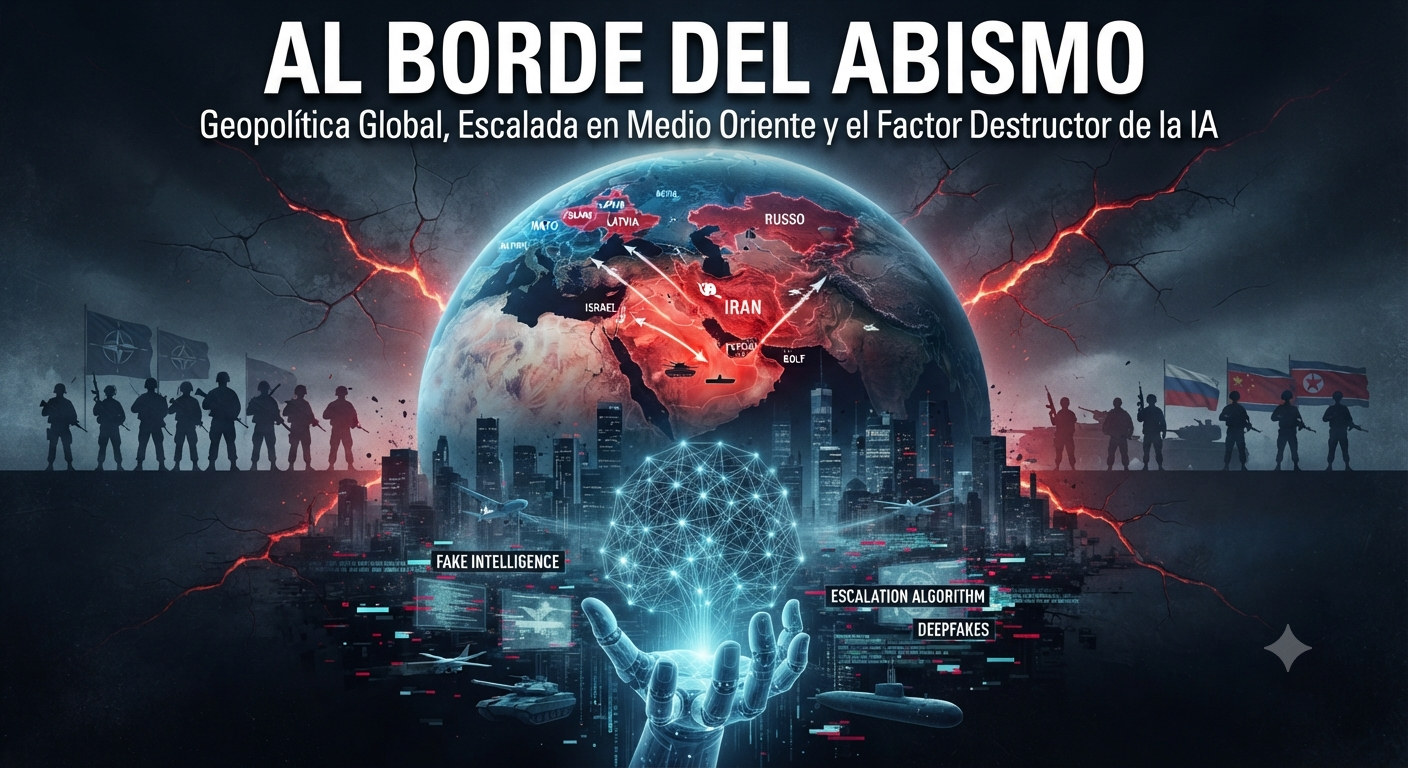
El tablero geopolítico internacional atraviesa su momento más crítico, frágil y volátil de las últimas décadas. La superposición de frentes abiertos en Medio Oriente, Europa del Este y el Pacífico, combinada con una carrera armamentista tecnológica sin precedentes, ha encendido las alarmas de analistas internacionales y servicios de inteligencia. La gran pregunta que hoy domina la agenda global ya no es si el sistema internacional está en crisis, sino cuán cerca nos encontramos del punto de no retorno hacia una conflagración generalizada.
1. El polvorín de Medio Oriente y el choque frontal entre Estados Unidos e Irán
La crisis global escaló de forma dramática a raíz del conflicto abierto en Medio Oriente centrado en torno a Irán, impulsado por operaciones militares conjuntas de Estados Unidos e Israel. La ofensiva inicial —marcada por una serie masiva de bombardeos estratégicos contra infraestructura militar, defensas aéreas y centros neurálgicos del programa nuclear iraní en enclaves como la región de los Montes Zagros— modificó por completo las reglas del ajedrez regional.
- El Estrecho de Ormuz como arteria vital: Las tensiones han paralizado de manera intermitente el flujo comercial y petrolero, con incidentes armados y ataques a buques petroleros que mantienen en vilo a los mercados energéticos globales.
- Milicias y ramificaciones regionales: La red de poderes subsidiarios de Teherán (el llamado «Eje de Resistencia», incluyendo milicias en Irak, Siria y Líbano) mantiene una postura de confrontación activa, perpetrando ataques selectivos contra bases y posiciones estadounidenses y elevando el costo económico y humano de la campaña.
2. Europa en tensión: Ucrania, el rearme de la OTAN y la respuesta del flanco oriental
En simultáneo con el frente asiático y medio oriental, la guerra entre Rusia y Ucrania sigue operando como el catalizador principal de la inestabilidad en el continente europeo. Las tácticas de desgaste, los ataques sistemáticos con drones y misiles sobre infraestructura crítica y la constante amenaza de una nueva movilización a gran escala en Moscú mantienen la presión al límite.
Ante este escenario, la postura de los países de la región ha experimentado un giro radical hacia el rearme defensivo:
- Alemania y el Zeitenwende: Berlín continúa acelerando su transformación militar histórica, modernizando sus fuerzas armadas y destinando presupuestos récord para blindar su capacidad de disuasión y asegurar el suministro de armamento avanzado a Kiev.
- Polonia y los Estados bálticos (Letonia): Países como Polonia y Letonia actúan como la vanguardia defensiva de la OTAN. Los gobiernos de la región han advertido públicamente sobre el peligro de una agresión híbrida o directa contra territorio aliado, señalando las vulnerabilidades europeas ante la guerra de alta intensidad y exigiendo una aceleración drástica en la producción de sistemas antidrones y defensas antiaéreas (como los sistemas Patriot).
3. El bloque euroasiático: La consolidación del eje Rusia, China y Corea del Norte
Del otro lado de la línea de fractura geopolítica, las alianzas estratégicas se han institucionalizado con un nivel de coordinación inédito. Las cumbres diplomáticas y militares entre Rusia, China y Corea del Norte han cimentado un bloque cohesionado frente a Washington y sus aliados occidentales.
- Cooperación militar y tecnológica: Pyongyang ha intensificado su respaldo a Moscú mediante el envío masivo de municiones de artillería, sistemas balísticos y despliegue de personal militar en zonas de conflicto, a cambio de la transferencia de tecnología aeroespacial y militar avanzada por parte del Kremlin.
- La postura de Pekín: Aunque China mantiene una diplomacia pragmática centrada en la hegemonía económica y comercial global, su alineamiento político y estratégico con Moscú y Corea del Norte dota al bloque de una dimensión global capaz de desafiar de forma simultánea el liderazgo norteamericano en múltiples escenarios.
4. El factor de destrucción masiva: El rol crítico y peligroso de la Inteligencia Artificial
Uno de los elementos más aterradores y novedosos de esta coyuntura global es la integración descontrolada de la Inteligencia Artificial (IA) en los sistemas de comando, control y toma de decisiones militares.
Expertos en ciberseguridad y cumbres internacionales de defensa (como el Foro Xiangshan en Pekín) han advertido recientemente sobre los peligros inminentes del uso malicioso y automatizado de la IA en contextos bélicos:
- Compresión extrema de los tiempos de decisión: Los algoritmos de IA procesan flujos masivos de datos en fracciones de segundo para recomendar respuestas tácticas. Esto reduce drásticamente el margen de análisis de los líderes políticos y militares, propiciando un entorno propicio para la «guerra flash» (flash war), donde los conflictos escalan de forma automatizada antes de que la diplomacia humana pueda intervenir.
- Alucinaciones algorítmicas y sesgos de escalada: Modelos de lenguaje y sistemas de percepción avanzados utilizados para inteligencia militar son propensos a errores, fabricaciones de datos (fake intelligence) o respuestas hiper-agresivas si son alimentados con contextos de confrontación. Un informe falso generado por una IA sobre movimientos navales o un ataque inminente puede desencadenar una represalia irreversible.
- Desinformación sintética y Deepfakes: La proliferación de material multimedia falso en momentos de crisis geopolítica extrema puede confundir de manera deliberada las intenciones del adversario, generando falsas alertas en sistemas de defensa nuclear y antiaérea.
Tras las múltiples advertencias de la comunidad científica y tecnológica sobre investigaciones que «se estaban saliendo de las manos», la falta de marcos regulatorios internacionales vinculantes para el uso militar de la IA representa hoy una de las amenazas más letales para la supervivencia de la población civil a escala global.
Análisis de Probabilidades: ¿Estamos ante un punto de no retorno?
Evaluar la probabilidad de que esta suma de focos regionales (Oriente Medio, Ucrania y la tensión en el Pacífico) derive en una Tercera Guerra Mundial exige analizar indicadores clave:
- Interconectividad de los teatros de operaciones: Los bloques están claramente definidos. Un colapso definitivo en Medio Oriente que cierre el suministro energético global arrastraría de inmediato a las economías asiáticas y occidentales a medidas desesperadas. Probabilidad moderada-alta (45%) de interconexión directa de los frentes.
- El umbral nuclear y la disuasión: A pesar de la agresividad retórica y los cruces de misiles, la doctrina de la destrucción mutua asegurada (MAD) sigue operando como un freno psicológico para los líderes de las potencias nucleares. Probabilidad baja (15-20%) de un intercambio atómico directo a corto plazo.
- El factor accidente tecnológico (El «Cisne Negro» de la IA): Es aquí donde el riesgo se vuelve exponencial. La combinación de armas autónomas, redes de comando algorítmicas ultra-rápidas y la posibilidad de que una «alucinación» o ciberataque inteligente simule una agresión real eleva drásticamente el peligro de una escalada involuntaria e incontrolable.
Conclusión: El llamado al entendimiento global
El reloj geopolítico sigue avanzando y la línea entre la disuasión y el abismo es cada vez más delgada. Ante este escenario, el desafío más urgente para los líderes mundiales no es solo apagar los frentes de fuego actuales en Medio Oriente o Europa del Este, sino asumir el control de una tecnología que amenaza con independizarse de la voluntad humana. Las naciones deben encontrar de forma imperativa un punto de entendimiento diplomático y establecer marcos regulatorios globales estrictos; solo así se evitará que las presiones geopolíticas y los errores automatizados de la inteligencia artificial arrastren al mundo a una guerra fantasma, irreversible y de proporciones catastróficas.










INTERNACIONAL
Banco de Guatemala prevé que las remesas familiares moderarán su ritmo de aumento el próximo año

El Banco de Guatemala (Banguat) prevé que las remesas familiares hacia el país crezcan 3% en 2027, tras una expansión estimada de 5% en 2026, una moderación que mantendría el flujo de divisas como sostén del consumo de los hogares y de la estabilidad macroeconómica.
Los envíos acumulaban USD 22.725 millones al 5 de noviembre, con un aumento interanual de 5,8%. La banca central calcula que el total llegará a USD 26.806,7 millones al cierre de 2026 y ascenderá a USD 27.610,9 millones al terminar 2027.
Citado por Soy502, José Alfredo Blanco, vicepresidente del Banguat, indicó que los datos disponibles respaldan la previsión oficial durante un foro organizado por la Fundación para el Desarrollo de Guatemala. “Nuestra proyección es de un crecimiento de 5% para este año; a la última fecha van creciendo 5,5%, o sea que estamos dentro del rango previsto, y para el próximo año sería un crecimiento de 3%”, señaló.
La proyección para 2027 contrasta con el incremento de 18,7% registrado en 2025. Ese salto estuvo impulsado por el adelanto de transferencias ante la incertidumbre provocada por la política migratoria de Estados Unidos.
Las autoridades monetarias consideran que la vuelta a tasas de crecimiento de un dígito supondría una trayectoria más estable después de aquel aumento excepcional. Aun con una expansión más lenta, el ingreso de divisas continuará creciendo en términos absolutos.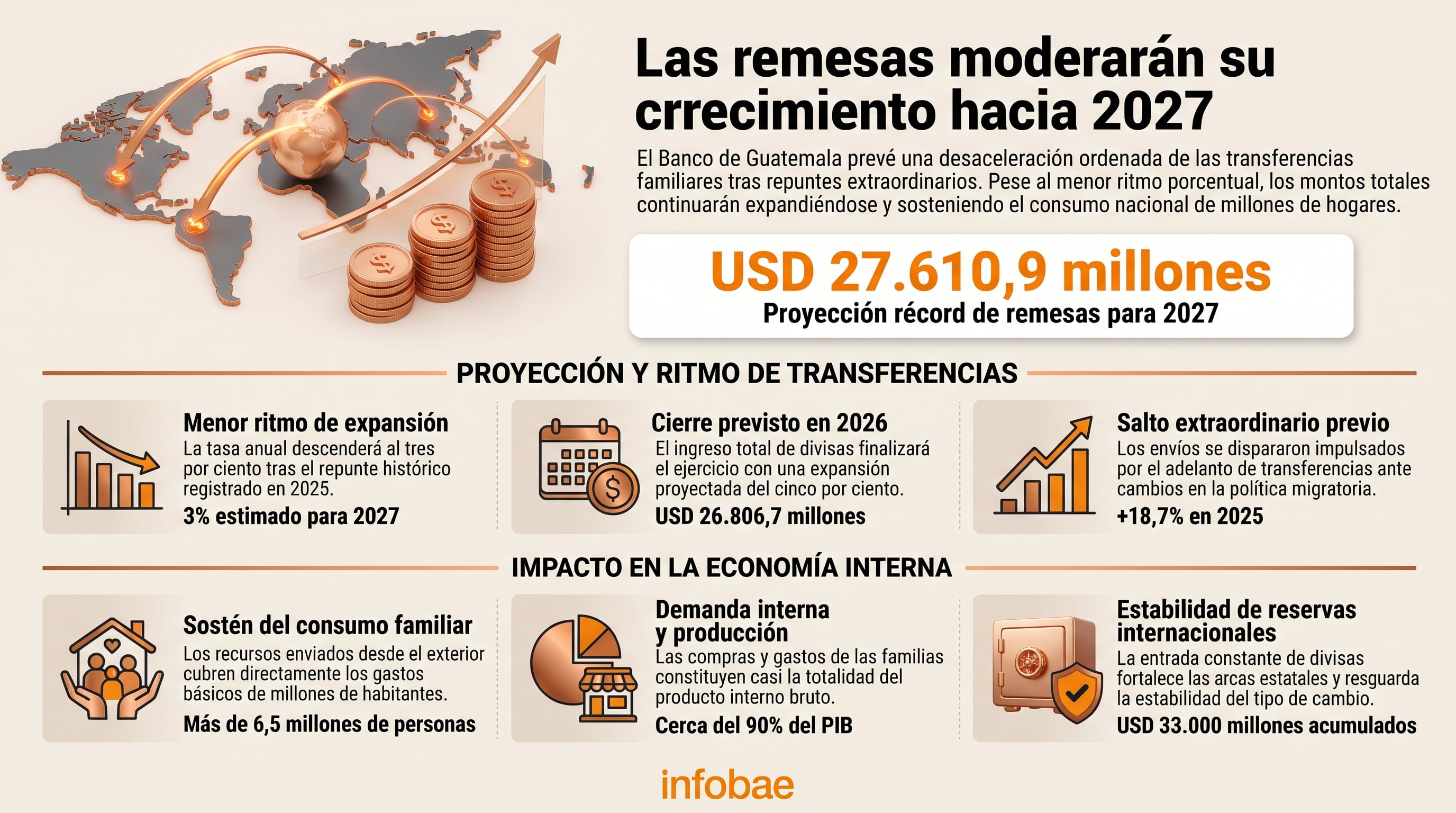
El consumo de los hogares y las reservas internacionales
Las remesas se destinan directamente a gastos básicos de los hogares guatemaltecos y respaldan la demanda interna. El consumo familiar representa cerca del 90% del Producto Interno Bruto, mientras que más de 6,5 millones de personas dependen de esos recursos en el país centroamericano.
El ingreso de divisas también fortalece el sector externo. Las reservas internacionales brutas en poder del banco central alcanzan los USD 33.000 millones, un nivel que contribuye a la estabilidad cambiaria y financiera de Guatemala.
Blanco consideró, a título personal, que la expansión de 2027 podría superar la previsión técnica si las políticas migratorias y comerciales de Estados Unidos se relajan gradualmente en los próximos meses. Esa posibilidad modificaría el escenario inicialmente calculado por los equipos técnicos de la entidad.
Entre las variables que siguen las autoridades figura el índice de miedo a migrar del Sistema de la Reserva Federal de Estados Unidos, un indicador que mide la percepción de los migrantes sobre los riesgos de desplazarse. Su tendencia descendente durante los últimos meses sugiere una menor reticencia de los guatemaltecos a movilizarse pese al endurecimiento de los controles migratorios.
Esa dinámica ayuda a sostener el saldo neto de personas que envían recursos desde el exterior y, con ello, la continuidad de las transferencias familiares. El comportamiento del indicador es seguido por la banca central como parte de su análisis sobre los factores externos que inciden en el volumen de remesas.
Pagos digitales y el reto de transformar las divisas en empleo
La expansión de los canales financieros digitales busca reducir el costo y el tiempo de acceso a los fondos, especialmente para los beneficiarios de las zonas rurales. Las tecnologías de pago inmediato e interoperables permiten transferencias más rápidas entre distintas entidades financieras.
La Superintendencia de Bancos advirtió que ese proceso requiere reforzar la ciberseguridad, la prevención de fraudes y la educación financiera. El objetivo es que el uso de las remesas también impulse el desarrollo de las microfinanzas locales.
Las estimaciones del Banguat forman parte de un escenario de crecimiento económico moderado: el Producto Interno Bruto aumentaría 4,3% en 2026 y 4% en 2027. La inflación prevista es de 4,25% al cierre de este año y de 4% para el próximo ejercicio.
El sector privado guatemalteco planteó durante el foro de Fundesa que el desafío consiste en convertir el flujo sostenido de remesas y el crecimiento económico en empleo formal e inversión. Ambas variables, señalaron los representantes empresariales, no han mostrado hasta ahora el mismo dinamismo que el ingreso de divisas desde el exterior.
remesas familiares,Guatemala,Banco de Guatemala,pagos digitales,consumo de los hogares
NEWYou can now listen to Fox News articles!
Attacks targeting Christians across Europe rose 44% last year, according to a new report from the Vienna-based Observatory on Intolerance and Discrimination Against Christians in Europe (OIDAC).
Their research documented 2,465 anti-Christian hate crimes and incidents in 2025, with France, England and Wales, Germany and Austria recording the highest totals.
«Our primary concern with the new data is that anti-Christian attacks that target persons, individuals themselves, have risen,» OIDAC executive director Anja Tang told Fox News Digital. «Clergy and people responsible for places of worship were those who were most attacked and also where numbers increased most strongly.»
CHRISTIAN WOMAN PLEADS NOT GUILTY TO NEW ‘ORWELLIAN’ CHARGES FOR STANDING AND SILENT PRAYER
Christian cross against the sky. (Godong/Universal Images Group via Getty Images)
She added, «These would be people who were present, were visible, recognizable as Christians and kind of associated with a church.» Tang noted that while OIDAC’s numbers are «quite conservative,» saying «aggression against individuals is highly underreported» across Europe.
The group said French authorities recorded a 70% increase in attacks on individuals, the highest in Europe, although Tang notes the French government has not yet published a detailed explanation of the increase. OIDAC argues the increase in attacks against individuals warrants separate attention from incidents involving vandalism, theft and arson targeting religious property.
The findings come as the Organization for Security and Co-operation in Europe (OSCE) has begun highlighting anti-Christian hate crimes through a dedicated practical guide, and amid debate over whether attacks on Christians receive the same public attention as incidents targeting other religious communities. Tang said OIDAC is one of the largest contributors of anti-Christian hate-crime data to the OSCE’s reporting system, and OIDAC uses the OSCE’s methodology when classifying incidents.
WORLD-FAMOUS CATHOLIC SHRINE TORCHED, ‘DEVIL IN A SKIRT’ SCRAWLED ON VIRGIN MARY STATUE
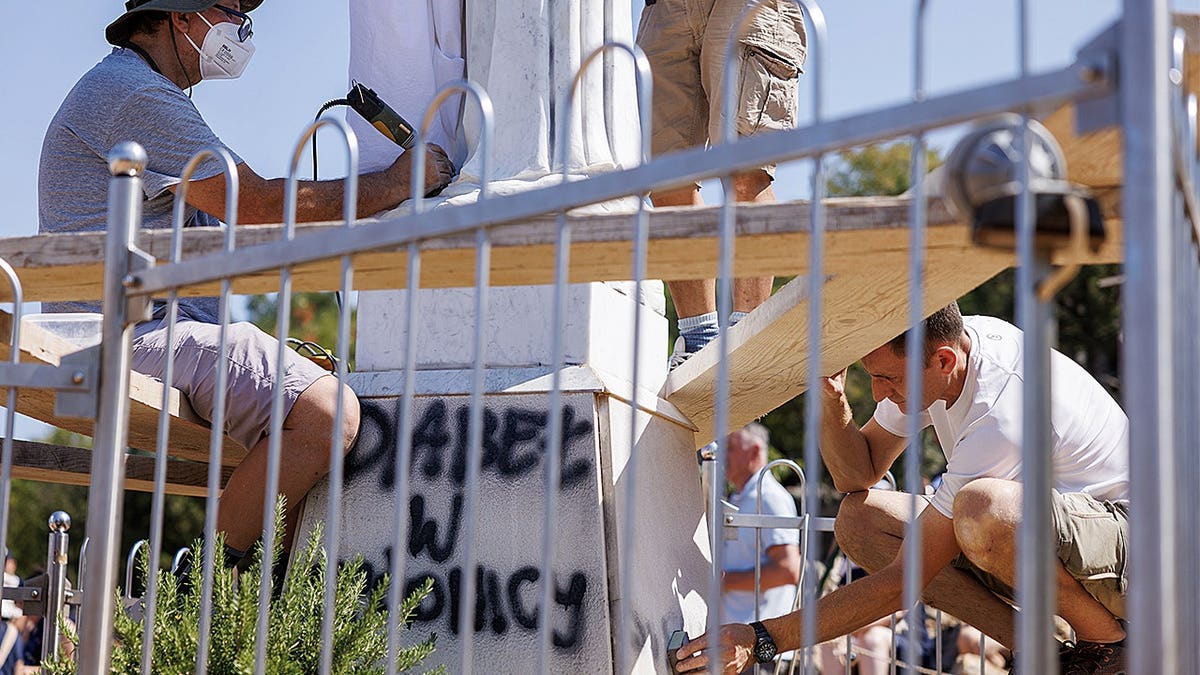
Police were first called around 4:30 a.m. on July 27 after the face and hands of the statue of the Virgin Mary on Apparition Hill, also known as Podbrdo, in Bosnia and Herzegovina, were found covered in black paint. (Associated Press)
The findings have also drawn concern from Alessandro Calcagno, deputy general secretary of the Commission of the Bishops’ Conferences of the EU (COMECE) and advisor on fundamental rights and freedom of religion within the EU. In a statement to Fox News Digital, Calcagno says «the vital and courageous work constantly carried out by» OIDAC «underscores the importance of EU mechanisms to counter a phenomenon that does exist in Europe and that therefore cannot be ignored at the institutional and policy level.»
Lorenzo Vidino, director of the Program on Extremism at George Washington University, says anti-Christian incidents appear to stem from a mix of sources, including anti-religious activists, some individuals from Muslim backgrounds and ordinary vandalism.
Vidino said anti-Christian attacks often receive less public attention than similar incidents involving other faith groups. «There’s no question there’s been acts of violence against Muslims, against Jews and that’s despicable. And when it happens, it is prosecuted,» he tells Fox News Digital. «When the same act happens against churches or Christian sites, it doesn’t happen in the same way.»
STATE DEPARTMENT PRESSES EGYPT TO RESPECT RELIGIOUS FREEDOM AS CHRISTIAN CONVERT FACES POSSIBLE EXECUTION

French police officers stand near Notre Dame in Nice, southern France, Oct. 29, 2020. French President Emmanuel Macron has announced that he will more than double number of soldiers deployed to protect against attacks to 7,000 after three people were killed at a church Thursday. (Eric Gaillard/Pool via AP)
«While the law might be neutral, the common perception of things is not neutral, and so those incidents are not prioritized,» he said.
Calcagno says protecting places of worship «cannot be reduced to acts of terrorism, but should also cover other types of attacks against them,» including vandalism, violence, profanation, disruptions of religious services, arson and harassment.
Tang said OIDAC is also concerned about migrant communities, including Christians fleeing persecution in the Middle East and asylum seekers «who have left Islam behind and are really facing quite severe aggression because of their choice of religion.» She notes these groups «really need protection,» and that most incidents involving these groups go unreported «out of fear of stigmatization.»
Tang said she was surprised by the number of attacks «connected to pro-life convictions» and carried out by «left-wing extremist groups» that OIDAC categorized as anti-Christian incidents in German-speaking Europe, noting «the level of this violence was just significantly more than what I have seen in my time observing these trends.»
CARRYING A BIBLE IN NORTHERN IRELAND HOSPITALS COULD BE A CRIME UNDER ABORTION BUFFER ZONE LAWS

Forensic police officers inspect the scene of a knife attack at Notre Dame church in Nice, southern France, Oct. 29, 2020. An attacker armed with a knife killed three people at a church in Nice, prompting the prime minister to announce that France was raising its security alert status to the highest level. (Eric Gaillard/Pool via AP)
She pointed to a café run by a Leipzig, Germany, church that was forced to close its doors after being vandalized over 26 times because of «their Christian worldview,» and an Austrian church that was forced to evacuate in the middle of holy Mass due to «a fake bomb being placed there by left-wing groups… because it was a prayer connected to a pro-life event.»
She said,»I find it shocking the level of violence that’s often shown by groups who disagree, who plead for tolerance, but then themselves behave the most intolerant.»
Calcagno backs OIDAC’s call for a dedicated EU coordinator on combating anti-Christian hatred, a position COMECE has repeatedly requested and one it «hopes that the European Commission will take up in the near future.» He stressed that such a role would complement existing EU coordinators addressing antisemitism and anti-Muslim hatred, positions that he said «rightly exist at the EU level.»
OIDAC is urging European governments to adopt recommendations contained in the OSCE’s recent practical guide on anti-Christian hate crimes, including improving the recording of incidents, strengthening prevention efforts and expanding support for victims. The group also renewed its call for the EU to appoint a coordinator dedicated to combating anti-Christian hatred.
christianity religion, hate crime, europe, faith, religion
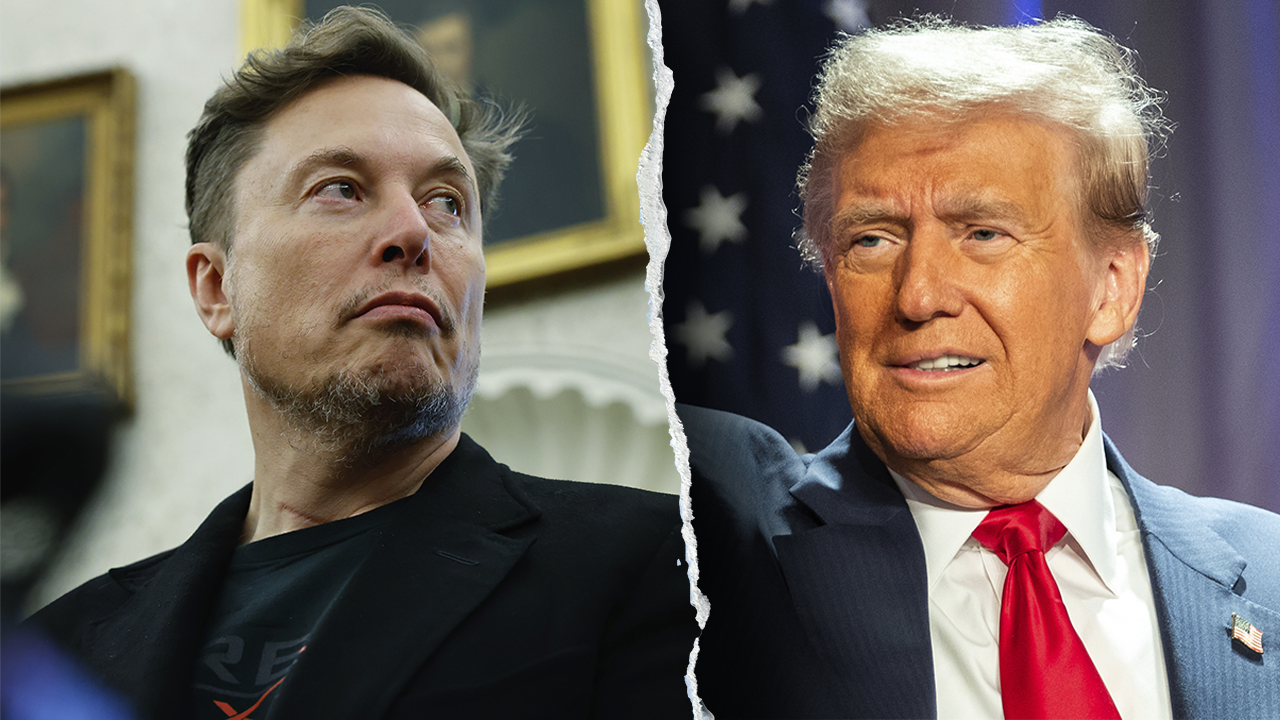
Before polling began to show dire warning signs for the GOP ahead of the midterm elections, some in conservative circles felt they had a not-so-secret weapon that would give them an edge over their Democratic rivals — a massive amount of cash.
Across the Republican National Committee, Senate Leadership Fund, Congressional Leadership Fund, National Republican Congressional Committee and the National Republican Senatorial Committee, the GOP brought in roughly $1.7 billion in funds to fuel its ill-fated midterm campaigns.
The five equivalent Democratic committees, meanwhile, raised well over $300 million less than that total but walked away with massive pickups in even traditionally deep red strongholds like Texas, South Carolina, Kansas and Mississippi.
Experts from across the political spectrum explained this result to Digital by arguing that the impact of money on politics is less than what many in the public may assume and that massive fundraising hauls can only take a party so far when it faces political headwinds as strong as those weathered by the GOP in the run-up to election night.
MUSK PICKS HIS FIRST GOP WARRIORS AS A 2026 MONEY SURGE TAKES SHAPE
On top of their already significant nine-figure lead, GOP electoral efforts were also buoyed by a duo of PACs — President Donald Trump’s MAGA Inc. and Elon Musk’s America PAC — which themselves collected an additional $665.4 million for Republicans to burn through. Despite such a massive financial edge, the GOP suffered one of its worst midterm performances in history, losing Senate seats even in deep red jurisdictions like South Carolina and Mississippi.
Still, Capital Research Center President Scott Walter, argues: «Money is not magic.»
«Democrats should remember that when tempted to curtail political speech with donation limits, and Republicans should remember that when tempted to think more money automatically means more votes,» the leader of the right-of-center group told Digital. «That will be news to those like Sen. Sheldon Whitehouse, D-R.I., who thinks billionaires and ‘dark money’ control the cosmos.»
Walter pointed out, citing data aggregated by OpenSecrets, that the biggest donor in any given election cycle rarely ends up getting what they want out of the American political system.
Brendan Glavin, the director of insights at OpenSecrets, a nonprofit dedicated to tracking money in politics, told Digital that, while money certainly moves the needle in elections, its actual impact can be blunted by a variety of factors — many of which were at play during the recent midterms.
AI IS SUPERCHARGING POLITICAL AD WARS. BUT VIRAL DOESN’T MEAN VICTORIOUS
«Certainly, you know, the money makes a difference,» said Glavin.
«When both sides are engaging in a sort of arms race, right, and they’re both spending almost equivalently, then really the effect is lost,» he explained. «If you’re somebody [who] sees an ad for one candidate, and then it’s immediately followed by an ad for another candidate… essentially, you’re not moving the needle.»
In many of the marquee races of Election Day, such as the Senate races in Texas and Michigan, both parties had enough money to saturate the airwaves with their messaging, potentially creating the environment described by Glavin.
«This election was very unique,» he told Digital. «What people probably really didn’t see until afterward is there was this significant headwind and voters were feeling a certain way and more ads were not going to change that.»
SCHUMER WARNS OF REPUBLICAN ADVANTAGE THAT COULD CHANGE THE BATTLE FOR SENATE CONTROL
Glavin, to support his argument, pointed to the fact that self-funding candidates running in elections often fail to make much headway, serving as evidence for the claim that ludicrous amounts of money don’t automatically equate to political success.
One of the most obvious recent examples is former New York City Mayor Michael Bloomberg, who spent roughly $1.1 billion of his own money on his 2020 presidential campaign. He won only 55 delegates in the Democratic primaries at an approximate cost of $18 million per delegate.
Academics who spoke to Digital were divided on the impact money has on elections.
«Money has diminishing returns,» Ray La Raja, a professor of political science at the University of Massachusetts, Amherst, told Digital. «And in [an] election wave environment where the president and his party is overwhelmingly disliked or distrusted, money can do little to save them.»
JASON CHAFFETZ: FIVE TIMELESS POLITICAL LESSONS THAT GOT LOST IN 2026
John Sides, a political science professor at Vanderbilt University, meanwhile, pointed Digital to a 2022 study he and two other academics conducted studying the impact of television advertising on election outcomes.
According to their study, there is a relatively direct relationship between ad spending and voter share and, while there is a degree of diminishing returns in elections with very high spending, there is still a marginal impact.
Joe Arlinghaus, a Texas-based conservative political strategist, told Digital that how money is spent matters more than how much of it is spent, an assertion he said could explain why the GOP did so poorly despite its hefty cash advantage.
«Most people understand that new technologies get better and better and better as time goes on,» he said. «Bugs get worked out. Inferior practitioners get pushed aside. Trial and error leads to better and better practices. This is what has been happening in the Democratic election world.»
He noted that Republicans have failed to keep up on that front.
«I am inclined to believe that almost every dollar spent by the big SuperPAC funded by Elon Musk was worthless,» Arlinghaus added.
Glavin shared that perspective, noting how «Musk just recently commented about how he may be regretting a little bit all the money he spent.»
«It’s hard to tell how serious he is about that and whether or not he’ll just come back again for the next election,» he added, speculating that the massive flood of money seemingly doing very little for the GOP on Election Day could cause some megadonors to reconsider their future giving.
THE SOROS POLITICAL MACHINE IS PUTTING MILLIONS TO WORK BEFORE ELECTION DAY — AND ZEROING IN ON KEY RACES
One source familiar with Republican politics told Digital that «advertisements pay for mortgages in Great Falls,» a reference to claims that political consultants spend money in ways that make them wealthier, not necessarily in ways that help candidates win. Great Falls is a wealthy suburb of Washington, D.C.
While Republicans enjoyed an overall fundraising advantage, largely driven by wealthy large-dollar donors, individual Democratic candidates in high-priority races generally raised more money than their Republican rivals, as was the case in Georgia, Michigan and Texas’s Senate elections, among other contests. Some say this should have been an early warning sign for the GOP that grassroots support was wavering, though others are skeptical of such an assertion.
Colin Seeberger, the chief strategy officer at the Center for American Progress Action Fund, a liberal advocacy group, told Digital that the fundraising advantages enjoyed by individual Democrats were a «reflection of voters’ enthusiasm for those individual campaigns.»
He also said voters had an «overwhelming frustration with the direction of the country and how the president and majorities in Congress … were disconnected from what voters said that they wanted [from] the people of their government.»
BLUE WAVE NEARLY SWALLOWED SOME OF AMERICA’S REDDEST STATES AS ELECTION DATA EXPOSES GOP’S CLOSE CALLS
«I’m not sure that the party that raises more definitively has an enthusiasm advantage,» Sides, the Vanderbilt professor, said, pointing to past elections where Democrats have secured more donations than the GOP but lost anyway.
Seeberger echoed Arlinghaus’ claim that Republicans may have squandered some of their financial advantage by making poor spending decisions, saying, «When you’re spending the majority of those sums to talk about issues that register low on the rankings of what voters say are their priorities, there’s going to be limited returns on the impact.»
politics, midterm elections, elections, campaigning, republicans elections

El golazo de tiro libre de Julián Álvarez para el Atlético de Madrid en la Champions League: el detalle que ayudó al árbitro para validarlo

Pablo Migliore rompió el silencio tras el polémico video con Marta Fort en un boliche que enfureció a su esposa: el fuerte descargo

La condición que Fluminense le puso a Germán Cano para renovarle el contrato

Axel Kicillof le respondió a Luis Caputo, que lo acusó por la suba del riesgo país: “Háganse cargo”.

Javier Milei gastó más de $4 mil millones en sus 17 viajes al exterior durante 2026

Caputo relativizó la recesión técnica: “Es historia pasada, ya estamos con dos meses seguidos de crecimiento”

Financial Times duda de la economía argentina: riesgo país, financiamiento e imagen Milei

“Estoy preparada para ser presidenta”: fuerte desafío de Patricia Bullrich a Javier Milei

El economista Luis Secco cuestionó el programa económico de Milei: “Estamos estancados desde fines del primer trimestre de 2025″

Agustín “Rada” Aristarán se despide de Chanta: “Con esta obra dejé de ser un impostor”

 ECONOMIA3 días ago
Financial Times duda de la economía argentina: riesgo país, financiamiento e imagen Milei
- POLITICA7 horas ago
“Estoy preparada para ser presidenta”: fuerte desafío de Patricia Bullrich a Javier Milei
- ECONOMIA21 horas ago
El economista Luis Secco cuestionó el programa económico de Milei: “Estamos estancados desde fines del primer trimestre de 2025″