INTERNACIONAL
La comisión legislativa de Finanzas del Congreso de Guatemala condiciona los aumentos presupuestarios de 2027 al avance del gasto público


La Comisión de Finanzas del Congreso de Guatemala continuó este martes el análisis del presupuesto de 2027, con exigencias sobre el ritmo de ejecución de los recursos antes de aprobar aumentos para el próximo año, cuando faltan ocho meses para las elecciones generales.
Las audiencias reunieron a autoridades de la Superintendencia de Administración Tributaria, el Ministerio de Finanzas Públicas y el Ministerio de Ambiente y Recursos Naturales.
La ejecución global del Organismo Ejecutivo llegó al 65,5% al 30 de septiembre de 2026, a menos de 90 días del cierre fiscal previsto para el 15 de diciembre. El Ministerio de Ambiente registró un 67,2% en la misma fecha, aunque proyectó cerrar el año con 96%.
La ministra de Finanzas Públicas, Deborah Alvarado, explicó que las cotizaciones y licitaciones suelen concentrarse durante el último cuatrimestre en la mayoría de las carteras estatales. El presidente de la comisión expresó preocupación por ese patrón, debido a que varios ministerios solicitan más fondos para 2027 pese al gasto rezagado.
La cartera ambiental había alcanzado una ejecución de 85,5% en 2024 y de 89,2% en 2025. La proyección para este año se ubica por encima de esos resultados, aunque la selección de proyectos de reforestación todavía no se había traducido en desembolsos.
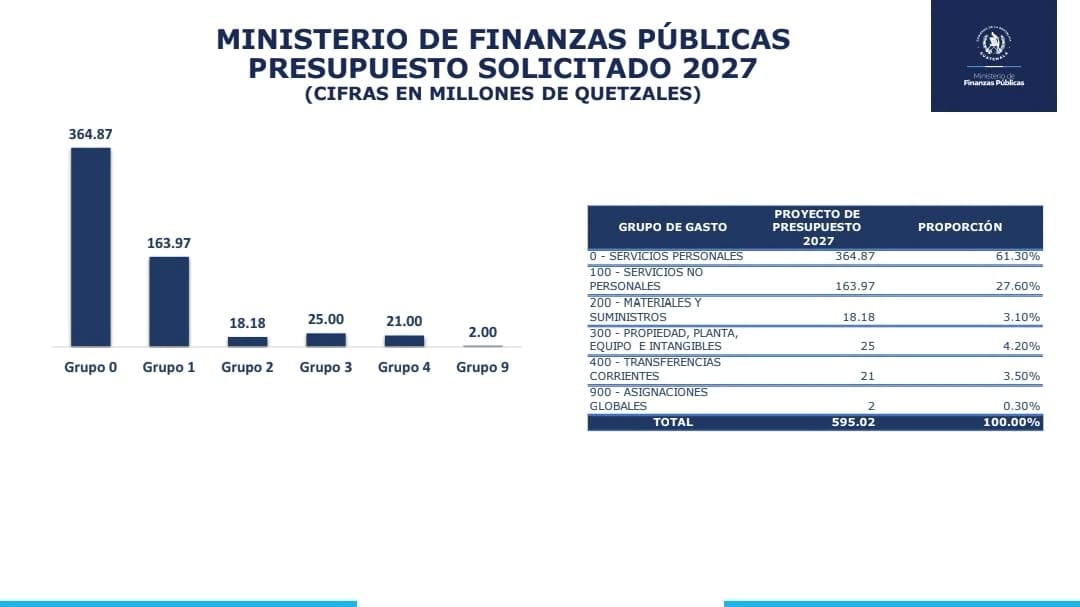
Un proyecto tecnológico sin ejecución y un nuevo crédito para 2027
El Sistema Integrado de Administración Financiera, conocido como SIAF, tenía una asignación de 29,5 millones de quetzales, pero no había ejecutado recursos hasta septiembre de 2026. Alvarado reconoció la situación durante su comparecencia ante los diputados.
Para 2027, el SIAF será reemplazado por una nueva unidad de modernización con 50 millones de quetzales, financiada mediante un préstamo del Banco Mundial bajo el convenio 9869-GT. La ministra afirmó: “2027 es el año central de inicio, ya con la ejecución propia de ese proyecto”.
El Ministerio de Finanzas Públicas también avanza en la renovación de su infraestructura tecnológica después del ciberataque ocurrido en 2023 y a comienzos de 2024. El plan incluye la construcción de un sitio alterno para asegurar la continuidad de las operaciones y un monitoreo permanente del tráfico inusual en sus sistemas.
La Superintendencia de Administración Tributaria entregó durante la sesión el saldo del fondo de crédito fiscal para exportadores, solicitado por el diputado José Pablo Mendoza. El superintendente Werner Lobayen informó que al 1 de octubre de 2026 alcanzaba 2.399,928 millones de quetzales, tras coordinar el dato con Finanzas Públicas porque no lo tenía disponible al inicio de su intervención.
Lobayen detalló que el personal de la SAT ya usa un mecanismo de doble factor de autenticación para ingresar a sus plataformas. La entidad busca extender esa medida a los 4,5 millones de guatemaltecos que utilizan la agencia virtual.
El superintendente indicó que durante el último año circularon dos informaciones sobre supuestos ataques contra la Administración Tributaria. Las verificaciones internas determinaron que ambos casos eran desinformación.
La SAT prevé ofrecer atención en cinco idiomas mayas desde 2027, además de implementar camiones de servicio móvil y puntos de atención en centros comerciales para llegar a áreas alejadas. La institución cuenta actualmente con 50 agencias tributarias en el país y mantendrá las placas de circulación de plástico mediante un convenio con Finanzas Públicas que garantiza su disponibilidad a través del Taller Nacional de Grabados.
Reforestación con demanda seis veces mayor que los fondos disponibles
El Ministerio de Ambiente y Recursos Naturales y el Consejo Nacional de Áreas Protegidas disponen de un presupuesto conjunto de 617 millones de quetzales, equivalente al 0,38% del presupuesto nacional. El ministro Edwin Castellanos pidió que los 29 millones de quetzales destinados en 2026 a transferencias para entidades externas se consideren recursos adicionales y no una reducción de los fondos operativos para 2027.
La diputada invitada Patricia Orantes respaldó esa propuesta y cuestionó que, en años anteriores, se incluyeran organizaciones no gubernamentales entre las asignaciones de la cartera. Señaló que esas entidades no necesariamente responden a la política ambiental del país.
El Fondo para los Bosques recibió 45 propuestas que suman 260 millones de quetzales, pero solo cuenta con 40 millones trasladados al Crédito Hipotecario Nacional. Según Castellanos, los proyectos solicitados permitirían proteger o reforestar 340.000 hectáreas, aunque ningún plan había comenzado a ejecutarse porque la selección aún seguía en curso.
El diputado Byron Rodríguez alertó sobre un posible uso electoral de los programas de reforestación en Retalhuleu, donde afirmó que algunos candidatos ya ofrecen entregas de árboles. “Sí me gustaría que estos recursos de reforestación no sean politizados”, planteó.
Rodríguez también pidió atención para el cierre del vertedero municipal de Coatepeque, en Quetzaltenango. Según indicó, ese depósito concentra el 80% de la basura que contamina las playas de la zona costera de San Marcos y motivó un pronunciamiento del estado mexicano de Chiapas.
Guatemala,Ministerio de Finanzas Públicas,presupuesto público,quetzales













As the U.S. works to refill its missile stockpile, it is also looking to develop new weapons for its arsenal.
«We’re going to need all three tiers of missiles. The cheap ones, the ones that are now the high-end like Patriot and then maybe some hypersonics,» said Mark Cancian, a retired U.S. Marines colonel and senior advisor with the CSIS Defense and Security Department.
The U.S. military is taking an increasing interest in hypersonic weapons, which are maneuverable and travel five times faster than the speed of sound.
«These hypersonic systems are now seen as the novel revolutionary system and the ballistic missile is seen as the archaic one,» said UC Berkeley Senior Research Scholar Cameron Tracy.
US FALLS BEHIND IN HYPERSONIC RACE AS CHINA, RUSSIA GAIN EDGE
But the weapons the military has traditionally invested in could come at a cost. Estimates from the Government Accountability Office show missiles for the Army’s long-range hypersonic weapon, the Dark Eagle, could cost more than $40 million each. As the Navy works to equip its Zumwalt Destroyers with hypersonics, the GAO puts estimates at $70 million per missile, which includes costs to develop and incorporate the necessary technologies. The GAO also notes the modernization project is two years behind schedule.
«In the long run, for example, the Army thinks that the long-ranged hypersonic weapon will become cheaper as production ramps up,» said Xiaodon Liang, arms control association senior policy analyst for Nuclear Weapons Policy and Disarmament.
Tomahawk missiles cost around $2.6 million, according to the U.S. Navy. Army budget documents show Patriot missiles cost nearly $4 million. Precision Strike Missiles or PrSMs cost $1.6 million per unit. The U.S. Navy could buy almost 27 tomahawks for the price of one hypersonic missile aboard the Zumwalt Destroyers. The Army could buy around 25 PrSMs for the price of one Dark Eagle hypersonic weapon.
«The U.S. has invested in recent years in several of the programs that are starting to become into fruition,» said Liang. «These are exquisite weapons. And I think that the military is acquiring them for exquisite purposes.»
Hypersonic weapons travel up to 20 times faster than traditional missiles and an adversary’s reaction time is thought to be six times shorter. Hypersonic speeds are also vital for both evading enemy defense systems and executing strikes. The Atlantic Council estimates 75% fewer hypersonic weapons would be needed for a mission.
US ARMY OFFERING DEFENSE FIRMS ‘CONCIERGE ACCESS’ TO TEST WEAPONS AT MILITARY RANGES
Startups are hoping to bring down some of the costs to produce hypersonic weapons with more affordable missiles and increased testing capabilities.
«The weapon itself is under $500,000, which, if you know about munitions, that’s incredibly cheap,» Castelion co-founder and CEO Bryon Hargis said.
The Army and Navy are investing in Castelion’s Blackbeard hypersonic weapon, which the company says is designed for mass production.
«It is a story about hypersonics and what they can provide in terms of a weapon, but it’s really a story of American manufacturing,» Hargis said. «The company is focused on providing America options to have that middle deterrence layer, and we’re doing that through production.»
This year, Castelion began building what it says will be the largest dedicated hypersonic weapon production factory in the U.S. Project Ranger is expected to produce thousands of Blackbeard weapons annually. Those will eventually be used to fill Castelion’s various contracts, such as integrating the weapons into the U.S. Navy’s F/A-18 Super Hornet Jets, incorporating the system into the U.S. Army’s HIMARS and deploying Blackbeard on unmanned surface vessels.
«The advantage of a hypersonic system is that it goes very far, it gets there quickly and it’s highly survivable because of that maneuverability. And that’s important for achieving deterrence because it’s hard to shoot down,» Hargis said.
Hypersonic weapons remain mostly in Earth’s atmosphere. The missiles are maneuverable during flight and can strike a target quickly, in 15-30 minutes from around 1,725 miles away.
US REBUILDING WEAPONS STOCKPILE COULD DELAY ORDERS FROM ALLIES
«If you don’t know what the target would be initially, unlike a ballistic missile where you can calculate where it’ll land, you might misinterpret, for example, an incoming strike as a decapitation attempt. And that would be very concerning,» Liang said.
Developers say the U.S. speaks with other countries about missile launches and what the intended targets are. But there are other concerns that hypersonic maneuverability could lead to inaccuracy.
«Technologies do tend to improve over time as testing and especially as experience with use builds up, but there are pretty important physical constraints on the performance of these systems,» said Tracy.
Defense contractor Rocket Lab is working with the War Department to improve hypersonic missile capabilities through an increasing number of test launches.
INSIDE AMERICA’S LASER REVOLUTION AS THE MILITARY NEARS BIG BATTLEFIELD BREAKTHROUGH
«With our HASTE program, what we have enabled is low-cost, high-frequency hypersonic and missile defense testing. And when you can say that you can get that cheaper and faster, now you’re looking at more of a shots on goal approach to demonstrating capability of the technology insertion cycle,» Rocket Lab Vice President of Global Launch Services Brian Rogers said.
Rocket Lab’s HASTE is a suborbital test bed launch vehicle that provides flight test opportunities for the government to advance hypersonic and suborbital system technology development. The vehicle is derived from Rocket Lab’s Electron rocket, which has launched nearly 100 missions.
«Rather than saying we need to be stuck in an analysis environment, and then it’s a very rigorous test campaign that costs a lot of money and involves a lot people, now you can say we’re planning 12 tests this year. We don’t have to bet the farm on any one of them, which allows us to take more risk and really move the needle in terms of technology development,» Rogers said.
The U.S. military has never used a hypersonic weapon but has explored deploying its Dark Eagle to the Middle East.
«I would be very surprised if we used them and would be even more surprised if we used it extensively because of the small number of missiles that exist and the concerns already about the munitions stockpile,» Liang said.
military tech, spending, military, politics, armed forces topics
INTERNACIONAL
Pope Leo diagnosed with lung cancer after surgeons remove part of right lung, Vatican says

NEWYou can now listen to Fox News articles!
Pope Leo XIV underwent a procedure at Agostino Gemelli University Hospital in Rome to remove a small nodule on his lung Tuesday, the Vatican said.
The 71-year-old pontiff underwent thoracic surgery to remove the lower lobe of his right lung and doctors confirmed he had lung adenocarcinoma, a form of lung cancer, according to a statement released by the Holy See Press Office.
The diagnosis was confirmed through a tissue examination conducted during the operation, consistent with findings from preoperative tests, the Vatican said.
The pope spent approximately three hours in the operating room, although the surgery itself lasted about 90 minutes.
Doctors said the procedure was successful and there were no complications.
POPE LEO ANNOUNCES TUMOR ON LUNG, SURGERY PLANNED IN ‘NEXT FEW DAYS’
Pope Leo XIV is welcomed by Health Director Andrea Cambieri as he arrives at the Gemelli University Hospital for an operation to remove a lump from his lung in Rome on Tuesday. (Alberto Pizzoli/AFP via Getty Images)
Leo awoke normally following surgery and, after a brief observation period, returned to his room on the hospital’s 10th floor, according to the statement from Dr. Luigi Carbone and Professor Stefano Margaritora.
«Doctors found a small lump in the lung,» Leo said after an Angelus address at St. Peter’s Square on Monday. «It was identified at a very early stage and well situated.»
«The doctors consider it appropriate to intervene and so, following their advice, I decided to have surgery to remove it,» he continued. «The surgery is already scheduled for the next few days. I thank you for your spiritual closeness and I rely on your prayer.»
The Vatican’s latest statement confirmed that the surgery involved the removal of the lower lobe of the pope’s right lung using a video-assisted technique.
POPE LEO XIV BEGINS HISTORIC 4-DAY VISIT TO FRANCE

Pope Leo XIV steps out as the first American pope in history at the Vatican on May 8, 2025. (Vatican Media)
The announcement comes as a surprise for the American-born pontiff, who has no previously known health problems and is known for maintaining an active lifestyle.
POPE LEO VISITS SITE OF MIRACLE CURES, MEETS PEOPLE WHOSE UNEXPLAINED HEALINGS STUNNED DOCTORS
Leo regularly plays tennis and swims at the papal summer retreat in Castel Gandolfo, according to The Associated Press.
Archbishop Ronald Hicks of New York offered his support to the pope, saying that the Holy Father is «in our prayers.»
«We thank God that the surgery on Pope Leo was, by all accounts, successful, and that he continues his recovery and recuperation,» Archbishop Hicks said. «I know that I join with people from all corners of this archdiocese, across the country, and around the world in keeping the Holy Father in our prayers.»
The pope is also scheduled to embark on a major international trip from Nov. 6–17, with planned stops in Uruguay, Argentina and Peru. It remains unclear whether his surgery and recovery will affect those travel plans.
UKRAINE’S ATTACKS ON RUSSIA ARE PUSHING PUTIN CLOSER TO NEGOTIATING TABLE, TRUMP NATO AMBASSADOR SAYS

Pope Leo XIV delivers the Angelus prayer in St. Peter’s Square at the Vatican on Sunday. (Gregorio Borgia/AP Photo)
In addition to addressing his health, Leo used his Sunday remarks to renew his appeal for peace in war-torn Ukraine, warning that the conflict continues to inflict suffering far beyond the country’s borders.
«The war in the martyred Ukraine continues to create suffering, even beyond its borders, especially in the poorest countries, where many people depend on the exports of cereals and grains,» the pope said.
Fox News’ Courtney Walsh and Stephen Sorace contributed to this report.
pope leo xiv, roman catholic, vatican, religion us, christianity religion, world
INTERNACIONAL
De trabajar en una cadena de comida rápida a espiar para Rusia: la historia del agente que terminó preso en Ucrania

No afirma ser el espía más brillante de Rusia. Sin embargo, Alexsander de verdad quería el trabajo. Nació en Ucrania pero creía en Rusia. Y era difícil salir adelante con sus turnos en McDonald’s. Así que cuando dos agentes rusos se le acercaron con la oferta de un trabajo de espionaje a destajo, aceptó de inmediato.
Estaba en Francia en ese momento, dijo. Los rusos querían material comprometedor de un funcionario de gobierno occidental. Parte de lo que hizo Alexsander fue verdadero espionaje de campo, como ver dónde vivía el funcionario. Gran parte fueron búsquedas en Google. Alexsander no necesitó mucho usar disfraces.
“Tenía un par de gafas de sol negras, pero rara vez las usaba. Solo cuando brillaba el sol”, dijo con ironía.
El trabajo de Alexsander cambió cuando Rusia invadió Ucrania en 2022. Se unió a un grupo de Facebook para extranjeros que se enlistaban en el ejército ucraniano. Se ganó la confianza de otros miembros. En viajes a Ucrania, informó a Rusia sobre la ubicación de las fuerzas ucranianas, sus operaciones de asalto planificadas y sus datos personales. Sus acciones, dijo, provocaron la muerte de soldados.
Entonces, todo le pasó factura. Mientras conducía por el norte de Ucrania, Alexsander fue detenido en un puesto de control. Un guardia le pidió ver su teléfono. Había olvidado borrar un mensaje a su jefe ruso.
“No digo que sea un buen espía”, me dijo Alexsander. “Me atraparon”.
Rusia

Vacaciones 2026: qué cambia con la reforma laboral y qué hay que saber antes de planificar el descanso

Pentagon pushes hypersonic weapons production as startups slash costs

Pope Leo diagnosed with lung cancer after surgeons remove part of right lung, Vatican says

"Me equivoqué por completo". El guionista de GTA 5 y Red Dead Redemption 2 asume la culpa por un juego de Rockstar que no tuvo el éxito que merecía

Uñac se lanzó como precandidato a presidente del peronismo con un spot: “Hay mucho desánimo en la sociedad”

Sergio Uñac lanzó su precandidatura presidencial: del guiño del kirchnerismo al desafío a Kicillof en la interna del PJ

Carlos Tevez busca juntar a Cristiano Ronaldo y Leo Messi en su partido de despedida

Régimen Penal Juvenil: la Defensoría Oficial busca que la Justicia porteña revise la baja de la edad de imputabilidad

Democrats are changing their transgender message. Republicans say they’re just flip-flopping