INTERNACIONAL
Blue wave battered GOP strongholds across America, but one red state held the line


On a night when Democrats made major gains across the country, South Dakota emerged as one of the few Republican strongholds where the GOP largely held its ground — even as Democrats made inroads around Sioux Falls.
Republican Gov. Larry Rhoden won roughly 63.5% of the vote Tuesday, nearly matching President Donald Trump’s 63.4% performance in 2024. Republicans also swept the state’s other statewide races and maintained overwhelming control of the legislature, despite Democrats picking up four seats.
Rhoden’s victory came against Democrat Dan Ahlers, who described himself as a «conservative Democrat» and campaigned on affordability, rural healthcare, education and other kitchen table issues. But his moderate pitch did little to narrow the GOP’s commanding statewide advantage, with Ahlers finishing at just 36.5% of the vote.
South Dakota’s results stood in contrast to several other deeply Republican states where the GOP maintained control but saw its margins shrink considerably. In Idaho and Wyoming, Republican gubernatorial candidates won comfortably but finished with smaller shares of the vote than President Donald Trump secured in 2024. South Dakota’s gubernatorial result, by comparison, remained virtually unchanged.
DESANTIS CALLS GOP MIDTERM LOSSES ‘EXTINCTION-LEVEL EVENT’ — AND EXPLAINS WHY FLORIDA SURVIVED
David Jolly, the Democratic nominee in Florida, ran a campaign with similar themes to Ahlers’ — pointing to the fact that he used to be a Republican and, like Ahlers, prioritized affordability and healthcare while on the campaign trail. Jolly cut the GOP’s vote share to just 50%, roughly six points below the party’s 2024 presidential performance. Tennessee’s Democratic gubernatorial nominee inflicted a similarly sharp cut on Republicans’ margins by employing a similar strategy.
Even down the ballot, South Dakota Republicans largely held their ground, though Democrats managed to flip four legislative seats in the Sioux Falls area, marking their first legislative gains in the state since 2008.
The losses were concentrated around the state’s largest city, where a growing population and a less conservative political landscape have created more opportunities for Democrats, according to University of South Dakota political scientist Julia Hellwege. Opposition to large data-center projects also resonated with some voters in the area, according to a local Democratic official.
«South Dakota Republicans did well because we took on the issues that mattered to the people of our state and delivered real results for them,» South Dakota’s Republican House speaker, Jon Hansen, told Digital. «The bottom line is that we ran on tackling the issues that mattered to people, and then we delivered real results for the people on those issues. Not just talk, not just excuses, but real solutions. It’s what our people deserve, and it’s what we delivered for them.»
VOTER POLL: 2026 MIDTERM ELECTIONS USHER IN A BLUE WAVE AS DEMOCRATS WIN CONTROL OF CONGRESS
Hansen pointed to property tax cuts enacted by the legislature, regulations aimed at preventing utility costs from rising amid data center build-outs, curbing corporate eminent domain and balancing the state’s budget, among other efforts, as crucial in the South Dakota GOP’s success on Tuesday night.
South Dakota’s unemployment rate has been hovering around 2% since last September, roughly half the rate of the United States at large. Average wages also increased by about 4% in the state over the course of 2025. All of this occurred as South Dakota remained one of the most affordable states in the country, though rising rent costs outpaced wage growth in 2025, according to data collected by Realtor.com.
At the federal level, Republican Sen. Mike Rounds cruised to victory with 60.5% of the vote, though the GOP wasn’t entirely immune to the national shift. South Dakota Attorney General Marty Jackley won the state’s at-large congressional seat with roughly 64% of the vote, down from the 72% fellow Republican Dusty Johnson secured in 2024.
South Dakota’s relatively modest legislative losses stood in sharp contrast to other Republican strongholds. In Texas, Democrats flipped 21 GOP-held state House seats, while Republicans in New Hampshire were on track to fall from the 222 House seats they won in 2024 to just 107.
DEMOCRATS SEIZE MAJORITY OF GOVERNORS’ OFFICES IN ELECTION-NIGHT SHIFT
Republicans in Arizona, Pennsylvania, Wisconsin, Georgia, North Carolina and Michigan all lost control of at least one chamber of their state legislatures on Tuesday night.
«Those Republicans who lost on Nov. 3 did so because their actions (or inaction) didn’t match their promises to voters. We didn’t have that problem in South Dakota under our leadership,» South Dakota’s GOP House Majority Leader, Rep. Scott Odenbach, told Digital.
politics, south dakota, gubernatorial, republicans, midterm elections











El peor error es pensar que perder en la política es una tragedia y que el fracaso se vuelve permanente. La victoria, por otra parte, también tiene sus consecuencias negativas, ya que siempre viene acompañada de la soberbia y la codicia (del poder o de lo que sea). La política latinoamericana es lamentablemente una cuestión de vida o muerte, o de libertad o cárcel, y esto lo hemos logrado arrastrar a cada lugar donde hemos podido latinoamericanizar la política, en su peor forma generalmente. La hostilidad irascible es una constante en la interacción sistémica y, como si ello no fuera lo suficientemente negativo, las redes han otorgado la capacidad de insultar, descalificar, discriminar y agredir de forma amplificada, lo que confiere una nueva dimensión a la participación política. El sistema político y la sociedad viven permanentemente alcanzando puntos de no retorno en la enemización y en los discursos de odio. La frase de que “el poder desgasta al que no lo tiene” se ha transformado en “el poder liquida al que no lo tiene”.
El funcionamiento pendular actual de los sistemas políticos, con variables dramáticas de alternancia, ha evitado, de alguna manera, encontrar condiciones o situaciones de continuidad y, por el contrario, ha transformado el sistema en un permanente juego de ajustes de cuentas. Se espera que los actores políticos aprendan cuando les toca estar en el llano para no repetir atrocidades o errores, pero no, ocurre exactamente lo contrario, se vuelve con más soberbia y con empatía inexistente, los protagonistas vuelven más dueños de la verdad que nunca.
Esto tiene consecuencias muy directas respecto a cómo se ejerce la gobernabilidad y cómo aquellos que asumen el poder tienen más vocación de destrucción de cualquier construcción anterior que de asegurar las dinámicas de continuidad institucional que son tan vitales para alcanzar estrategias sostenibles, así como para hacer funcionar proyectos a largo plazo.
Esto nos lleva a efectos colaterales poco beneficiosos, como condiciones especiales de persecución e inhabilitaciones políticas, procesos electorales enrarecidos y la neutralización del funcionamiento institucional.
La persecución política es uno de los principales problemas. Estamos viviendo en una época en la que las violaciones de Derechos Humanos se presentan como solución a los problemas que nos afectan, ya sean la falta de seguridad, los malos resultados económicos, la ineficiencia institucional, la pobreza, el desempleo o la desigualdad. La política nos muestra que es exactamente lo contrario y que el fracaso es prácticamente una certeza, lo cual se vuelve evidente cuando las políticas económicas sobre seguridad o gobernabilidad comienzan a afectar los derechos humanos de la población. Y el resultado más probable de eso es que se sufran duros reveses políticos. Podemos ver el ejemplo de las megacárceles o de las políticas antimigratorias, donde la eficiencia de los resultados iniciales se ve completamente desvirtuada por la falta de garantías o del debido proceso, lo cual deteriora variables sociales y económicas. Aparte de la manifiesta y patética ineficiencia de tener que cancelar la presunción de inocencia de 120.000 personas y negarles el debido proceso, para resolver algo que con el arresto, respetando el debido proceso de 5.000 liderazgos, cabecillas y actores de peligrosidad especial, se solucionaba. El peor engaño es pensar que la situación anterior era tan mala que cualquier variable represiva u opresiva constituye una solución al respecto, una política represiva quizás resuelva un tema puntual, pero disfuncionaliza tantos otros que las soluciones macro que necesitan los países se ven atrofiadas. Para quienes son subdesarrollados, es una condena letal.
Los fracasos anteriores son una oportunidad para construir y no para destruir. La hostilidad manifiesta contra la realidad no es la forma de resolver los problemas que contiene la misma; esos problemas requieren de una comprensión profunda y desarrollo de capacidades en una interacción continua que permita el cambio y no el agotamiento o destrucción de lo existente.
Los procesos electorales han sufrido también, no solamente las variables de persecución, sino también inhabilitaciones, creación de expedientes, asesinatos, ataques o presiones varias e indebidas sobre las autoridades electorales, destituciones, violaciones varias de independencia funcional de autoridades electorales o de la justicia.
En esa frenética alternancia que ha habido entre derecha e izquierda en el hemisferio se podría haber comprendido que las derrotas reflejan la frustración de la gente con la incapacidad y los malos resultados y la corrupción y etc., etc., y que cuando se tiene la oportunidad de volver, o de acceder al poder no es necesario ni el resentimiento ni la hostilidad ni la agresividad hacia los adversarios políticos, sino solamente gobernar bien, de buena fe y con el más pleno respeto de los derechos de todos.
Las victorias electorales dan algo que es tan importante como lo es la oportunidad de servir a la gente, la gente no vota para hacer a nadie rico o más rico, no vota para elegir a nadie para que haga negocios o más negocios para sí mismo, no vota a nadie para que desaparezca gente, o se lleven preso al vecino por votar diferente, o para que se asesinen periodistas, o se discrimine a mujeres, población LGBTQI, afrodescendientes, ni a migrantes, ni para cometer actos de antisemitismo, ni de islamofobia. En realidad, se vota para tener más derechos y poder ejercer más derechos y por ello la gente ha votado derecha, izquierda, derecha, izquierda, derecha para ver si alguien se aviva y con honestidad, inteligencia, capacidad de trabajo construye país/patria para todos. Y eso quizás pueda inspirar a su sucesor en la lógica de alternancia para que refuerce los ciclos positivos y no el insalubre ejercicio de la venganza personal y política.
Luis Almagro/Director Observatorio de Democracia de CASLA
Elections,South America / Central America,Elections / Voting
INTERNACIONAL
American war hero details dire living conditions US troops face as Hegseth taps him to ‘fix’ it
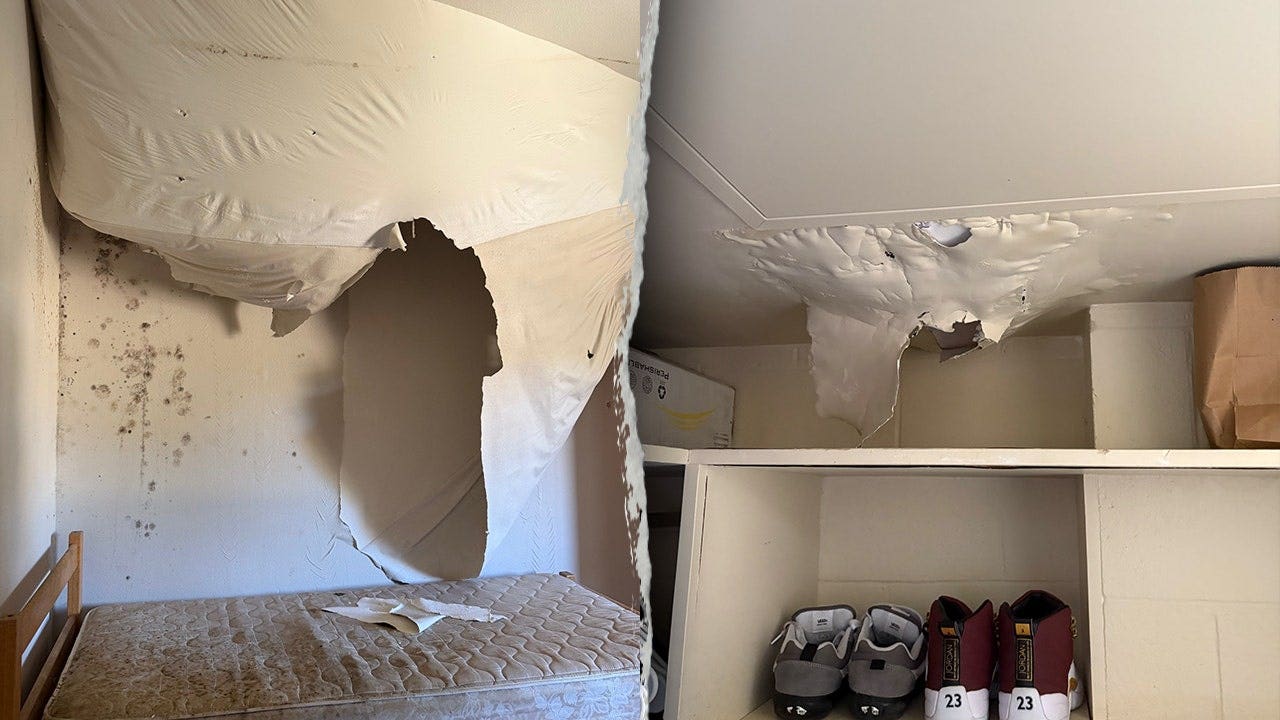
Some troops have gone a year without hot water. Others are sleeping in their cars to escape barracks without air conditioning. And some are asking for little more than drywall, spackle and paint so they can make repairs themselves.
Those are among the conditions Medal of Honor recipient Dakota Meyer says he has encountered while touring military installations on a mission from War Secretary Pete Hegseth: Fix a barracks system plagued by decades of neglect.
«I would tell you that there’s only a couple that I’ve seen that are good,» Meyer told Digital in an interview Thursday.
Meyer, who serves as senior adviser to the Pentagon’s Barracks Task Force, has visited more than eight installations across the Army, Navy, Air Force and Marine Corps since taking on the assignment and plans to visit 30 before the end of the year.
«What I thought was gonna be a professional job very quickly turned into personal,» Meyer said.
DAKOTA MEYER TALKS SERVICE, BLASTS CONTROVERSIAL DESIGN FOR GLOBAL WAR ON TERROR MEMORIAL
At one installation, Meyer recalled asking a 19-year-old service member what she would change about her living conditions if she could «wave a magic wand.»
«If she could just have a hot shower,» Meyer recalled. «It’s absolutely heartbreaking.»
The Pentagon’s barracks problems long predate Hegseth and have survived repeated attempts at reform.
A sweeping 2023 Government Accountability Office investigation documented serious health and safety hazards and found that the department lacked reliable information about the condition of its own barracks, could not determine how much of its facilities spending went toward them and provided insufficient oversight.
Congress and the military services have since committed billions toward improvements, including initiatives ranging from the Marine Corps’ «Barracks 2030» to a Navy overhaul of unaccompanied housing. Yet serious problems persist. As of this year, 12 of GAO’s 31 recommendations remained outstanding.
Hegseth has sought to centralize the effort under a department-wide task force and accelerate improvements, with Meyer saying the secretary has made clear that identifying problems is no longer enough.
«The secretary has made it clear to me he doesn’t expect me to observe this, study it, or to make it better. He expects me to fix it,» Meyer said. «And that’s exactly what we’re going to do.»
Meyer, the only Medal of Honor hero to reenlist after receiving the award, said one of his first requests was for Hegseth to give the task force an «authoritative role,» rather than simply create another layer of oversight.
The goal, he said, was to give the team the ability «to go out and make decisions, to be able to have impact, to be able to make change, and to be able to direct where that funding goes and how fast it gets to our service members.»
EXCLUSIVE: HEGSETH TO DOUBLE CUTS TO GENERALS, ADMIRALS IN MAJOR PENTAGON SHAKEUP
Meyer argued the problem is not simply a lack of money. Funding shortfalls, continuing resolutions and years of deferred maintenance have all contributed, he said, but so have layers of contracting rules and bureaucracy that can slow even relatively basic repairs.
A separate watchdog review found the Pentagon facing a $285 billion maintenance backlog across its broader military facilities’ portfolio, underscoring the scale of the department’s infrastructure challenges.
«When you look at the contracting aspect, it’s easier for people to say no,» Meyer said.
Funding is also part of the problem, according to Meyer, who pointed to Congress’ failure to enact full-year defense appropriations for fiscal 2027. The Pentagon is currently operating under a continuing resolution through Dec. 11, which generally funds ongoing programs at prior-year rates while lawmakers negotiate a broader spending package.
«When you can’t get a budget, when you’re waiting on Congress to pass a budget, to be able to get the funding there, I mean, that is a huge issue,» Meyer said.
But he also argued that the Pentagon has too often measured progress by how much money has been obligated or put under contract, rather than whether troops actually see improvements in their living conditions.
«Our service members don’t, they don’t live in our budget lines,» Meyer said. «They live in the rooms that those budget lines are there to impact.»
For Meyer, that has meant getting out of Washington and hearing directly from the troops living with the consequences.
«You can’t fix these problems or understand these problems by standing on the carpet of the Pentagon,» he said. «You’ve got to go out there and talk to these service members.»
What he has heard, Meyer said, is striking partly because of how little troops are asking for.
«They’re asking for a hot shower. They’re asking for a place to wash their clothes. They’re asking for a door that locks. They’re asking to be able to go to sleep in a place that doesn’t have mold. I mean, they’re asking for light bulbs.»
«They’re willing to be part of the solution,» he added.
Meyer stopped short of placing the blame solely on installation commanders, saying many want to improve conditions but have been constrained by a system that has normalized poor barracks for years.
«I think this is a multidimensional problem, and it’s complex,» he said. «I think that you have commanders out there that want to take care of their service members. I’ve seen that across the board. But … they still have to have the ability to do that.»
Meyer was far less forgiving of previous Pentagon leadership, arguing that years of investments and reform initiatives had failed to translate into adequate living conditions for troops.
«Don’t kid yourself,» Meyer said. «In the past … it wasn’t a priority to the leadership.»
Previous administrations and military leaders did launch barracks improvement efforts and devoted billions of dollars to construction, renovation and maintenance, even as government watchdogs continued to document serious deficiencies.
Meyer said Hegseth has made the issue a personal priority.
«We have the Secretary of War who is putting people first, and he’s not just saying that, he’s doing it through his actions,» Meyer said.
Meyer has put his own name on whether the latest effort succeeds, saying previously that if the barracks aren’t fixed, there is «only one person to blame» — himself.
Asked what «fixed» would actually look like, Meyer offered a simpler standard than any Pentagon metric.
«People are living in places that I would be okay for my daughters living in,» he said.
military, secretary of defense, defense, pete hegseth, spending, politics
INTERNACIONAL
Top Gulf official offers glimmer of hope on Trump-Iran nuclear talks as threat of war hangs over region
NEWYou can now listen to Fox News articles!
DUBAI, United Arab Emirates — A senior United Arab Emirates official says he is cautiously optimistic about negotiations between the United States and Iran, citing progress through Qatari mediation over the past days, even as fears of renewed military confrontation continue to grip the Middle East.
«We see some progress. … We hope that both sides will be able to reach a point where they will start building trust and engaging in a way to avoid the war, to find a political solution. … I am a little bit optimistic, but I don’t exclude the other option,» Dr. Ali Rashid Al Nuaimi, chairman of the Defense, Interior and Foreign Affairs Committee of the UAE’s Federal National Council, told Fox News Digital in an exclusive interview.
His remarks came as Reuters reported on Nov. 5 that Iran had submitted a new nuclear proposal to Washington through Qatar. Tehran, however, continued to insist that the U.S. meet seven conditions before negotiations could proceed, including sanctions relief and an end to the American naval blockade.
IS THIS TRUMP’S LAST ‘LAST CHANCE’? CEASELESS STRING OF BROKEN CEASEFIRES FUELS DOUBT OVER IRAN DEAL
Dr. Ali Rashid Al Nuaimi, chairman of the UAE Federal National Council’s Defense, Interior and Foreign Affairs Committee, speaks to Fox News Digital in Abu Dhabi about the Iranian threat, regional security and prospects for diplomacy. (Efrat Lachter/Fox News Digital)
President Donald Trump has not ruled out further military operations, while Iran has threatened broader retaliation if fighting resumes.
For the UAE, which endured thousands of Iranian missile and drone attacks earlier this year, the possibility of a diplomatic breakthrough offers hope. But its leaders are making clear that hope cannot replace preparedness.
«We plan for the worst. We hope for the best. … We always make sure that we are ready to deal with all the challenges or the threats,» Al Nuaimi said.
That combination of optimism and caution was evident during Fox News Digital’s reporting trip across the Emirates, where daily life appeared remarkably normal despite the uncertainty surrounding the country.
On an evening in downtown Dubai, restaurant terraces were packed, tourists filled the streets and crowds gathered around a fountain show set to music that moved between Arabic songs and Western pop hits.
Businesses were operating, international visitors were arriving and the city continued to project an image of prosperity and openness.
IRAN’S STRAIT OF HORMUZ SCHEME COULD DERAIL ONE GULF NATION’S BRIGHT FUTURE

Crowds gather to enjoy an evening fountain show in downtown Dubai, United Arab Emirates, as daily life continues despite the threat of renewed regional conflict with Iran. (Efrat Lachter/Fox News Digital)
The contrast was just as striking in Abu Dhabi, where Fox News Digital attended the opening of ADIPEC 2026, one of the world’s largest energy conferences, against the backdrop of continuing tensions with Iran and the disruption of the Strait of Hormuz.
Days before the conference, ExxonMobil and Chevron executives had canceled their planned appearances because of security concerns, Reuters reported on Oct. 29.
Yet inside the exhibition halls, delegates from around the world gathered to discuss investment, announce partnerships and explore technological solutions to the energy crisis.
It was a demonstration of the UAE’s determination to keep its economy moving while preparing for a security environment that has changed dramatically.
TRUMP ADMIN THREATENS IRAN WITH ‘CONSEQUENCES’ AS ALLIES CONVENE AMID THREATS OF POST-ELECTION ESCALATION
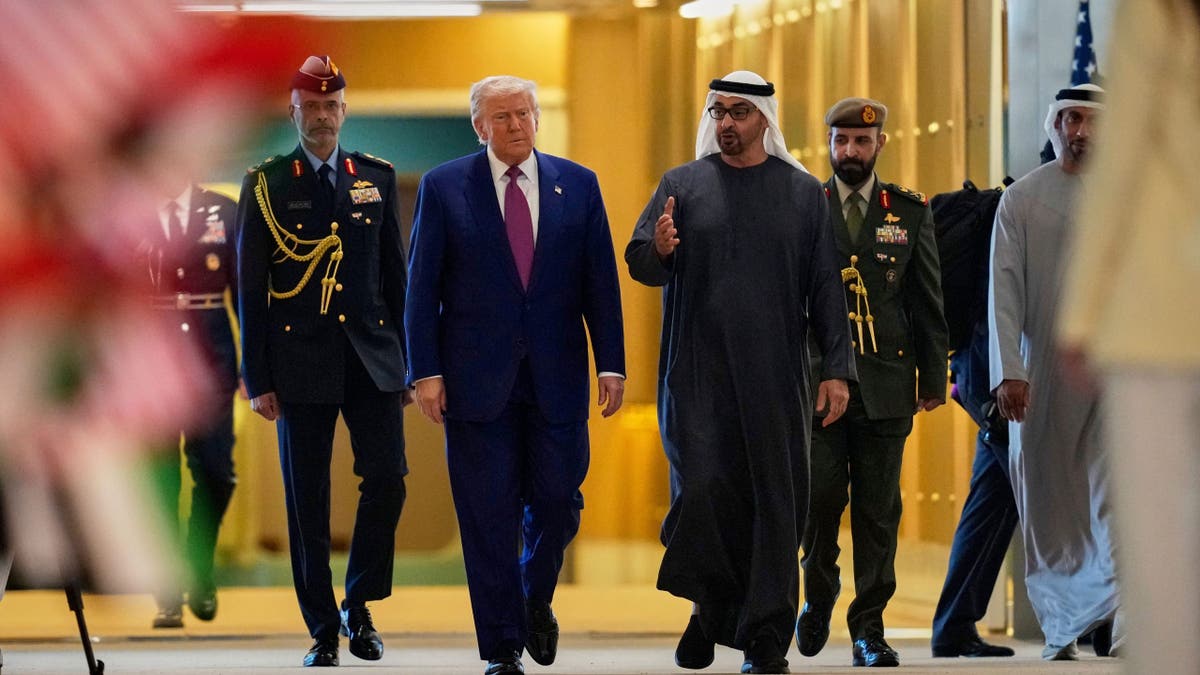
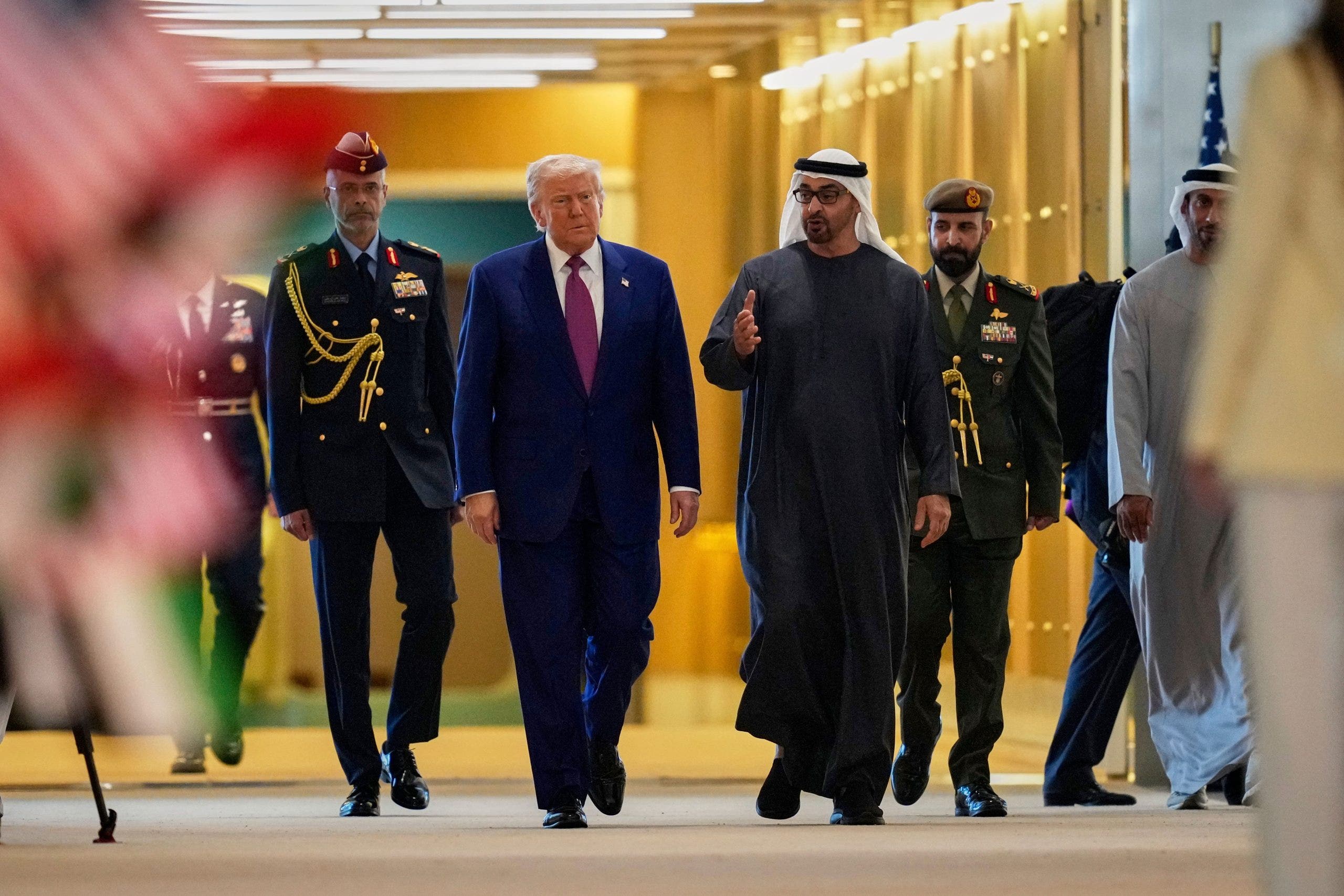
United Arab Emirates President Sheikh Mohammed bin Zayed Al Nahyan greets President Donald Trump at Abu Dhabi International Airport on Thursday, May 15, 2025. (AP Photo/Altaf Qadri)
Preparing for another confrontation
The UAE has already paid a significant price for its proximity to the conflict.
More than 3,000 Iranian missiles and drones targeted the Emirates during the war, according to figures cited by The Associated Press on Nov. 2. The attacks caused casualties and damage to civilian infrastructure.Although no new Iranian attacks had targeted the UAE since May, the threat of renewed confrontation has kept the country on alert.
Al Nuaimi emphasized that while the UAE considers itself a nation committed to peace, it will not hesitate to protect its population.
«Every nation, when it is attacked, [has] the right to defend their people, their sovereignty, their nation,» he said.
But he also drew a clear distinction between the Iranian regime and the Iranian people, who are repressed by the regime. «The Iranian people deserve to be respected, accepted. They have great values, great civilization, and they are our neighbor.»
MIDDLE EAST TAKES CENTER STAGE AT UN AS REGIONAL LEADERS CONFRONT IRAN WAR, GAZA AND HOUTHI THREAT

A man walks past a housing compound as a tall plume of black smoke ascends following an explosion in the Fujairah industrial zone on March 3, 2026. Iran’s strikes on Gulf neighbours since February 28, following the US-Israeli attack, forced the UAE to shut its airspace, blindsiding travellers who thought they were headed to one of the region’s safest holiday destinations. (Fadel SENNA / AFP via Getty Images)
A partnership beyond any administration
Despite the confrontation with Iran, Al Nuaimi rejected the suggestion that the UAE’s relationship with Washington should be judged primarily through the current conflict or any particular U.S. administration.
«We don’t see our relationship with the United States through these conflicts, through security and defense. No, it’s a partnership. It’s a strategic partnership. It is a sustainable partnership. … Our main partnership is with the United States as a nation, with the American people.»
He emphasized that the relationship extends across education, medicine, technology, energy and investment, and is intended to endure political changes in Washington.
«We don’t look at the United States through a certain administration. Our engagement and partnership with the United States … [is] with the nation. It’s with the people. … We have the flexibility and the ability to [adapt] and engage with any administration.»
The comments come at a sensitive time for Gulf governments, whose security relationships with Washington have become more consequential as Iran threatens regional infrastructure and international shipping.
At ADIPEC’s opening ceremony on Nov. 2, Dr. Sultan Al Jaber, the UAE’s minister of industry and advanced technology and chief executive of state-owned energy giant ADNOC, emphasized that the country’s ability to withstand the crisis was the result of years of preparation. «We did not write our resilience playbook during this disruption. We wrote it years before,» Al Jaber told the audience.
The message was consistent with what officials and analysts repeatedly emphasized during Fox News Digital’s visit: the UAE intends to remain a reliable international partner despite the possibility of another regional escalation.
GULF COUNTRIES STRONGLY CONDEMN IRAN’S DRONE ATTACK ON BAHRAIN AS RISING TENSIONS THREATEN MOU

The exhibition floor at ADIPEC 2026 in Abu Dhabi, United Arab Emirates, where global energy companies showcased new technologies and innovations amid growing concerns over energy security and regional instability. (Efrat Lachter/Fox News Digital)
Security beyond military defense
In a separate exclusive interview with Fox News Digital in Dubai, Mohammed Baharoon, director general of the Emirati research center B’huth, argued that the confrontation with Iran has fundamentally expanded the meaning of national security.
«Our resilience now becomes our deterrence,» Baharoon said.
The UAE’s security strategy, he explained, involves far more than intercepting missiles and drones. It also means ensuring reliable energy supplies, food security, functioning infrastructure and the ability to maintain international commerce during a crisis.
For Baharoon, the conflict cannot be understood as a single confrontation between Washington and Tehran.
He described three interconnected wars: the initial American-Israeli campaign against Iran, Tehran’s subsequent attacks on Gulf states and Iran’s disruption of international shipping through the Strait of Hormuz.
«The second war was Iran’s attack on the GCC, because that attack was also unprovoked,» Baharoon said, referring to the Gulf Cooperation Council.
He described the disruption of shipping as a separate confrontation with the global economy, arguing that the consequences extend to countries far removed from the Middle East.
Despite his criticism of Tehran, Baharoon rejected the idea that Iran should permanently be treated as an enemy. Its population, economic potential and geographical importance, he argued, could make it an important contributor to regional prosperity if its leadership shifted away from confrontation.

Attendees gather at ADIPEC 2026, one of the world’s largest energy conferences, held in Abu Dhabi, United Arab Emirates, Nov. 2–5, 2026, as industry leaders discuss global energy security, technological innovation and the growing role of artificial intelligence. (Efrat Lachter/Fox News Digital)
For the UAE, the challenge now is to prepare for the possibility of another confrontation without abandoning the diplomatic and economic relationships it has spent decades building. The crowded streets of Dubai and busy exhibition halls of Abu Dhabi reflect a country determined to move forward, even as the threat of war remains close. Whether the latest negotiations with Iran lead to a breakthrough or another round of fighting, the Emirates is betting that its resilience will allow it to weather the next crisis without losing sight of the future it is trying to build.
war with iran, middle east, national security, geopolitics

Melody Luz reveló el recuerdo más doloroso de Mariana Nannis que quebró su relación con Alex Caniggia: “Le mostraba mi panza y ella…”

Gimnasia de Mendoza e Independiente Rivadavia jugarán el clásico en el cierre del Torneo Clausura: hora, TV y formaciones

Los proyectos en el Congreso de Estados Unidos que podrían presionar sobre una eventual asistencia financiera de Trump a Milei

Así es la vida, campeón, a veces se gana y a veces se pierde

¿Era Vlahovic un ‘9’ para el Barça?

El mensaje del Papa que inquieta a Milei, el impacto de la derrota de Trump y la advertencia de los mercados

La oposición cuestionó la suspensión de embargos a las pymes y criticó el plan económico: “Llegaron tarde”

Milei parte nuevamente a España y en el gobierno dicen que no bajará el tono de sus críticas a Pedro Sánchez

Sindicatos del transporte y de la industria se diferencian de la estrategia de la CGT y deciden acciones propias

El embajador de EEUU ratificó el apoyo de Trump a la Argentina tras la derrota republicana: “Nuestro compromiso es firme”

 POLITICA2 días ago
El embajador de EEUU ratificó el apoyo de Trump a la Argentina tras la derrota republicana: “Nuestro compromiso es firme”
- INTERNACIONAL2 días ago
Santiago Peña renunció a la Presidencia de Paraguay por el escándalo del Ueno Bank
- INTERNACIONAL2 días ago
Cámara periscópica de 50 MP y tecnología NXTPAPER en pantalla AMOLED: así es el nuevo smartphone que llega a Perú