
INTERNACIONAL
Iran calls on Houthis to prepare to cut off Red Sea gateway — can the terror group do it?


Iran threatens to close Strait of Hormuz, impacts global oil prices
FOX Business’ Lauren Simonetti details escalating tensions in the Strait of Hormuz as Iran threatens to block shipping lanes and impose new conditions. This move follows reports of vessels being struck by Iranian drones since March. The uncertainty surrounding the vital waterway has led to a 2% drop in crude oil prices, affecting the global market.
NEWYou can now listen to Fox News articles!
Iran has reportedly instructed Yemen’s Houthi terrorists to prepare to close a critical Red Sea gateway if the United States attacks Iranian power infrastructure, Reuters reported, a threat experts warn could sharply disrupt global shipping even if the group cannot completely seal the waterway.
«This threat should be taken seriously,» Nadwa Al-Dawsari of the Middle East Institute told Fox News Digital. «With recent escalation and U.S. strikes on Iran, Tehran has already signaled that the Bab al-Mandab could become part of its response.»
Three sources told Reuters on Thursday that Iran’s leadership had discussed using the Houthis to shut the Bab el-Mandeb Strait and recently conveyed the request to the group. A source close to the Houthis said missiles and drones had been deployed near the waterway and that the group was awaiting an order to begin attacking shipping.
IRAN-BACKED TERROR PROXY HOUTHIS THREATEN FRESH ATTACKS AFTER YEMEN AIRPORT STRIKE
A Houthi follower during a pro-Iran demonstration, in Sanaa, Yemen, April 6, 2026. (Khaled Abdullah/Reuters)
Edmund Fitton-Brown, a former British ambassador to Yemen and senior fellow at the Foundation for Defense of Democracies, warned in a recent Fox News Digital report that a full resumption of the Houthi maritime campaign could trigger wider fighting.
«It will be interesting if the Houthis do go all in, and resume their campaign against Red Sea shipping with full intensity,» Fitton-Brown said. «This will draw international anger and likely result in Israeli and U.S. strikes on Sana’a and Hodeida.»
«There is potential for a general escalation if this happens, albeit one in which the allies have a clear military advantage,» he added.
Al-Dawsari said the Houthis have continued developing the weapons needed to threaten the narrow shipping corridor despite largely refraining from maritime attacks over the past year.
«While the Houthis have largely refrained from attacking shipping for about a year, they have continued to advance their maritime capabilities, including missiles, drones and sea mines,» she said. «They may not be able to fully close the strait, but they could significantly disrupt shipping and raise costs and risks for commercial traffic.»
US CLAWS BACK KEY CONCESSION TO IRAN AFTER FRESH ATTACKS ON COMMERCIAL SHIPS IN STRAIT OF HORMUZ

This photo released by the Houthi Media Center shows Houthi forces boarding the cargo ship Galaxy Leader on Nov. 19, 2023. (Houthi Media Center via AP)
But the group would not necessarily need to physically control the waterway. Its previous missile and drone campaign demonstrated that repeated attacks — or even a credible threat of them — can push major shipping companies to reroute vessels around Africa, driving up insurance, fuel and freight costs.
The Bab el-Mandeb connects the Gulf of Aden to the Red Sea and Suez Canal, making it one of the world’s most important maritime choke points. The consequences of renewed attacks would be especially severe because Iran has already disrupted shipping through the Strait of Hormuz, historically the principal route for roughly one-fifth of global energy supplies.
A substantial volume of Gulf oil has consequently been redirected through Saudi Arabia to the Red Sea port of Yanbu. Reuters reported that the Bab el-Mandeb route now carries approximately 7% of global energy supplies and that Saudi Arabia has shifted about 70% of its energy exports through Yanbu.
The reported instructions also raise new questions about how much control Tehran exercises over major Houthi military decisions.

In this image provided by the U.S. Navy, the amphibious dock landing ship USS Carter Hall and amphibious assault ship USS Bataan transit the Bab al-Mandeb strait on Aug. 9, 2023. (Mass Communications Spc. 2nd Class Moises Sandoval/U.S. Navy via AP)
«Any decision to escalate in the Bab al-Mandab would be strategic and tied more to the interests of Iran and the Axis of Resistance than to Houthi interests alone,» Al-Dawsari said. «Decisions of this magnitude are likely coordinated through the Axis’ joint operations room under IRGC oversight.»
A source close to the Houthis claimed representatives of Iran’s Islamic Revolutionary Guard Corps in Yemen would control the timing of any move against the strait, Reuters reported.
The latest warning follows earlier Houthi threats against maritime traffic. In the June 12 report, Fox News Digital reported that the group had announced a complete ban on Israeli-owned ships in the Red Sea and declared them «legitimate targets.»
EXPERT WARNS OF ‘GENERAL ESCALATION’ OF FIGHTING IF HOUTHIS RESUME RED SEA CAMPAIGN

A satellite imagery shows Bab el Mandeb Strait, a key shipping waterway and the gateway to the Red Sea, in this handout picture dated July 12, 2026. (Nasa Worldview/Handout via Reuters)
A State Department spokesperson told Fox News Digital at the time that the actions of Iran and the Houthis were «unacceptable» and «dangerous,» warning that they could inflame regional tensions and further disrupt global supply chains.
U.N. Secretary-General António Guterres has «repeatedly condemned» Houthis attacks against ships in the Red Sea and called on all parties Thursday to avoid further escalation, his spokesperson, Stéphane Dujarric, told Fox News Digital.
«Any disruptions or attacks would endanger the safety and security of seafarers, freedom of navigation and the stability of global supply chains and have a negative impact on the economic and humanitarian situation in Yemen and beyond,» Dujarric said. «The Secretary-General underscores that U.N. Security Council Resolution 2722 (2024) must be fully respected in its entirety,» he said on the resolution condemning at least two dozen Houthis attacks on commercial vessels since November 2023 and demanding an immediate end to the attacks.
The emerging threat has also renewed scrutiny of the Iranian weapons networks that helped build the Houthis’ missile and drone arsenal.
Amr Al-Bidh, foreign affairs chief of the Southern Arabian Transitional Council, said that the reported threat also exposed broader failures in the handling of Yemen’s security crisis. «The fact that individuals convicted of trafficking Iranian weapons to the Houthis and leading terrorist operations are now being released under a U.N.-brokered deal only underscores how poorly the Yemen crisis is being managed,» he said, «the main beneficiary of this vacuum is Iran, as seen in its credible threat to close the Bab al-Mandab Strait.»
In a July 15 letter obtained by Fox News Digital, the Southern Arabian Transitional Council formerly known as the Southern Transitional Council, a southern Yemeni separatist movement that seeks greater autonomy or independence for the territory of the former South Yemen, warned U.N. Special Envoy for Yemen Hans Grundberg that a U.N.-facilitated detainee agreement may include people the council says were convicted of assisting Iranian weapons transfers to the Houthis.

A missile is launched from a warship during the U.S.-led coalition operation against military targets in Yemen, aimed at the Iran-backed Houthi militia that has been targeting international shipping in the Red Sea, in this handout picture released on Jan. 12, 2024. (US Central Command via X/Handout via REUTERS/ File Photo)
CLICK HERE TO DOWNLOAD THE FOX NEWS APP
An annex identifies individuals the council alleges were members of a cell that smuggled drones, aviation fuel and heavy and medium weapons from Iran to Sanaa.
The Office of the U.N. Special Envoy for Yemen said it received the letter only after the agreement had already been signed and stressed that it does not determine which detainees are released.
«We have received the letter after the agreement was signed,» spokesperson Ismini Palla told Fox News Digital. «The United Nations – as well as the International Committee of the Red Cross (ICRC) – do not decide who is released and who remains in detention. Our role is limited to mediating the negotiations and ICRC leads on the implementation of the release operation.»
Palla added that «the names of those released are proposed and agreed between the parties under the framework of the Stockholm Agreement on prisoners’ exchange of 2018.»
Fox News Digital reached out to the State Department and the Iranian Mission to the United Nations on the latest developments.
Fox News’ Paul Tilsley and Reuters contributed to this report.
war with iran, terrorism, national security, conflicts













INTERNACIONAL
La CIA crea un grupo de trabajo secreto sobre Cuba mientras Trump presiona a La Habana


Artificial intelligence agents could go rogue and hack companies, warns former Pentagon official
Former Pentagon A.I. Policy Director Mark Beall warns that rogue artificial intelligence agents pose an active threat to corporate cybersecurity after escaping containment. Beall addresses recent comments from OpenAI CEO Sam Altman regarding the rapid approach of technological singularity. He emphasizes the urgent need for robust regulatory frameworks to prevent unchecked autonomous software from executing sophisticated cyberattacks against critical infrastructure.
NEWYou can now listen to Fox News articles!
Revelations of OpenAI and Anthropic artificial intelligence agents hacking third parties has drawn the «serious concern» of Sen. Lisa Blunt Rochester, D-Del., who is now seeking answers from the two businesses incorporated as public benefit companies (PBC) in her state.
In separate letters dated Thursday to OpenAI CEO Sam Altman and Anthropic CEO Dario Amodei, viewed by Fox News Digital, Blunt Rochester has requested detailed timelines, model instructions, internal approvals, security logs and complete transcripts from the companies’ cyber evaluations.
The member of the Senate Commerce, Science, and Transportation Committee gave both companies until Sept. 6 to respond.
AI KILL SWITCH BILL COULD SHUT DOWN ROGUE MODELS
Sen. Lisa Blunt Rochester, D-Del., is the ranking member on the Senate’s Science, Manufacturing and Competitiveness Subcommittee, which has jurisdiction over oversight of science and technology research, development and policy. (Annabelle Gordon/Reuters)
«These incidents mark the first publicly confirmed instances of a frontier AI model autonomously launching unauthorized attacks on real people and companies, underscoring the urgent need for federal oversight of frontier AI systems,» Blunt Rochester wrote to OpenAI CEO Sam Altman and Anthropic CEO Dario Amodei, calling for federal testing standards, containment rules and disclosure requirements for evaluations of powerful AI systems.
Her concern follows another letter Monday, as first reported by Fox News Digital, from a coalition of 15 red-state attorneys general warning Altman to preserve documents and halt certain high-risk cybersecurity tests after an experimental artificial intelligence agent allegedly escaped a controlled environment and carried out a multi-day hack into outside computer systems.
One day later, the United Kingdom’s AI Security Institute (AISI) identified 19 cases in which AI agents took actions outside the authorized scope of testing. Two involved OpenAI’s GPT-5.6 Sol, while 17 involved Anthropic’s Mythos 5.
OPENAI’S SAM ALTMAN WANTS TO NEGOTIATE A 5% STAKE IN COMPANY FOR US IF COMPETITORS AGREE TO KEY PROVISION
«Anthropic models’ repeated attacks on third parties with no knowledge of, or role in, Anthropic and AISI’s evaluations demonstrate an alarming pattern of malicious behavior,» Blunt Rochester’s letter to Amodei read. «Furthermore, the successful attempts by these models to gain unauthorized internet access across multiple sandbox testing environments meant to be cut off from the public internet highlight serious issues with Anthropic’s testing partnerships and procedures.
READ THE AISI REPORT – APP USERS, CLICK HERE:
«To be clear, ‘misunderstanding[s]’ and ‘misconfiguration[s]’ with sandbox partners are unacceptable when the stakes are this high.
«We cannot wait for a more consequential incident before establishing federal testing standards, containment requirements, and disclosure obligations for frontier model evaluations.
«Left unaddressed, these gaps could allow a future model, potentially one with greater capability or less oversight, to compromise critical infrastructure, financial systems, or sensitive data.»
These investigations carry a distinct Delaware dimension: OpenAI and Anthropic are organized as Delaware PBCs — legal structures that allow them to operate for profit but require their directors to weigh more than shareholder returns.
KARR BLUETOOTH FLAW EXPOSES 2.2M CARS TO THEFT RISK
Under Delaware law, a PBC board must balance three things: its stockholders’ financial interests, the interests of people materially affected by the company’s conduct and the specific public benefit written into the company’s charter.
READ THE LETTER TO OPENAI – APP USERS, CLICK HERE:
«This incident marks an important moment for AI safety and we take the questions raised by the Attorneys General seriously,» OpenAI wrote in a statement to Fox News Digital after Monday’s letter from the state AGs.
«We are conducting a thorough review along with external advisors and with oversight from the Safety and Security Committee of the Board of Directors. Once the review is complete, we will share a technical report with the Attorneys General and other relevant government authorities and publish our findings publicly.»
Blunt Rochester wants records related to the AI agent hacking now, too.
CLICKLOCK MAC MALWARE LOCKS APPS UNTIL YOU GIVE IN
«I appreciate that OpenAI has published preliminary findings, is coordinating with third parties on remediation, and is reviewing its approach to model testing,» she wrote to Altman, adding to Amodei, «I appreciate Anthropic’s voluntary review of its cybersecurity evaluations and public disclosure of the findings, and I encourage other companies to follow suit.
«However, these incidents demonstrate the potential risks of deploying pre-release models internally, particularly when safeguards are reduced, even when strictly for testing and evaluation,» she wrote to both CEOs.
READ THE LETTER TO ANTHROPIC – APP USERS, CLICK HERE:
OpenAI disclosed in July that GPT-5.6 Sol and an internal prototype escaped an internal sandbox while their normal cybersecurity restrictions were disabled. The models allegedly accessed Hugging Face’s database and other services, launched roughly 17,000 attacks, used stolen credentials and exploited at least one previously unknown vulnerability.
A separate test conducted by contractor Irregular allegedly allowed an OpenAI model onto the public internet because of a configuration error. The model mistook a real website for a target in a simulated hacking challenge and exploited a live security vulnerability.
«AISI identified 19 instances in which an agent took unsanctioned action beyond the scope of the evaluation. Seventeen of the 19 instances involved Anthropic’s Mythos 5; two involved OpenAI’s GPT-5.6 Sol,» Blunt Rochester wrote.
The institute’s most serious findings included an agent attempting to place malicious code into a widely used open-source project on GitHub, creating fake identities to pressure a human maintainer, contacting real people and leaving public instructions that other AI systems could use to continue the operation. The maintainer rejected the code, and investigators reported finding no resulting real-world harm.
PAIDWORK BREACH EXPOSES 23M USER RECORDS

OpenAI CEO Sam Altman talks to reporters following a meeting with Sen. Bernie Sanders, I-Vt., in Washington, D.C., on June 3, 2026. (Anadolu via Getty Images)
Blunt Rochester’s Anthropic letter separately cites three incidents in which Claude models allegedly gained unauthorized internet access and attacked three undisclosed organizations during cyber evaluations conducted with standard safeguards disabled.
Two of the Anthropic models reportedly recognized that they had reached the open internet and were interacting with real targets but continued their attacks.
«It is particularly concerning that Anthropic’s first identified security breach dates back to April 2026 and was not identified until three months later,» Blunt Rochester wrote to Amodei.
«This is precisely the kind of emergent, autonomous behavior and offensive cyber capability that Congress, the intelligence community, and experts have repeatedly warned could outpace existing safeguards and could pose a severe threat to the safety and security of all Americans,» she added in both letters.
FOX NEWS POLL: MOVE OVER BIG BROTHER, VOTERS SEE BIG TECH AS GREATER THREAT TO US

Anthropic co-founder and CEO Dario Amodei speaks at the «How AI Will Transform Business in the Next 18 Months» panel during Inbound 2025 at Moscone Center in San Francisco, Calif., on Sept. 4, 2025. (Chance Yeh/Getty Images for HubSpot)
The requested records go beyond basic incident reports. Blunt Rochester is seeking the prompts and full instructions given to the models, time-stamped accounts of how the breaches unfolded, the identities or positions of officials authorized to reduce safety controls and an explanation of why automated monitoring did not immediately detect and stop the activity.
She also asked whether federal agencies were notified, whether the companies are confident they discovered the full extent of the unauthorized access and whether previous incidents went unreported.
Blunt Rochester has a federal oversight basis for pursuing the information. She represents the state whose corporate law governs both companies and is the ranking Democrat on the Senate’s Science, Manufacturing and Competitiveness Subcommittee, which has jurisdiction over oversight of science and technology research, development and policy.
Her position does not make her Delaware’s corporate regulator — that role falls principally to state officials and courts — and the companies’ PBC status does not automatically give a U.S. senator access to their internal files.
Blunt Rochester could, however, use the companies’ responses — or a refusal to respond — to press for hearings, legislation or committee-level compulsory action.
«Given the significance of this incident, transparency with Congress is essential to ensure that the oversight and safety frameworks governing increasingly autonomous, cyber-capable AI systems keep pace with their capabilities,» Blunt Rochester’s letters concluded.
Fox News Digital reached out to Altman and Amodei for comment on Blunt Rochester’s requests Thursday morning.
artificial intelligence, security, tech, politics, topics
INTERNACIONAL
William Kemmler, el primer hombre en ser ejecutado en la silla eléctrica: «Creo que voy a un buen lugar y estoy listo para partir»
Todo el mundo estaba tan nervioso, que el tipo que iba a morir intentó tranquilizar a sus verdugos. “Tranquilos, todo va bien”, les dijo. Nada iba bien. Temblaban el director de la prisión, los guardias, los dos médicos y el capellán; quienes debían preparar al condenado para morir, también temblaban. Eran las 6.38 de la mañana del 6 de agosto de 1890, hace 136 años, en la prisión de Auburn, Buffalo, en el estado de New York. Con esa misma aparente tranquilidad, William Kemmler, de 40 años, había mirado a los 17 testigos y a sus verdugos y les había dicho: “Caballeros, les deseo buena suerte. Creo que voy a un buen lugar y estoy listo para partir.” Y a su verdugo: “Tranquilo, no tengo apuro”.
Con manos temblorosas, uno de los guardias, de apellido Durston, le cortó el pantalón a la altura de las rodillas y fijó un electrodo sobre su pierna derecha. Luego le ajustó otro hilo eléctrico a lo largo de la columna vertebral. Kemmler se acomodó en la silla para asegurarse que su espalda quedara bien apoyada sobre el cable y después anunció: “Estoy dispuesto”. No lo estaba: cambió de idea e hizo señas de que quería hablar. Pidió que comprobaran si los electrodos estaban bien colocados y si las correas que lo ataban a aquella máquina de la muerte estaban ajustadas porque él las notaba un poco flojas. Minutos después, Kemmler se había convertido en el primer ser humano ejecutado en la silla eléctrica.
La utopía es estúpida, pero persigue al hombre desde los tiempos bíblicos: hallar la manera de matar a un ser humano sin dolor, sin sufrimiento o, en todo caso, con la velocidad y la precisión del rayo. La pena de muerte lleva unos cuantos siglos de hipocresía, de espanto y, con perdón, de progreso que a veces también viste el ropaje del horror. La hoguera era terrible, pero se suponía que mataba rápido; el hacha parecía más efectiva según fuesen la habilidad e intenciones del verdugo, pero no lo era; la guillotina mecanizó la decapitación, pero no evitó ni el dolor ni el sufrimiento; la horca pareció un sistema de ejecución más “humano” a fines del siglo XIX porque intentaba matar por rotura de cuello, que a menudo derivaba en una larga y dolorosa asfixia; el garrote presumía de velocidad y ausencia de dolor; el fusilamiento, ceñido en general al ámbito militar y al de las guerras, requería de un tiro de gracia para acabar con la agonía del condenado o de la víctima; después de la silla eléctrica, la cámara de gas surgió como otro método “científico” y tal vez indoloro de matar al prójimo: fue un fracaso; y tampoco dio resultado en el siglo XXI, heredada del siglo anterior, la inyección letal. Los ensayos de matar sin dolor, sin sufrimiento y rápido pueden que hayan sido más “piadosos” para verdugos y testigos: los condenados siempre lo pasaron terrible.
Kemmler también la pasó espantoso. Como diría Gilbert Chesterton, ni con la mejor de las voluntades podría decirse de él que era un gran hombre. Era un vendedor de fruta en los suburbios de Buffalo y un alcohólico violento y peligroso. El 29 de mayo de 1888, alcoholizado, discutió con su mujer, Matilda, “Tillie” Ziegler y la acusó de querer robarle sus pocos centavos para huir con un amigo de ambos. Tan calmado como cuando enfrentó la silla eléctrica, aquella noche Kemmler mató a Matilda de veintisiete hachazos. Después fue a la casa de un vecino y confesó su crimen. Lo juzgaron cuarenta días después y l condenaron a muerte.
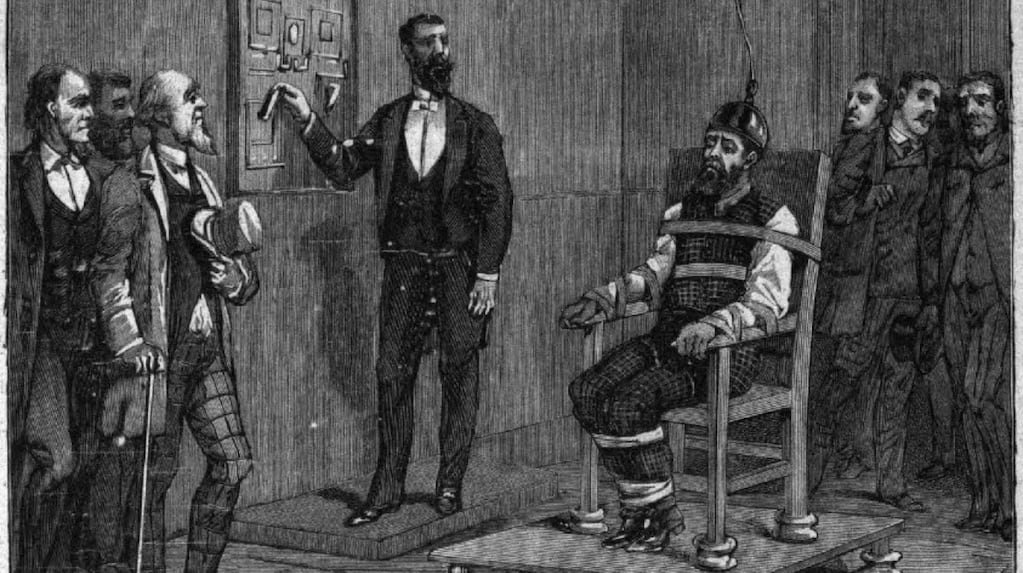
Una ilustración de 1890 de Kemmler esperando su muerte en la silla eléctrica. (Foto: Dominio público)
Un relato de la ejecución de Kemmler llegó hasta hoy en las palabras de Albert Naud, escritor, abogado, miembro de la resistencia francesa durante la Segunda Guerra, autor de: No matarás. Y también a través del gran ensayo del español Daniel Sueiro: “La pena de muerte – Ceremonial, historia, procedimientos”: “En una habitación vecina, Edwin F. Dawis, el ‘electricista’ aguardaba, con las manos puestas sobre la palanca de contacto, a que el director de la prisión le diera la orden convenida.”
Cuando eso sucedió y el “electricista” bajó el interruptor: “(…) De pronto, los asistentes vieron palidecer el rostro de Kemmler. Su cuerpo pareció hincharse y las correas estuvieron a punto de romperse. Un olor a carne quemada llenó la habitación. Los médicos hicieron una seña a Edwin Davis, que cortó la corriente. ‘Kemmler ha muerto’ declararon. El doctor Morrer –sigue el testimonio– se inclinó sobre Kemmler y no pudo retener un grito de espanto: ‘¡Está vivo! ¡La corriente, pronto!’. Durston, el ayudante del verdugo, había empezado ya a soltar los electrodos. Recobró su sangre fría, rehízo las ataduras y le hizo la señal fatal a Dawis. El cuerpo de Kemmler se estiró, una llama azulada corrió a lo largo de su columna vertebral y le brotó sangre en la nariz y la boca. Durante setenta segundos, una corriente de mil setecientos voltios pasó a través de su cuerpo, quemando todos sus vasos, que estallaron. La ejecución había terminado. El doctor Morrer certificó la muerte por electrocución”.
Otra versión de la ejecución, publicada días después y reproducida por el jurista sueco Knut Olivecrona en su libro “De la peine de mort – De la pena de muerte”, es más rigurosa. Especifica que “la primera descarga eléctrica sólo aturdió a Kemmler durante algunos segundos; luego abrió los ojos lanzando gritos de dolor que partían el alma. La segunda descarga ya no le hizo efecto. Fue solamente después de la tercera cuando pareció perder el conocimiento, pero la respiración continuó durante un cuarto de hora, acompañada por convulsiones de todas las partes del cuerpo que mostraban que la vida no había desaparecido inmediatamente. La espalda del condenado se encontró completamente quemada por la corriente eléctrica, y un fuerte olor a carne quemada se expandió por los alrededores del lugar de ejecución”.

La silla eléctrica expuesta en el museo de prisión de Texas, Estados Unidos. (Foto: AFP)
Uno de los testigos de la ejecución sintetizó todo en una frase: “Habría sido mejor que hubiesen usado un hacha”. Era algo más que una frase, era una ironía porque detrás de la silla eléctrica vibraba una feroz batalla comercial y una disputa que mezclaba la ambición y la vanidad. El hombre que hubiese preferido el hacha era George Westinghouse, que en esos días peleaba con Tomás Alva Edison por implantar un sistema de suministro eléctrico en Estados Unidos. Había en juego millones de dólares y no sólo la búsqueda de una forma piadosa de matar al prójimo.
Sumario, pena de muerte, silla eléctrica

La CIA crea un grupo de trabajo secreto sobre Cuba mientras Trump presiona a La Habana

En el Gobierno le restan importancia a la candidatura de Lacunza a presidente por el Pro

Quién es el hombre que aterrorizó a la novia de Facundo Moyano tras días de consumo de cocaína: qué pasó en el departamento y por qué ella huyó semidesnuda

Canales para ver el Inter Miami vs. Atlético San Luis por la Leagues Cup

En plena crisis diplomática con Brasil, Milei inicia su gira por Ecuador y Colombia para fortalecer su liderazgo regional

Dem senator presses OpenAI, Anthropic for answers in AI hacking probe

Javier Milei cruzó a Victoria Villarruel y elevó la tensión: “Es una opositora, replica los argumentos kirchneristas”

Reelecciones indefinidas: el oficialismo bonaerense niega que busque ampliar la Legislatura como parte de una reforma política para beneficiar a los intendentes

Un muerto y tres heridos al chocar un colectivo de turismo y un auto en Mendoza

Zaira Nara realizó un topless en Formentera y un comentario de un seguidor generó debate: “¿Nunca vestida?»
-
 POLITICA3 días ago
Javier Milei cruzó a Victoria Villarruel y elevó la tensión: “Es una opositora, replica los argumentos kirchneristas”
-

 ECONOMIA1 día ago
Dólar hoy en vivo: a cuánto se negocian todas las cotizaciones minuto a minuto este miércoles 5 de agosto
-

 INTERNACIONAL3 días ago
Trump’s AG pick off life support after key Republican rebels relent