INTERNACIONAL
Más de 2.000 islas sin hospitales: así funciona la red de clínicas flotantes de India


India encontró una respuesta concreta a uno de sus problemas sanitarios más persistentes: llevar atención médica a comunidades que viven en islas fluviales remotas, rodeadas de agua y alejadas de cualquier centro de salud fijo. Clínicas instaladas en embarcaciones móviles recorren los ríos del país para acercar médicos, medicamentos y servicios básicos de laboratorio a poblaciones que, de otro modo, quedarían sin asistencia.
El programa opera en el estado de Assam, en el noreste del país, donde el río Brahmaputra forma más de 2.000 islas temporales y bancos de arena —conocidos localmente como chars— a lo largo de su curso, según informó la agencia AFP. Gran parte de esas formaciones carece de infraestructura sanitaria o cuenta apenas con servicios mínimos. La geografía cambiante del río, cuyas crecidas estacionales reconfiguran el territorio, hace inviable la construcción de centros médicos permanentes en esos territorios.
La red Akha lleva médicos y vacunas a 13 distritos de Assam desde 2005

La red de clínicas flotantes lleva el nombre de Akha, que en lengua asamesa significa “esperanza”. Fue creada en 2005 por el Centro para Estudios y Políticas del Noreste (C-NES), una organización sin fines de lucro con base en Guwahati. Desde su lanzamiento, el proyecto fue ampliando su flota y su cobertura territorial hasta consolidarse como el principal mecanismo de atención sanitaria para las comunidades ribereñas de la región.
Hoy, la red cuenta con 15 embarcaciones activas distribuidas en 13 distritos del estado: Dhubri, Barpeta, Nalbari, Morigaon, Sonitpur, Lakhimpur, Dhemaji, Dibrugarh, Tinsukia, Jorhat, Goalpara, Bongaigaon y Kamrup, con unidades adicionales en Dhubri y Barpeta. Cada barco funciona como un consultorio itinerante que se desplaza entre distintos chars siguiendo un calendario regular, con campamentos de entre cuatro y seis días en cada recorrido.
El programa recibió el respaldo de las autoridades locales y de Unicef, cuya incorporación le dio visibilidad internacional y recursos para sostener la operación. Con ese apoyo, la iniciativa pasó de ser un proyecto local a convertirse en una red que asiste a unas 20.000 personas por mes, según cifras de la agencia de Naciones Unidas.
Las mujeres y los recién nacidos son los principales destinatarios del servicio

La salud materna e infantil ocupa el centro de la agenda sanitaria de las embarcaciones. El objetivo declarado del programa es reducir las tasas de mortalidad materna y neonatal en Assam. Habibul Hoque, médico de una de las clínicas que opera en el distrito de Nalbari, explicó que “principalmente apuntamos a las mujeres embarazadas que necesitan controles prenatales y a los recién nacidos que deben recibir la vacunación de rutina”, según recogió AFP.
El impacto del servicio es tangible para quienes viven en esos territorios. Rekibul Amin, habitante de la isla Barballa, subrayó que su comunidad depende por completo de las embarcaciones. “Cualquier medicamento que la gente recibe aquí, lo obtiene a través de la clínica flotante”, afirmó, y destacó que las mujeres resultaron especialmente beneficiadas.
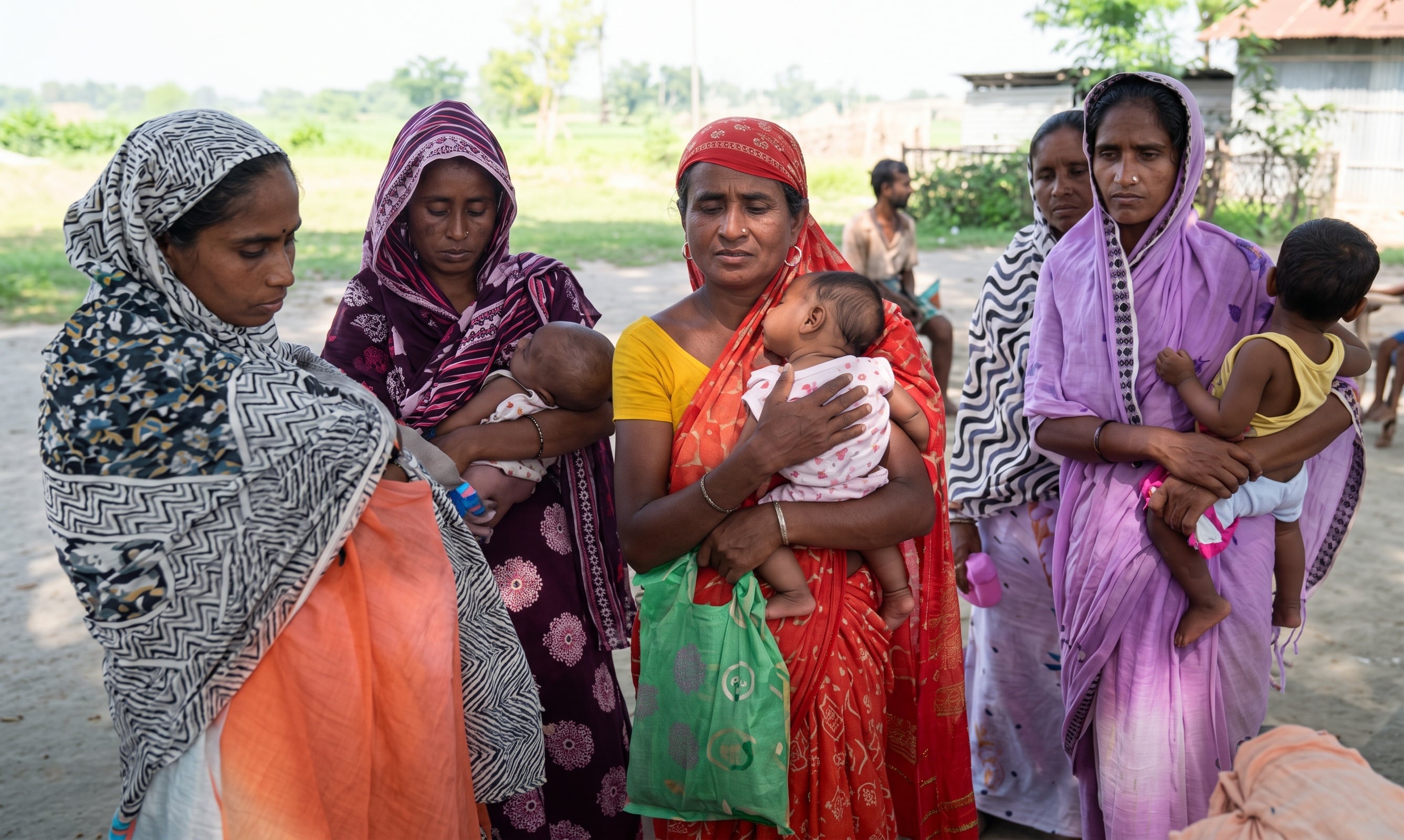
Cada embarcación cuenta con un equipo que incluye médicos, enfermeros, parteras, farmacéuticos, técnicos de laboratorio y trabajadores comunitarios. Antes de partir hacia otro punto del río, el personal informa a los residentes sobre la próxima visita programada. En situaciones de urgencia, el C-NES ofrece traslado al hospital de distrito más cercano.
A lo largo de sus dos décadas de funcionamiento, el programa trató a más de 1,7 millones de pacientes en controles generales de salud, según datos oficiales del gobierno de Assam. La cifra refleja tanto la escala del déficit sanitario en la región como la capacidad que fue adquiriendo este modelo de atención itinerante para dar respuesta a una demanda que los sistemas convencionales no lograban cubrir. Solo en el rubro de planificación familiar, el programa registró más de 548.000 prestaciones acumuladas desde su inicio, según el mismo registro oficial.
Las embarcaciones ofrecen atención general

Los barcos-clínica brindan un conjunto definido de prestaciones sanitarias. En el área curativa, se realizan consultas de medicina general para el diagnóstico y tratamiento de enfermedades comunes. En materia de salud reproductiva y materna, se efectúan controles prenatales y posnatales, con seguimiento de embarazos de riesgo.
El componente de inmunización incluye la vacunación de rutina para niños y embarazadas, así como campañas de vacunación especial y administración de vitamina A. Las embarcaciones también ofrecen servicios de planificación familiar y cuentan con un laboratorio básico a bordo para análisis de diagnóstico. Desde 2016, algunas unidades incorporaron además atención odontológica, como extracción de piezas dañadas y educación en salud bucal, en una extensión piloto del programa original.
atención médica,barco hospital,zona fluvial










The White House has asked Kimberly Guilfoyle to resign as U.S. ambassador to Greece amid mounting allegations involving her financial dealings, treatment of embassy staff and relationships with foreign business interests.
«We have asked Ambassador Guilfoyle to resign. She has been a wonderful asset to the team, and we wish her well,» White House press secretary Katie Zacharia announced Tuesday during her first-ever briefing to the press.
It is not clear whether Guilfoyle lodged her official resignation, and when asked for clarity, the White House referred Digital to the remarks from the briefing.
The update from Zacharia came just one day after President Donald Trump publicly acknowledged that he was considering firing Guilfoyle, who was previously engaged to his eldest son, Donald Trump Jr.
Trump further distanced himself from the ambassador when asked about the reports and her status with the first family.
«Kimberly Guilfoyle — she was almost a member of your family. How surprised were you to learn about these allegations? What did you think?,» a reporter asked Tuesday before he left for Alaska.
«She wasn’t a member of my family. She, I guess, dated my son a long time ago,» Trump said. «She was doing a good job, but we didn’t like what we were reading.»
TRUMP ‘LOOKING AT’ FIRING AMBASSADOR TO GREECE: ‘WE’RE NOT HAPPY’
Guilfoyle was with Donald Trump Jr. for six years, four of which they were engaged. They publicly split in December 2024, the same month Trump nominated her to serve as ambassador to Greece.
The ambassador came under scrutiny last week after The Wall Street Journal reported that she asked Trump donor Eric Deters to pay off a $100,000 American Express bill shortly before her Senate confirmation hearing in July 2025.
According to messages reviewed by the Journal, Guilfoyle urged Deters to wire the money directly to American Express, saying the transaction would not leave a paper trail, while offering to help him gain access to senior Trump administration officials. Deters said he never made the payment.
Guilfoyle’s attorney, Jesse Binnall, disputed the authenticity of the messages, saying Guilfoyle had been paid to speak at events before her nomination and «was owed a balance for traveling to and supporting these patriotic events.»
The allegations followed an earlier Journal investigation into Guilfoyle’s conduct in Greece, including claims that she promoted the interests of Greek construction and energy company Aktor Group and allowed its registered lobbyist, Christos Marafatsos, to accompany her to private diplomatic meetings with senior officials.
The Journal also reported that Guilfoyle suggested at a dinner with Greek officials that the U.S. would undermine their government, citing political developments in Romania. Greece’s foreign minister subsequently said there was no need to summon Guilfoyle for an explanation because the country’s energy minister denied that any threat had been made.
Separately, the State Department’s Office of Inspector General reportedly opened an investigation into allegations involving Guilfoyle’s treatment of embassy employees, private travel, acceptance of gifts and relationships with business interests, according to the Daily Mail.
HOUSE DEMOCRAT INVESTIGATED OVER ALLEGED ‘INAPPROPRIATE SEXUAL CONTACT’ WITH STAFFER
Sources described a hostile workplace in which Guilfoyle allegedly threatened to fire employees. They also claimed that she demoted members of her security detail over minor incidents, including an officer who reportedly failed to answer a 4 a.m. request for ice while she was vacationing in Mykonos.
The inspector general’s office declined to confirm or deny the existence of an investigation. Binnall told the Daily Mail that «any implication of wrongdoing by the Ambassador is unsupported.»
The allegations drew scrutiny from congressional Democrats, including Sen. Jeanne Shaheen, D-N.H., and Rep. Gregory Meeks, D-N.Y., who called for a review of Guilfoyle’s conduct. Meeks urged her removal if the allegations were substantiated.
Vice President JD Vance addressed the controversy Friday, cautioning against rushing to judgment while acknowledging that misconduct should carry consequences.
«Let’s actually see what the facts are. Let’s see what the truth is,» Vance told reporters in Ohio. «And obviously, if there was something bad that happened, then people have to suffer consequences for it.»
Secretary of State Marco Rubio, who visited Greece last week and delivered remarks against the backdrop of the Acropolis, initially defended Guilfoyle’s performance.
«Our ambassador has been a strong ambassador here,» Rubio told reporters Wednesday.
A day later, Rubio declined to address the allegations directly, challenging reporters over their reliance on unnamed sources. «You guys walk around thinking that because some source told you something, and you reported it, it’s the gospel. It’s not the gospel,» Rubio said last Thursday. Just days later, the White House announced their request for her resignation.
Trump nominated Guilfoyle to the diplomatic post in December 2024. A former California prosecutor and longtime Trump ally, she previously served as a prominent surrogate and fundraiser for the president.
Before her engagement to Don Jr., Guilfoyle was previously married to California Gov. Gavin Newsom, a Democrat, from 2001 to 2006, when he served as mayor of San Francisco.
politics, white house, secretary of state, controversies state and local, state department
INTERNACIONAL
Investigadores argentinos lograron reducir tumores de mama triple negativo en un estudio preclínico

Una proteína que ayuda a las células de un tumor de mama agresivo a crecer y a esquivar las defensas del organismo quedó bajo estudio como posible blanco para futuros tratamientos. Investigadores del Consejo Nacional de Investigaciones Científicas y Técnicas (CONICET) bloquearon esa proteína, llamada receptor H4 de histamina o H4R, en células tumorales y ratones.
Como resultado, los tumores crecieron menos y el sistema inmunitario respondió con mayor fuerza contra las células cancerosas.
El trabajo se publicó en la revista Frontiers in Immunology. Se trata de una investigación preclínica, es decir, realizada con células de ratón y modelos animales. Por lo tanto, todavía no se puede afirmar que este método funcione en personas con cáncer de mama ni que el compuesto utilizado sea seguro para pacientes.
La investigación fue liderada por Mónica Vermeulen, investigadora del CONICET y directora del Laboratorio de Células Presentadoras de Antígeno y Respuesta Inflamatoria del Instituto de Medicina Experimental (IMEX). El primer autor fue Ramiro Vázquez, integrante del mismo equipo.

Por qué el cáncer de mama triple negativo es difícil de tratar
El cáncer de mama triple negativo representa entre el 10 y el 15% de todos los casos de cáncer de mama. Se lo denomina “triple negativo” porque las células del tumor no tienen tres proteínas que suelen servir como objetivo de tratamientos: los receptores de estrógeno, los receptores de progesterona y la proteína HER2.
En otros tipos de cáncer de mama, los médicos pueden usar medicamentos que bloquean esas proteínas o hormonas para frenar el tumor. En el triple negativo, esas opciones no sirven porque las células cancerosas no tienen esos blancos. Por eso, los especialistas buscan otras proteínas que puedan atacar sin dañar en exceso a las células sanas.
El equipo del CONICET estudió el receptor H4R en células 4T1, un tipo de célula de ratón que se usa para investigar tumores con características parecidas a las del cáncer de mama triple negativo.
H4R es uno de los receptores de la histamina, una sustancia que el cuerpo produce de manera natural. La histamina participa, por ejemplo, en las reacciones alérgicas y en la inflamación. También cumple funciones en el estómago y el sistema nervioso. Para actuar, se une a receptores ubicados en las células. Uno de ellos es H4R, que aparece en distintos tumores mamarios.

El compuesto bloqueó una señal que favorecía al tumor
Los investigadores usaron un compuesto llamado JNJ-7777120, abreviado como JNJ. Su función es bloquear H4R. Dicho de forma simple, impide que la histamina active ese receptor y envíe señales a la célula tumoral.
Cuando trataron las células cancerosas con JNJ, observaron que se multiplicaban menos y perdían parte de su capacidad para moverse. Este segundo punto es relevante porque las células tumorales deben desplazarse para invadir otros tejidos y, en algunos casos, formar metástasis. La metástasis ocurre cuando el cáncer se extiende desde el tumor original hacia otros órganos.
El compuesto no eliminó las células tumorales. Lo que hizo fue detenerlas en una etapa previa a la división. En otras palabras, no las mató, pero redujo su capacidad para generar nuevas células cancerosas.
Además, el tratamiento redujo la producción de especies reactivas de oxígeno. Son moléculas que las células producen y que, en cantidades elevadas, pueden contribuir al crecimiento y a la supervivencia de algunos tumores. El bloqueo de H4R también modificó procesos metabólicos, es decir, la forma en que las células obtienen y utilizan energía.

“Nuestros hallazgos respaldan un papel protumoral de la histamina que actúa a través de H4R durante las primeras etapas de la tumorigénesis en células 4T1”, escribieron los autores. Esto significa que, en el modelo analizado, la histamina parece favorecer el desarrollo del tumor cuando se une a ese receptor.
Los tumores crecieron menos después de una sola exposición al compuesto
Luego, los científicos evaluaron qué ocurría en animales. Para eso, trataron las células tumorales con JNJ antes de inocularlas en ratones con un sistema inmunitario normal.
Una semana después, los ratones que recibieron células tratadas desarrollaron tumores más pequeños que los animales del grupo de control, que recibieron células sin exposición al compuesto. El efecto se mantuvo durante al menos dos semanas.
“Curiosamente, una sola dosis fue suficiente para inhibir el crecimiento tumoral durante al menos dos semanas”, indicaron los investigadores.
Este resultado sugirió que el JNJ no actuaba solamente sobre la célula tumoral. También parecía modificar la respuesta de las defensas del organismo frente al cáncer.
El efecto dependió del sistema inmunitario
Para comprobarlo, el grupo repitió la prueba en ratones RAG1. Estos animales no tienen linfocitos T y B funcionales, dos tipos de células esenciales para la inmunidad adaptativa. Se trata de la parte del sistema inmunitario que reconoce amenazas específicas, como una célula infectada o cancerosa, y dirige una respuesta contra ellas.
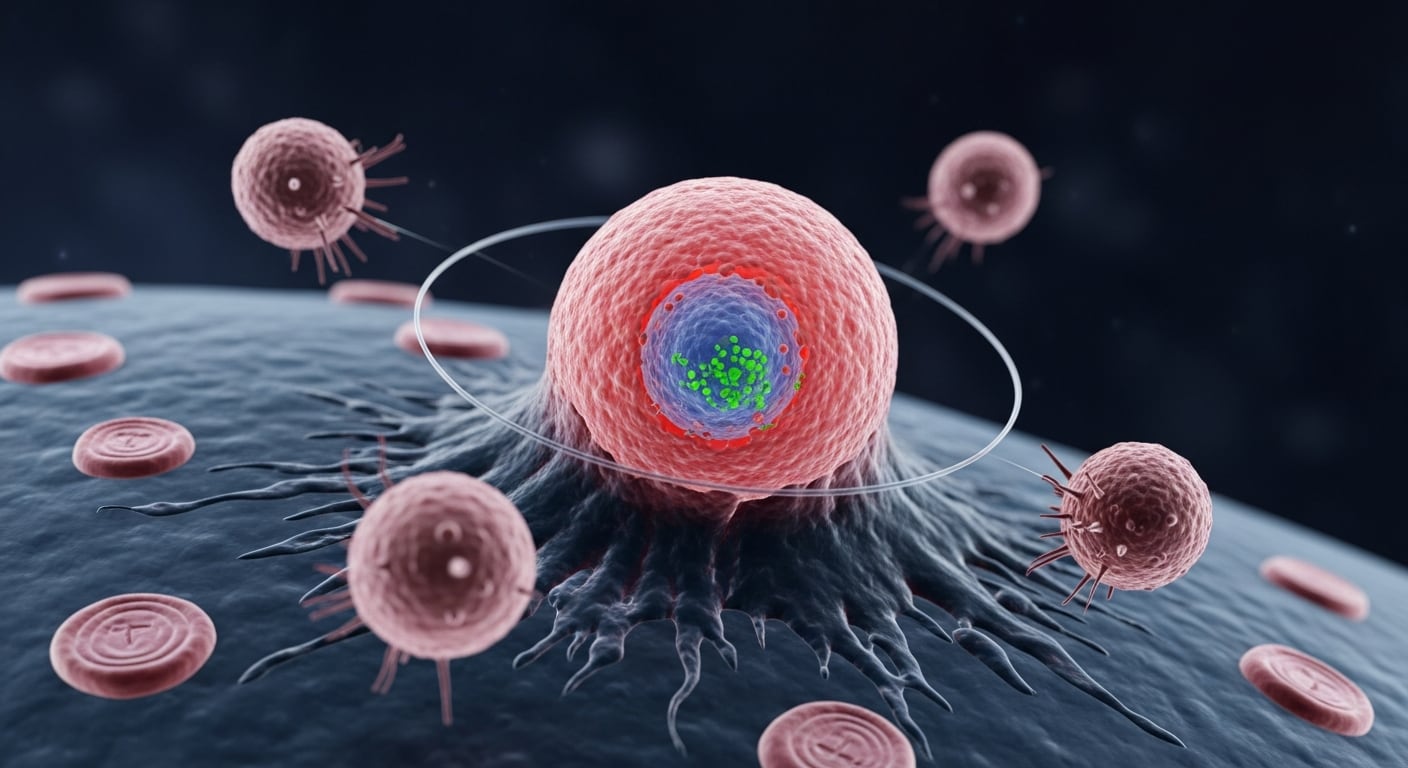
En esos ratones, el tumor creció de manera similar al del grupo que no recibió el compuesto. “El crecimiento tumoral en estos animales fue comparable al de los controles, lo que indica que la respuesta inmunitaria adaptativa desempeña un papel central”, señalaron los autores.
En los ratones con defensas normales, en cambio, el bloqueo de H4R aumentó la presencia de linfocitos CD8+ dentro del tumor durante la primera semana. Estos linfocitos son células que pueden reconocer y destruir células cancerosas.
A los 14 días, su cantidad ya era similar a la registrada en el grupo de control. Sin embargo, los linfocitos obtenidos de tumores tratados con JNJ mostraron mayor capacidad para eliminar células cancerosas.
Los investigadores también detectaron un aumento de interferón gamma, una proteína que participa en la activación de las defensas y en la respuesta contra infecciones y tumores.
Falta comprobar si el mecanismo se repite en pacientes
Vermeulen remarcó que los resultados todavía están lejos de una aplicación médica. “Son resultados alentadores que requieren estudios adicionales para determinar si pueden reproducirse en muestras humanas de pacientes con cáncer de mama triple negativo”, sostuvo.
El próximo paso será analizar tumores humanos para determinar si H4R tiene el mismo papel que mostró en el modelo de ratón. También será necesario establecer qué tipo de medicamento podría bloquearlo, en qué dosis y bajo qué condiciones podría resultar seguro.
Los investigadores indicaron que esta línea también puede ser de interés para otros tipos de tumores donde la histamina y sus receptores tienen participación, entre ellos los cánceres de colon, páncreas, ovario e hígado, además del melanoma.
mamografía,cáncer de mama,negatoscopio,médica,diagnóstico
There are two big differences between the previous Trump-era midterms and this year’s contest.
The first is the president’s approval rating, which is lower now than it was during President Donald Trump’s first term in 2018 or President Joe Biden’s term in 2022.
The second is Democrats’ generic ballot lead, which is wider and more enduring than it was in the 2018 «blue wave» election and much larger than the edge the GOP had in 2022.
Combined with Democrats’ candidate quality improvements and a Republican-led redistricting effort that could fall short of expectations, the House is likely out of reach for the GOP this year.
REPUBLICANS FACE BRUTAL MIDTERM HEADWINDS. SIX FORCES COULD HELP THEM DEFY HISTORY.
Then there’s a similarity: in all three elections, the Senate has been in play right up until the finish line.
In Trump’s first term, the Republicans ended up gaining two Senate seats despite a gloomy national environment. Four years ago, with inflation surging, the Democrats managed to add a Senate seat to their tally.
12 RACES SCRAMBLE SENATE BATTLEFIELD AS DEMOCRATS EYE COMEBACK
The Democrats have plentiful paths to 51 seats on election night. Republicans keep plowing money into six toss-up states, plus Kansas, and those efforts haven’t much moved the needle.
Yet the GOP’s paths to 50 are getting wider. That, plus a major update to the House forecast, in this week’s edition of the Power Rankings.
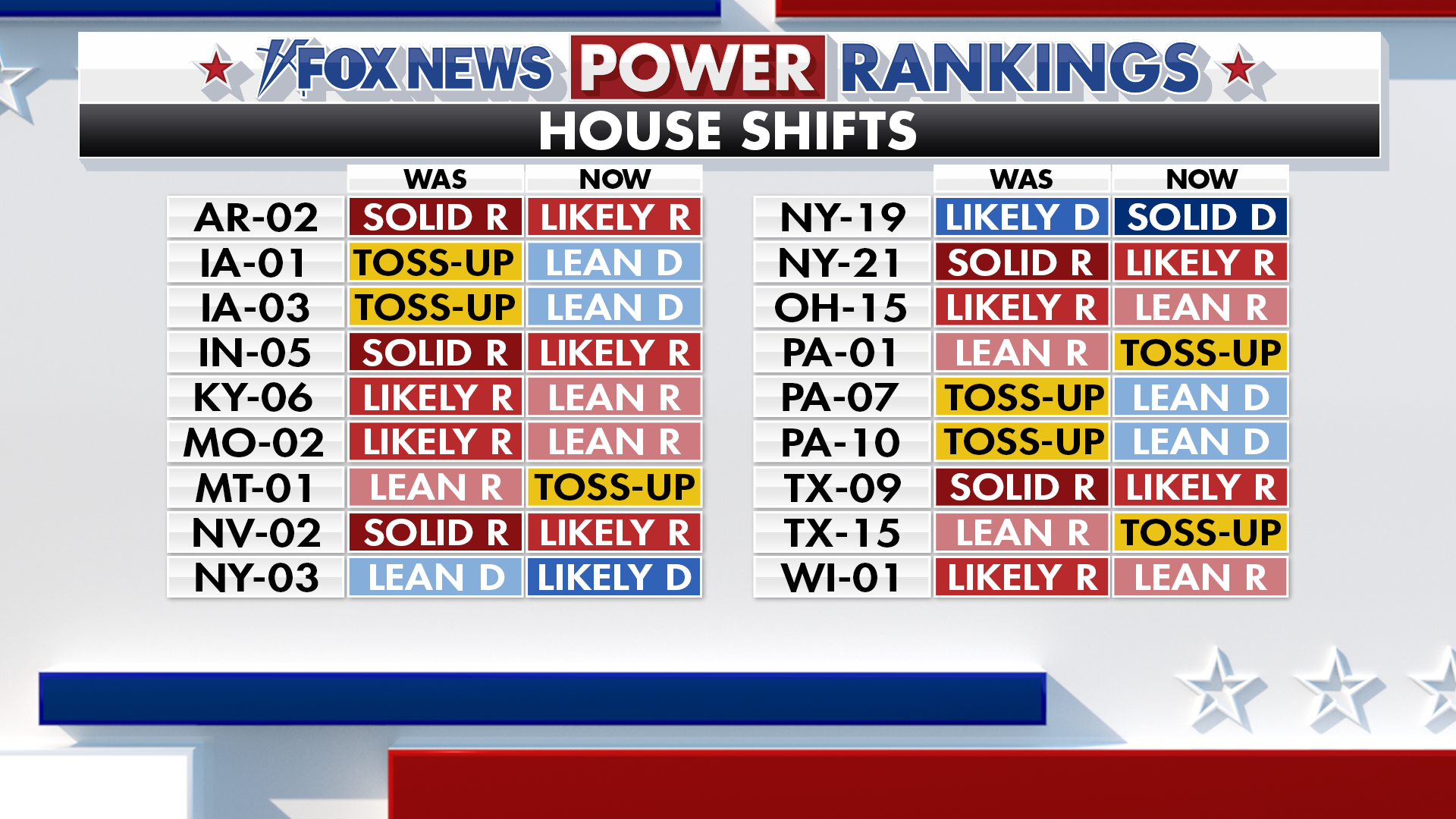
The Democratic Party has enjoyed a lead in the House all year. Now, as another 20 races shift leftward, this forecast sees the Democrats taking control.
THE BLUE WAVE LOOKS REAL UNTIL YOU LOOK A LITTLE CLOSER
Democrats have an advantage in at least 219 seats, while Republicans should hold on to at least 198 seats. There are 18 toss-ups on the board.
On a good night for the Democrats, the party will hold around 237 seats, or a gain of 22 from their current position. That’s because toss-up seats have mostly fallen in one party’s direction in previous elections.
POWER RANKINGS: FOR THE DEMOCRATS, WHERE COULD IT POSSIBLY GO WRONG?
(A «great night» for the Democrats, which would see the party take some Lean R seats as well, would mean a Democratic majority of up to 249.)
If the toss-up seats go the other way, the GOP could make life hard for the left. A good night for Republicans would see the party end up with around 216 seats. That’s two short of a majority but also leaves the Democrats with a mere two-vote cushion in the House.
In that scenario, a coalition of far-left Democrats, like the «Squad» of years past, could band together to put policy pressure on the next House speaker. That group is about to get bigger, thanks to the sure-thing victories of Democratic Socialists like Darializa Avila Chevalier and Claire Valdez.
Some of this week’s shifts are a product of polling. The Democrats’ generic ballot lead has pushed districts like Kentucky’s 6th District (Lexington and its suburbs) and Texas’ 15th District (Rio Grande Valley and Coastal Bend) away from the GOP.
The party’s strength in statewide races also plays a role, especially in Iowa (the 1st and 3rd districts, which contain the state’s biggest cities), and in Pennsylvania (three districts have shifted to the left, thanks in part to Governor Josh Shapiro’s coattails).
Other shifts are the result of Republican groups moving resources elsewhere, like from New York’s 19th District. Democratic Rep. Josh Riley lost this race by fewer than 5,000 votes four years ago, but as the GOP sends its money to more winnable races, it’s moving to Solid D.
A more surprising theme is also emerging: the GOP is in trouble with rural voters.
Sitting above Albany, New York’s 21st District contains some of the state’s most rural areas. Its voters delivered President Trump a 21-point victory over Vice President Harris two years ago. A survey last week had the Democratic candidate four points ahead of the Republican, 46%-42%.
DEMOCRATS SEE NEW CHANCES TO FLIP RED STATES — BUT A $400M GOP SPENDING ADVANTAGE COULD DERAIL THEIR PLANS
Maine’s 2nd District, which famously voted for President Trump three times in a row – and last time by nine points – is an open race this year after Rep. Jared Golden’s retirement. It was thought to be one of the best flip opportunities for the GOP. A new poll has the Democrat at 51% and the Republican at 45%.
Even Virginia’s 5th District, stretching across the Southside region and home to a two-thirds rural population, is a six-point race in a recent survey (45%-51% with the Republican ahead). The Democrat, Tom Perriello, was recently endorsed by Rep. Alexandria Ocasio-Cortez.
Gas, diesel and grocery prices are to blame. In dollar terms, the cost of living is higher in cities and suburbs, but voters across the country keep saying they are feeling the pressure of those increases and blame Republicans for them.
Iowa, for example, has experienced the fourth-highest gas price hike in the nation. Kentucky, Ohio and Texas are all in the top five states for diesel increases. That has proven tough for GOP candidates to counter.
New York’s 21st District moves from Solid R to Likely R. (Virginia’s 5th and Maine’s 2nd districts remain at Lean R and Toss-up, respectively.)
The Senate is still a toss-up with Democrats and Republicans taking 47 seats apiece. Six toss-ups are the most likely to determine control.
If Democrats win all six of those states, the party will take the majority with two seats to spare, for a total of 53. On the other hand, this forecast still sees a pathway for the GOP not to lose any seats. They’d accomplish that just by holding on to the same six states.
The toss-ups have largely been locked in through summer. There’s been a lot more movement in the «lean» categories (Kansas in, Georgia and North Carolina out). Collectively, you can think of these as the election night battlegrounds.
This week, a ninth state joins the list: Minnesota.
The North Star State has been on the political radar since Republicans recruited Michele Tafoya, the former NFL sideline reporter. She has deftly navigated her foray into politics by focusing on fraud, crime, and the cultural issues that animate GOP voters.
She also has a favorable matchup against Peggy Flanagan, Minnesota’s sitting lieutenant governor. It’s not clear whether Flanagan’s progressive politics or her proximity to the fraud issue is giving voters pause. Whatever the cause, there are signs that they are.
A new gold-standard survey shows 47% of likely voters support Flanagan, while 43% back Tafoya. Another 9% are undecided.
Republicans are fully united behind Tafoya, while 9-in-10 Democrats say they’ll support Flanagan’s bid. Independents are much less settled: 38% back Tafoya, 32% support Flanagan, and 29% haven’t decided.
Minnesota’s voter profile and election history suggest that there are some left-of-center voters in the «independent» column. They may be wavering on Flanagan now, then show up to vote for her on election day.
The Senate hopeful’s spot on the ballot next to Amy Klobuchar, the Democrats’ gubernatorial candidate and electoral over-performer, may also help push her over the line.
Either way, that poll can’t be ignored. Minnesota moves from Likely D to Lean D.
power rankings, midterm elections, politics, senate elections, elections

El Reino Unido respaldó la explotación petrolera en Malvinas y anunció medidas legales para blindar a las empresas de la presión Argentina

Esequiel Barco fue elegido MVP de la liga rusa y recibió el premio de una leyenda del fútbol

El emotivo video de Laura Novoa por los 86 años de su mamá junto a su padre Pepe: “Sigue el amor intacto”

El último misterio de Perón: el encuentro secreto con el Papa en una iglesia de Roma y la carta por el cuerpo de Eva

Así es HomeView, la última pantalla inteligente de Apple para controlar los hogares con su nueva IA

Viajó un año por Europa y sobrevivió al Titanic: la historia del Rolls-Royce que todavía conserva la familia Pereyra Iraola

Conciliaciones entre comercios y consumidores resuelven reclamos por más de $12.5 millones en Panamá

Regresos importantes y una duda clave: Arruabarrena definió el equipo de Boca Juniors para visitar a Instituto

El nuevo mapa del mercado automotor: qué marcas ganaron y cuáles perdieron con la apertura de las importaciones