INTERNACIONAL
This robot dog was made to save soldiers’ lives as US races into new era of autonomous warfare

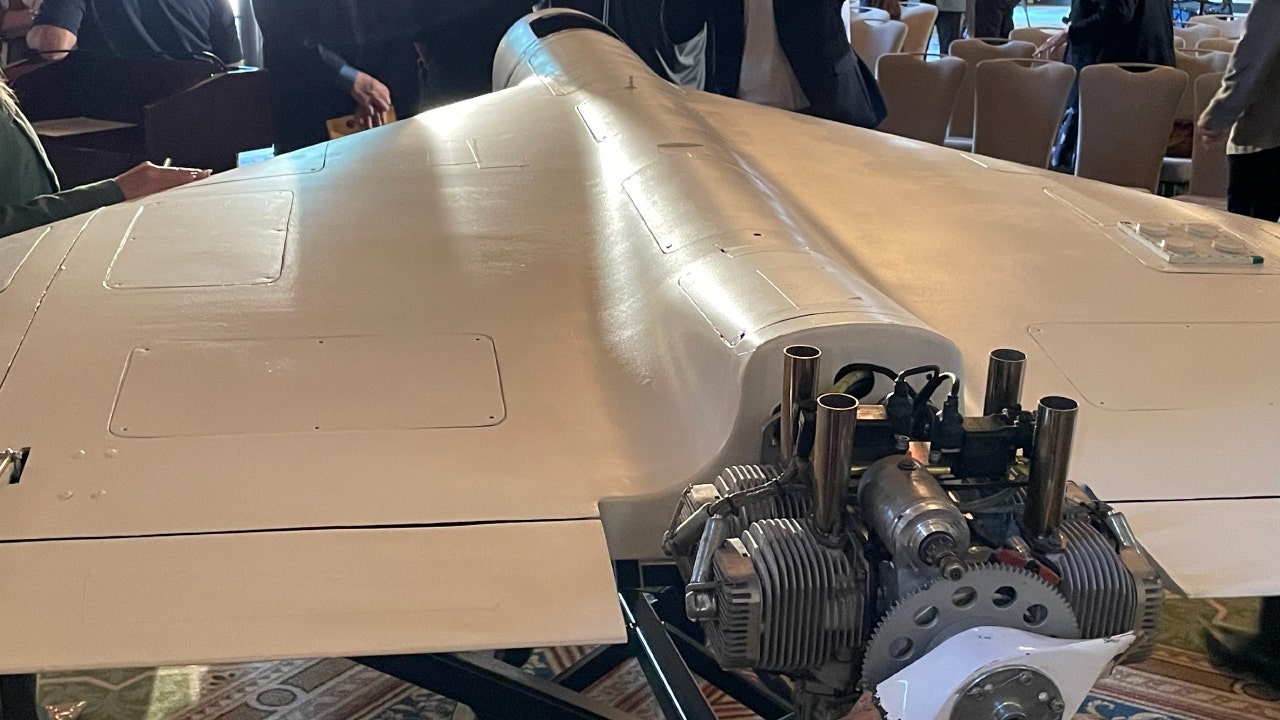
A four-legged robot dog prowled the floor of the Army’s largest annual conference in Washington, D.C., this week. Nearby a handheld weapon promised to knock drones from the sky without firing a shot, and a new interceptor was built to chase down the faster, deadlier versions coming next.
The displays offered a glimpse of a battlefield changing at a pace that is forcing the U.S. military and defense industry to race not only to develop new weapons, but to keep them from becoming outdated as quickly as they arrive.
«It’s always a cat and mouse game, and we do have to be looking down the field,» Eric Brock, CEO of defense technology company Ondas, told Digital in an interview at the Association of the United States Army’s (AUSA) annual meeting.
That race was hard to miss at the AUSA expo this week, where drones, counter-drone weapons and autonomous systems crowded the show floor as the Army looks to rapidly incorporate lessons from conflicts in Ukraine and the Middle East into its battleplan.
PENTAGON JUMPS FROM $225M TO $55B ON DRONES AS CHEAP ATTACKS OVERWHELM US DEFENSES
«If you walk around the hall at AUSA, it’ll give you a good indication of the Army’s priorities. Our priorities are reflected in what we’re procuring,» Army Under Secretary Mike Obadal said ahead of the conference.
On the ground, Ondas demonstrated a huge piece of that shift: Scout, a four-legged robotic system designed to move ahead of troops into buildings, tunnels and other potentially dangerous areas while sending imagery back to an operator.
«The whole concept is that if the Scout takes fire, it’s better than the soldier,» Brock told Digital during the demonstration.
The Army’s new autonomous systems command is part of a wider Pentagon effort to organize around unmanned warfare, while War Secretary Pete Hegseth said at AUSA this week that the department is working toward a four-star-led Autonomous Warfare Command.
Obadal predicted an «immense number» of drones and counter-UAS systems at the show, saying their prevalence reflected procurement and budget priorities across the Pentagon. Ukraine, he said, had «cemented» counter-UAS as a critical part of modern operations.
The Army is reorganizing around that reality. This month it announced a new Futures and Autonomous Systems Command tasked with accelerating autonomous capabilities across formations including aviation, armor, fires, sustainment and reconnaissance. At AUSA, the service also expanded drone and counter-drone marketplaces designed to allow the U.S. and its allies to purchase pre-approved systems in days rather than months.
US MILITARY BASES ARE ‘ILL-EQUIPPED’ TO STOP DRONE SWARMS, TOP COMMANDER REVEALS AFTER RUBIO’S UAP WARNING
For Brock, one of the clearest lessons from the recent war with Iran was the sheer number of threats defenses could be forced to confront.
«It’s more about mass,» he said. «So we have to make these affordable, low cost, returnable systems, and we have to produce this to scale.»
Ondas has rapidly expanded its own role in that push. Its Mistral subsidiary has secured more than $240 million in orders under the Army’s $982 million Lethal Unmanned Systems contract, including an additional order worth more than $50 million announced in August.
The company also acquired DZYNE Technologies this summer in a deal valued at roughly $875 million, adding a portfolio of drones and counter-drone weapons that includes the IonStrike kinetic interceptor and handheld Dronebuster demonstrated for Digital at AUSA.
INSIDE AMERICA’S LASER REVOLUTION AS THE MILITARY NEARS BIG BATTLEFIELD BREAKTHROUGH
IonStrike is designed to physically intercept incoming drones, including Shahed-class one-way attack drones. Brock said newer versions of the threat are becoming faster and increasingly difficult for defenses built around earlier, slower drones to defeat.
«The faster moving [Shaheds] now need more autonomous systems,» Brock said during a demonstration of the interceptor. «So this system is designed to be very fast.»
The system uses onboard guidance to pursue a detected threat and is designed to be deployed in numbers when multiple drones are approaching.
But no single weapon can address the growing range of unmanned threats.
Ondas also demonstrated its handheld Dronebuster, which uses electronic warfare to jam or spoof communications and navigation links rather than physically destroying an incoming drone. The company recently unveiled a longer-range version under contract for delivery to the Office of Naval Research for testing and evaluation.
Those tools illustrate the increasingly layered approach to counter-drone warfare: electronic attack may be enough against one type of drone, while another operating without a vulnerable radio link could require a physical interceptor.
And each adaptation can prompt another.
Brock pointed to Ukraine, where defenders have developed increasingly effective ways to counter the Shahed-type drones Russia has used in attacks across the country. Russia and its suppliers, in turn, have worked to make those weapons faster and harder to stop.
That rapid cycle is putting pressure on a Pentagon acquisition system historically accustomed to developing major weapons over years or decades. The Army used AUSA itself to hunt for more affordable interceptor technology, offering up to $20 million through a competition focused on defeating air and missile threats at a more sustainable cost.
The challenge is also moving beyond individual drones and interceptors.
Ondas has partnered with Palantir on software aimed at connecting sensors, drones, robotic platforms and command systems so they can operate as part of a larger autonomous network. Its SkyWeaver system uses Palantir-powered AI as part of an architecture designed to link intelligence, mission planning and autonomous operations across multiple domains.
«We’re moving from each platform being individually autonomous platforms to mission autonomy,» Brock said.
That could mean connecting intelligence gathered by high-altitude balloons and long-endurance unmanned aircraft with smaller drones, ground systems and other sensors closer to the fight, including in environments where traditional communications are degraded.
For Brock, keeping pace will increasingly depend on whether the U.S. can manufacture autonomous weapons and defenses in the numbers a future conflict could demand.
«I think that’s the bigger challenge,» Brock said. «Technology is not really a challenge. We can build fast interceptors. We can build autonomy. That technology is there. It’s ready.»
«Can we produce this en masse as our adversaries are?»
armed forces topics, military, robots, us army, geopolitics, politics









NEWYou can now listen to Fox News articles!
French President Emmanuel Macron is facing criticism over his decision to attend a Celine Dion concert Friday night, on the eve of nationwide demonstrations that descended into violence, leaving hundreds of emergency personnel injured and nearly 1,800 people arrested.
Macron and his wife, Brigitte, were spotted at Dion’s concert at the Plenitude Arena in Nanterre, west of Paris, according to French media reports. The couple reportedly arrived and left discreetly and were among roughly 35,000 spectators at the performance.
The concert came after Macron spent Thursday and Friday in Brussels attending a European Council meeting. During a news conference in Brussels on Friday, he called for «calm and respect» ahead of Saturday’s planned demonstrations, saying the right to protest must be exercised with respect for people and property.
By Saturday, demonstrations over rising living costs, school conditions and declining public services had escalated into clashes with police, fires, looting and attacks on public buildings in several cities.
VIOLENCE ERUPTS AT FRANCE PROTESTS AS MACRON WARNS UNREST IS BEING EXPLOITED
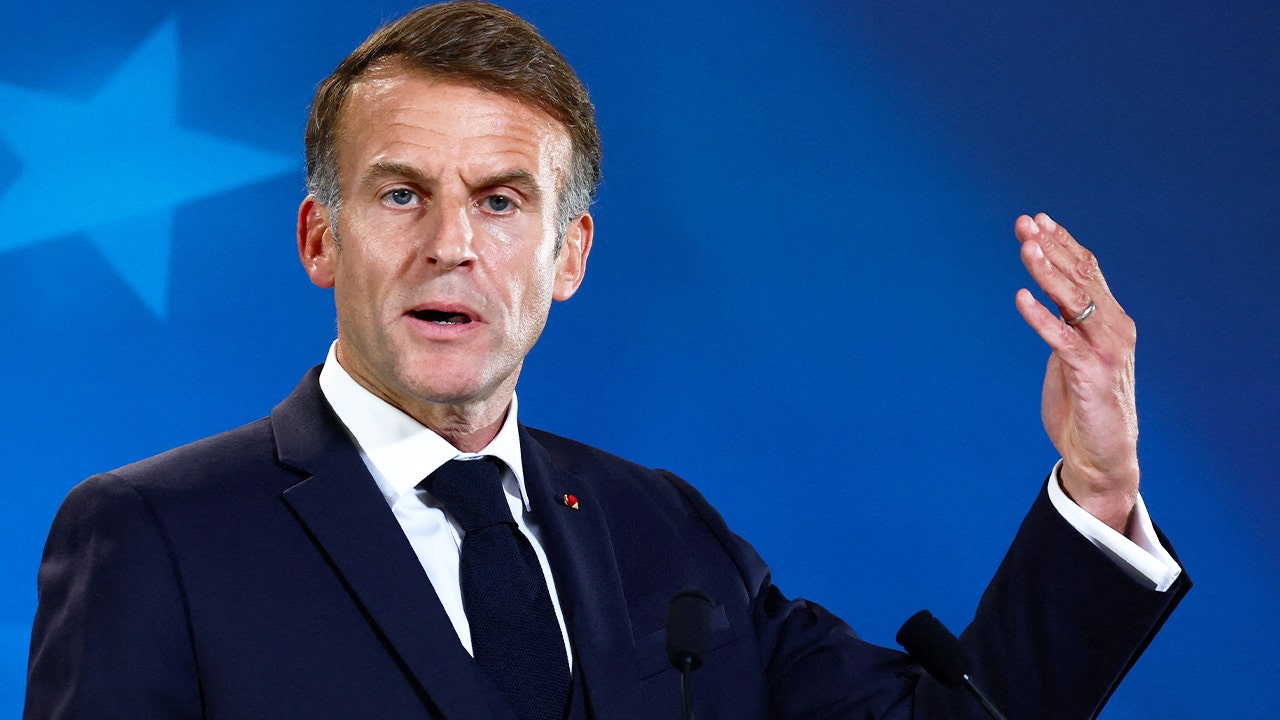
President of France Emmanuel Macron gestures as he speaks during a press conference at a European Union leaders’ summit in Brussels, Belgium, October 16, 2026. (REUTERS/Yves Herman)
French authorities said Sunday that nearly 1,800 people had been arrested nationwide, including 855 in the Paris region. More than 500 police officers, gendarmes and firefighters were injured, according to Interior Minister Laurent Nuñez. One protester died after suffering cardiac arrest during demonstrations in Paris, authorities said.
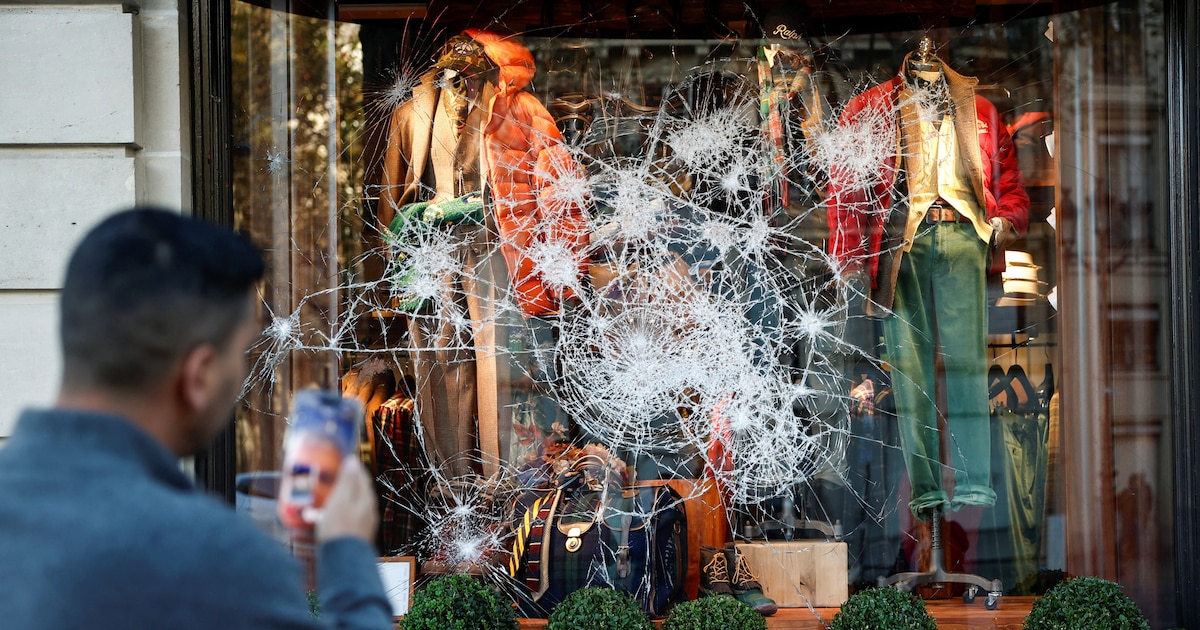
In Limoges, a fire that authorities said was deliberately set at the city hall caused significant damage to the historic building. Shops were looted in Paris, Bordeaux, Marseille, Lyon and other cities, while public buildings were vandalized or targeted by fires.
Authorities estimated that more than 550,000 people participated in demonstrations across France. Organizers put the figure at roughly 800,000.
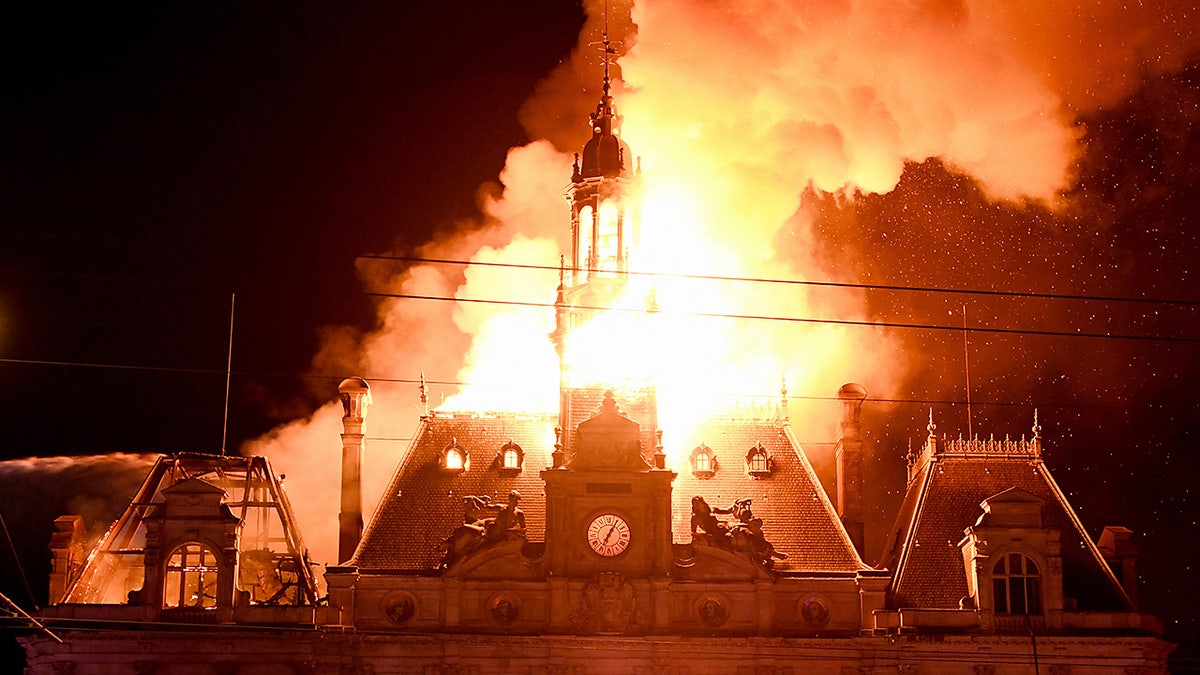
This photograph shows a fire burning and destroying the city hall after a group of individuals forced entry into the building during ongoing protest action against the «high cost of living», in Limoges, central France on October 17, 2026, (Pascal Lachenaud / AFP via Getty Images)
Macron condemned the destruction Saturday evening, writing on X that those responsible for damaging property, attacking public buildings and looting businesses would face prosecution and punishment. He also expressed support for law enforcement and warned against efforts to undermine French institutions.
His statement came after violence had spread through several major cities, raising questions about the government’s preparations for the demonstrations and its ability to contain the unrest.
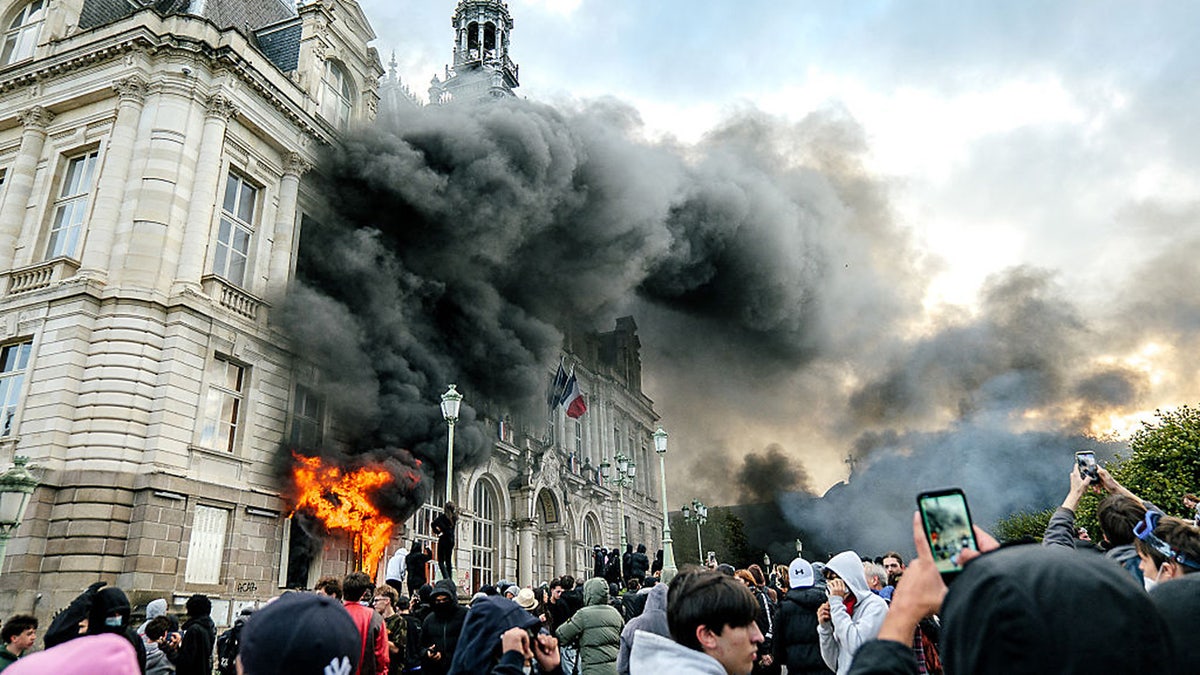
During the demonstration on 17 October in Limoges protesters set fire to the town hall in Limoges Haute-Vienne in the Nouvelle-Aquitaine region of France on 17 October 2026. (Elise Cabane / Hans Lucas / AFP via Getty Images)
The hostilities began as a month-long student movement over school conditions and teacher shortages in working-class suburbs before broadening into a larger protest movement against inequality, public spending cuts and the rising cost of living.
LIMOGES TOWN HALL ‘LARGELY LOST’ AFTER FAR-LEFT RIOTERS SET HISTORIC BUILDING ON FIRE AMID FRENCH UNREST
Government officials have blamed violent groups and looters for the destruction. Prime Minister Sébastien Lecornu attributed the unrest to the «ultra-left» and criminals, while opposition leaders criticized the government’s handling of the violence ahead of next year’s presidential election.
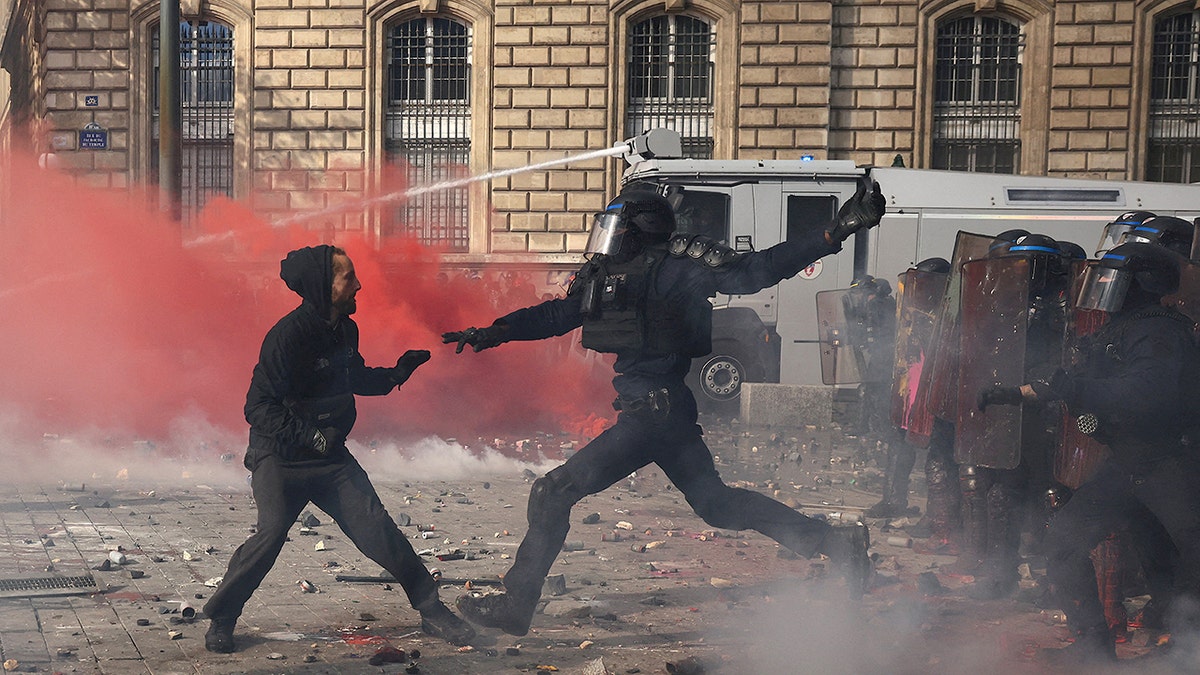
A protester faces off with French riot police amid clashes during a demonstration against the cost of living and rising fuel prices at the Place de la Republique in Paris as part of nationwide protests called by the «Yellow Vests» movement, joined by French high school and university students, teachers and parents demanding better school conditions and government action, as well as labour unions, workers, farmers and retirees, France, Oct. 17, 2026. (Jack Taylor/Reuters)
Right-wing leader Marine Le Pen condemned the looting and destruction, while left-wing leader Jean-Luc Mélenchon defended the protesters’ broader grievances and criticized the government’s handling of the demonstrations. Mélenchon accused Lecornu of «playing with fire,» according to reports.
The violence also left businesses facing extensive damage and mounting financial losses. Carrefour CEO Alexandre Bompard told French television that 50 of the retailer’s stores were damaged, including 20 that were looted, with losses estimated in the tens of millions of euros, according to Reuters.
The mayors of Paris, Marseille and Lyon have requested a meeting with the prime minister to discuss the damage. Local officials in Marseille and Bordeaux have announced or proposed emergency assistance for affected businesses.
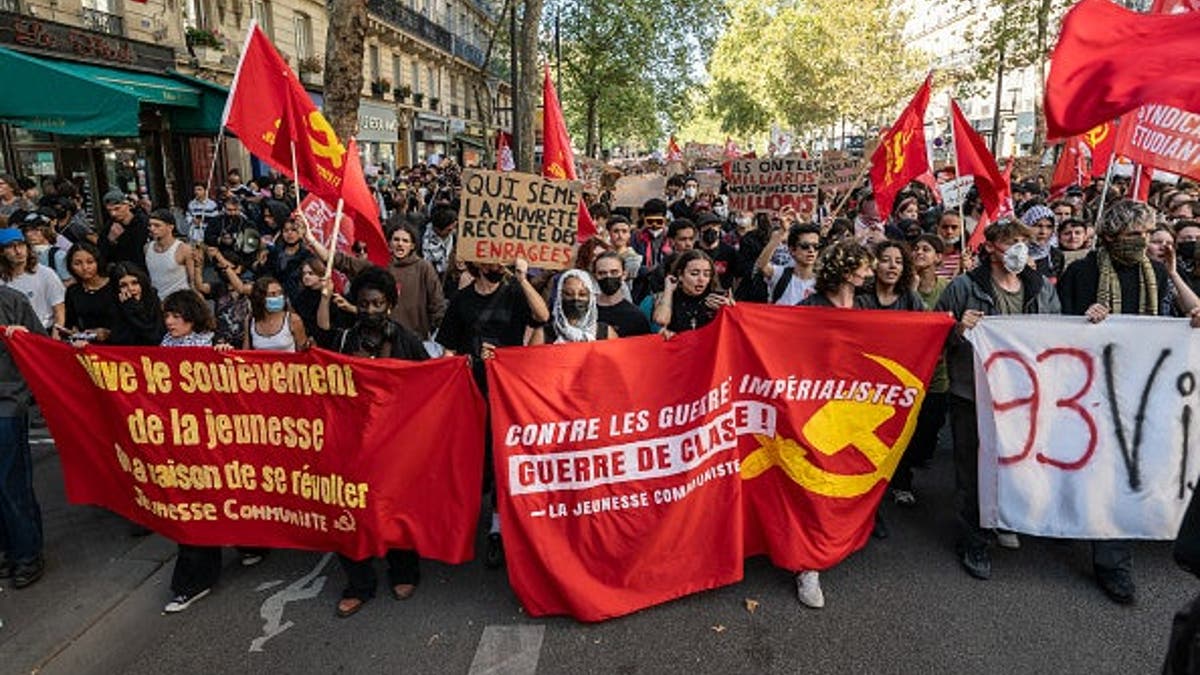
Tens of thousands of secondary school students and their supporters march from Republic to Nation square on Oct. 6, 2026, in Paris, France. (Guy Smallman/Getty Images)
Macron is scheduled to address the nation at 8 p.m. local time Sunday, or 2 p.m. Eastern, after meeting with senior government officials. His speech will come as France begins a nationwide cleanup effort and authorities prepare prosecutions for those arrested.
CLICK HERE TO GET THE APP
The address will mark a critical test for Macron as his government faces mounting pressure over the scale of the destruction, the police response and the economic grievances that fueled the demonstrations.
Reuters and the Associated Press contributed to this report.
france, world, europe, world politics
INTERNACIONAL
Francia amaneció con comercios destrozados y calles arrasadas: 35 fotos de los daños causados durante las protestas


Business,Civil Conflict,Demonstrations,Riots,Corporate Events,Europe,Civil Unrest
INTERNACIONAL
Trump tries different approach with Russia to bring Americans relief amid ongoing war with Ukraine
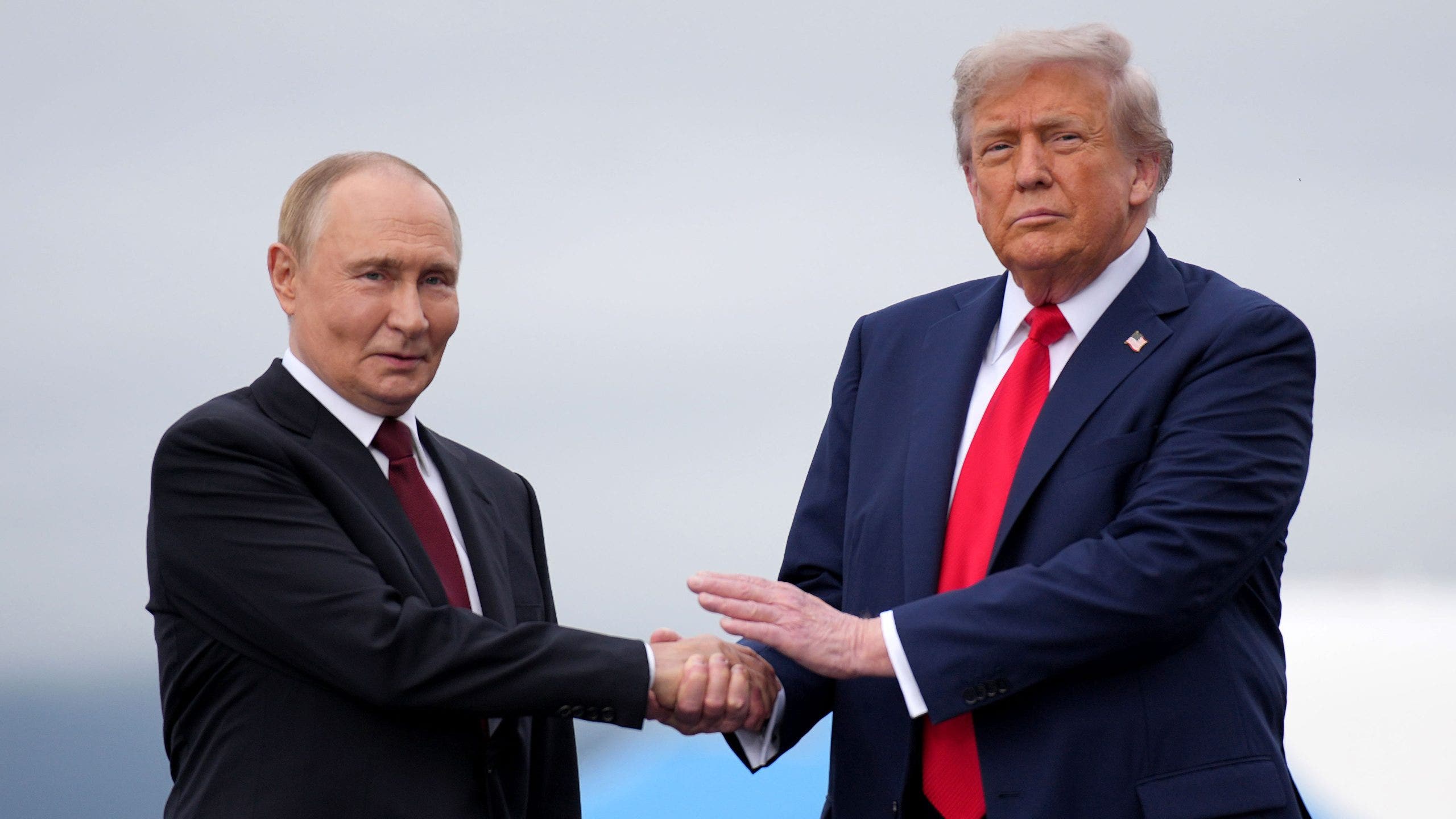
President Donald Trump is easing some of the economic pressure on Russia in hopes of bringing Vladimir Putin closer to a peace deal — a gamble that will test whether economic incentives can move Moscow where years of sanctions have not.
The administration’s decision to temporarily ease restrictions on Russian diesel has drawn opposition from Republicans on Capitol Hill and skepticism over whether the move will meaningfully lower prices for Americans.
Meanwhile, Russia has offered few public signs of concessions in return.
Six Republican senators joined Democrats this week in urging Trump to reverse the decision, while five House Republicans signed a separate bipartisan letter Thursday seeking to revoke the Treasury authorization.
The resistance comes as Washington approaches an Oct. 18, 2026, deadline to begin implementing a sweeping new sanctions law Congress overwhelmingly approved to increase economic pressure on Russia.
BIPARTISAN SENATORS DEMAND TRUMP SCRAP RUSSIA DIESEL DEAL, CALL IT ‘BETRAYAL’ OF US ALLIES
The administration argues that allowing Russian diesel back onto global markets could help bring down prices for American consumers while demonstrating the economic benefits Russia could gain through improved relations with the United States.
Trump has defended the agreement as a way to add supply to a global diesel market strained by high prices, stressing that the Russian fuel does not necessarily need to come state side to benefit American consumers.
«That’s a diesel deal that’s going to be released into the world for the world market because the world market suffers with high prices,» Trump told reporters Tuesday.
But energy analysts have questioned whether the volumes involved would meaningfully affect prices. Russia, meanwhile, continued striking Ukrainian energy infrastructure after Trump declared an immediate energy ceasefire Sunday.
John Hardie, deputy director of the Russia Program at the Foundation for Defense of Democracies, argued the diesel agreement would make more sense as part of a reciprocal deal under which Moscow and Kyiv both stopped attacking energy infrastructure.
«The Ukrainians could stomach it if it were part of a mutual energy truce where both Russia and Ukraine don’t strike each other’s infrastructure,» Hardie told Digital.
Instead, Hardie said, Trump pressed Ukraine to halt its refinery strikes without securing the same restraint from Putin.
«The better solution is to go back to the Kremlin and try to get that two-way solution,» he said.
Trump announced the diesel agreement Oct. 9 after a phone call with Putin, saying Russia would immediately supply more than 300,000 metric tons of diesel to the «American and Global Marketplace,» followed by another 500,000 tons in November, 1 million tons shortly thereafter and eventually another 3 million tons depending on the condition of its refineries.
TRUMP RUSSIA DEAL COULD FUEL PUTIN’S WAR, EX-NATO COMMANDER WARNS AS ZELENSKYY SAYS ‘NYET’
Treasury issued General License 135 the same day, temporarily authorizing transactions involving Russian-origin diesel through April 7, 2027.
The diesel dispute has become part of a broader strain between Trump and Ukrainian President Volodymyr Zelenskyy.
Trump has repeatedly pressed Kyiv to halt refinery attacks, while Zelenskyy has criticized the diesel deal and accused Russia of ignoring Trump’s energy ceasefire. Ukraine resumed attacks on Russian oil infrastructure this week after saying Moscow had failed to observe the pause.
Russia, meanwhile, has intensified attacks on Ukraine’s energy system as winter approaches. A major missile and drone attack Wednesday damaged dozens of energy facilities and left hundreds of thousands of Ukrainians without power, according to Ukrainian officials.
The White House says the deal serves two purposes: adding supply to global fuel markets and showing Moscow some of the economic benefits that could come with improved relations.
Trump envoys Steve Witkoff and Jared Kushner discussed the agreement with Ukrainian officials as part of an effort to revive peace negotiations, Reuters reported. One person briefed on the talks said the deal could help «soften» Moscow’s position by signaling that Trump remains open to doing business with Russia.
But analysts question how much genuinely new diesel Russia can provide.
«The amount of diesel Russia can provide would be a drop in the bucket compared to global demand,» Masha Kotkin, a fellow at the Center for Strategic and International Studies, told S&P Global.
«If you are asking about US diesel prices, I don’t think it’s going to make a difference,» she said.
Sergey Vakulenko, a senior fellow at the Carnegie Russia Eurasia Center and former Russian oil executive, similarly cautioned against treating the roughly $7 billion value of the diesel contemplated under the agreement as new revenue for Moscow, noting that Russia was already exporting substantial quantities despite Western sanctions.
He estimated the sanctions relief could instead benefit Russian exporters by roughly $30 to $40 per ton through better commercial terms and lower shipping costs — tens of millions of dollars per month, only part of which would reach the Russian state through taxes.
At the same time, Ukrainian strikes have sharply constrained Russia’s ability to increase supply. Vakulenko said Russian diesel available for export fell from roughly 3 million tons per month in April to about 325,000 tons in September, leaving both Russia’s additional financial benefit and the deal’s potential impact on global prices more limited than the headline figures suggest.
Hardie said signs of division between Washington and Kyiv could encourage Putin to increase military pressure rather than compromise.
«That message of irresolution and of division between Washington and Kyiv only encourages Putin to intensify military pressure, kind of seeing that opportunity,» Hardie said.
He said the administration had previously presented sanctions relief and renewed economic ties as benefits Russia could unlock through a negotiated settlement. Offering some of those benefits beforehand, he warned, could undermine that incentive.
«It’ll lead Putin to kind of digging his heels in on maximalist demands,» Hardie said.
The debate comes as Congress is moving in the opposite direction.
Trump signed the Lindsey O. Graham Sanctioning Russia and Iran Act into law Sept. 18, giving the administration new authorities to target Russian officials, financial institutions and entities helping sustain the war. Its first 30-day implementation deadline arrives Oct. 18.
Six Republican senators — Thom Tillis, Susan Collins, Alan Armstrong, Lisa Murkowski, Mitch McConnell and John Cornyn — joined six Democrats Tuesday in calling on Trump to rescind the diesel agreement and implement the new sanctions law.
The senators acknowledged the need to bring down energy costs but argued the Russian diesel would have a «negligible impact» on prices while generating additional revenue for Moscow.
A separate bipartisan group of 22 House lawmakers called on Trump Thursday to revoke the diesel authorization and fully implement the Graham law.
The White House has stood by the agreement, arguing Trump’s priority is lowering costs for Americans while continuing to pursue an end to the war.
Hardie questioned whether economic incentives would carry enough weight to change Putin’s calculations.
«Putin cares much more at this point about Ukraine and his legacy, and this broader kind of cocktail of grievances that led him to this war than he does about, you know, clearly Russia’s GDP or well-being, or else he never would have done this in the first place,» Hardie said.
The diesel agreement now puts Trump’s theory of leverage to an early test: whether giving Putin a glimpse of the economic benefits available through improved relations can draw him toward a settlement, or whether Moscow will see easing pressure before a ceasefire as a reason to hold out for more.
politics, sanctions, vladimir putin, russia, ukraine, economy, foreign policy

¿Dónde ver EN VIVO y ONLINE el Ferro vs Racing de Córdoba?

Mauricio Macri mostró fotos de los 15 de Antonia: el vestido bordado, el baile y los detalles de la fiesta

Flores, regalos y una foto vintage, así celebró Wanda Nara el Día de la Madre: “Mi prioridad”

Cómo se gestó la caída de la sesión opositora en Diputados y cuál fue el rol de los gobernadores aliados

Ante la mejoría de Mirtha Legrand, Martín Llaryora propuso celebrar sus 100 años en el estadio Kempes

El majestuoso yate que compró Lionel Messi: cuatro camarotes, sauna y garage para motos acuáticas

Milei tildó a Lula de comunista, ratificó su alineamiento con Trump y pidió “defender el legado de occidente”

La lesión de Lautaro Martínez que encendió las alarmas de la selección argentina: el comunicado del Inter

El crédito que nadie te cobra