INTERNACIONAL
600 groups with $2B in revenue mobilize 3,000 May Day protests in a ‘red-blue’ alliance, probe finds

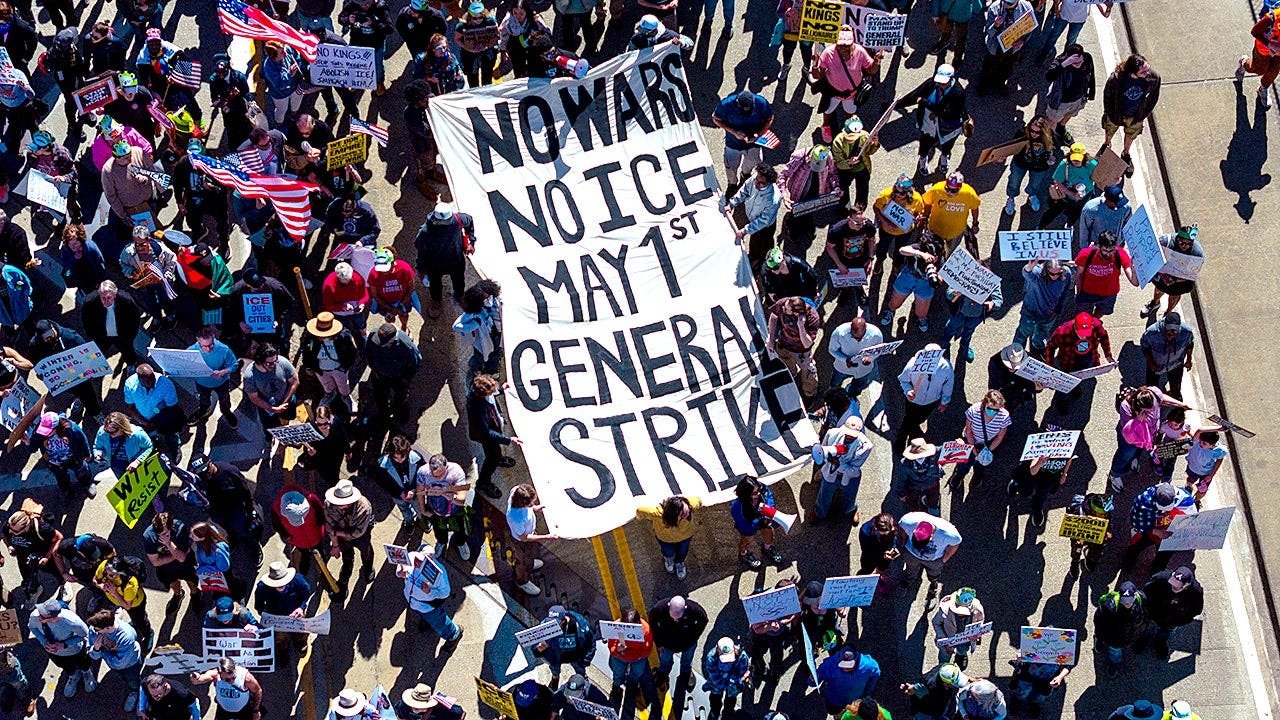
Teachers plan May Day walkouts nationwide, igniting debate
‘Outnumbered’ discusses teachers planning May Day walkouts nationwide, sparking a debate about the impact on students. The panel debates the political motivations behind protests against President Donald Trump’s policies, and the implications for declining student academic performance in cities like Chicago.
NEWYou can now listen to Fox News articles!
FIRST AT FOX: Some 600 groups, including hard-line communists and groups affiliated with the Democratic Party, are mobilizing all over the country today to demonstrate for May Day, socialism’s high holy day.
A Fox News Digital investigation has identified a sprawling «red-blue» network with combined annual revenue of about $2 billion organizing some 3,000 protests and events and advancing what critics describe as an anti-American agenda. They have called for Americans to skip work, school and shopping.
At the center of the May Day mobilization, which has expanded from earlier indications, is a network of communist, socialist, Marxist and other far-left organizations, led by chapters of the Democratic Socialists of America and a network of groups – including the People’s Forum, the Party for Socialism and Liberation, ANSWER Coalition and Code Pink – funded by an American-born tech tycoon, Neville Roy Singham, based in Shanghai, promoting the propaganda of the Chinese Communist Party.
The Communist Party of the USA has rallied workers to «rise against MAGA on May Day,» promoting leaflets by the «People’s World,» its Marxist-Leninist publication. The Revolutionary Communist Party has put out a call to dismantle the «capitalist-imperialist system.» The Maoist Communist Union has summoned members to join the «Anti-Imperialist Contingent» at the New York City protests.
The deeper concern, critics say, is that the pro-communist and pro-socialist network, symbolized by the color of red, is promoting May Day events with traditionally blue organizations that make up the Democratic Party network, including nonprofits Indivisible, MoveOn.org and the American Federation of Teachers, as well as at least 13 state and local chapters of the Democratic National Committee, including the California Democratic Party.
MAY DAY PROTESTS TO TAKE PLACE FRIDAY AS AGITATORS ACROSS THE US PUSH «WORKERS OVER BILLIONAIRES» MOTTO
The California Democratic Party is using the pro-Democratic tech platform, Mobilize.us, to promote «Workers over Billionaires May Day rally» protests, like at the corner of Monroe Street and Highway 11 in Indio, Calif. In its publicity material, the California Democratic Party notes it’s «the largest state party in the nation with more than 10 million members.»
The Ohio Democratic Party Progressive Caucus, North Carolina’s Young Democrats of Moore County, Young Democrats of Wisconsin and the Yuba County Democratic Central Committee are on the official list of organizers for a coalition, «May Day Strong,» promoted online.
In Ohio, the Licking County Democrats organization is hosting a «May Day Strong» protest at the courthouse in Newark, promoting the national event’s official mantra: «No Work No School No Shopping.» The groups didn’t respond to requests for comment.
Meanwhile, local chapters of the Party for Socialism and Liberation, an openly communist group in the Singham network, organized «Art Build» projects across the country, including in Washington, D.C., and Chicago, to build May Day signs at its «Liberation Centers,» located in about 25 metropolitan U.S. cities. Members shuttled inside, painting banners and readying their protest gear.
Leaders at the Party for Socialism and Liberation’s Chicago «Liberation Center» post anti-ICE signs on its window, seen on Jan. 29, 2026, promoting student walkouts and the message, «Chicago Resists.» It later hosts an «Art Build» sessions to support teacher and student walkouts for May Day 2026. (Kamil Krzaczynski for Fox News Digital)
«The increasing willingness of mainstream Democrats to align with extremist socialist groups is a major factor in why the Democratic Party is losing the center more and more, and why so many lifelong Democrats find themselves feeling politically homeless,» Democratic strategist Melissa DeRosa told Fox News Digital.
«May Day has a proud history of honoring workers,» she said, «but too many Democratic organizations have allowed that tradition to be hijacked by the activist fringe — including groups aligned with the Democratic Socialists of America, pushing a fantasy agenda that has failed everywhere it has been tried.»
«The increasing willingness of mainstream Democrats to align with extremist socialist groups is a major factor in why the Democratic Party is losing the center more and more, and why so many lifelong Democrats find themselves feeling politically homeless.»
Together, political analysts say the new May Day network shows how a once-fringe ideological coalition has moved into the bloodstream of Democratic-aligned organizing — linking communist groups, socialist chapters, anti-Israel activists, labor unions, immigration groups, climate organizations and Democratic Party affiliates in a national protest campaign critics say is less about worker solidarity than about advancing a radical political agenda.
AFTER 30 YEARS, 5 THINGS I LEARNED FROM MY STUDENTS WHY THEY LIKE SOCIALISM
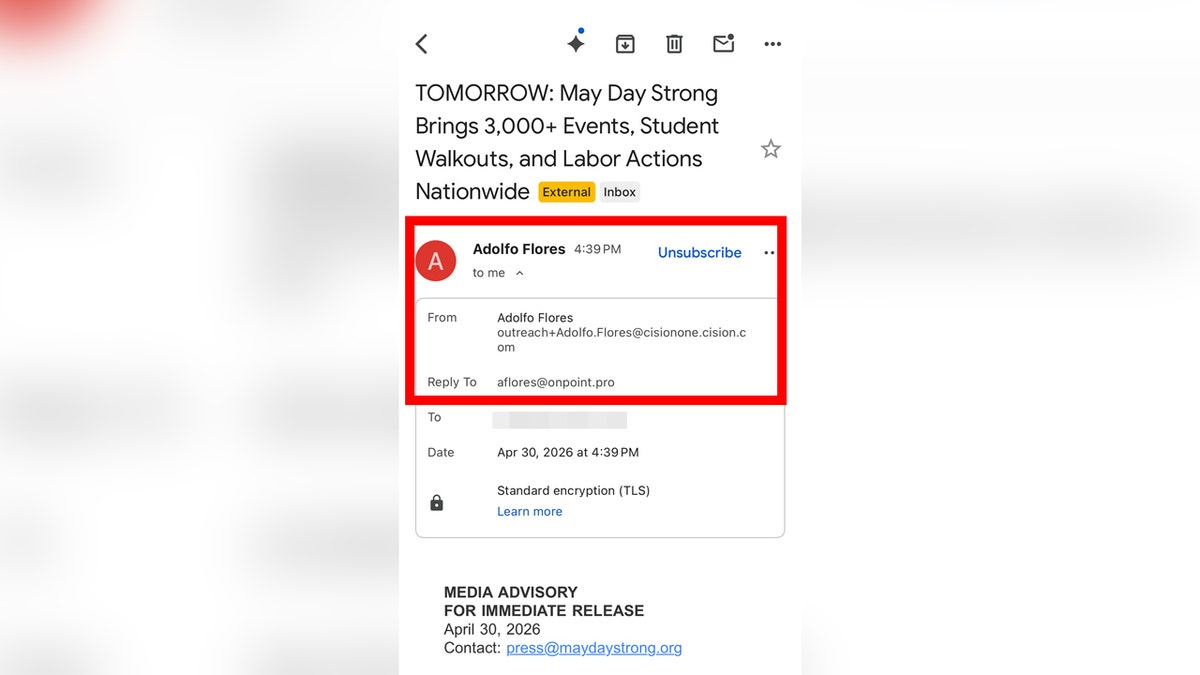
On the eve of May Day, organizers sent out a professionally composed media advisory, with the email’s metadata directing readers to reply to a name associated with public relations for a Chicago teachers’ union. (Fox News Digital)
In a reflection of the coordination of the red-blue alliance, the «May Day Strong» coalition issued a press release at 4:39 p.m. on Thursday with the email’s metadata identifying the sender as Adolfo Flores, a public relations expert at On Point, a media relations firm that has done public relations for the Illinois Federation of Teachers, which works closely with the Democratic Party. Flores didn’t return a request for comment.
In his press release, Flores wrote, organizers say more than «3,000 May Day events» nationwide will mobilize workers and students under the banner «Workers Over Billionaires,» framing the protests as a response to what they call an «authoritarian billionaire takeover of government.» The advisory highlights large-scale actions, including «more than 100,000 students expected to walk out» and coordinated efforts in multiple cities urging «No Work, No School, No Shopping,» with some leaders stating «we can and will shut it down to secure prosperity for all working people.»
The coalition’s core demands – «Tax the rich,» «No ICE. No War,» and «Expand Democracy, not corporate power» – are paired with broader claims that the system is «rigged» by elites, that policies are «attacking our neighbors» and «turning ICE loose on our neighborhoods» and that current leadership is «seeking to end democracy as we know it,» according to the press release.
Across statements, participants, including traditionally Democratic-aligned leaders from the Illinois Federation of Teachers and Chicago Teachers Union, the National Education Association, the AFL-CIO, the American Federation of Teachers, 50501 and the United Auto Workers, among others, emphasize mass mobilization and collective action, arguing «we are organizing… to demand change» and that «real change happens when working people act together.»
COMMUNISTS, DEMOCRATS USE #NOKINGS RALLY TO CALL FOR MAY DAY STRIKE: «SHUT IT DOWN»
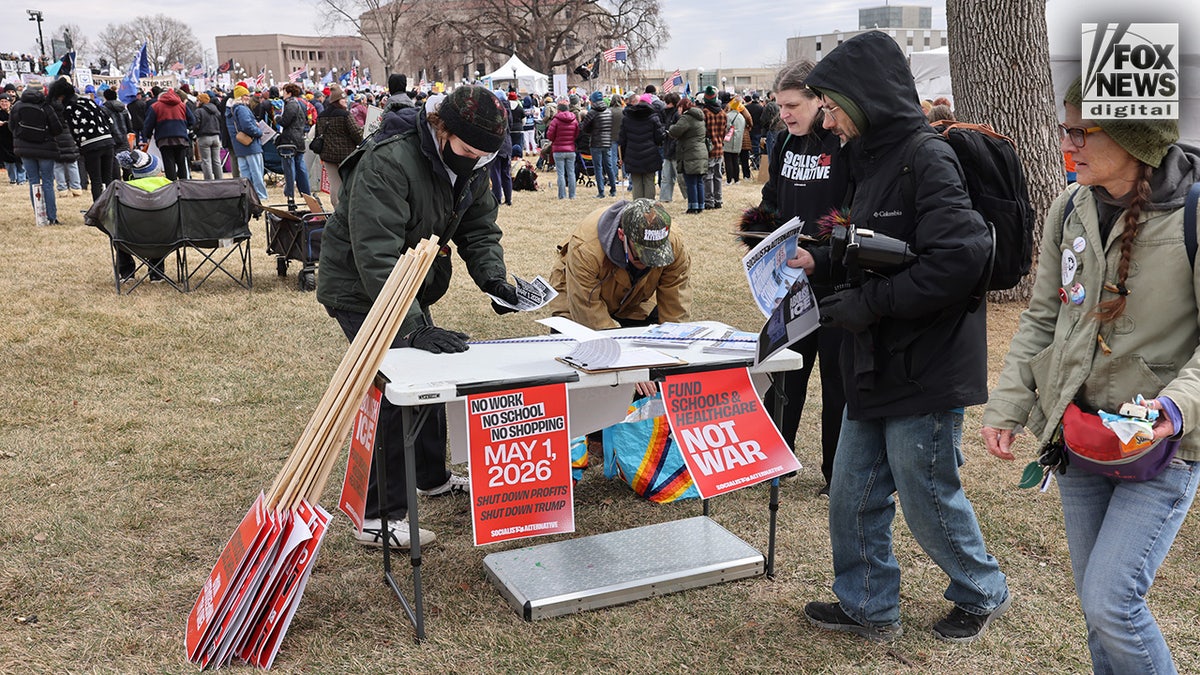
General strike literature is displayed on a table during a No Kings protest at the Minnesota State Capitol in St. Paul, Minnesota, on March 29, 2026. Protesters gathered with flags from various organizations, including the Freedom Road Socialist Organization. (Derek Shook/Fox News Digital)
The so-called «red-blue» alliance exposes a growing challenge inside Democratic politics, political experts say, as the Democratic Party’s activist infrastructure increasingly overlaps with groups and influencers, like controversial Democratic Socialists of America influencer Hasan Piker, as they echo anti-American rhetoric and propaganda narratives promoted by U.S. adversaries, including China.
In the 600 estimated total, Indivisible, one of the largest Democratic Party-aligned grassroots networks in the country, has at least 200 chapters nationwide supporting May Day events, from Yorktown, N.Y., to Tempe, Ariz., appearing alongside about 80 chapters of the Democratic Socialists of America.
Indivisible has received millions of dollars in funding over the years from billionaire George Soros’ philanthropy network, and it has led the organizing for three «No Kings» protests produced after Trump’s inauguration to protest his administration. Many of the groups involved in «No Kings» protests are organizing the May Day events, reflecting the shared ecosystem of anti-Trump rhetoric built around this professional protest infrastructure.
Law enforcement officials said alleged would-be assassin Cole Allen attended a «No Kings» protest in Los Angeles, according to his family, before attempting to kill Trump the night of the White House Correspondents’ Dinner this past weekend. His manifesto parroted the precise language that the groups rallying for May Day have alleged against Trump, calling him a «pedophile,» «traitor» and «rapist,» among other unsubstantiated aspersions.
Allen’s hometown of Torrance, Calif., where he lived with his parents before boarding an Amtrak to allegedly kill Trump and cabinet members, is hosting a May Day protest Friday evening at the corner of Hawthorne Boulevard and Sepulveda Boulevard, where local activists have regularly held «No Kings» protests.
In its promo, the Torrance protest organizers noted: «A core principle behind all our events is a commitment to nonviolent action.»
However, they wrote more prominently: «Because when the billionaires break every rule, it’s going to take more than a rally to stop them.»
Among the strongest forces behind the protest ecosystem, fusing increasingly with Democratic groups, is the network tied to Singham, the American-born tech tycoon living in Shanghai. A Fox News Digital investigation found that Singham pumped an estimated $278 million into the constellation of groups driving divisive street mobilizations in the U.S., like the May Day protests. BreakThrough News, a media outlet in the Singham-funded network, regularly parrots language the tycoon delivered at a conference in Shanghai last fall, expressing support for the Marxist «new world order» of the Chinese Communist Party and decrying the «fascism» of the U.S.
POWER COUPLE OF CHAOS: HOW A TYCOON AND ACTIVIST BUILT A ‘REVOLUTIONARY BASE’ AT THE HOUSE OF SINGHAM
For some political analysts in the Democratic center, the alliance with socialists represents an ill-fated quest to win over working people.
«The Democratic Party used to speak the language of work, wages, dignity, family, safety and upward mobility,» said Derosa, the Democratic strategist. «Now it’s morphing into a pamphlet for the Democratic Socialists of America: slogans instead of policy, disruption instead of leadership and the demonization of free enterprise instead of a serious plan to help working families get ahead.»
«That is not how you build a majority. That is how you turn a governing party into a protest movement — and a losing one,» she said.
Undeterred, late Thursday afternoon, the Party for Socialism and Liberation’s chapter in North Carolina reminded members to meet at «the Quad» on the campus of the University of North Carolina at Chapel Hill for the May Day protests, pressing the narrative, «We are many. They are few.»
Fox News Digital’s Kyle Schmidbauer contributed to this report.
CLICK HERE TO DOWNLOAD THE FOX NEWS APP
world protests, us protests, labor unions, democratic party, socialism










INTERNACIONAL
Italy shuts down effort linked to Gaza flotilla group to track Jewish, Israeli tourists
NEWYou can now listen to Fox News articles!
Italian authorities shut down an anonymous online effort that asked the public to report the locations of Israeli tourists, Italian Jews and businesses believed to have ties to Zionism, drawing condemnation from senior government officials and Jewish leaders who compared the initiative to fascist-era persecution.
«I think we’re going back to the 1930s, to hunting Jews,» Walker Meghnagi, president of the Jewish Community of Milan, said after the Google form began circulating on social media and messaging platforms.
The questionnaire said it was intended to «map Zionist tourism,» property purchases and what it described as «Zionist neo-colonization» in Italy, according to reports. It asked users to identify Jews, Israelis and people believed to be connected to Zionism at hotels, vacation rentals, businesses and other public places.
ISRAEL, JEWS TARGETED WORLDWIDE AS WELL-FUNDED LEFTIST, ISLAMIST GROUPS JOIN FOR ‘NAKBA 78’ PROTESTS
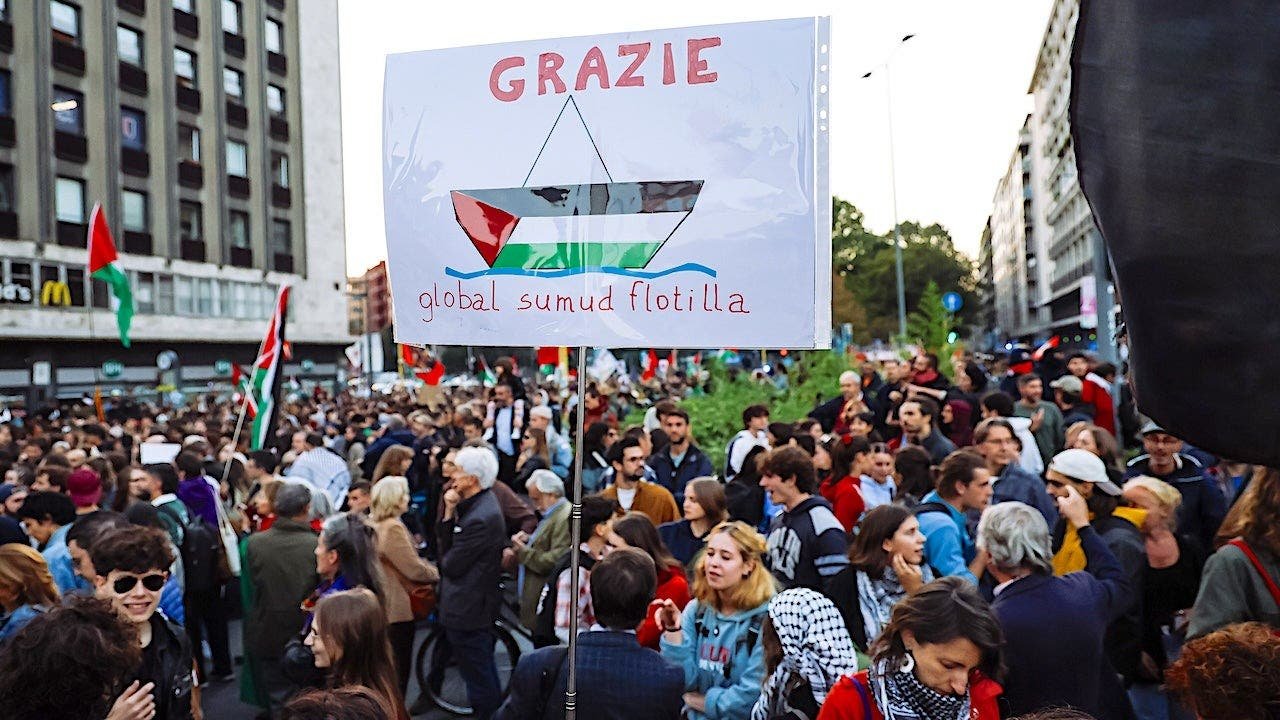
People take part in a flash mob entitled «In the same boat» to protest the detention and treatment of activists participating in the Global Sumud Flotilla in Milan, northern Italy, on May 21, 2026. (AFP via Getty Images)
«The online mapping of so-called ‘Zionist tourism,’ rightly denounced by the president of the Jewish Community of Milan, Walker Meghnagi, is an aberrant initiative, in direct violation of fundamental human rights and the constitutional principles on which our nation is founded,» Italian Senate President Ignazio La Russa wrote in a statement, as translated to English.
«No form of cataloguing of persons on the basis of their religious belief or their connection with Israel is acceptable or justifiable. Behind all this lies a profound anti-Semitism that must be unanimously, firmly, and determinedly rejected,» he added. «We cannot remain motionless in the face of such serious facts that recall the ghosts of the past. To the Jewish Community all my closeness.»
The form was removed following the intervention of Gen. Pasquale Angelosanto, Italy’s national coordinator for the fight against antisemitism, according to Italian and Israeli media reports.
‘NOT ON OUR WATCH’: GLOBAL LAW ENFORCEMENT LEADERS UNITE IN POLAND AGAINST HATE
A view of participants in a May 21 flash mob demonstration in Milan, northern Italy, with people gathered in public space to show solidarity with detained Global Sumud Flotilla activists. (AFP via Getty Images)
«This form is intended to record cases of Zionist tourism, property purchases, and, more generally, Zionist neo-colonization in Italy,» the questionnaire stated.
It said the information collected would be received by the Global Sumud Movement, an activist network associated with flotilla efforts to reach the Gaza Strip, and would remain confidential. Respondents were asked to provide sources so the reports could be verified and used to coordinate unspecified «initiatives.»
The Global Sumud Movement denied commissioning the form or knowing about it before the controversy erupted, according to The Jerusalem Post.
«Zionism is one of the issues we work on, but we do not hunt Jews, and we know nothing about this questionnaire,» the group told the Italian newspaper La Repubblica. «We did not commission it and had not even seen it before it was taken offline.»
EXILED MUSLIM SCHOLAR WARNS FAR-LEFT–ISLAMIST ALLIANCE BEHIND ANTI-ISRAEL PROTESTS ECHOES IRAN’S RISE
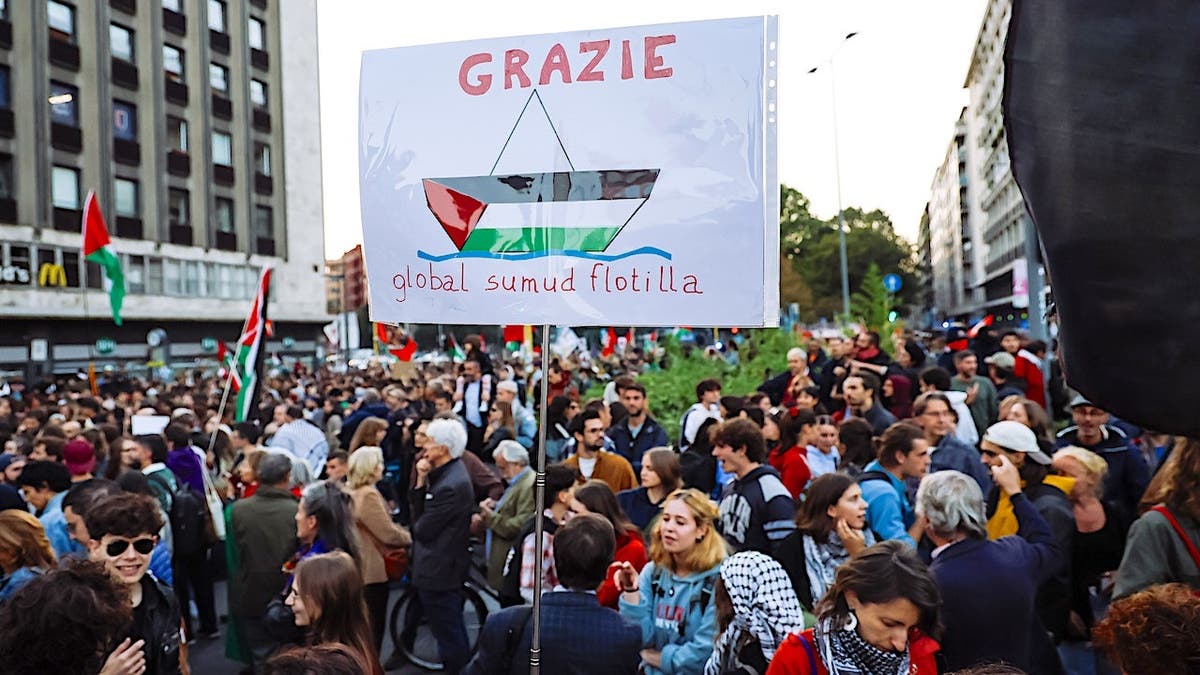
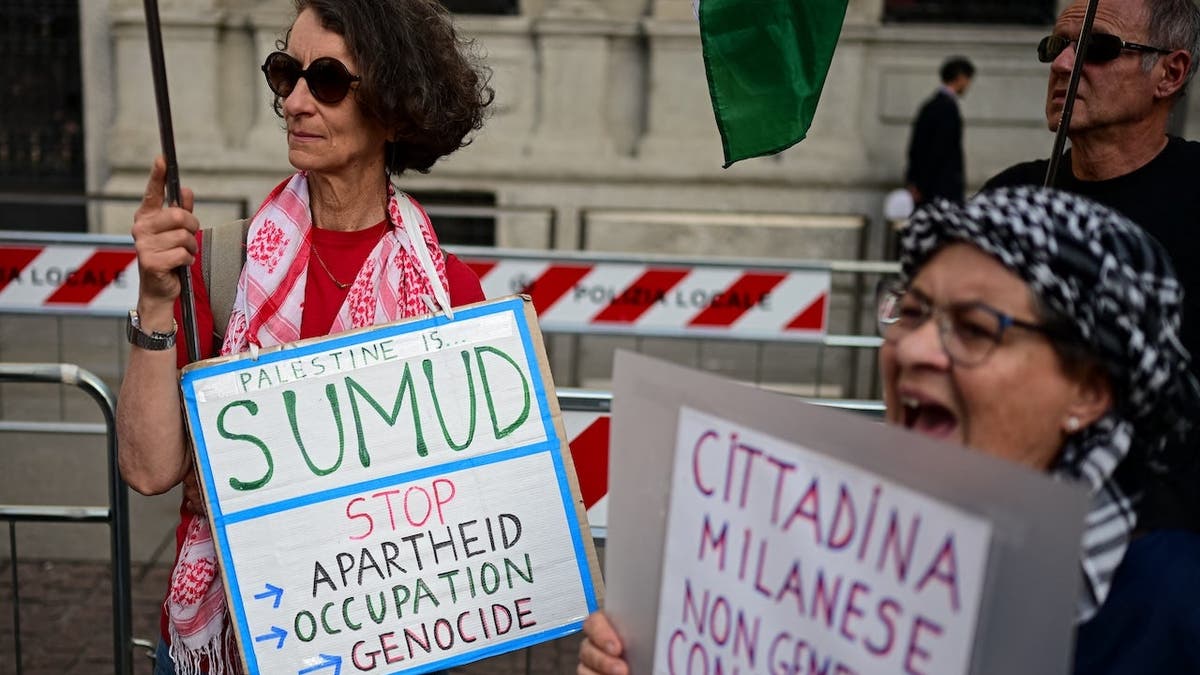
Seen Oct. 2, 2025, in Piazzale Loreto in Milan, Italy, demonstrators participate in a protest supporting the Global Sumud Flotilla after its interception by the Israeli army off the Gaza coast. (Alessandro Bremec/NurPhoto)
The organization said it learned about the questionnaire through news reports and reserved the right to take further action, including issuing a formal statement.
According to La Repubblica, later sections of the form asked respondents to name locations where Jewish or Israeli visitors had been seen and to indicate whether local organizations or activist groups were already «managing the phenomenon.»
Meghnagi warned that collecting and circulating such information could encourage extremists to target Jews and Israelis.
«What is happening today shows that there are unbalanced individuals out there, and if this kind of message spreads widely enough, you are certain to find someone willing to act on it,» he said. «For this reason, mapping where Jews are is extremely serious.»
CLICK HERE TO DOWNLOAD THE FOX NEWS APP
Alessandro Morelli, an Italian deputy secretary of state, ripped the form as «abhorrent» and said those responsible should not go unpunished.
italy, anti semitism, israel, hate crime, religion, world, world politics
INTERNACIONAL
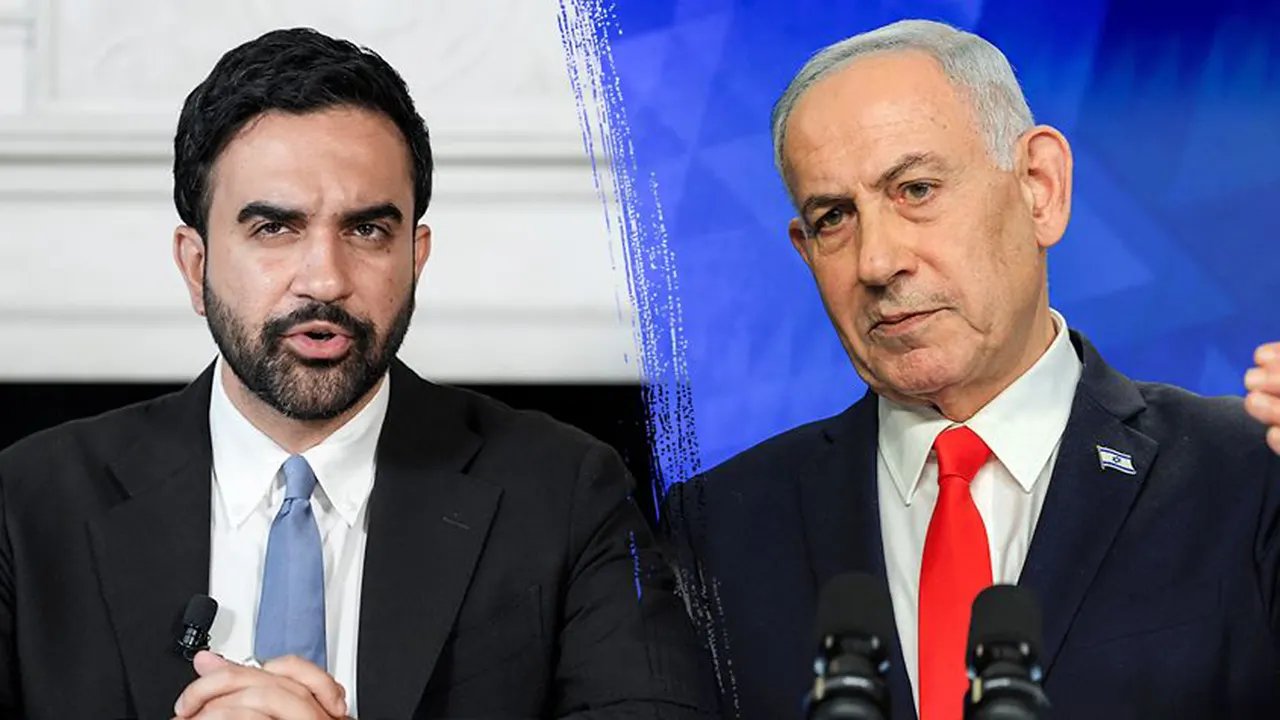
Mamdani dodges on ‘political theater’ of empty Netanyahu arrest threat, calls for US action and NYC protests
NEWYou can now listen to Fox News articles!
New York City Mayor Zohran Mamdani declined Wednesday to say when he learned the city had no authority to arrest Israeli Prime Minister Benjamin Netanyahu, after repeatedly campaigning on a promise to detain the Israeli leader if he came to New York.
Pressed over whether the now-abandoned arrest threat amounted to «political theater,» Mamdani said his administration had reviewed the applicable laws and concluded that only the federal government could execute the International Criminal Court warrant.
«It’s clear that the city does not have the authority to execute this warrant,» Mamdani admitted at a New York City Hall news conference Wednesday, urging the federal government to act on the ICC warrant even though the U.S. is not a member of the ICC and does not recognize the court’s jurisdiction in the U.S. or over Israel, which is also not a member.
With the Trump administration already fully rejecting his call to arrest Netanyahu for being a «war criminal,» Mamdani called for New Yorkers to take to protest «if anyone feels a level of frustration or opposition.»
MAMDANI GOES BACK ON CAMPAIGN PROMISE, SAYS NYC CAN’T ARREST NETANYAHU
New York City Mayor Zohran Mamdani has been forced to admit his threat to arrest Israeli Prime Minister Benjamin Netanyahu has no force or measure in the law. (Getty Images)
«I believe that this is an arrest warrant that should be executed, and also that I would follow the laws that we had, and I would be respectful of those laws,» he added. «And that is why I asked my administration to review of all applicable laws. And I believe, however, in that same finding, that the United States government does have the ability to both joining the International Criminal Court and executing that work, and that is something that I want to see happen.»
Short of that, Mamdani suggested that people protest when the Israeli leader visits for the United Nations General Assembly, potentially in September.
«This is a city where, if anyone feels a level of frustration or opposition, protest is something that we will always respect,» Mamdani told reporters. «I leave it to New Yorkers themselves to make that decision.»
The mayor was repeatedly asked why he did not resolve the legal question before taking office, given that experts had challenged the legality of his arrest pledge during the campaign.
HAMAS, HEZBOLLAH FLAGS FLY AT ANTI-ISRAEL PROTEST MINUTES AFTER MAMDANI CONDEMNS TERROR PLOT AGAINST JEWS
Mamdani would not provide a date for when his administration informed him that the city lacked the power to carry out the ICC warrant.
«That’s a review that I asked them to do,» he said. «They made it clear that this is not possible through applicable law.»
Mamdani said Palestinian New Yorkers disappointed that he cannot fulfill his arrest promise had reason to be frustrated, declaring that Netanyahu would no longer be welcomed by City Hall.
«I understand it because we are talking about someone who has been charged with crimes against humanity, someone who has visited the city on many an occasion and who has been welcomed by previous mayors,» Mamdani said.
«I want to make it very clear that that welcome ends with me,» he continued. «I will not be welcoming Benjamin Netanyahu or any other war criminals when they come to this city.»
NYC REPUBLICAN LAWMAKER SLAMS MAMDANI ANTISEMITISM OFFICE AS A ‘BLACK HOLE’ LACKING PUBLIC-FACING RESOURCES
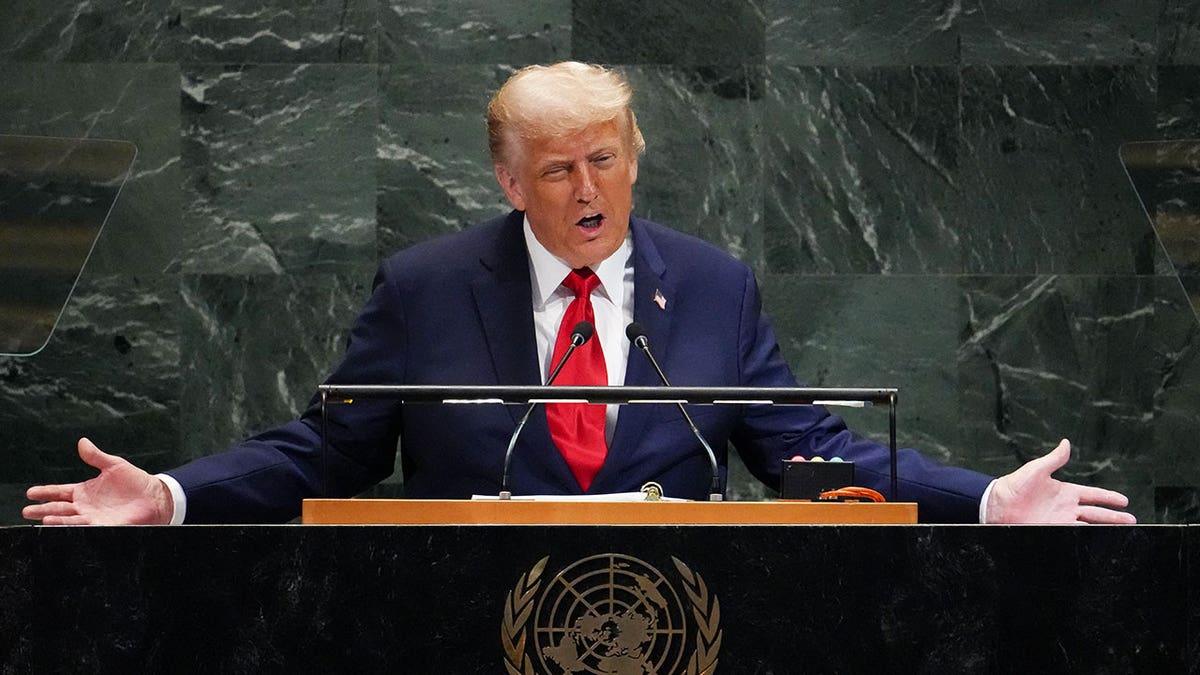
President Donald Trump has forcefully rejected New York City Mayor Zohran Mamdani’s threats to arrest Israeli Prime Minister Benjamin Netanyahu under an unenforceable International Criminal Court arrest warrant that the U.S. nor Israel are a party to. (Timothy A. Clary/AFP via Getty Images)
Mamdani also faced questions over criticism that his focus on Netanyahu created a one-sided account of the Israel-Hamas war.
Asked directly whether he considered Hamas’ Oct. 7, 2023, terrorist attack to be genocide, Mamdani did not use that term.
«I consider Oct. 7 to be a horrific war crime,» he said. «I’ve considered it to be something that should be deeply opposed with every single fiber of our being.»
Mamdani said his approach was rooted in what he called the «universality of humanity,» arguing that officials should not «pick and choose which crimes against humanity we oppose.»
The mayor also said he would support honoring ICC warrants against Hamas leaders as well as Netanyahu.
«My interest in executing that warrant is not specific to Benjamin Netanyahu, but to anyone who they put a warrant towards for war crimes and crimes against humanity,» Mamdani said.
He accused Netanyahu of having «orchestrated this genocide» in Gaza and described the Israeli prime minister as a «war criminal.» Israel has repeatedly rejected genocide allegations and condemned the ICC case as illegitimate.
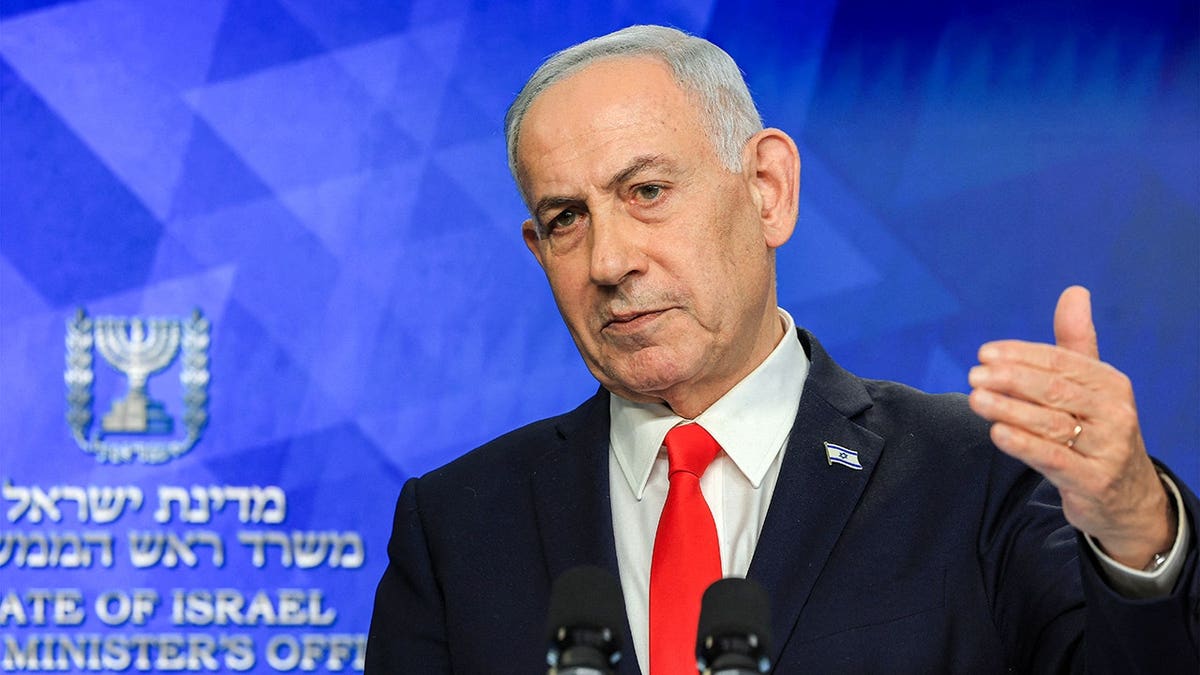
New York City Mayor Zohran Mamdani said his administration is exploring whether the city has legal authority to arrest Netanyahu if he visits for the U.N. General Assembly. (Ronen Zvulun/Pool/AFP via Getty Images)
CLICK HERE TO DOWNLOAD THE FOX NEWS APP
Mamdani said he remained committed to protecting Jewish New Yorkers, including those who disagree with his position.
«My responsibility to them is to ensure that they are cherished, they are celebrated and they are safe in their city,» he said, «and that never are they made to feel as if their opinions on any one issue is the precondition for that safety.»
zohran mamdani, benjamin netanyahu, new york city, international law, politics

Inter Miami presentó a una ex estrella del Real Madrid como flamante refuerzo: llega tras jugar el Mundial con Brasil

La respuesta de un exsecretario de la CGT a Pérez-Reverte tras las críticas a la selección argentina: “No sabe nada”

Italy shuts down effort linked to Gaza flotilla group to track Jewish, Israeli tourists

Pampa prevé exportar crudo de Vaca Muerta por u$s17.000 millones bajo el RIGI

Llega al país el nuevo embajador del Vaticano y crece la expectativa sobre la visita del papa León XIV

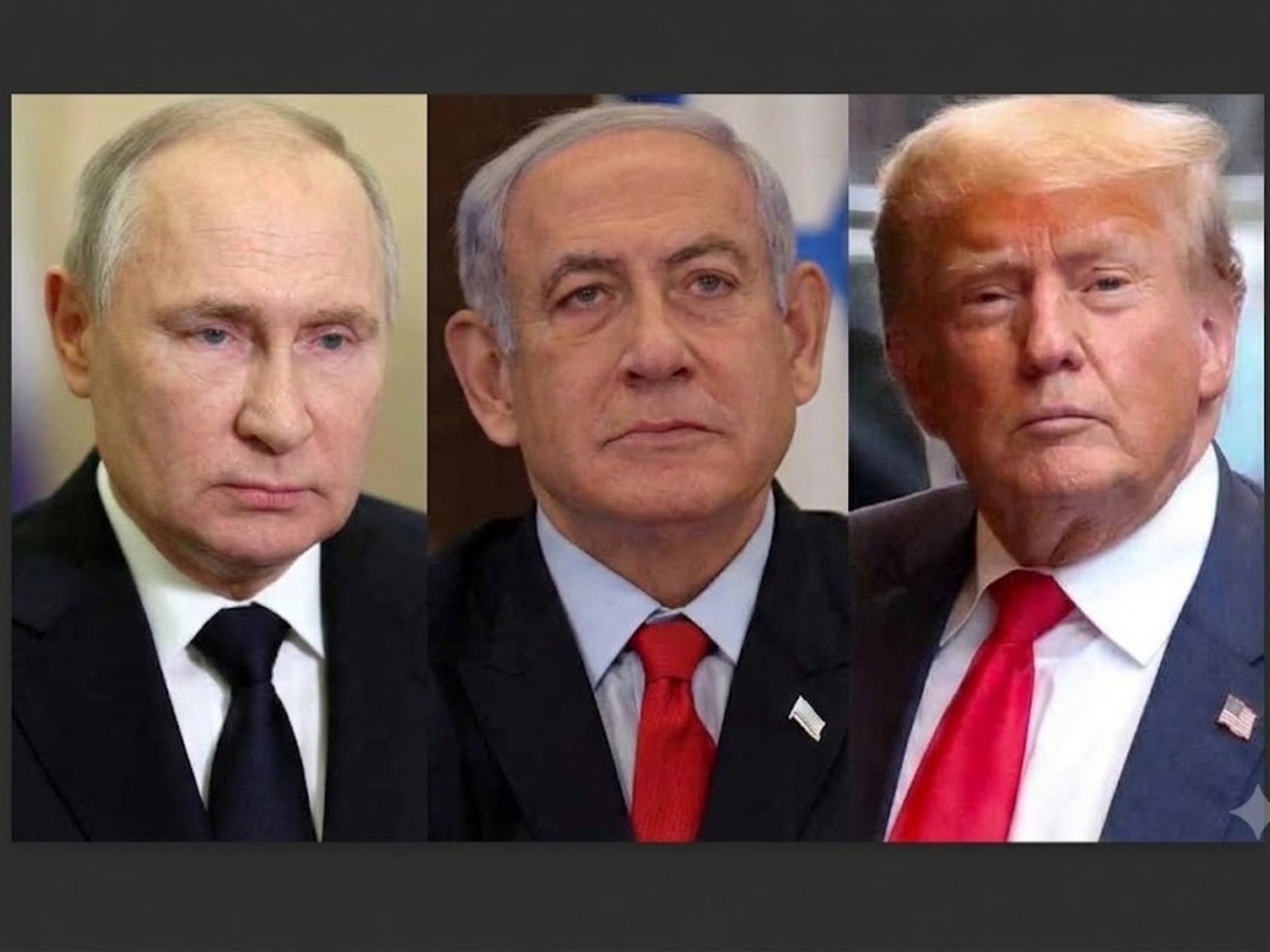
Tres líderes mundiales. Tres decisiones increíblemente equivocadas

Sin la Copa y sin Messi en el avión, vuelve Tapia y deberá enfrentar tres frentes de tormenta tras la pausa del Mundial

Samuel L. Jackson llamó a Argentina “el país más racista del mundo”: la contundente respuesta que le dejó Bárbara Lombardo

Escándalo Mundial: Las presiones secretas, la amenaza de la FIFA por Malvinas y la verdad detrás del partido contra España

Le ganan a la inflación: los senadores pasarán a cobrar $12 millones brutos a partir de agosto

 POLITICA2 días ago
Sin la Copa y sin Messi en el avión, vuelve Tapia y deberá enfrentar tres frentes de tormenta tras la pausa del Mundial
- CHIMENTOS2 días ago
Samuel L. Jackson llamó a Argentina “el país más racista del mundo”: la contundente respuesta que le dejó Bárbara Lombardo
- POLITICA2 días ago
Le ganan a la inflación: los senadores pasarán a cobrar $12 millones brutos a partir de agosto