INTERNACIONAL
A los 100 años, murió Alan Greenspan, histórico presidente de la Reserva Federal de Estados Unidos


El influyente economista estadounidense Alan Greenspan, quien presidió la Reserva Federal de Estados Unidos durante casi dos décadas y atravesó cinco mandatos presidenciales, murió este lunes a los 100 años.
La noticia fue informada por su esposa, la periodista Andrea Mitchell, corresponsal jefe en Washington y de asuntos exteriores de la cadena NBC News. Según el comunicado que difundió la mujer, Greenspan falleció por la mañana en su domicilio a causa de complicaciones derivadas del Parkinson. Mitchell, con quien estuvo casado durante 29 años, destacó además la brillantez y la calidez humana del economista.
Nacido el 6 de marzo de 1926 en el barrio de Washington Heights, en Nueva York, Greenspan se convirtió en una de las figuras más influyentes de la política económica de Estados Unidos. Conocido con el apodo de “El Maestro”, estuvo al frente de la Reserva Federal entre 1987 y 2006, un período en el que trabajó bajo las presidencias de Ronald Reagan, George H. W. Bush, Bill Clinton y George W. Bush.
Antes de dedicarse por completo a la economía, su vida estuvo marcada por la música. Hijo de un corredor de bolsa, estudió clarinete en la prestigiosa Escuela Juilliard y realizó giras profesionales por Estados Unidos tocando el saxofón y el clarinete en la banda de Henry Jerome.
La figura más influyente de la política monetaria de EE.UU.
Nació el 6 de marzo de 1926 en el barrio de Washington Heights, en Nueva York. (Foto: Reuters)
Tras esa etapa artística, inició su formación académica en economía. Obtuvo su licenciatura en la Universidad de Nueva York en 1948 y luego completó una maestría en la misma institución en 1950. Más adelante, comenzó un doctorado en la Universidad de Columbia bajo la dirección de Arthur Burns, quien años después también sería presidente de la Reserva Federal.
En 1953 fundó su propia consultora, Greenspan, Townsend & Co., desde donde asesoró a diversas empresas, entre ellas Republic Steel. Su carrera en el ámbito público empezó a ganar relevancia en la década de 1960.
En 1968 fue asesor de la campaña presidencial del republicano Richard Nixon y posteriormente ocupó distintos cargos en las administraciones de Nixon, Gerald Ford y Ronald Reagan.
En 1974, durante el gobierno de Ford, asumió la presidencia del Consejo de Asesores Económicos. Ese cargo terminó de consolidarlo como una figura de peso en los círculos de decisión económica de Washington.
Leé también: Javier Milei autorizó tomar créditos por US$5000 millones con bancos internacionales para afrontar el pago de deuda
Su llegada a la Reserva Federal se produjo en 1987, cuando Reagan lo nominó para suceder a Paul Volcker. El Senado estadounidense confirmó su designación el 11 de agosto de ese año.
Apenas dos meses después de asumir, Greenspan enfrentó uno de los mayores desafíos de su carrera. El denominado “Lunes Negro” de octubre de 1987 provocó un derrumbe superior al 22% del índice Dow Jones en una sola jornada, la mayor caída diaria de su historia. La decisión de garantizar liquidez al sistema financiero evitó una crisis de mayor magnitud y dio origen al concepto conocido como “Greenspan Put”.
Durante su gestión, la Reserva Federal condujo una de las expansiones económicas más prolongadas de la historia de Estados Unidos, aproximadamente entre 1991 y 2001. Ese ciclo coincidió con el avance de la globalización y el auge de internet. Con su esposa, la periodista Andrea Mitchell, corresponsal jefe en Washington y de asuntos exteriores de la cadena NBC News. (Foto: Reuters)
También debió gestionar otros episodios de elevada tensión financiera, entre ellos el colapso del fondo Capital Management en 1998 y el estallido de la burbuja de las empresas puntocom en 2001. Su prolongada permanencia al frente del banco central y su capacidad de influir sobre los mercados le otorgaron un nivel de notoriedad poco habitual para un banquero central.
Sin embargo, su legado fue objeto de revisiones críticas después de dejar la Reserva Federal en 2006. En 2008, durante un testimonio ante el Congreso estadounidense, reconoció haber encontrado una falla en su modelo económico, vinculada a su defensa de la autorregulación bancaria.
Leé también: Se terminó la década de tasas bajas: qué significa para la Argentina la nueva etapa de la Reserva Federal
Con posterioridad, recibió cuestionamientos por su oposición a regular los derivados financieros y por el papel que algunos analistas le atribuyeron en el desarrollo de la burbuja inmobiliaria, decisiones que fueron señaladas tras la crisis de 2008 como factores que contribuyeron al colapso financiero.
Luego de su retiro, fundó la consultora Greenspan Associates y continuó participando del debate económico. En sus últimos años,advirtió sobre la persistencia de la inflación y también se pronunció sobre episodios recientes, como el colapso del exchange de criptomonedas FTX.
Alan Greenspan, Reserva Federal de los Estados Unidos

INTERNACIONAL
Tras la ajustada victoria de Abelardo De la Espriella, Colombia inicia una transición tensa y repleta de dudas


INTERNACIONAL
Cops could be forced into race-based guessing game after Supreme Court move, Thomas joins dissent

NEWYou can now listen to Fox News articles!
Justices Samuel Alito and Clarence Thomas on Monday dissented from the Supreme Court’s refusal to take up a case that they said forces police officers to create a separate set of rules for racial minorities.
«It is dangerous to allow an individual to be treated differently based on statistics, studies, or expert testimony that purports to show that members of the racial or ethnic group to which he belongs are more likely to act in a certain way than are members of other groups,» Alito wrote on behalf of himself and Thomas. «Here, the special treatment helped the individual; in other situations it will not.»
The case, U.S. v. Donte J. Carter, involved a Black man whose firearm and theft convictions were vacated after the D.C. Court of Appeals held that police seized him before they had reasonable suspicion. Officers later recovered a .40-caliber pistol from Carter’s pants and the government said the gun had been stolen from an FBI agent’s vehicle.
According to the D.C. court, «black Americans like [Carter] are ‘especially distrustful of law enforcement’» and therefore «‘less likely’ than other people ‘to terminate a police encounter’ due to skepticism that any attempt to exercise their constitutional rights will be respected.»
SUPREME COURT REJECTS BOSTON PARENTS’ APPEAL CLAIMING RACIAL BIAS IN AN ADMISSIONS POLICY
Supreme Court Justices Clarence Thomas and Samuel Alito are pictured together. (Getty Images)
The D.C. court reasoned that Carter’s race was relevant to whether a reasonable person in his position would have felt free to end the police encounter. It ruled that the encounter effectively became a seizure, and that such an action was unlawful because police officers hadn’t established reasonable suspicion before subjecting him to it.
Alito and Thomas argued that the D.C. ruling effectively forces law enforcement to treat people differently based on their race, something precedent established by the Supreme Court prohibits.
«Under the test, officers will need to quickly assess a person’s race, and if officers and courts must craft special rules for black persons, what about dark-skinned Latinos, other Latinos, and members of other minority groups?» Alito continued. «We have said that our ’Constitution is color-blind.’ It ‘almost never’ allows government actors to treat persons differently based on their race.»
SUPREME COURT RULES ON KEY VOTING RIGHTS ACT RULE AS REPUBLICANS AND DEMOCRATS WAGE REDISTRICTING WAR
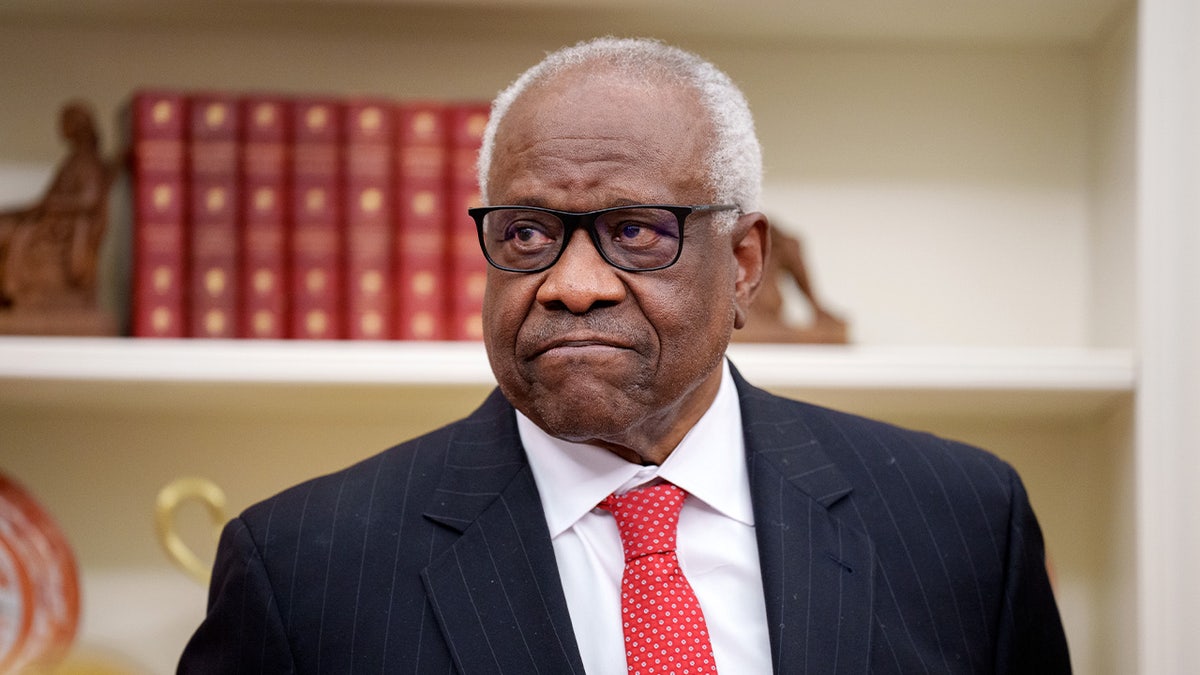
U.S. Supreme Court Justice Clarence Thomas appears before swearing in Pam Bondi as U.S. Attorney General in the Oval Office at the White House in Washington, D.C., on Feb. 5, 2025. (Andrew Harnik/Getty Images)
To support his claims, Alito cited Students for Fair Admissions v. Harvard and Louisiana v. Callais and Shaw v. Reno.
«And we have rejected the proposition that the Constitution permits an individual to be treated differently based on a ‘perception that members of the same racial group — regardless of their age, education, economic status, or the community in which they live — think alike,’» Alito wrote, citing Shaw v. Reno.
This appears to be a direct challenge to the D.C. Court of Appeals, which lawyers representing the United States argued forced police officers to assume that all black people have the same attitudes toward police officers and would therefore feel uncomfortable exercising constitutional rights in their presence.
TRUMP’S FIRING POWER FACES TWIN SUPREME COURT TESTS, BUT ONE AGENCY MAY GET SPECIAL TREATMENT
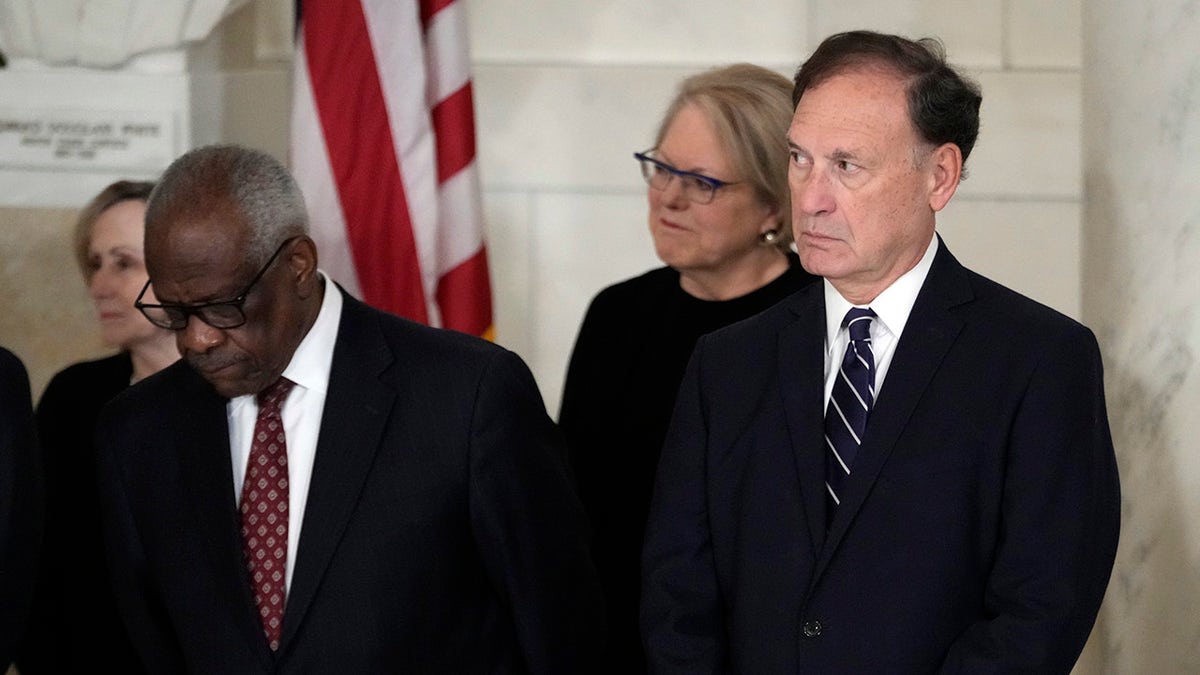
Supreme Court Justice Clarence Thomas and Justice Samuel Alito are seen inside the Supreme Court building in Washington, D.C., in December 2023. (Jacquelyn Martin-Pool/Getty Images)
CLICK HERE TO DOWNLOAD THE FOX NEWS APP
Carter, the individual Alito noted was helped by the case, initially lied to officers by answering in the negative when approached and asked if he was carrying a weapon.
The police then asked Carter to pull his pants up, at which point they noticed an L-shaped bulge which was later identified as a .40-caliber pistol that had been stolen from a federal agent’s vehicle.
supreme court, second amendment, police and law enforcement, constitution, fbi
INTERNACIONAL
Keith Kellogg tells Iranian dissidents the ‘window is open’ to force regime change in Tehran
NEWYou can now listen to Fox News articles!
As the Trump administration pushes forward with a new Iran deal, retired Lt. Gen. Keith Kellogg told a Paris gathering of the National Council of Resistance of Iran — an exiled Iranian opposition coalition aligned with the People’s Mujahedin Organization of Iran (MEK) — that Tehran’s rulers are weaker than they have been in decades and urged dissidents to seize what he described as a historic opening.
«The window is open wider than at any moment in a generation, and windows do not stay open forever,» Kellogg said at the two-day event. «The theocratic regime in Tehran will not leave voluntarily. You must force it. The hope is here. Now must come the action.»
Kellogg, a retired U.S. Army lieutenant general and former U.S. special envoy for Ukraine, framed any disarmament agreement not as an endpoint, but as «the first step of something far larger,» saying it should become the foundation for Iran’s future without the current regime.
POMPEO SAYS IRANIAN REGIME HAS ARRIVED AT ‘NATURAL TERMINUS’: ‘LET’S NOT WASTE THIS HISTORIC OPPORTUNITY’
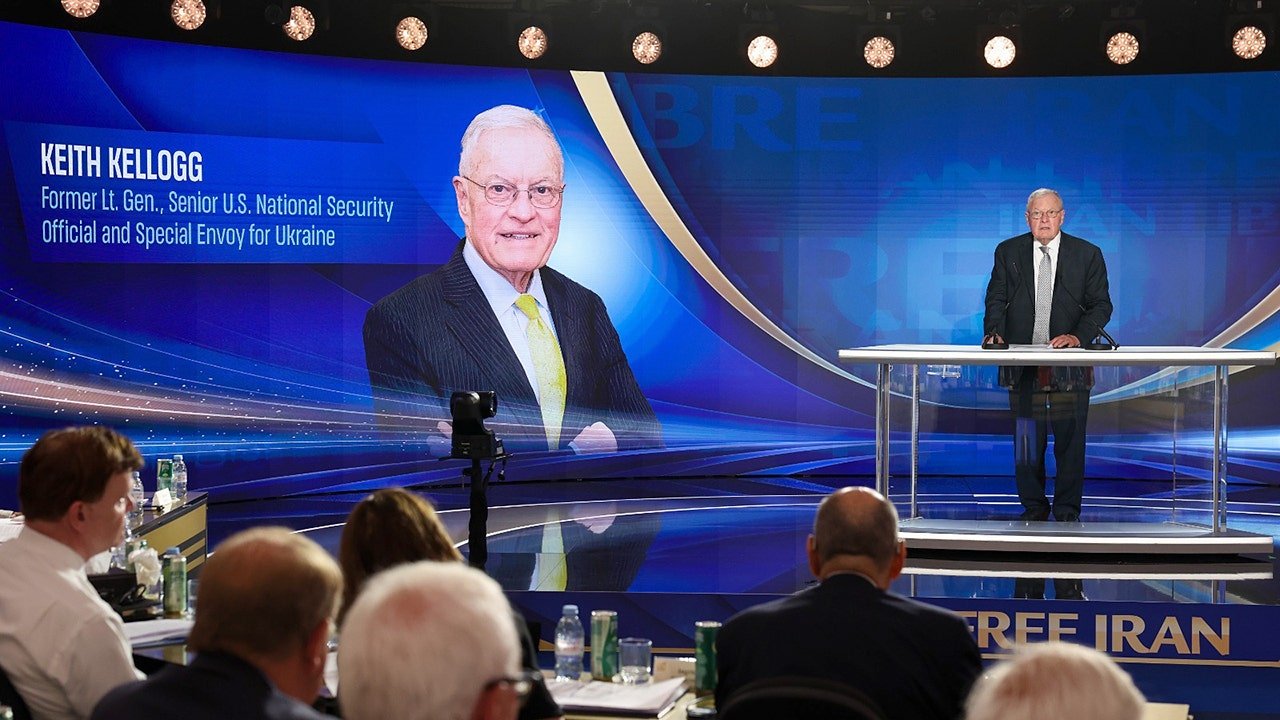
Retired Lt. Gen. Keith Kellogg speaks at the National Council of Resistance of Iran’s two-day conference in Paris, where he urged Iranian opposition supporters to seize what he called a historic opening against Tehran’s regime. (Mousa Mohebbi)
Maryam Rajavi, the NCRI’s president-elect, used her remarks at the conference to argue that neither war nor negotiations had solved the threat posed by Tehran’s rulers. «A peaceful, non-nuclear Iran is possible only through the overthrow of this regime by the Iranian people and their organized Resistance,» Rajavi said, adding that any international agreement to end the war should include an end to executions of political prisoners and the killing of protesters.
Kellogg also invoked the NCRI’s 2002 disclosure of Iran’s Natanz and Arak nuclear sites, saying the group should play a role in pushing for strict verification of any agreement. «When I say trust, but verify, understand that verification is not an abstraction to this Council. It is your legacy,» he said. «You must be the conscience that ensures every barrel of uranium leaves, every centrifuge stops, and every promise on that page becomes a fact on the ground.»
The remarks came as NCRI organizers had expected tens of thousands of Iranian expatriates from North America and Europe to attend two days of events in Paris. French authorities banned a planned outdoor rally, citing security threats. A French court later upheld the ban, pointing to specific intelligence about alleged bomb threats and risks of violence involving rival Iranian opposition factions, including possible threats from Iranian regime-linked actors or monarchist groups.
FRANCE CONDEMNS IRAN PROTEST CRACKDOWN, WEIGHS SATELLITE INTERNET AID AMID BLACKOUT
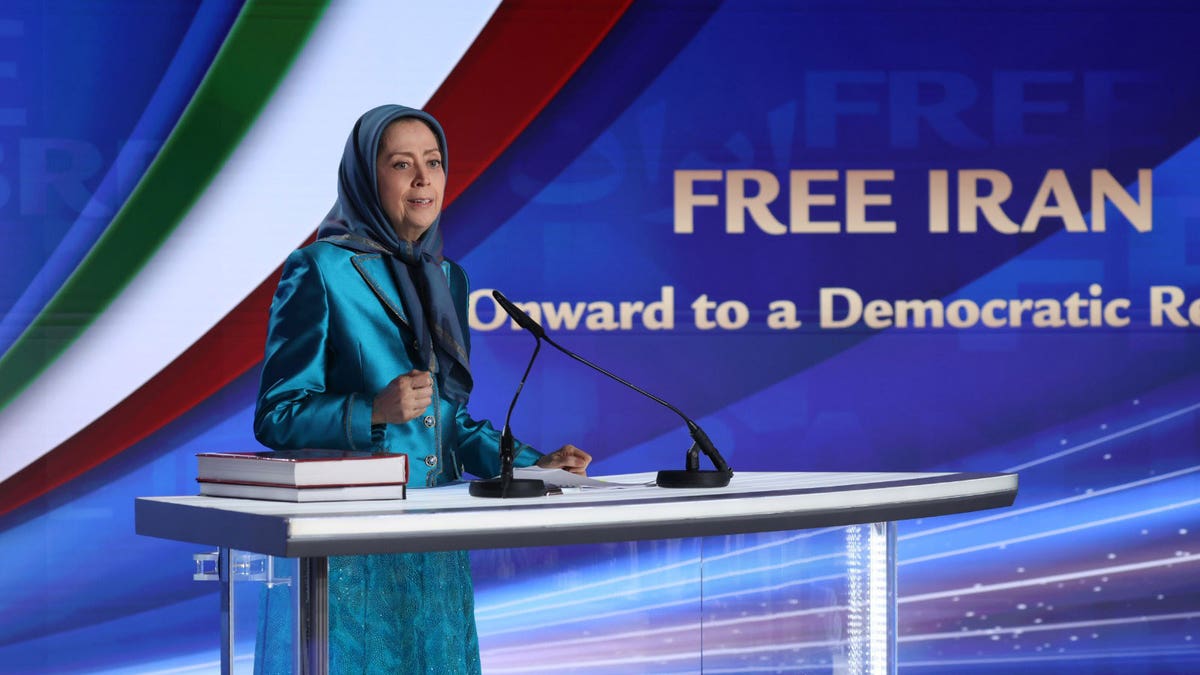
Maryam Rajavi, president-elect of the National Council of Resistance of Iran, speaks at the NCRI’s two-day conference in Paris, where she called for a democratic republic in Iran and said any international agreement should include an end to executions of political prisoners. June 21, 2026. (Mousa Mohebbi)
The NCRI’s main member organization is the MEK, which was previously listed as a terrorist organization by the U.S., U.K. and European Union before being delisted in 2012. The group is a major thorn in the side of the Tehran regime and has been the target of alleged Iranian plots in the U.S. and Europe, including a foiled 2018 bomb plot against the group’s rally outside Paris.
Despite the ban, demonstrators gathered at the site on Saturday. Police ordered the crowd to disperse and arrested around 20 people, a police source told AFP.
Ali Safavi, a member of the NCRI’s Foreign Affairs Committee, told Fox News Digital that the French decision amounted to «an unjustifiable act of capitulation,» arguing that Paris should have protected the rally rather than banning it, «Rather than yielding to intimidation, France should have defended the fundamental democratic right to peaceful assembly.»
Former British Prime Minister Boris Johnson also criticized the French ban, calling it a «tragic mistake» and saying Western capitals must allow Iranian opposition voices to be heard.
IRAN GOES DARK AS REGIME UNLEASHES FORCE, CYBER TOOLS TO CRUSH PROTESTS
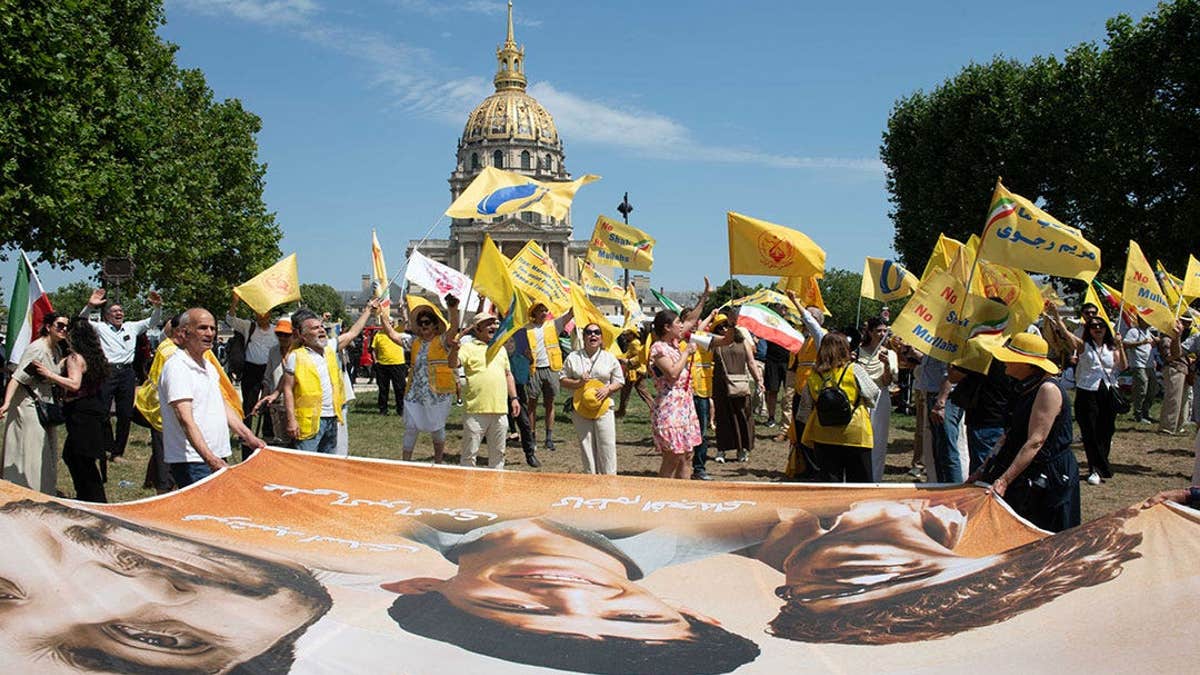
Supporters of the National Council of Resistance of Iran gather in Paris on June 20, 2026, after French authorities banned an outdoor rally against repression and executions in Iran. Police ordered demonstrators to disperse and arrested around 20 people, according to AFP. (National Council of Resistance of Iran)
«If the voices of freedom are to be heard in Iran, then we in the West must allow those voices of freedom to be heard in our capitals and around the world,» Johnson said during his speech.
Former Ukrainian Foreign Minister Dmytro Kuleba also addressed the event Saturday, linking Ukraine’s struggle against Russia to the Iranian opposition’s fight against Tehran. Kuleba said Ukrainians had wanted to join the rally and were «appalled» by the French ban, adding, «The people of Ukraine stand by those who defend democracy, freedom, liberty in their lands.»
He also pointed to Iran’s support for Russia’s war effort, saying that while Russian ballistic missiles were targeting Kyiv, drones using technology «provided to Russia by the current regime in Iran» were also striking Ukraine.
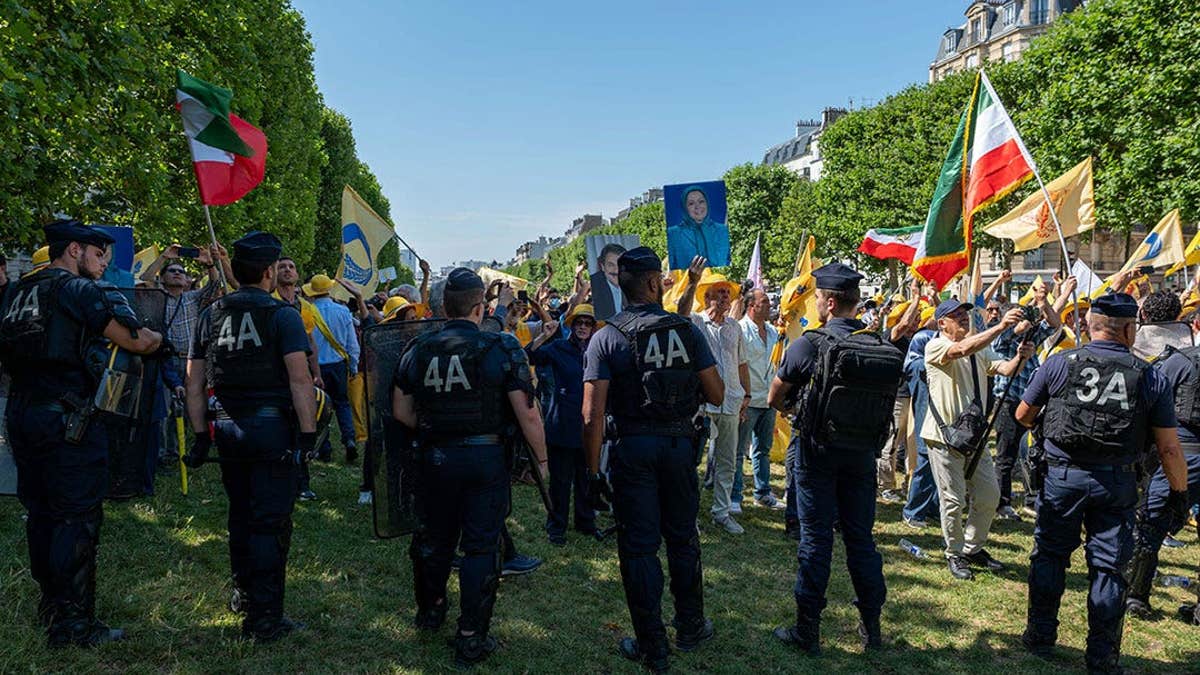
Supporters of the National Council of Resistance of Iran gather in Paris after French authorities banned a rally against repression and executions in Iran, June 20, 2026. (National Council of Resistance of Iran)
CLICK HERE TO DOWNLOAD THE FOX NEWS APP
«Like you, I know very well what it means to be attacked and killed and destroyed by the regime that currently holds its grip over the people of Iran,» Kuleba said.
The French government did not immediately respond to a Fox News Digital request for comment.
iran, world protests, war with iran, boris johnson

Dólar hoy en vivo: a cuánto se operan todas las cotizaciones minuto a minuto este lunes 22 de junio

Un ministro clave de Kicillof dijo sobre Insaurralde: “Si existe delito, la Justicia tendrá que sancionarlo”

Maximiliano Pullaro, gobernador de Santa Fe: “Si Manuel Adorni fuera funcionario mío, no estaría desde hace rato en su cargo”

Tim Payne habló de Olimpia y el presidente reveló que usaron Transfermarkt

Qué ver en Netflix, la miniserie de 10 episodios, de solo 13 minutos cada uno, para mirar en pocas horas: «El tiempo que te doy»

Banco por banco: cuánto sale comprar dólar oficial

LA DOBLE VARA ZURDA: Militantes K prefieren el pasado dictatorial y los excesos de Maradona antes que el éxito limpio de Messi

Preocupación en el oficialismo por el impacto digital del caso Adorni y la insuficiencia del “efecto Mundial”

El lapidario posteo de Javier Milei contra Florencia Peña por la fake news sobre la muerte del papá de Messi

Difundieron videos en los que Jésica Cirio aparece junto a miles de dólares

 POLITICA1 día ago
LA DOBLE VARA ZURDA: Militantes K prefieren el pasado dictatorial y los excesos de Maradona antes que el éxito limpio de Messi
- POLITICA1 día ago
Preocupación en el oficialismo por el impacto digital del caso Adorni y la insuficiencia del “efecto Mundial”
- POLITICA2 días ago
Difundieron videos en los que Jésica Cirio aparece junto a miles de dólares