INTERNACIONAL
Más allá del ADN: descubren que ciertos rasgos heredados pueden persistir durante 15 generaciones en algunos organismos

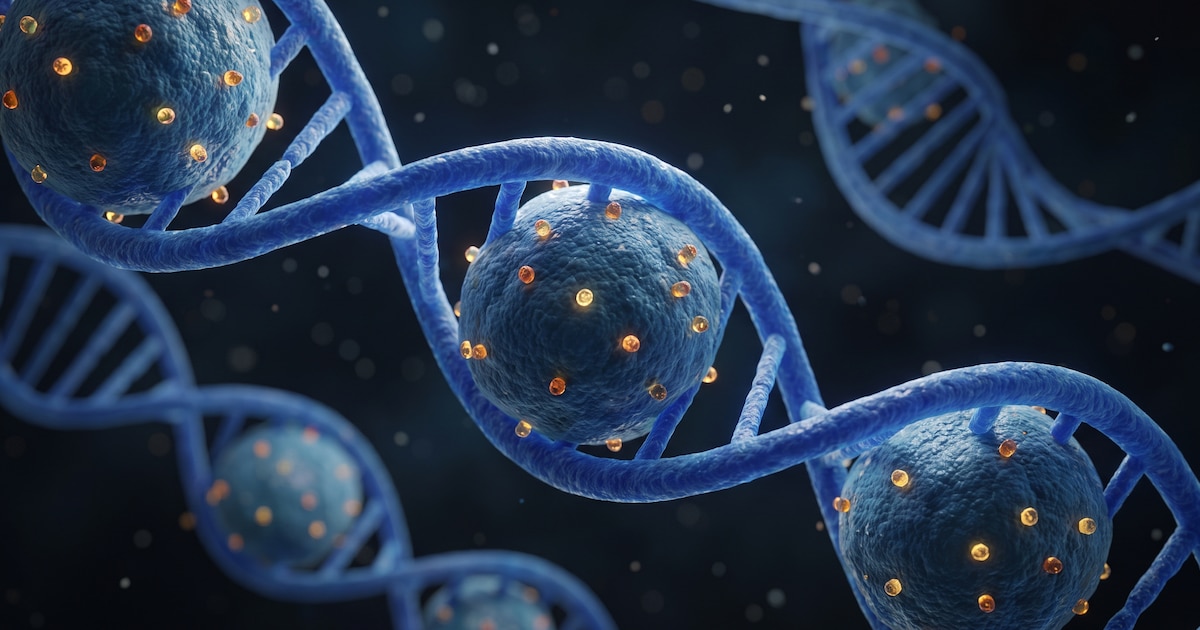
La herencia suele explicarse a partir del ADN que pasa de padres a hijos. Sin embargo, investigadores de la Universidad de Ginebra comprobaron que cambios en la actividad de los genes pueden mantenerse durante al menos quince generaciones, aun cuando el ADN de los descendientes no presenta la alteración inicial. El trabajo se realizó con el gusano microscópico Caenorhabditis elegans.
La pregunta era cuánto podían durar las señales que regulan los genes sin modificar su secuencia, un campo conocido como epigenética. Estas señales ayudan a determinar cuáles instrucciones del genoma se usan en cada célula, de modo que una célula nerviosa y una muscular, aunque compartan el mismo material genético, cumplen tareas distintas. Un estudio publicado en la revista EMBO Journal siguió ese proceso en distintas camadas de gusanos y halló que sus efectos podían persistir mucho más de lo que se había observado hasta entonces.
El resultado aporta una pista para entender que la información hereditaria no depende solo de las letras del ADN. La trayectoria de vida y el ambiente pueden influir en la forma en que los genes se activan o se silencian, sin reescribir el código genético. El experimento no se hizo en personas ni permite trasladar sus resultados a la salud humana, pero aclara mecanismos básicos de la regulación genética.
Las proteínas que envuelven el ADN también guardan información

Dentro de cada célula, el ADN está enrollado alrededor de proteínas llamadas histonas, que permiten ordenarlo y compactarlo. Esas proteínas pueden recibir pequeñas señales químicas que funcionan como indicaciones sobre qué genes deben quedar activos y cuáles deben permanecer en silencio. No cambian el contenido del ADN, pero sí condicionan la lectura que la célula hace de él.
El equipo encabezado por Florian Steiner, profesor del Departamento de Biología Molecular y Celular de la Universidad de Ginebra, se concentró en una de esas señales, denominada H3K27me3. Se trata de una modificación presente en las histonas que ayuda a impedir la activación de determinados genes. Para volverla más fácil de identificar, los investigadores alteraron de manera transitoria su distribución en los gusanos.
El cambio inicial se produjo al hacer que los animales fabricaran una versión modificada de una histona. Esa intervención redujo la fertilidad de forma notable: en condiciones habituales, cada ejemplar podía tener cerca de 300 crías, mientras que los afectados tuvieron entre 50 y 100 descendientes. Sin embargo, los hijos seleccionados para continuar el experimento ya no llevaban la modificación genética que había provocado la alteración.

Aun así, conservaron tanto la distribución inusual de la señal química como la menor fertilidad. “Los cambios en la regulación de los genes y los problemas de fertilidad persistieron durante al menos quince generaciones”, afirmaron Isa Özdemir, estudiante de doctorado, y François-Xavier Stubbe, investigador posdoctoral del grupo de Steiner, según el comunicado de la Universidad de Ginebra.
La señal se instala primero y luego se conserva
Los investigadores comprobaron que este fenómeno no depende de un único mecanismo. Según el trabajo, la transmisión tiene dos fases encadenadas: una inicial, necesaria para establecer el nuevo estado, y una segunda, que permite conservarlo en la descendencia. Ambas intervienen sobre las histonas, aunque actúan en momentos diferentes.
En la primera, una proteína llamada SET-32 agrega una señal química transitoria a las histonas. Esta modificación resulta necesaria para que el cambio pase de la generación expuesta a sus hijos. Después, otra proteína, MES-4, toma parte en la conservación del efecto a lo largo de las siguientes camadas. “Mantener un estado epigenético depende de una sucesión de mecanismos especializados, y no de un solo proceso”, explicaron Özdemir y Stubbe, según el comunicado.

El estudio también mostró que la transmisión no era idéntica en todos los animales. En cada camada, algunos recuperaban el patrón habitual de regulación genética y su fertilidad, mientras que otros conservaban la alteración. Entre los descendientes de ejemplares con baja fertilidad, entre el 25% y el 40% mantuvo ese rasgo en las generaciones observadas.
Esta variación se explica porque conviven dos procesos. Uno replica el estado alterado y otro reconstruye el patrón normal. El paper indica que esa competencia hace que el cambio sea inestable: puede perdurar, aunque también puede revertirse en cada individuo y en cada camada. Por eso, el hallazgo no implica que toda modificación epigenética se transmita de forma automática ni permanente.
Un modelo para estudiar la herencia sin mutaciones
El uso de C. elegans permitió seguir muchas camadas en poco tiempo y observar células individuales. Este gusano es un modelo habitual en biología porque se reproduce rápido y comparte procesos celulares básicos con otros seres vivos. De todos modos, sus resultados no equivalen a una demostración de que el mismo fenómeno ocurra en humanos.

Lo que sí establece el estudio es que una alteración transitoria de la regulación genética puede dejar una huella heredable sin modificar el ADN. “Una alteración temporal de la regulación genética puede dejar una impronta duradera y transmisible, aunque el cambio genético que la provocó haya desaparecido en los descendientes”, concluyó Steiner, según el comunicado.
Para los autores, esta forma de transmisión podría constituir un mecanismo adicional con el que los organismos responden a condiciones cambiantes. La investigación describe ese mecanismo en gusanos y no determina qué experiencias concretas podrían activar procesos comparables fuera del laboratorio. Aun así, permite separar con mayor precisión dos preguntas que suelen confundirse: qué información está escrita en el ADN y qué señales influyen en la manera en que las células la utilizan.
ADN,epigenética,histona,H3K27me3








NEWYou can now listen to Fox News articles!
WASHINGTON, D.C. – As demonstrators, including the headline-grabbing CodePink agitators, descend on the nation’s capital late Saturday afternoon for a «coordinated global day of action» against Israel, they will join a worldwide wave of marches and planned disruptions that may appear to be unfolding independently.
In Kuala Lumpur, Malaysia, on Friday, anti-Israel demonstrators carried signs deploying emotionally charged language against Israel, including one featuring a Palestinian flag and a bloodied hand with the message, «STOP GENOCIDE.» Nearby, two women carrying mock machine guns flanked a cardboard image of a handcuffed Israeli Prime Minister Benjamin Netanyahu with a noose around his neck.
Anti-Israel demonstrators carry a cutout depicting Israeli Prime Minister Benjamin Netanyahu alongside mock cardboard weapons and placards during a rally on Oct. 09, 2026 in Kuala Lumpur, Malaysia. People gathered in Kuala Lumpur in solidarity with Palestinians in Gaza as part of a «global day of action.» (Annice Lyn/Getty Images)
But a Fox News Digital investigation has found that, long before the first demonstrators gathered, the messages for the protest’s «communications framing» and transnational action plan had already been written, the banners designed, the tactics circulated and the media strategy laid out to «turn public outrage into collective leverage.»
The campaign documents reveal that coalition organizers instructed participating groups to direct protesters to «shut down city squares,» «encircle government buildings» and «blockade complicit corporate hubs.»
The document declares, «This is not a symbolic march and not a routine protest.»
Fox News Digital identified 179 organizations in the coalition, while an interactive Google Map published by the network lists 322 events scheduled across three days through Sunday. They include a rally on an «Intifada Trail» in Saint John, New Brunswick, Canada, a protest in Bangladesh by the «Bangladesh Intifada Youth Collection» and actions in South Africa by «Social Intifada.» All three use «intifada,» a term associated with Palestinian uprisings against Israel, including periods marked by deadly terrorist attacks. Activists describe the term as a call for resistance.
The global coordination illustrates how contemporary protest movements combine international leadership, local activist networks, standardized visual branding, emotionally charged messaging and traditional news outreach into a single mobilization infrastructure in which professional political organizing amplifies the sincerely held convictions of individual demonstrators.
LAWMAKERS THROW OUT ‘TROJAN HORSE’ ACTIVISTS THEY SAY ARE ENGAGED IN AMERICAN SUBVERSION
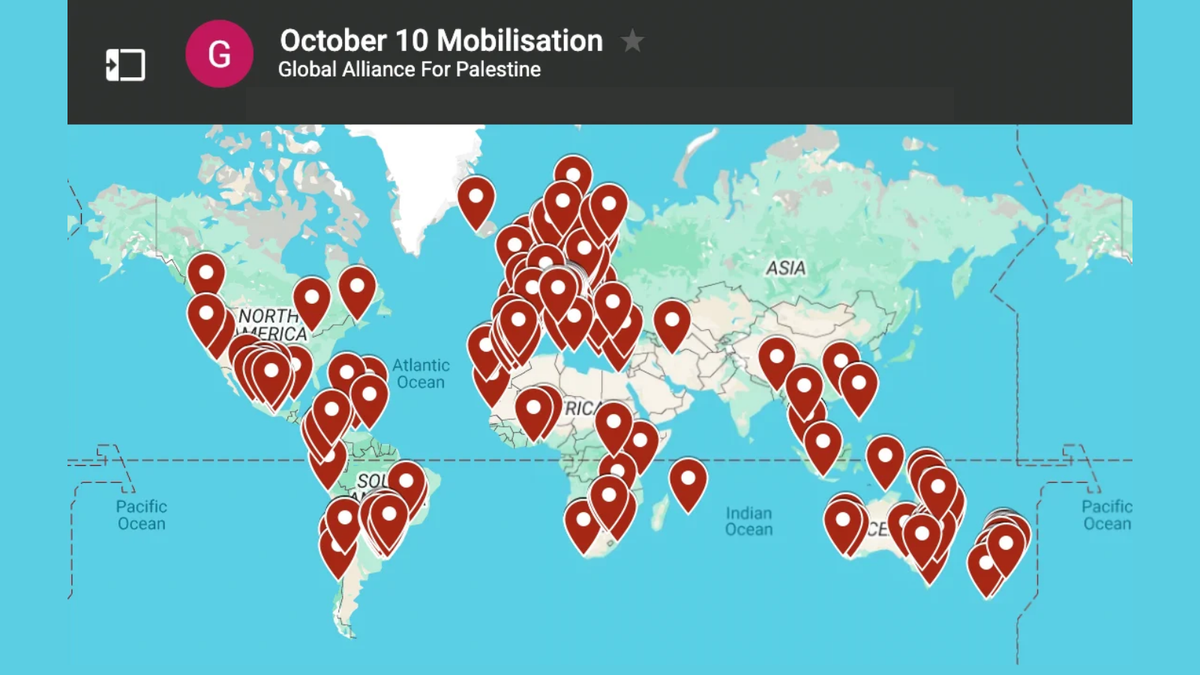
Organizers from a coalition, Global Action for Palestine, share a map «Global Day of Action» events for 2026. (Global Alliance for Palestine)
Among the participating organizations is CodePink, a 501(c)(3) nonprofit that has received $1.33 million from Neville Roy Singham, a Shanghai-based tech tycoon who has funneled $278 million into a network of nonprofits under scrutiny by the House Ways and Means Committee and its chairman, Rep. Jason Smith, over allegations that some operate as «Trojan horses» and proxies for the Chinese Communist Party and other malign foreign interests. CodePink and other organizations under scrutiny have denied wrongdoing.
Two days ago, CodePink co-founder Medea Benjamin and D.C. coordinator Olivia DiNucci dispatched a letter to members, directing them to join the «Feminist Contingent» at the Library of Congress for the «global day of action.»
«And don’t forget to WEAR PINK!» they noted.
The network’s connections were also visible last week, when CodePink co-founder Jodie Evans, who married Singham in 2017, joined an anti-Israel protest in New York City, marching behind a band of activists from Revolutionary Communists of America as they chanted, «Long live the intifada.»
Evans told Fox News Digital Singham supports CodePink’s efforts and the «amazing work» nonprofits are doing to «stand up when violent things are happening.»
Taken together, the documents reveal a coordinated protest and influence campaign spanning continents, combining accusations of Israeli «genocide,» attacks on the news media, workplace and university walkouts, blockades, political lobbying and carefully orchestrated publicity.
A review of the planning documents for the global protests reveals the machinery behind the wave of anti-Israel demonstrations across continents as not only a protest campaign but a psychological operation: a common playbook combining strategic accusations of Israeli «genocide,» attacks on the news media, workplace and university walkouts, blockades, political lobbying and coordinated publicity.
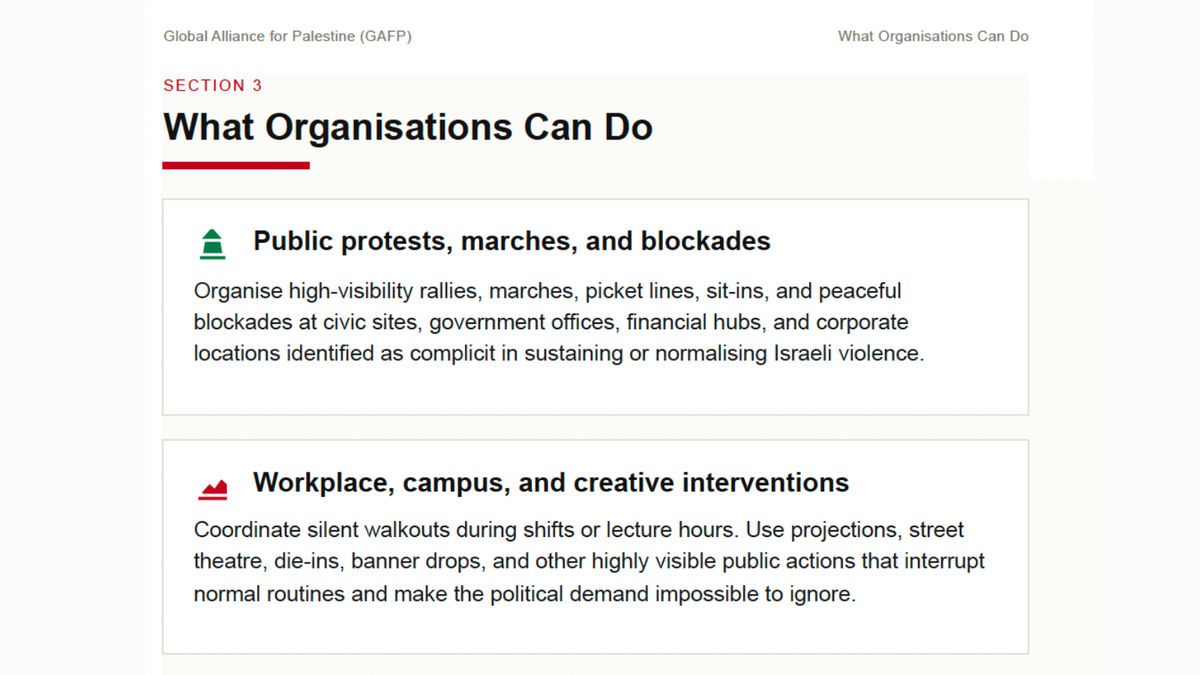
In a document, leaders of the «Global Alliance for Palestine» spell out «What Organisations Can Do» to oppose the state of Israel and support a «global day of action» on Oct. 7, 2026. (Global Alliance for Palestine)
At the center of the international mobilization are three organizations identified in the campaign documents: the «Global Alliance for the Palestinian territories,» launched in July 2025 in London as a «truly international popular front for Palestinian liberation»; the «Anti-Apartheid Movement for Palestine»; and the «Global Coalition to End the Occupation of Palestine.»
An online directory displays 179 organizational logos from participating groups worldwide. Fox News Digital extracted the names from the logos and built a database of the coalition.
The same pattern of coordinated organizing has emerged in another international protest movement: the so-called «student protests» rolling through France.
A separate Fox News Digital investigation identified a network of 50 organizations coordinating and amplifying those demonstrations. Only 15 were classified as youth- or student-led groups, while the remaining 35 included communist organizations, labor groups, political organizations and professional protest coordinators.
Organizers supplied participating groups with campaign materials, coordination and strategic support to «turn public outrage into collective leverage.»
In an August «Launch Statement,» the alliance laid out a strategy to synchronize student demonstrations, workplace actions, rallies and civil disobedience across Asia, the Americas, Europe, Africa and the Middle East.
The stated objective wasn’t simply to organize demonstrations, but to add Israel’s war in Gaza to the international media agenda, turning separate protests into a coordinated communications effort intended to shape what audiences around the world see, hear and think about the conflict.

Anti-Israel demonstrators holds a Palestinian flag and signage during a rally on Oct. 09, 2026 in Kuala Lumpur, Malaysia, as part of a «global day of action» against Israel. (Photo by Annice Lyn/Getty Images) (Annice Lyn/Getty Images)
But the most revealing aspect of the operation may be its stated objective: shaping what the world sees, hears and thinks about the Israeli-Palestinian conflict.
In a «Launch Statement» in August, the alliance declared that the demonstrations are intended to return Israel’s military campaign against Palestinians to the international media agenda.
The campaign materials describe a strategy of synchronizing protests across continents, connecting student demonstrations, workplace actions, rallies and civil disobedience from Asia to the Americas, Europe, Africa and the Middle East.
The result is a coordinated communications campaign designed to transform demonstrations organized by separate groups into the political impact of a single international mobilization.
ISRAEL, JEWS TARGETED WORLDWIDE AS WELL-FUNDED LEFTIST, ISLAMIST GROUPS JOIN FOR ‘NAKBA 78’ PROTESTS
Weeks before the demonstrations, the alliance had already prepared a collection of campaign posters in seven languages – English, Arabic, Turkish, Finnish, French, Portuguese and Spanish. They supplied graphics for a large street banner carrying carefully selected slogans, along with protest-sign designs from folders marked «HANDHELD PLACARDS» and «STREET DEMANDS.»
One of the downloadable images is a poster with the message «GAZA GENOCIDE» next to graphics of barbed wire and watermelon, both symbols of Palestinian «resistance» against Israel.
In Malaysia, a woman wearing a black-and-white Palestinian keffiyeh raised her fist while holding a printed version of the watermelon-and-barbed-wire placard], with the organizers’ branding in smaller letters on her sign: «GLOBAL ALLIANCE FOR PALESTINE.»
Behind her, other women carried the same sign and other signs featuring additional graphics from the same campaign materials.

A woman covers her hairs with a Palestinian keffiyeh scarf and raises her fist while holding a placard reading «Gaza Genocide» during an anti-Israel rally on Oct. 09, 2026 in Kuala Lumpur, Malaysia. The sign is part of a series of downloadable pre-made graphics created by organizers of the global protest. (Annice Lyn/Getty Images)
Other placards held by protesters in Malaysia yesterday, read, «HUMANITY IS NOT A CRIME» and «STOP THE GENOCIDE WAR!»
Another downloadable sign, carried in Malaysia, reads: «LET GAZA LIVE!»
The campaign’s «Communications Framing» employs familiar techniques of political persuasion: repetition, emotional imagery, collective identity, moral urgency and the portrayal of inaction as complicity.
The materials offer a window into the battle for public attention that increasingly accompanies international conflicts.

Women at an anti-Israel rally on Oct. 9, 2026, in Kuala Lumpur, Malaysia, hold placards reading messages created by the leaders of the Global Alliance for Palestine for protests around the country. The messages read «Humanity Is Not a Crime,» «Let Gaza Live» and «Stop the Genocide War.» (Annice Lyn/Getty Images)
One poster declares, «You cannot erase a homeland.»
Another commands, «End the genocide. Defend the land.»
A third combines an image of a child with the message, «Defend the land. Protect its children.»
Another repeats the words «Silence normalises» across the background before presenting the word «genocide» in oversized red lettering.
But the campaign’s internal messaging guidance goes further, prescribing accusations against Israel and the news media in a section called «Slogans & Hashtags,» with «Call to Action & Core Street Demands.»
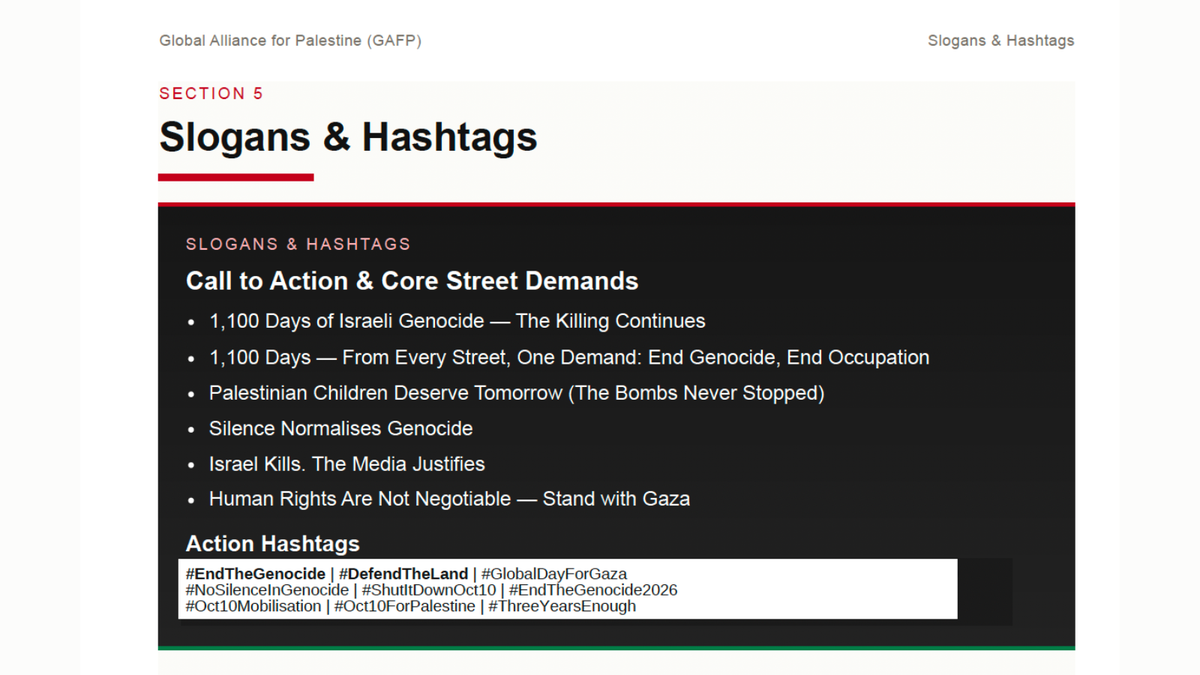
In a «Concept Paper» for the «Global Alliance for Palestine,» organizers share guidelines for «Slogans & Hashtags» that carry explicit negative messages about Israel. (Global Alliance for Palestine)
Among its recommended slogans is the blunt declaration: «Israel Kills. The Media Justifies.»
Another declares, «1,100 Days of Israeli Genocide — The Killing Continues.»
Yet another calls for action under the message, «1,100 Days — From Every Street, One Demand: End Genocide, End Occupation.»
Together, the slogans strategically combine accusations of «genocide» with demands for political action, while claiming the media «justifies» Israel’s conduct.
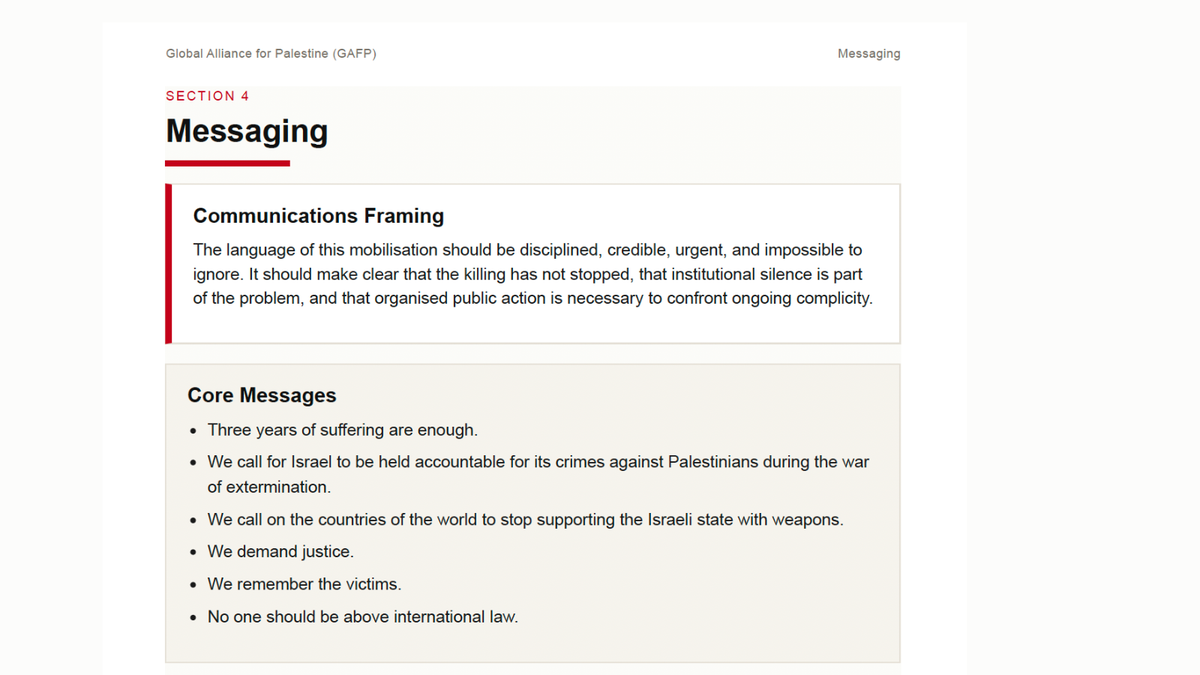
In a «Concept Paper» for the «Global Alliance for Palestine,» organizers share guidelines for «Communications Framing,» including «Core Messages» that intentionally describe Israel negatively. (Global Alliance for Palestine)
In its «Concept Paper,» the alliance describes Israel’s actions as a «war of extermination» and calls for countries to stop providing weapons to the Israeli state.
The same document instructs participating organizations in its «Communications Framing» to use language that is «disciplined, credible, urgent and impossible to ignore.»
It also directs organizers to portray «institutional silence» as part of the problem and public mobilization as necessary to confront what the alliance calls continuing complicity.
The objective isn’t simply to communicate a political position, but to encourage audiences to emotionally identify with a movement and participate in its activities.
The campaign presents its allegations of «genocide» and other violations of international law as established claims.
On Friday, South African human rights lawyer Navi Pillay received the 2026 Nobel Peace Prize for her work, which included arguing that Israel has committed a «genocide» against Palestinians. Israel disputes the «genocide» accusation.
ANTI-ISRAEL GROUPS RALLY ACROSS US ON OCTOBER 7 ANNIVERSARY, CHANTING ‘LONG LIVE THE INTIFADA’
The organizing documents go beyond encouraging supporters to attend demonstrations.
Instead, organizers describe a campaign intended to «interrupt business-as-usual» and organize «high-visibility rallies, marches, picket lines, sit-ins and peaceful blockades» at «civic sites, government offices, financial hubs and corporate locations» that its organizers have «identified as complicit in sustaining or normalising Israeli violence.»
They also recommend synchronized «workplace, campus and creative interruptions,» including «silent walkouts,» banner drops, nighttime projections, street theater, «die-ins» and «other highly visible public actions that interrupt normal routines and make the political demand impossible to ignore.»
A detailed logistical plan urges organizations to «allocate funds,» arrange transportation and establish «legal, stewarding, and participant support.»
ISRAELI PM NETANYAHU ARGUES PUBLIC OPINION SHIFT ON ISRAEL ‘CORRELATES ALMOST 100%’ TO SOCIAL MEDIA

Yahya Sinwar (C), Hamas leader in Gaza, Mahmoud al-Zahar (R), senior Hamas leader, and Mustafa Barghouti (L), Secretary General of the National Initiative and supporters of the Palestinian Hamas movement gather during a rally in solidarity with al-Aqsa mosque on Oct. 1, 2022 in Gaza City, Gaza. The Al-Aqsa mosque has been a major flashpoint for Israeli-Palestinian violence for decades. Protests are being held over recent Israeli settler intrusions at the Al-Aqsa mosque. (Mohammed Dahman/Getty Image)
The organizing documents go beyond encouraging supporters to attend demonstrations.
The campaign’s organizational structure brings together prominent political figures with longstanding backgrounds in international politics and anti-Israel activism in Europe, the Middle East, Africa and Asia.
A press release for the protests identifies seven members of the international steering committee, including: former British Labour Party leader Jeremy Corbyn, who joined a coalition supporting the Communist Party of Cuba; pro-communist former Greek finance minister Yanis Varoufakis; former Sinn Féin leader Gerry Adams; Palestinian political leader Mustafa Barghouti; former South African government minister Ronnie Kasrils; Indian activist Varsha Gandikota-Nellutla; and Italian politician Angelo Bonelli.
Anas Altikriti serves as secretary-general.
Jessica Breakey, the campaign’s public relations officer, didn’t respond to a request for comment.
Beyond the streets, the alliance’s strategy documents lay out a plan to convert the demonstrations’ visibility into «sustained political pressure» on lawmakers and government institutions.
In a separate advocacy document, organizers urge participating groups to mobilize protesters to write lawmakers, submit coordinated institutional letters and arrange meetings with elected representatives.
The campaign calls for «immediate, total arms embargoes» and «comprehensive state sanctions» against Israel for alleged violations of international law.
It also urges governments to suspend preferential trade agreements and institutional partnerships associated with Israeli policies.
The alliance demands an end to what it calls Israel’s «genocide and occupation,» without specifying whether its reference to occupation encompasses Gaza, the West Bank or the entire State of Israel. The distinction takes on particular significance amid chants of «from the river to the sea» at anti-Israel demonstrations.
Organizers encourage participating groups to use «targeted, template-driven letters» and «digital briefing toolkits» to support «localised political campaigning,» adapting them to their national political systems.
The documents provide direct instructions that participating organizations issue local press releases, distribute «ready-made social-media toolkits,» share «graphics across digital channels» and hold briefing sessions to «ensure clear, aligned messaging ahead of the weekend.»
fox news investigates

American truckers are warning that sky-high diesel prices are eating into their profits and putting pressure on trucking companies to cut routes, raising concerns that some drivers could be forced off the road and the pain could eventually reach Americans at the grocery store.
«Fuel prices is going up, the rates are not going up,» Miami-based trucker Suave Dorsett told Digital. «So it’s hurting our pockets real bad.»
The warnings come as the Iran war sends diesel prices soaring, squeezing American truckers even as President Donald Trump predicts oil prices will fall «like a stone» amid expectations that the conflict could soon end. Drivers told Digital the damage is already mounting, with routes being cut and smaller operators facing mounting financial pressure.
Dorsett is among several truckers who told Digital that soaring fuel costs are cutting into their earnings and putting pressure on an industry responsible for moving goods across the country, with one driver reporting fewer routes and others warning that smaller operators could eventually be forced to park their rigs.
THE OVERLOOKED WAY THE IRAN WAR IS MAKING GROCERIES, AMAZON PACKAGES AND NEW HOMES MORE EXPENSIVE
The national average for diesel stood at roughly $6.32 per gallon Monday, according to AAA — up from about $3.69 at the same time last year, a jump of more than 70%. The surge has also eclipsed the previous record of $5.816 per gallon, set in June 2022 under former President Joe Biden as Russia’s invasion of Ukraine sent global energy prices soaring.
For Dorsett, who has been driving for nine years, the price at the pump was even steeper. He told Digital he was seeing diesel at $7.40 per gallon while traveling through Ohio.
Dorsett said the fuel spike comes as truckers are already shouldering a long list of expenses, including diesel exhaust fluid (DEF), which helps reduce harmful emissions, parking, showers, weighing and reweighing loads, repairs and towing.
And if diesel prices remain elevated, Dorsett predicted smaller operators will be the first to buckle.
BIDEN-ERA ENVIRO RULE ACCUSED OF STRANGLING TRUCKERS, SQUEEZING AMERICANS LANDS ON TRUMP CHOPPING BLOCK
«Some of the smaller companies, like the smaller owner ops, would slowly fall off and it’s going to create a chain effect,» Dorsett said, predicting a «domino effect» that could eventually put pressure on larger carriers.
Tyler Rinaldi, a Louisiana trucker with about a decade of experience who transports hazardous materials and other freight for an LTL company, said he has already seen weekend routes scaled back at his company.
«I’ve seen a lot of routes get cut,» Rinaldi told Digital. «They’re not really running like they want to on the weekends right now.»
«I definitely see a lot change because of it at my company, slowly, but it’s starting to be more noticeable,» he added.
TRUMP TAPS VETERANS TO FIX ILLEGAL ALIEN TRUCKING PROBLEM PLAGUING US ROADWAYS
Rinaldi, who is married with two children, said fewer routes could eventually mean less money coming home.
«When they start cutting routes and trying to limit the expenses on what routes they send out,» Rinaldi said, «that takes away from the people that work in the company’s pockets.»
Avante Jackson, an 11-year trucking veteran from Charlotte, North Carolina, who transports steel and other construction materials, said rising diesel prices are forcing truckers to take a harder look at whether the money they bring in is enough to keep their businesses running.
«If I’m putting all of my profit in the tank,» Jackson said, «at the end of the day, what do I have left to keep the doors open?»
CUT THE BULL: THE REAL REASON BEEF COSTS SO MUCH — AND WHAT TRUMP IS TRYING TO DO
Jackson cautioned against «fear-mongering» about potential shortages, but said a widespread loss of drivers could ultimately reach consumers.
«It really could hit the community,» he said.
The latest diesel spike echoes a similar crunch in 2022 under former President Joe Biden, when the economic fallout from the COVID-19 pandemic and Russia’s invasion of Ukraine sent fuel prices flying. Diesel reached a then-record national average of $5.82 per gallon that June, squeezing truckers as operating expenses climbed.
According to the American Transportation Research Institute, trucking fuel costs surged 53.7% in 2022, helping drive a 21.3% jump in overall operating costs to a then-record $2.25 per mile. The latest spike threatens to revive those pressures, particularly for smaller operators with less room to absorb rising fuel bills.
As the Trump administration pushes international partners to release emergency fuel reserves in an effort to bring prices down, the truckers had their own message for the president: don’t forget about the drivers absorbing the costs on the road.
«My message to President Trump would just be to think about who’s keeping America moving,» Jackson told Digital. «Think about the little guys out here each and every day.»
TRUMP JUST BROKERED A DEAL WITH THE COUNTRY SITTING ATOP THE WORLD’S LARGEST OIL RESERVES
«We truly are the backbone of America, we keep America moving,» he added. «We just want you just to think about us and put yourself in our shoes…Let’s try to get the fuel prices down and let’s try to just make more of a change,» he said. «We know we can do better.»
Trump defended higher fuel prices Thursday as a temporary sacrifice in the fight to prevent Iran from obtaining nuclear weapons, saying on Truth Social that rising gasoline costs were «a small price to pay for Iran not having a Nuclear Weapon.»
Trump said last week that European countries had agreed to release diesel from their stockpiles after he pressed them to put more supply on the market. The G7 subsequently agreed to release 100 million barrels of oil and fuel products from previously pledged emergency reserves over four months, including a substantial diesel release during the first 20 days, in an effort to ease pressure on global fuel markets.
Trump also said his administration would not pursue a diesel export ban and expressed confidence that oil prices would eventually return to levels seen before the latest spike, though energy markets remain under pressure from global supply disruptions.
Trump predicted during a Wednesday night rally in San Antonio, Texas, that oil prices would «come down like a rock» once the war with Iran ends, insisting the conflict would be over «very soon.»
«This week, President Trump signed an executive order that will quickly cut diesel costs and put money directly back into the pockets of American truckers, saving them over $100 every time they refill at the gas pump. Last week, he negotiated a deal with our European counterparts to release 100 million barrels—mainly diesel—from their stockpiles to add supply to the market and lower costs,» White House spokesperson Taylor Rogers told Digital.
«The President wants to see prices at the pump fall and continues to take historic action to ease temporary disruptions as oil flowing through the Strait of Hormuz approaches pre-conflict levels,» Rogers added.
costs, economy, transportation, white house, energy in america
INTERNACIONAL
Cómo la forma de la cola podía convertir a un reptil marino de hace más de 66 millones de años en un cazador letal

Un solo golpe de cola podía modificar la distancia entre un mosasaurio y su presa. Estos reptiles marinos, emparentados con los lagartos y habitantes de los mares de la era de los dinosaurios, tenían colas de formas distintas.
Los fósiles permitían ver esas diferencias, pero no mostraban con claridad cómo influían en su manera de moverse.
La pregunta era si una cola más larga y flexible podía dar ventaja en un ataque y qué ocurría con las especies de cola más corta. Para responderla, un equipo de investigadores reconstruyó la anatomía de cuatro especies y calculó cuánto podían avanzar con un único movimiento de la cola.
Un análisis de fósiles y simulaciones basadas en principios físicos, publicado en Current Biology, permitió estimar la aceleración explosiva de estos animales.

Según sus autores, es el primer trabajo que pone cifras a la rapidez de arranque de mosasaurios y vincula la forma de sus colas con dos maneras posibles de cazar, mediante emboscadas o persecuciones en aguas abiertas.
Un impulso de cola que podía decidir la captura
La investigación fue liderada por Kiersten Formoso, profesora asistente del Departamento de Ecología, Evolución y Recursos Naturales de la Escuela de Ciencias Ambientales y Biológicas de la Universidad Rutgers.
El equipo analizó esqueletos fósiles de Platecarpus, Tylosaurus, Mosasaurus y Plotosaurus, cuatro tipos de mosasaurios con tamaños y formas de cola diferentes.
Los científicos analizaron un movimiento en el que el animal curvaba la cola hacia un lado y luego la desplazaba con fuerza en sentido contrario. Ese golpe contra el agua podía impulsar el cuerpo hacia delante.
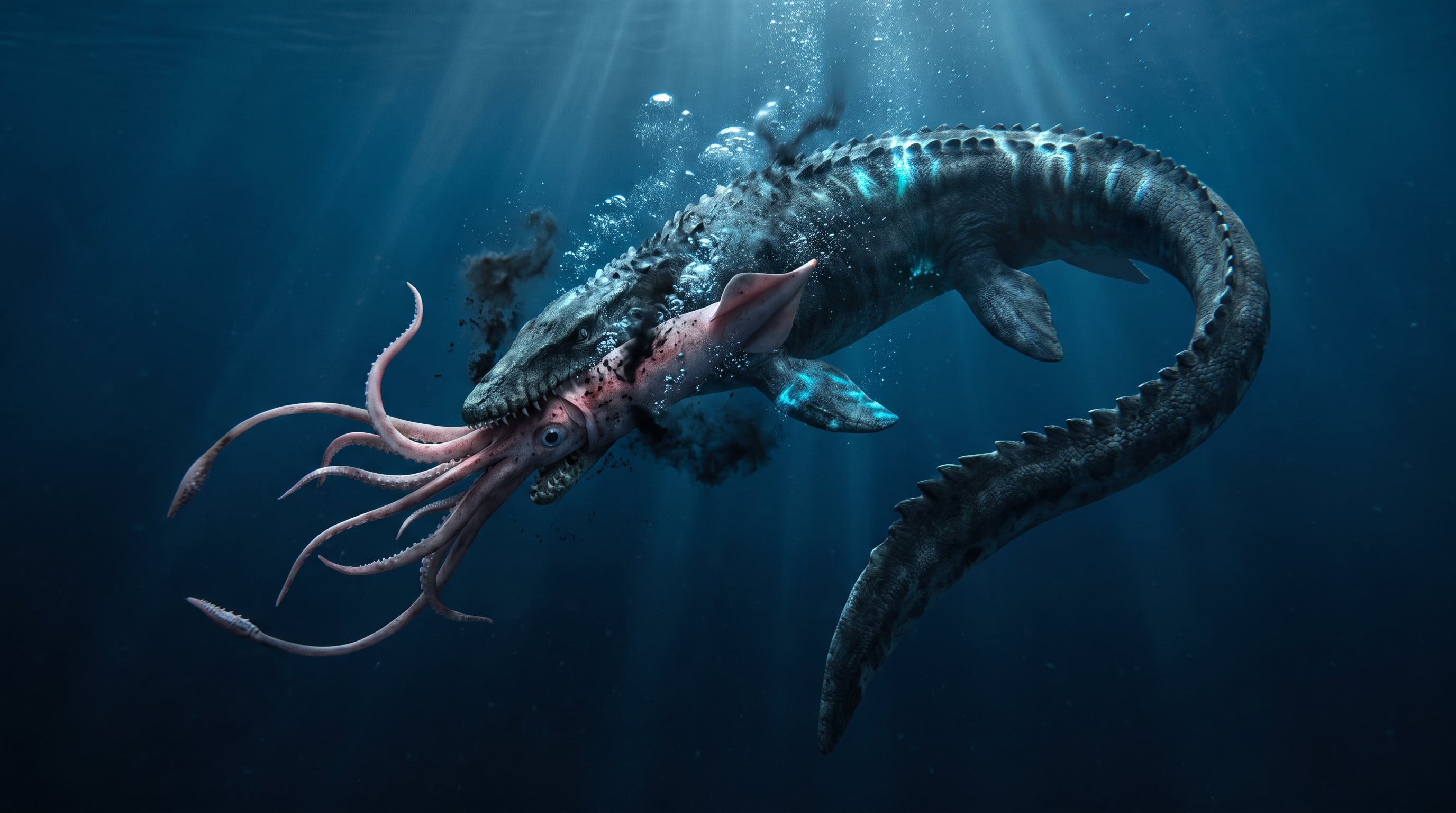
Para elaborar las estimaciones, los investigadores partieron de las dimensiones de los fósiles y calcularon cómo habrían sido los músculos, que no se conservan en los huesos.
Para completar esa estimación, usaron como referencia la anatomía de lagartos actuales, entre ellos los dragones de Komodo. También probaron distintas posibilidades para la fuerza muscular, la flexibilidad de la cola y la fuerza con la que el agua frena el avance.
La comparación permitió comprobar si las diferencias entre especies se mantenían incluso cuando cambiaban esas condiciones.
Según el comunicado institucional de Rutgers, Platecarpus y Tylosaurus lograron arranques más rápidos para su tamaño que Mosasaurus y Plotosaurus. Las simulaciones no muestran un ataque real, pero permiten comparar cómo respondía cada forma de cola bajo las mismas condiciones de cálculo.
Las colas largas favorecían los ataques de emboscada
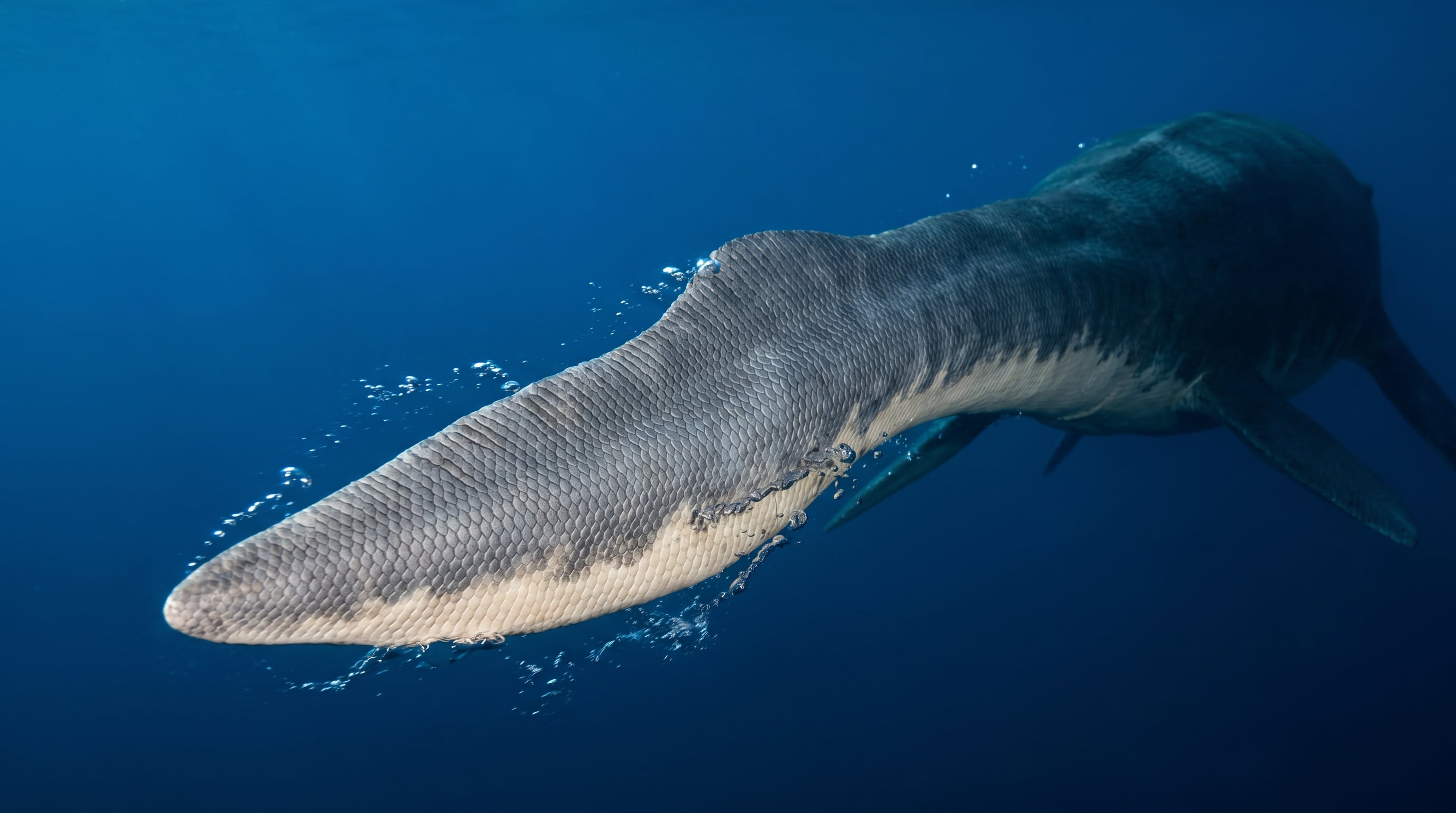
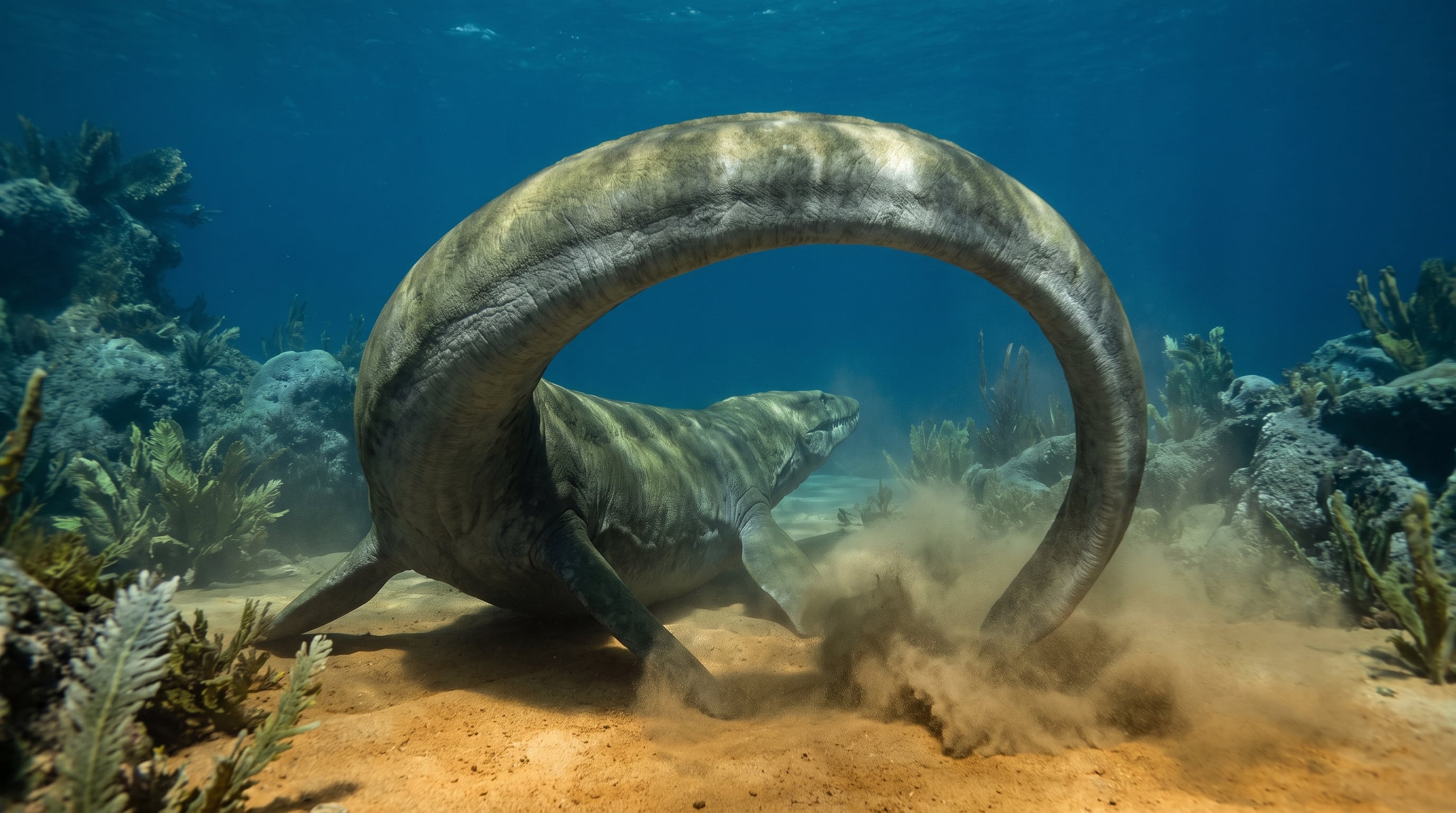
La diferencia principal estuvo en la parte flexible de la cola. Platecarpus y Tylosaurus tenían un segmento más largo, que podía curvarse más antes de impulsarse. Esa capacidad facilitaba un arranque más rápido.
El comunicado señala que Platecarpus fue la especie más veloz entre las cuatro analizadas en la simulación.
En el caso de un Tylosaurus de gran tamaño, los cálculos indican que un único golpe de cola podía llevarlo a cerca de 24 kilómetros por hora. La cifra corresponde a un impulso breve y no a una velocidad constante de nado.
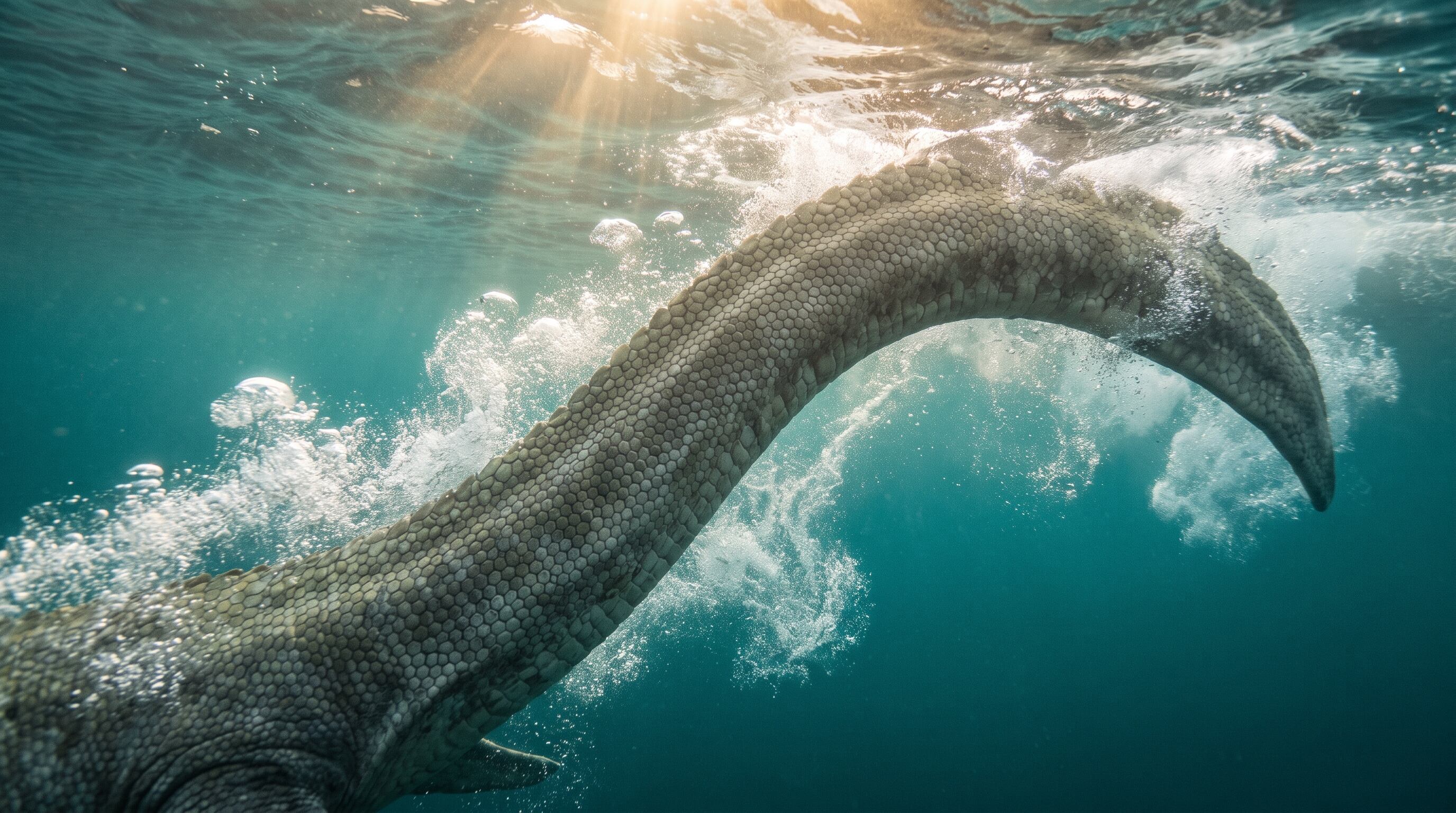
Esa capacidad habría resultado útil para un depredador que esperaba cerca del fondo o en zonas menos profundas antes de atacar.
El estudio vincula esa ventaja con la posibilidad de que los mosasaurios de cola larga se especializaran en emboscadas, una estrategia que exige reducir al mínimo el tiempo entre la detección de la presa y el ataque.
Formoso explicó, según el comunicado, que la longitud y la flexibilidad de la cola influyeron más en las velocidades estimadas que las demás variables del análisis. Por eso, el trabajo sitúa a esa parte del cuerpo en el centro de la explicación sobre cómo se movían estos reptiles marinos.
Mosasaurus y Plotosaurus parecían adaptados a nadar durante más tiempo
Los resultados no indican que los mosasaurios de cola más corta fueran lentos. Mosasaurus y, sobre todo, Plotosaurus mostraron menor aceleración inicial, pero su anatomía parece haber favorecido otro tipo de desplazamiento, con una natación más sostenida en aguas abiertas.
Esa distinción permite asociar la forma de la cola con dos formas de buscar alimento. Por un lado, los animales de cola larga podrían haber aprovechado su impulso para sorprender a una presa a corta distancia.
Por otro, los de cola más corta habrían estado en mejores condiciones para perseguirla durante trayectos más prolongados.
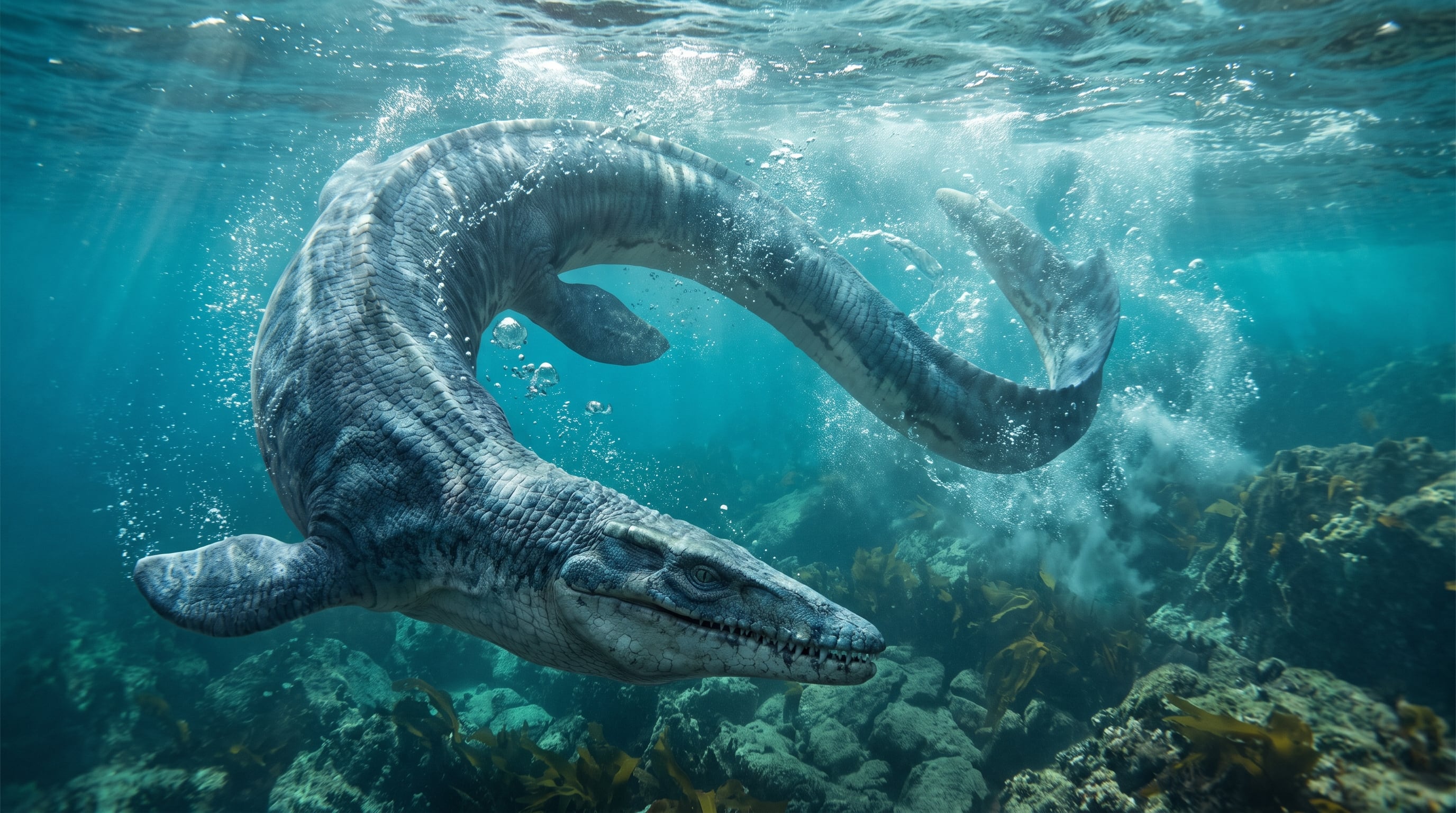
Los autores advierten que las velocidades exactas siguen siendo inciertas, porque proceden de simulaciones construidas a partir de restos fósiles.
Sin embargo, las diferencias que aparecen de forma consistente entre las especies ofrecen una base para analizar cómo convivían grandes depredadores marinos con maneras diferentes de obtener alimento.
De acuerdo con el comunicado de Rutgers, los autores consideran que este es el primer estudio que calcula con cifras el impulso inicial de reptiles marinos de la era de los dinosaurios.
También anunciaron que pondrán sus herramientas a disposición de otros especialistas, con el fin de aplicar el método a más especies extintas.
Tylosaurus,Cretoxyrhina,paleontología

Adiós a las paredes que aíslan la cocina: la solución elegante y versátil que imponen los decoradores de vanguardia

Zaira Nara reveló los detalles íntimos de su reconciliación con Jakob Von Plessen tras cuatro años separados: así se reencontraron

River Plate buscará ingresar a zona de Playoffs ante un Estudiantes de Río Cuarto que puede descender: hora, TV y formaciones

La estrategia del Gobierno para suspender las PASO, los datos que preocupan a Caputo y las dudas por el efecto Bolsonaro

Dawda Camara, del Girona al Alverca de Vinicius: ‘Trabaja para que no nos falte nada; ojalá algún día pueda conocerle’

Más allá del ADN: descubren que ciertos rasgos heredados pueden persistir durante 15 generaciones en algunos organismos

Escándalo total en la AFA: reventa millonaria, un homenaje paupérrimo a Messi y el pedido urgente de renuncia a Chiqui Tapia

Después de su prohibición, las plataformas de apuestas deportivas y los casinos en línea ya están fuera de servicio en Brasil

Marcha contra la Corte: sectores del PJ, la izquierda, gremios y piqueteros protestan por el fallo que libera la venta de tierras para extranjeros

El discurso completo de Leo Messi en su despedida con Argentina: ‘Hoy me toca quizás el día más triste de mi carrera’

 DEPORTE2 días ago
Escándalo total en la AFA: reventa millonaria, un homenaje paupérrimo a Messi y el pedido urgente de renuncia a Chiqui Tapia
- SOCIEDAD2 días ago
Tobey Maguire se quedaba ciego con el traje de Spider-Man y casi se desmaya durante una prueba: fabricar su disfraz fue una pesadilla
- DEPORTE2 días ago
El presidente de Burkina Faso, duro tras el amistoso con la Selección: «Nuestro fútbol está enfermo» :: Olé