INTERNACIONAL
Inédito: Suiza vota limitar su población a 10 millones de personas (y prohibir todo tipo de inmigración)


Los ciudadanos suizos podrían cerrar este domingo las puertas de su país. Suiza va a las urnas el domingo en un referéndum, como hace cuatro veces cada año, para votar, entre otras cosas, si el crecimiento de la población del país se limita a 10 millones de personas.
Si el referéndum, para el que los sondeos dan prácticamente un empate técnico, sale adelante, el país tendría una grave crisis con la Unión Europea y podría tener que prohibir todo tipo de inmigración.
La propuesta surgió del Partido Popular Suizo, una formación de extrema derecha xenófoba que podría conseguir un triunfo histórico si los ciudadanos aprueban su iniciativa. El Gobierno suizo rechaza el plan, pero si sale adelante en referéndum tendrá que aplicarlo.
Ningún país en el mundo puso nunca un límite a su población. Suiza tenía a finales de 2025 unos 9,1 millones de personas. La población crece a un ritmo más elevado que la mayor parte de sus vecinos europeos. En la última década creció un 10% y desde principios de siglo un 23%. La mayoría de esos migrantes no son del África subsahariana, Oriente Medio o el Magreb, sino del resto de Europa.
La propuesta tiene su origen en 2023, cuando el Partido Popular Suizo planteó limitar el crecimiento de la población de forma que el país nunca llegara a tener 10 millones de habitantes.
Según la extrema derecha, era necesario para proteger el modo de vida de los suizos y proteger el medio ambiente de una presión excesiva. Porque buena parte de sus argumentos para defender el voto afirmativo en el referéndum no son de limitación de la inmigración sino de protección medioambiental. Alegan que el entorno natural suizo no puede con más presión demográfica.
La propuesta busca un cambio constitucional que permita poner un límite estricto a la llegada de migrantes o solicitantes de asilo, e incluso a su prohibición total.
El plan consiste en alcanzar en 2035 los 9,5 millones de habitantes. Ni uno más. Eso se haría endureciendo la política migratoria y restringiendo el derecho de asilo y la reagrupación familiar. Además, en esa primera fase el Gobierno suizo debería revisar todos sus acuerdos internacionales para hacer que respeten esta medida.
Si ese límite de 10 millones de personas se excede en algún momento, prevé la propuesta, el Gobierno tendría que “tomar todas las medidas disponibles”, incluyendo retirarse de acuerdos internacionales que faciliten la migración hacia Suiza, pero manteniendo el acuerdo con la Unión Europea que prevé la libertad de movimientos y residencia de sus ciudadanos.
Si tomando esas medidas la población no baja de los 10 millones de personas en menos de dos años, entonces sí el Gobierno, asegura la propuesta, debería suspender los acuerdos con sus vecinos europeos. Esos acuerdos permiten a los ciudadanos de los 27 países de la Unión Europea moverse por Suiza -y establecerse en el país- como en el resto del bloque. Funciona así también en países europeos que no son miembros de la Unión Europea, como Noruega o Islandia.
Mantener esa libertad de circulación y establecimiento para los ciudadanos europeos es algo esencial si Suiza quiere seguir manteniendo unas buenas relaciones con sus vecinos. Y si quiere mantener otros acuerdos, como los comerciales y su acceso al mercado común europeo sin cuotas ni aranceles.
De los 9,1 millones de personas residentes en Suiza a finales del año pasado, 1,5 millones son nacionales de países de la Unión Europea. La propuesta de la extrema derecha prevé que, en última instancia y para cumplir ese acuerdo, sus permisos de residencia podrían ponerse en cuestión.
La extrema derecha no vende el referéndum únicamente desde el punto de vista migratorio, sino también como un momento clave para el medio ambiente del país. Asegura que la población actual ya es mucha y pone en peligro la conversación del medio ambiente del país.
La mayor asociación de empresas del país asegura que se trata de una “iniciativa del caos” y que el país debe reconocer que “seguirá dependiendo de mano de obra extranjera en el futuro”. El Gobierno suizo asegura que un sí en el referéndum de este domingo aislará al país.


Entre los trayectos diarios, las jornadas laborales y el tiempo dedicado a su hija Vega, la familia colombo-española formada por Sara y Jorge ha construido una rutina en la que el núcleo familiar ocupa el centro de sus prioridades.
Ella llegó desde España en busca de nuevas oportunidades; él, tras varios años en el sector audiovisual, decidió emprender. Actualmente, ambos consolidan un hogar mientras se adaptan al ritmo dinámico de una ciudad que exige movimiento constante.
En un recorrido junto a Volkswagen Taos, la pareja compartió su cotidianidad: cómo organizan su vida entre la crianza de su hija y sus proyectos laborales.
Sara llegó desde Madrid a los 27 años con el propósito de viajar y vivir nuevas experiencias. Lo que comenzó como una estadía de uno o dos años terminó transformándose en su hogar en Colombia. “Sin duda, mi viaje más largo y aventurero fue a Colombia”, recuerda.

La distancia con su familia y su red de apoyo fue un desafío, pero con el tiempo logró construir una nueva vida junto a Jorge y su hija Vega. Para ella, el hogar no está definido por un lugar físico, sino por las personas con quienes comparte la vida: “El hogar se construye donde están ellos”. En ese proceso, su mascota Lola fue su primera compañía en el país y, posteriormente, la llegada de su hija redefinió sus prioridades.
Jorge trabajó durante años en el sector audiovisual. No obstante, el deseo de construir algo propio lo llevó a fundar El Club, un gastro bar concebido como proyecto familiar. La etapa inicial requirió reorganizar rutinas y prioridades para equilibrar las exigencias del emprendimiento y la crianza de su hija pequeña.

Aun así, Jorge resume esta etapa con claridad: “Me siento sumamente orgulloso de mi esposa, de mi hija y de lo que hemos construido”. La llegada de Vega marcó un punto de inflexión. Desde entonces, el emprendimiento dejó de ser solo un proyecto individual para convertirse en una construcción compartida.
Entre el trabajo, la crianza y la ciudad, la familia ha aprendido a organizar su rutina con precisión. El tiempo se convirtió en su recurso más valioso.
“El tiempo en familia es innegociable”, afirma Sara. A pesar de las exigencias laborales, siempre encuentran espacios para compartir, incluso en los trayectos diarios por Bogotá.

Dentro del vehículo, los recorridos se transforman en momentos de conversación, conexión y pausa en medio del ritmo acelerado de la ciudad.
Para ambos, esos espacios cotidianos también hacen parte de la construcción del hogar.
Sara asegura que la maternidad la llevó a su mejor versión, mientras que Jorge define la paternidad como una transformación profunda que redefinió sus prioridades y su visión de vida.

En la rutina de Sara, Jorge y Vega, el Volkswagen Taos es una herramienta clave para sus desplazamientos diarios. Este SUV compacto proporciona un equilibrio entre espacio, tecnología y confort, adaptándose a las necesidades de una familia en movimiento. Su diseño incorpora una parrilla frontal moderna, iluminación LED y faros IQ Light, elementos que refuerzan su carácter.
En el interior, destaca la amplitud de la segunda fila, el techo panorámico y una experiencia digital centrada en el usuario, con pantalla VW Play de 10 pulgadas, conectividad inalámbrica y un entorno intuitivo. El baúl de 500 litros permite afrontar tanto la rutina urbana como los viajes de fin de semana.

En materia de seguridad, el Volkswagen Taos integra asistentes de conducción, control crucero adaptativo, frenado autónomo de emergencia y múltiples airbags, elementos diseñados para entornos urbanos exigentes. Su motor 1.4 TSI de 150 caballos de fuerza y transmisión automática Tiptronic de 8 velocidades ofrece eficiencia y desempeño tanto en ciudad como en carretera.
En Colombia, la diversidad en la composición de los hogares es cada vez más visible. De acuerdo con el Departamento Administrativo Nacional de Estadística (DANE), los hogares biparentales representan el 51,3%, los monoparentales el 24,3%, los unipersonales el 20,2% y otras formas de convivencia el 4,2%. Esta transformación social evidencia la coexistencia de estructuras tradicionales y nuevas configuraciones familiares.
Volkswagen propone una visión amplia de familia, entendida como el círculo de personas con quienes se comparte la vida y el progreso. Bajo esta premisa, el Volkswagen Taos se adapta a diversas formas de convivencia, integrando tecnología, espacio y seguridad para la vida cotidiana.
El modelo está disponible en colores como Azul Perlado, Blanco Puro, Gris Flannel, Gris Platino Metalizado, Negro Profundo y Plata Pirita Metalizado, en línea con la diversidad de estilos de vida urbanos.
Conozca más sobre el Volkswagen Taos y las características que lo acompañan.
Taos,Volkswagen,Carros

‘FINISH LINE’: Lummis reveals CLARITY Act TIMELINE
Sen. Cynthia Lummis, Senate Digital Assets Subcommittee Chair, confirms the CLARITY Act is set for a Senate floor vote the week of July 20th. This crucial bill, developed over 10 months, aims to bring much-needed stability and regulatory certainty to the US crypto markets. Its passage before the August recess is vital for encouraging onshore business.
NEWYou can now listen to Fox News articles!
Senate Republicans want to rein in President Donald Trump’s income explosion since returning to the White House, but Democrats aren’t sold on how they’re going to do it.
The Senate is on the cusp of moving landmark cryptocurrency legislation known as the Clarity Act that, if passed, proponents say would finally fold the novel currency into the nation’s web of financial regulations.
Tucked away in the over 600-page package are a slate of ethics provisions that target Trump, the vice president and their spouses. The White House signed off on the provisions, and the architects of the bill say that the restrictions reach beyond just Trump and target lawmakers, too.
GOP RIFT GROWS AS THUNE HITS BRAKES ON TRUMP’S ELECTION BILL TO AVERT SHUTDOWN
The Senate advanced a massive, Trump-backed housing package geared toward lowering the costs of homes and supercharging the housing supply. Sen. Elizabeth Warren, D-Mass., pitched it as legislation to prevent America from becoming a «nation of renters.» (Jemal Countess/Getty Images for Protect Borrowers ; Anna Moneymaker/Getty Images)
But for now, it’s not enough for Senate Democrats.
«Someone can call it an ethics provision,» Sen. Elizabeth Warren, D-Mass., said. «But if it doesn’t stop the president from profiting off of crypto, and using it as a way to take bribes right out in public. Then it’s not really any expedition.
The list of guardrails included preventing federal officials from creating their own digital currency for profit, promoting or endorsing crypto, creating a divestiture or blind trust requirement one year after enactment, allowing officials to own crypto and a disclosure of crypto sales.
Sen. Cynthia Lummis, R-Wyo., who has led the effort on the Clarity Act, told Fox News’ Maria Bartiromo that the idea isn’t to «plan legislation around one person who holds one office for the next two years, but rather, over time, that will serve the House, the Senate, the judiciary, and the executive branch in a fair way.»
HOUSE GOP VOTES TO PUNT GOVERNMENT SHUTDOWN BATTLE TO AFTER NOVEMBER MIDTERMS
«The struggle is, of course, a lot of Democrats are absolutely focused on one person, and that’s President Trump,» Lummis said. «So since President Trump actually agreed that he would have the choice to either put his assets in a blind trust, or divest of his participation in digital assets and companies that derive revenue from digital assets, somehow, that’s not enough.»
There are other gripes with the package, but the ethics provisions are proving a sharp red line. That’s because Trump’s income between 2024 and 2025 erupted by about 250% — from just over $620 million to about $2.2 billion.
And much of that increase is attributed to his various holdings and ventures in crypto, which are run by his sons, Don Jr. and Eric, according to the president’s financial disclosure forms reviewed by Fox News Digital.
Trump’s income shot up by $1.4 billion during his first year in office thanks to earnings from the $TRUMP memecoin, World Liberty Financial token sales and Stablecoin Holdco, among others.
Sen. Bernie Moreno, R-Ohio, who alongside Sen. Cynthia Lummis, R-Wyo., worked with the White House to draft the ethics provisions, said that the «behavior» that was being targeted was issuance, promotion, and sponsorship of crypto.
«Again, a very different standard than Nancy Pelosi was held to,» Moreno said.
REPUBLICAN SAYS TRUMP’S TOP ELECTION PRIORITY ‘DEAD’ IN SENATE AS GOP FRACTURES AHEAD OF MIDTERMS
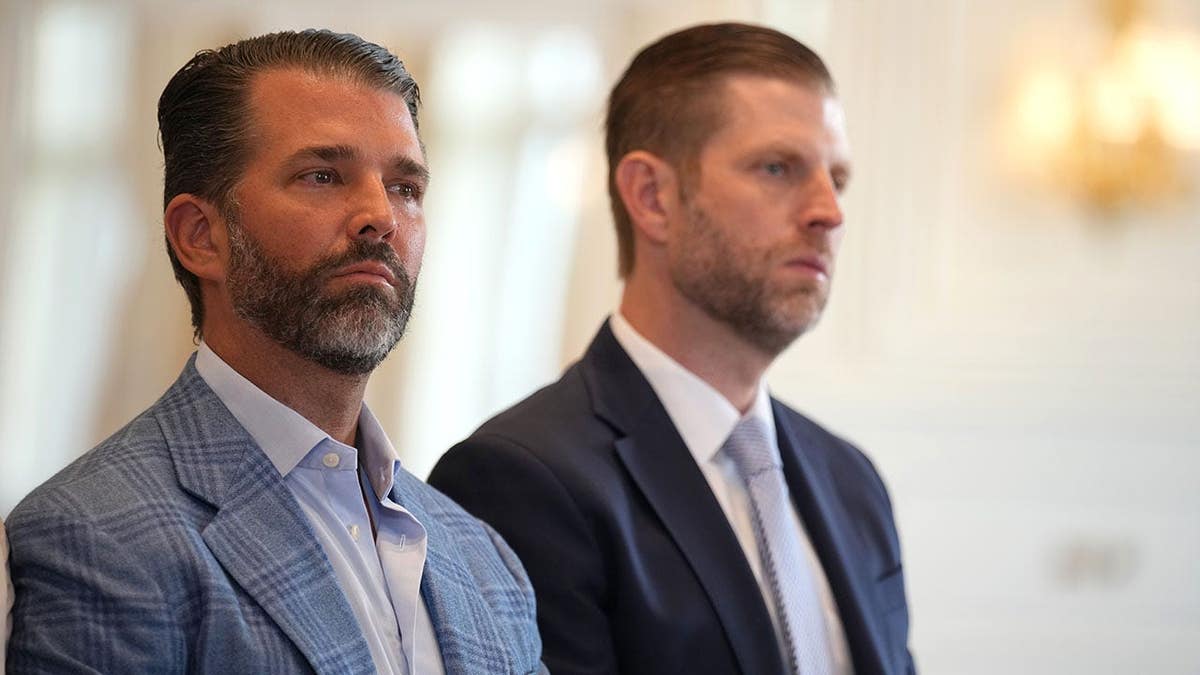
Much of the president’s income increase is attributed to his various holdings and ventures in crypto, which are run by his sons, Don Jr. and Eric, according to the president’s financial disclosure forms reviewed by Fox News Digital. (Andrew Harnik/Getty Images)
When asked about Democrats already raising issues with the provisions, Moreno told Fox News Digital, «They’re always obsessed with putting things into the base bill, just offer an amendment.»
«That’s the way this place was built, you know, let’s put the base bill out there,» he said. «The ethics piece is this much of the bill — Tiny bit — just offer an amendment.»
Democrats have noted that the ethics provisions don’t specifically target his sons, meaning that the Trump family crypto empire, which has heavily benefited from his name and time in office, would be left largely unchecked.
They also put sole enforcement power into the hands of Acting Attorney General Todd Blanche, a close ally of Trump’s, and are set to sunset on Jan. 20, 2029, when Trump will have left office.
Sen. Cory Booker, D-N.J., told Fox News Digital that he still has «a lot of ethics concerns, and there’s still work to do.»
CLICK HERE TO DOWNLOAD THE FOX NEWS APP
«This is the partisan draft. It’s very obviously not going anywhere,» Booker said. «If there’s only one pathway to do this it’s doing (it in) a bipartisan manner. There are enough of us on both sides of the aisle that we should be able to land this. It’s good faith negotiations.»
The objections to the bill, for now, appear to be slowing its roll through the Senate as the upper chamber sprints to a monthlong break in August, and deals with a shrinking window of opportunity to finish legislation before the year is out.
Senate Majority Leader John Thune, R-S.D., had hoped to get the Clarity Act on the floor next week, but acknowledged that might not be possible.
«I don’t think we’ll be able to get it done, but I would like to at least get Clarity started,» he said.
politics, donald trump, elizabeth warren, senate elections, legislation
INTERNACIONAL
Tras las multas a Google y AliEpress, ahora la Unión Europea apunta contra TikTok por no proteger a los chicos
La semana europea acaba con otro aviso a una de las grandes plataformas digitales del planeta. Después de multar el lunes a AliExpress y el jueves a Google, la Comisión Europea anunció este viernes que prepara sanciones contra TikTok por incumplir el Acta de Servicios Digitales al no garantizar cuentas seguras para los menores. Esa norma, en vigor desde 2024, es la que está permitiendo al brazo ejecutivo de la UE meter en vereda a las grandes plataformas pese a las protestas de Washington o Beijing.
La empresa china recibió este viernes el documento con las conclusiones preliminares (que no suele variar prácticamente del definitivo) de la investigación lanzada por la Comisión Europea el 19 de febrero de 2024. Bruselas asegura que las cuentas de los menores de edad en esa red social “no cumplen los estándares de seguridad exigidos por el Acta de Servicios Digitales”.
Henna Virkkunen, comisaria europea de Soberanía Tecnológica, Seguridad y Democracia, dijo este viernes que “los menores merecen disfrutar de una experiencia segura desde el momento en que se conectan a internet. El Acta de Servicios Digitales exige a las plataformas incorporar protecciones para los menores en el diseño de sus servicios y las hace responsables cuando no lo hacen. Un alto nivel de protección no debería depender de que el usuario lo active; debe ser la configuración por defecto. Esa es nuestra responsabilidad con las generaciones presentes y futuras”.
Los servicios del brazo ejecutivo de la Unión Europea explican que en esa red social los menores “pueden elegir configurar su cuenta como pública”. Eso significa que cualquier usuario, incluso quienes no tienen cuenta en TikTok, puede acceder al contenido que publican esos menores. Además, la plataforma permite que en su apartado “Para ti” (For your feed, en inglés) se recomiendo a adultos el contenido de menores de edad de 16 y 17 años.
Para la Comisión Europea eso es un peligro para los menores porque “puede dar lugar a contactos no deseados por parte de posibles depredadores, así como aumentar el riesgo de que el contenido sea utilizado para ciberacoso”.
La Comisión Europa asegura que “esta funcionalidad ofrece a desconocidos una ventana a la vida privada de un menor” y que “dado que lo que los menores publican puede permanecer en internet de forma permanente y acompañarlos durante la vida adulta, existe el riesgo de que esas publicaciones tengan consecuencias a largo plazo”.
Bruselas va más allá. Explica que incluso cuando los menores de edad configuran sus cuentas como privadas sus perfiles siguen siendo localizables a través de listas de seguidores y seguidos para otros usuarios, sus fotografías de perfil permanecen visibles para cualquier persona. Eso, cree la Comisión Europea, expone “a los menores a riesgos como el contacto no deseado, el ciberacoso o comportamientos depredadores”.
El Acta de Servicios Digitales obliga a que las plataformas tengan en marcha sistemas que garanticen “un alto nivel de privacidad, seguridad y protección”. Y la Comisión Europea considera que TikTok deja mucho que desear “al permitir una exposición excesiva de las cuentas y contenidos de los menores”.
Bruselas recuerda que el momento de crear una cuenta es uno de los primeros contactos de cualquier usuario con una plataforma digital, y que las forma en la que la cree “puede condicionar de forma duradera su experiencia en línea”.
Las directrices europeas sobre protección de menores, que las plataformas deben cumplir, recomiendan configuraciones que tengan el máximo nivel posible de privacidad, seguridad y protección.
La Comisión le señala a TikTok que debe cambiar la forma en que se configuran por defecto las cuentas públicas de los menores para que su contenido sólo sea visible para los usuarios de TikTok que el menor haya aceptado previamente. Además, Bruselas exige a la compañía que deje de recomendar el contenido de las cuentas de los menores a otros usuarios.
El proceso sigue con un período de alegaciones para TikTok, pero generalmente los resultados preliminares de la investigación suelen repetirse cuando esta es definitiva. Si cuando llegue esa resolución la plataforma no ha tomado las medidas necesarias para cumplir con las exigencias de la Comisión Europea, esta ya avisa que le impondrá una multa que dependerá “de la naturaleza, gravedad, reiteración y duración de la infracción”. En este caso, podría llegar hasta el 6% de la facturación mundial de la empresa.

Los nuevos gestos que hace el Gobierno con las provincias para tratar de suspender las PASO del 2027

Tony Romo es arrestado por conducir intoxicado en el condado de Milwaukee

Tras el caso Adorni, la oposición pide excluir a los funcionarios del proyecto de “Inocencia Fiscal 2”

Oficial: la mora de las familias volvió a crecer en mayo y casi triplicó al nivel del año pasado

Se confirmó la tercera en discordia en la separación de Juanita Viale y la famosa habló por primera vez: “Estoy…”

Emprender lejos de casa: así es la vida de una familia colombo-española en Bogotá

Escándalo Mundial: Las presiones secretas, la amenaza de la FIFA por Malvinas y la verdad detrás del partido contra España

Samuel L. Jackson llamó a Argentina “el país más racista del mundo”: la contundente respuesta que le dejó Bárbara Lombardo

Jorge Berredo, general retirado de las FFAA, asumió como Secretario de Seguridad en San Isidro

Sin la anestesia mundialista, aflora la crisis del conurbano y Milei necesita reconectar con lo popular

 DEPORTE3 días ago
Escándalo Mundial: Las presiones secretas, la amenaza de la FIFA por Malvinas y la verdad detrás del partido contra España
- POLITICA2 días ago
Jorge Berredo, general retirado de las FFAA, asumió como Secretario de Seguridad en San Isidro
- POLITICA1 día ago
Sin la anestesia mundialista, aflora la crisis del conurbano y Milei necesita reconectar con lo popular