INTERNACIONAL
Jeffries’ socialism dilemma: New York victories expose Democratic Party divide

Surging socialism deepens Democrat divisions as Hakeem Jeffries pushes back
Fox News contributor Byron York discusses socialism rise on deepening Democrat divisions as House Minority Leader Hakeem Jeffries struggles to counter far-left candidates. York analyzes the impact of extreme candidates, like those backed by New York’s mayor Zohran Mamdani, winning primaries. York also weighs in on concerns about antisemitism within the Democratic Party’s far-left ranks.
NEWYou can now listen to Fox News articles!
The man looks tired.
Veteran observers of Democratic House Leader Hakeem Jeffries know at a glance when the fellow isn’t catching his Zs.
Some politicians bark gruffly when they are under pressure. Others become wildly frenetic. Some pick fights. Others go quiet, and retreat. Jeffries gets puffy.
It has been one of those tells that longtime Empire State and Washington, D.C. hands have noticed for years. When the Brooklyn Democrat appears on morning television looking a little baggy, a tad swollen around the eyes; when he speaks in his trademark measured cadence but stumbles over the elucidation; when he presents the unmistakable glaze of someone who has squeezed three hours of sleep into what should have been a seven-hour night, it usually means he spent the evening on the phone.
HAKEEM JEFFRIES CONFRONTED ON ‘YOU’RE NEXT’ CHANTS FOLLOWING NY DEMOCRATIC SOCIALIST VICTORIES
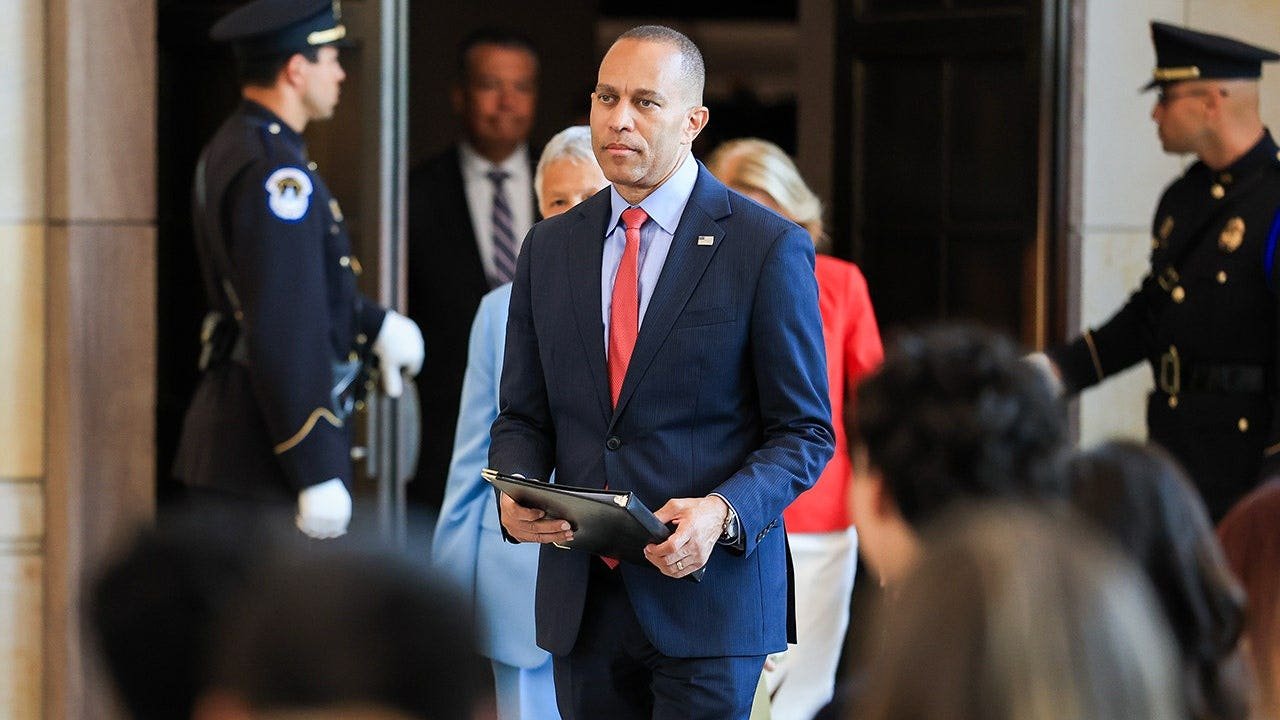
House Democratic Leader Hakeem Jeffries faces growing pressure as democratic socialist-backed candidates gain influence in New York, raising new questions about the party’s ideological direction. (Tom Williams/CQ-Roll Call, Inc via Getty Images)
Counting votes.
Putting out fires.
Trying to solve a problem.
Since Tuesday, the problem has been coming from inside his own party.
Not Donald Trump.
Not Republicans.
Not the economy.
Not the spending bill.
The Democratic Party.
More specifically, the Democratic Socialists of America inside the Democratic Party.
For much of the last week, Jeffries has found himself staring transfixed at perhaps the most difficult political challenge of his career — immobilized not because he does not know what he thinks, but because he knows exactly what he thinks.
He believes Democrats need to look mainstream to win swing districts. He believes affordability is a stronger message than ideology. He believes most Americans don’t want a political revolution. And he surely believes that Republicans — from President Donald Trump on down — cannot wait to compel every rival candidate to answer for the most controversial voices inside the Democratic Party.
That has always been the danger of ideological movements. They rarely stay quaintly confined to the neighborhoods where they first emerge. They spread. They redefine brands. They force everyone wearing the same jersey to bear responsibility for the teammates they did not recruit.
This week, such a menace landed squarely on Jeffries’ desk.
The source of the headache was New York City, where Mayor Zohran Mamdani’s stunning Democratic victory last November now has staged a second, hugely consequential act, as three candidates backed by Mamdani — Brad Landler, Claire Valdez and Darializa Avila Chevalier — won congressional primaries. Valdez and Chevalier are both members of the Democratic Socialists of America.
The victories are significant for reasons that resonate far beyond New York.
For years, the Democratic establishment has comforted itself with the belief that support for democratic socialism was limited to a handful of safe districts represented by colorful personalities who generated cable-news segments but exercised limited influence over the broader direction of the party.
Tuesday suggested something different. Democratic socialists did not merely sustain their corner of the party with fringe support, they expanded it — and expanded it in Jeffries’ own backyard.
It is difficult to overstate the implications of such a predicament for the Democratic leader.
Jeffries is not Bernie Sanders, nor is he Alexandria Ocasio-Cortez. Rather, Jeffries has spent years carefully cultivating an image as a disciplined institutionalist — a modern Democratic leader capable of appealing to progressives without frightening suburban moderates. His personal politics always have been considerably closer to the political center than to those of the raucous activists in his coalition. He is, by temperament and instinct, a coalition builder.
Coalition builders do not enjoy civil wars. It is a major hurdle for Jeffries to explain and finesse the ballooning faction without detonating a timebomb inside his party.
Almost immediately after Tuesday’s results, reporters and anchors began asking Jeffries his opinion of the new nominees — not whether he supported them, but whether he supported what they unequivocally endorsed. It was an impossible line of questioning precisely because everyone already knew the answer. Jeffries does not believe America should abolish Immigration and Customs Enforcement, prisons or the police force. He has never argued for dismantling capitalism, nor has he embraced many of the wider ideological positions associated with the Democratic Socialists of America.
So, he did what experienced political leaders often do when trapped between principle and practicality. He tried to change the subject.
In interview after interview, Jeffries gently, nebulously, acknowledged that he did not share every position or previous statement made by the nominees. He steered the conversation toward affordability, alternate Democratic victories and the overarching national map. It was classic Hakeem Jeffries: polite, measured, disciplined and careful.
But politics rarely allows careful people to remain above the fray forever, and, before long, one of the nominees, Chevalier, became a national story.
Opposition researchers — and increasingly, reporters — began to dredge up years of Chevalier’s social-media posts and public statements, staunchly expressed and clearly defined. She did indeed call for abolishing police and prisons, and argued for eliminating borders and ICE. She harshly, profanely, criticized Kamala Harris and Joe Biden, and decried America as «a f—— disgrace.» Her many posts involving race, white women, and interracial relationships spread rapidly, first across conservative media and then on MSNOW and CNN.
For many, it does not matter that she has deleted and repudiated some of the posts.
One Democratic Party stalwart told me ruefully, «Chevalier is our David Duke. She is poisoning the possibility of a Democratic majority.»
AOC ISSUES WARNING TO HER FELLOW DEMOCRATIC INCUMBENTS IN THE WAKE OF SOCIALISTS WINNING BIG IN NYC
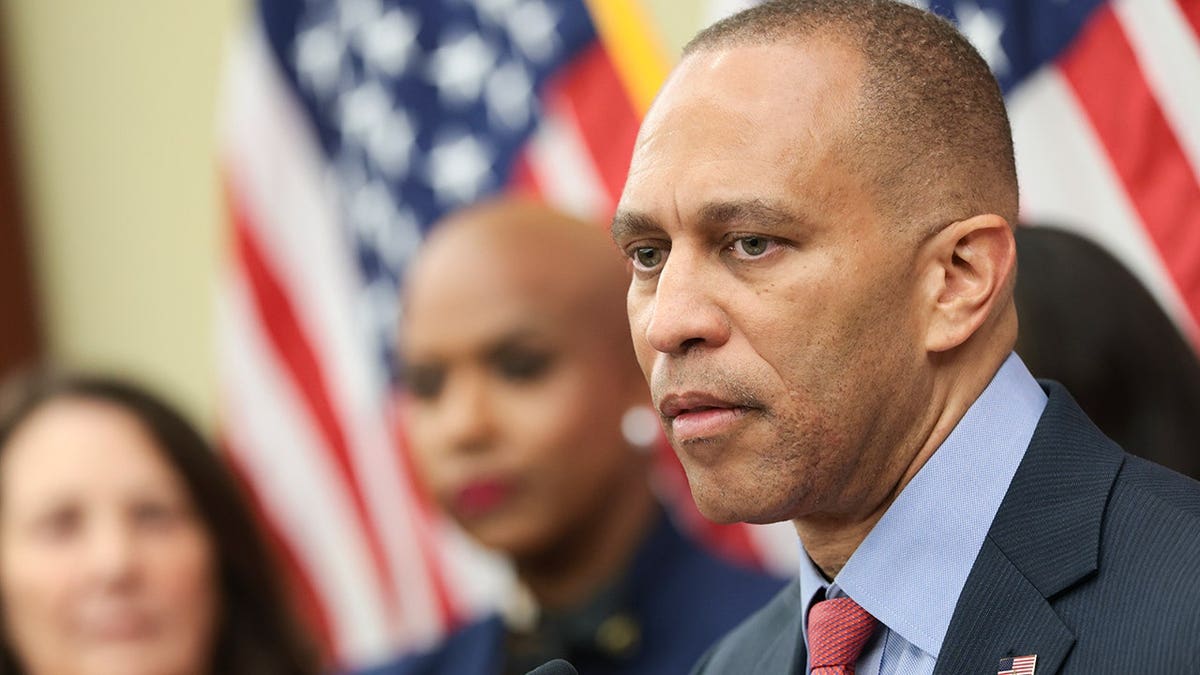
Hakeem Jeffries is balancing party unity with mounting concerns that Democratic Socialists of America-backed candidates could complicate Democrats’ efforts to win swing districts. (Anna Moneymaker/Getty Images)
But another Democrat familiar with the House caucus, who has been aligned with the progressive wing, offered me an opposing view. «The reality is that the energy of the party in primaries is anti-genocide, anti-billionaire and for Medicare-for-all. Many centrists and House Democratic members are having a hard time coming to terms with this. But that’s where voters primary are. They are unfortunately jamming Jeffries unnecessarily instead of letting him embrace the progressive wing.»
Whether Chevalier’s comments are viewed as youthful activism, sincere ideological conviction or political malpractice, they guarantee one thing: the questions will not stop.
Republicans understood immediately that they had been handed a gift, and Democrats knew every candidate in a competitive district could now expect variations of the same questions: Do you agree with this? Is this your party? Does Chevalier represent today’s Democrats?
Jeffries undoubtedly knew exactly where this was heading. Yet on Saturday afternoon, he nevertheless offered an official welcome to Chevalier, Landler and Valdez with a celebratory post on X.
«Congratulations to our newest members of the NYC congressional delegation,» he wrote. «From public servants to union organizers to community activists, the path is different but the work is the same. We must decisively address the affordability crisis and crush far-right extremism!»
With this statement, Jeffries conceded that his paramount job is to elect a majority, despite the risks to his own reputation, digital and otherwise.
«Jeffries is doing what he needs to do to keep his Democratic caucus as whole as he can,» a veteran Democratic political operative in New York told me. «That means making sure the tent is seen as broadly as it needs to be while moving it into a (hopefully) governing coalition come January. There is no win by holding out and claiming these folks are socialists and therefore not our people. They are going to vote for Jeffries [for Speaker] and we will need their votes for that and much more going forward. And the folks who didn’t get that in last year’s election for Mayor also paid a real price for not recognizing it.»
Even so, moderate Democrats have been urging Jeffries, publicly and privately, to draw sharper distinctions between the party’s mainstream constituency and its socialist wing. Those calls escalated dramatically after Tuesday.
When I asked a spokeswoman for Jeffries about the content and timing of the X post, and how he might respond to those calling for his repudiation of Chevalier and other controversial candidates, she only would say that Jeffries has put out similar congratulatory messages in virtually every race this cycle, on behalf of nominees from every state, background, and ideology.
But that hardly is sufficient for many of the most prominent voices in the party.
Rep. Josh Gottheimer, a leading moderate/centrist Democrat from New Jersey, told Jewish Insider that the socialists’ anti-Israel point of view is a «growing cancer, and we can’t let it spread, and we cannot ignore it.» He warned that the incoming DSA-aligned lawmakers will be coming to Washington to «wreak havoc in Congress» and will try to «hold the party hostage» to their socialist views. «It will lead to more gridlock and dysfunction, and hard-working families will pay the price for this,» he said. «The socialists have put their own personal hatred above our national security and our promises to our allies. And I think we’ve got to call out hate when we see it.»
«This is a bridge too far,» agrees veteran Democratic strategist James Carville, who cautions that embracing candidates whose politics fall well outside the party’s historical mainstream risks alienating precisely the voters Democrats need to regain strong, enduring governing majorities. He dismisses the political views of Chevalier as entirely anathema to the Democratic Party, insisting that «they should not seat her in the caucus. Her views are totally against anything that any Democrat has. We believe in pluralism, she doesn’t believe in interracial dating…Lady, I ain’t in the same party as you…She has attacked interracial relationships and the American flag.» Carville considers this a line in the sand. «I actually do think it’s time for Democrats to talk the S word,» he says. «Schism. I really do. Everybody’s always said, ‘No, no, we’re a coalition. We’re a big tent.’ And there’s some – there’s just some s— that I can’t be in the same tent with.»
Trump himself sees a similarly dire scenario. «The Democrat Party is in big trouble,» he said Friday at the Faith & Freedom Coalition’s policy conference. «Because this isn’t stopping with New York. This is the most serious threat to our country in its existence, in my opinion.»
Jeffries, meanwhile, understands that fear now runs in both directions inside the Democratic Party. Moderate Democrats worry about losing swing voters. Party leaders worry about losing their own base. The activists who dominate many Democratic primaries are intensely engaged, highly organized and deeply angry. They have shown they are willing to target incumbents they regard as insufficiently progressive. Jeffries must have felt a nervous little chill last week at the New York election night victory party. When his image appeared, the DSA celebrants put him on notice with the ominous chant, «You’re next!»
To be sure, this is not the first time Democratic leaders have confronted an insurgency from the party left.
During Donald Trump’s first presidency, Nancy Pelosi was faced with a similar complication with the rise of «the Squad.» New congressional members Alexandria Ocasio-Cortez, Ilhan Omar, Rashida Tlaib and Ayanna Pressley, independently and as a team, became media stars almost overnight, with their youth, charisma, modern brio, irreverence, and controversial views. Republicans tried relentlessly to define the entire Democratic Party through their most radical statements.
Pelosi’s response was remarkably effective. She did not attempt to defeat them ideologically, but instead, managed them institutionally. She reminded everyone who counted votes, controlled committee assignments, raised money, determined legislative priorities, and possessed the experience and power to turn slogans into laws. When necessary, Pelosi criticized «the Squad,» but more often, she simply outmaneuvered them.
Nancy Pelosi understood something that many ideological movements forget. In Congress, power is measured not by followers on social media but by the ability to assemble 218 votes.
Jeffries inherited Pelosi’s position, but he has not inherited Pelosi’s authority. He has never held the Speaker’s gavel, nor spent years disciplining a majority. He has not had to decide which members receive prized committee chairs while balancing dozens of competing factions. Most importantly, he has never governed with a razor-thin Democratic majority.
If Democrats capture the House this November by only a handful of seats, the arithmetic becomes brutal.
Every member and every vote will matter, as will every defection. A bloc of uncompromising ideological members can exercise influence wildly disproportionate to its size. Republicans know this because they lived through it, Kevin McCarthy learned this tough lesson, and Mike Johnson is enduring it now. Jeffries may soon discover it himself.
Which explains why this week’s story matters beyond a handful of New York primaries. The broader struggle inside the Democratic Party has been building for years.
Bernie Sanders demonstrated—twice–that democratic socialism has enormous appeal inside Democratic presidential politics. Alexandria Ocasio-Cortez transformed progressive activism into celebrity politics and brand name recognition. Mamdani, magnetic and unapologetic, has shown that the movement can capture America’s largest city.
What makes this movement especially potent is that it has found an organizing principle steeped in emotion that extends well beyond traditional left-right politics. For many younger activists, the Israeli-Palestinian conflict, especially conditions in Gaza, has become not merely a foreign policy issue but a moral litmus test. The language of «genocide,» «apartheid» and «settler colonialism» has moved from campus protests into Democratic primaries, online pressure campaigns, and frequent heckling at live events, creating an intensity that traditional establishment politicians often struggle to comprehend. Whether those characterizations are accepted or fiercely disputed, whether they veer into glib virtue signaling, the political reality is undeniable: arguments over Gaza have become a powerful engine of grassroots activism and candidate recruitment in ways that few Democratic leaders anticipated.
Each DSA victory expands the movement’s confidence and makes compromise less attractive, while increasing pressure on Democratic leaders who must somehow persuade suburban voters that none of this defines the party while simultaneously assuring activists that it absolutely does.
That balancing act has grown more difficult every election cycle, and is teetering on the unsustainable.
And this is not simply Hakeem Jeffries’ problem. Chuck Schumer faces his own version of the same challenge. As the Democratic leader in the Senate, he must deal with his socialist-aligned (and acutely flawed) nominee in Maine, Graham Platner, and with the frontrunner in the August Senate primary in Michigan, Abdul El-Sayed, another Sanders disciple with controversial views.
In many respects, Jeffries and Schumer are tackling what Joe Biden and Kamala Harris sidestepped during their administration. As progressive cultural politics and increasingly strident anti-Israel sentiment spread through elite institutions, universities, activist organizations and social media, the Biden White House generally sought accommodation rather than confrontation. The result was that ideas once largely confined to activist circles migrated steadily, unchecked, into Democratic primaries—not only in New York, but in blue cities, college towns and even pockets of some of America’s reddest states. Leaders who decline to police the boundaries of a coalition eventually discover that someone else has redrawn them.
Perhaps Jeffries hopes the controversy fades.
Washington is certainly capable of changing the subject. Trump is still able to absorb all the oxygen in any room, in any crisis. Inevitably there will be other international emergencies, budget showdowns, political and cultural shiny objects. Jeffries has a few potential lifelines, such as the natural evolution of his peers. AOC, for example, has in recent years become less of a bomb-thrower and more of a legislator. She still sits firmly on the left flank of the party, but she has learned the value of coalition-building, party discipline and picking her spots. Jeffries can reasonably hope that today’s firebrands eventually follow a similar trajectory. The gamble, of course, is that this new generation may conclude that AOC moderated and matured too much. There are already indications of that sentiment.
So, while politics has an extraordinary capacity to move on, this DSA controversy probably won’t. The views of some of these new candidates are simply too extreme, too genuinely insulting to a majority of Americans, too unsavory for citizens who want calm, not drama; common sense, not gauzy, faddish ideology.
There will be more archived posts. More old videos. More awkward interviews. More Republican ads. More questions shouted down Capitol hallways. More uncomfortable television appearances. More brash and polarizing statements. And, if Democrats win the House, more difficult internal negotiations between party leadership and members who see compromise not as governing but as surrender.
JEFFRIES WELCOMES DEMOCRATIC SOCIALISTS INTO THE FOLD AS CRITICS WARN PARTY IS REVEALING ‘EXACTLY WHO IT IS’
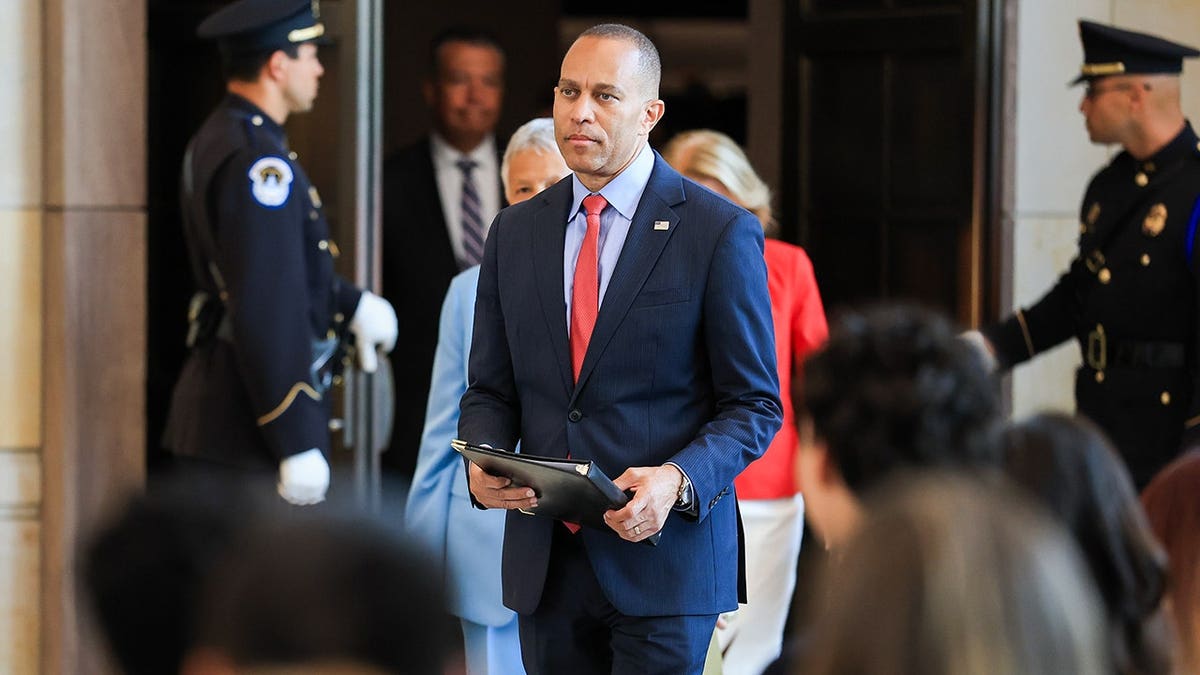
Democratic socialist victories in New York have intensified debate over the Democratic Party’s future and presented Jeffries with a difficult political test. (Anna Moneymaker/Getty Images)
The larger lesson extends beyond Jeffries. Political parties can survive disagreements and factions, even bitter internal fights. But what presents a deeper threat is the pretense that people who march beneath the same wide banner all are ultimately headed toward the same destination.
The Democratic Party today contains centrists who want to make capitalism work better, progressives who want to regulate it much more aggressively, and democratic socialists who openly question whether capitalism itself should remain the organizing principle of American life. Those are not merely policy disagreements. They are competing visions of the country.
Jeffries knows this.
He also knows that House elections are not won in Park Slope, but in places where swing voters often pay little attention to Congress until a thirty-second television advertisement flashes across the screen showing the most controversial quote imaginable beside the words «Democrat for Congress.» And he knows, that for others, the Democratic establishment and its officeholders are now more unpopular than socialism.
CLICK HERE TO DOWNLOAD THE FOX NEWS APP
Sometimes leadership is less about choosing between good options than about choosing between bad ones. This week, Hakeem Jeffries, faced with nothing but bad options, chose rhetorical party unity.
It is too soon to say if Jeffries’ choice was clever statesmanship — or simply the first compromise in what assuredly will be a very long negotiation over the future of his party.
politics, democrats, democratic party, house of representatives politics, the squad









Dem, GOP lawmakers trade jabs as midterms approach
Republican strategist Collin Reed and Fox News contributor Richard Fowler weigh in on the escalating midterm election battles as ‘America’s Newsroom’ anchor Bill Hemmer breaks down the power rankings for the House and Senate.
NEWYou can now listen to Fox News articles!
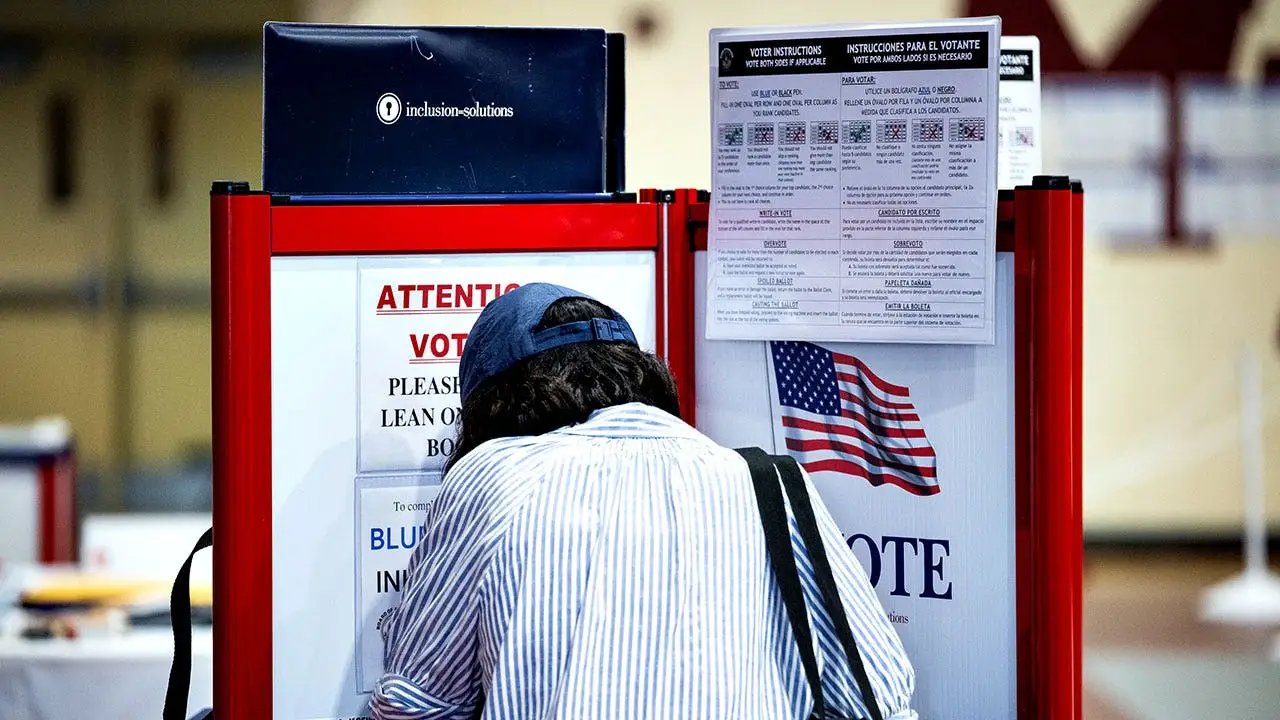
Several findings in the latest Fox News Poll show voters are unhappy and want major change, which bodes well for Democrats in November: President Donald Trump’s job approval remains near a record low, more Democrats are motivated to vote, Republicans join Democrats and independents in rating the economy negatively, and 4 in 10 voters want «dramatic» or «revolutionary» change. Plus, more view the GOP as tied to elites than the Democratic Party.
Voters say Democrats can better handle income inequality (+22 points), healthcare (+21), inflation (+10), the economy (+9), and foreign policy (+7). Republicans hold the advantage on crime (+7 points), while government spending (Democrats +3) and national security (R +2) are more evenly divided. On immigration, the GOP had an 8-point edge in April. Now, Democrats are preferred by one point.
FOX NEWS POLL: AN EARLY LOOK AT THE GEORGIA SENATE RACE
More Democrats (68%) say they are extremely motivated to vote in November than Republicans (57%) by an 11-point margin. By a 25-point spread, more MAGA Republicans (66%) are extremely motivated than non-MAGA Republicans (41%).
FOX NEWS POLL: A CLOSE SENATE CONTEST IS BREWING IN IOWA
If the election were today, 53% of voters would back the Democratic candidate in their House district and 46% the Republican. That 7-point edge is just outside the poll’s margin of error. Democrats were up by 5 points in April. Notably, 53% is the highest percentage either party has received on the generic House ballot in Fox News polling since 1996.
When looking only at counties where the 2024 presidential vote was close — Trump and former Vice President Kamala Harris within 10 points — the Democratic candidate leads by 59-41%.
«Although these data look promising for the Democrats, some of their support is in less-contested districts, padding their national totals without adding House seats,» says Republican pollster Daron Shaw, who conducts Fox News polls with Democrat Chris Anderson. «The best estimates I’ve seen suggest the GOP could retain the House even if the Democrats win the national vote by 2-3 points, but if Democrats win by 6-7 points, they probably take the House.»
The Democratic advantage comes amid weak ratings for Trump and continued economic pessimism. Trump’s job approval stands at 39%, unchanged for the third month in a row and one point above his low of 38% in October 2017. Approval of Trump is a touch lower than former President Barack Obama’s at the same point in his second term (42% in July 2014).
Trump received net-negative ratings for handling immigration (42% approve, 57% disapprove), Iran (34-66%), the economy (33-67%), and inflation (27-73%).
Three-quarters rate the economy negatively, about the same for the past six months.
Another three quarters say inflation has caused them financial hardship, including 34% who say «serious» hardship, up from 26% last year.
Fifty-four percent expect the economy to worsen in the coming year; only Republicans express optimism (71%), while Democrats (75%) and independents (64%) expect it to worsen.
Dissatisfaction extends beyond individual figures to both political parties and the broader economic system.
«Democrats and Republicans have a surprisingly broad array of shared beliefs about politics today,» says Shaw. «Both think elected officials answer to the elites, both think the system is rigged, both want to see new blood in office, both feel betrayed by their party, both disapprove of their members in Congress, and both want a mandatory retirement age for Congress.»
Some 70% say the Republican Party is closely tied to elite interests, while 55% say the same about the Democratic Party. The 15-point gap reflects more Democrats and independents saying the GOP is tied to elites, yet even Republicans are equally likely to describe both parties as close to elites.
There’s disillusionment in both parties. Many Democrats (48%) and Republicans (41%) say they feel betrayed by their party, and for both it is primarily for selling out to special interests.
Perceptions that the political system favors elites are reshaping views of the economy as well. The number who accept income inequality because «that’s how our economy works» has fallen 16 points compared to 2014 (from 62% to 46%), while the share who want government action has more than doubled (from 13% to 30%).
At the same time, an increasing number, 65%, think the country’s system is rigged in favor of the wealthy (up 9 points compared to 2019).
By 2-to-1, voters say it is more important to elect new people than keep those with experience.
Overall, 19% say they want revolutionary change in the nation’s government, while many others want substantial (38%) or dramatic (23%) change.
Almost twice as many Democrats (52%) as Republicans (28%) want dramatic or revolutionary change.
Nearly 7 in 10 voters disapprove of both Democrats and Republicans in Congress.
Some 32% of Republicans disapprove of their party’s lawmakers, while 39% of Democrats disapprove of theirs. More than 8 in 10 independents disapprove of both.
Fully 85% support a mandatory retirement age for members of Congress, up 20 points since 2002.
Of those in favor of setting a cap, 80% think it should be before age 75, with 61% selecting a cutoff between 65 and 74 — a boundary supported by more than half of every generation.
Poll-pourri
Just 50% of voters have a positive view of capitalism, down from a high of 57% in 2019. For socialism, it’s 30% favorable, up from 27% last year but below the 32% who said the same in 2021. The Democratic Socialists of America are viewed positively by 31%.
By an 11-point margin, more Democrats have a favorable opinion of socialism (52%) than capitalism (41%), while by a 50-point margin, more Republicans have a positive view of capitalism (61%) than socialism (11%).
Forty-five percent of voters have a favorable view of Vermont Sen. Bernie Sanders, I-Vt., That makes him more popular than Vice President JD Vance (41% favorable), Trump (38%), and Rep. Alexandria Ocasio-Cortez, D-N.Y., (35%). Each is viewed more unfavorably than favorably. Voters under 30 and those ages 65+ are equally likely to view Sanders positively (48% and 46% respectively). For AOC, more voters 65+ (41%) have a favorable view than young voters (33%), and three times as many of those under 30 say they’ve never heard of her (30% vs. 9%).
Overall, 44% have a favorable view of Israel, down from 58% a decade ago. Positive ratings are lower today among Democrats (by 14 points), Republicans (-12), and independents (-21). Voters ages 65 and over (56%) are twice as likely to view Israel favorably as those under 30 (27%).
Conducted July 17–20, 2026, under the direction of Beacon Research (D) and Shaw & Company Research (R), this Fox News survey includes interviews with a sample of 1,003 registered voters randomly selected from a national voter file. Respondents spoke with live interviewers on landlines (70) and cellphones (681) or completed the survey online after receiving a text (252). Results based on the full sample have a margin of sampling error of ±3 percentage points. The survey includes an oversample of 200 voters aged 18–29, bringing the sample size for that subgroup to 350 (±5). Sampling error for results among subgroups is higher. In addition to sampling errors, question wording and order can influence results. Weights are generally applied to age, race, education, and area variables to ensure the demographics are representative of the registered voter population. Sources for developing weight targets include the most recent American Community Survey, Fox News Voter Analysis, and voter file data.
Fox News’ Victoria Balara contributed to this report.
fox news poll, politics, economy, elections, voting, democratic party, republicans, donald trump
INTERNACIONAL
EE.UU. y Arabia Saudita firmaron un acuerdo nuclear que incluiría el enriquecimiento de uranio: crece la preocupación en Israel

Estados Unidos y Arabia Saudita firmaron este miércoles un acuerdo que permitirá al reino árabe desarrollar un programa nuclear civil y que, según algunos medios, le abriría al reino la puerta al enriquecimiento de uranio.
Este plan desató preocupación en Israel, informó la prensa local.
El acuerdo, que debe ser ratificado por el Congreso estadounidense, se produce en un contexto de tensión con Irán, rival de Arabia Saudita en Oriente Medio, y bajo los esfuerzos de Washington por limitar las capacidades nucleares de Teherán, que niega buscar desarrollar armas nucleares.
El documento, conocido como “Acuerdo 123”, fue firmado por el secretario de Energía de Estados Unidos, Chris Wright, y su homólogo saudita, Abdulaziz bin Salman, según informó en un comunicado el Gobierno estadounidense.
Arabia Saudita no mantiene vínculos diplomáticos con Israel.
“Fines pacíficos”
El comunicado no incluyó el texto íntegro del acuerdo, pero asegura que el programa tiene “fines pacíficos” y que está comprometido con la “no proliferación nuclear”.
Asimismo, indicó que el acuerdo dará a las empresas estadounidenses acceso preferente al sector de la energía nuclear producida en Arabia Saudita.
“Pueden tener la certeza de que estos acuerdos cumplen con los más altos estándares de seguridad y no proliferación nuclear, al tiempo que se apoyan en la mejor tecnología nuclear y en los mejores científicos del mundo, desarrollados aquí mismo en Estados Unidos”, afirmó Wright.
Donald Trump firma un acuerdo nuclear con Arabia Saudita (Foto: REUTERS/Evelyn Hockstein)
Medios como The New York Times adelantaron el acuerdo, que, según esas informaciones, permitiría a Riad el enriquecimiento de uranio, yendo más allá de los pactos nucleares convencionales que Washington ha suscrito con otros aliados, como Emiratos Árabes Unidos.
Desde que se filtraron los detalles el martes por la noche, algunos legisladores demócratas criticaron el acuerdo y pidieron que el Congreso lo rechace, aunque los republicanos tienen mayoría en ambas cámaras.
Leé también: Mientras aumenta el precio del petróleo, Trump amenaza con destruir puentes y centrales eléctricas de Irán
Desde que regresó al poder en 2025, el presidente de Estados Unidos, Donald Trump, impulsó un acercamiento a Arabia Saudita y al príncipe heredero, Mohamed bin Salman, pese a que este fue acusado por la inteligencia estadounidense de estar detrás del asesinato en 2018 del periodista Jamal Khashoggi de The Washington Post.
Enriquecimiento de uranio
Una cláusula del pacto, que tendría una duración de 30 años, prevé que empresas estadounidenses construyan una instalación de enriquecimiento de uranio en Arabia Saudita si un estudio conjunto determina que está justificado, informó The Wall Street Journal.
Pero algunos legisladores estadounidenses de ambos partidos y funcionarios israelíes expresaron su oposición a un proyecto atómico civil para Arabia Saudita, por temor a que pueda convertirse eventualmente en un programa para desarrollar armas nucleares. El presidente estadounidense, Donald Trump (REUTERS/Evelyn Hockstein)
El reino sunnita es uno de los principales aliados de Washington en Oriente Medio y ha sido afectado por ataques iraníes en respuesta a la ofensiva estadounidense contra Irán. Además, los rebeldes hutíes de Yemen han anunciado un bloqueo marítimo en el mar Rojo contra buques saudíes.
Arabia Saudita y los hutíes intercambiaron ataques la semana pasada por primera vez en años, lo que puso en peligro una tregua de 2022. Los rebeldes, en gran medida, se mantuvieron al margen desde que Israel y Estados Unidos atacaron a Irán a finales de febrero.
El asunto es de larga data. Arabia Saudita ha defendido durante mucho tiempo su derecho a desarrollar un programa nuclear civil.
En los últimos años, Washington ha tratado de integrar cualquier acuerdo relativo a la cuestión nuclear en una estrategia más amplia que incluiría la normalización de las relaciones de Arabia Saudita con Israel, junto con la firma de un pacto de defensa con Estados Unidos.
Washington firmó un acuerdo nuclear en 2009 con el vecino Emiratos Árabes Unidos, aunque este país no enriquece su propio uranio.
(Con información de EFE y AFP)
Donald Trump, arabia saudita

NEWYou can now listen to Fox News articles!
France has recorded more than 5,700 excess deaths during its historic summer heat wave, marking the country’s deadliest heat-related toll in more than two decades, Public Health France announced Wednesday.
Between June 17 and July 2, the agency expected 15,910 deaths but instead recorded 21,674. The difference — 5,764 excess deaths — was 36% higher than what would have been expected.
During the heat wave, temperatures climbed well above 104 degrees Fahrenheit in many parts of the country, Public Health France said.
«This unprecedented event, characterized by its early onset, intensity, and duration, exposed almost the entire population to extreme heat during a period that was still largely dedicated to school and work activities,» the agency said.
EUROPE’S FIRES REVEAL DEADLY MIX OF RECORD HEAT, HUMAN ERROR, ARSON AND LAND MISMANAGEMENT
Tourists enjoy cooling off at a public water fountain in Paris, Friday, June 26, 2026. (Christophe Ena)
Deaths from all causes increased across hospitals, private homes and nursing homes during the heat wave.
The agency’s analysis included people ages 15 and older, with mortality increasing beginning at age 45. Adults 75 and older accounted for roughly two-thirds of the provisional death toll, representing at least 3,719 excess deaths.
SCIENTIST CALLS FOR AMERICANS TO CUT OFF AIR CONDITIONING IN SUMMER, CLAIMING IT CAUSES GLOBAL WARMING
The Paris region was hit hardest, recording 1,999 excess deaths — more than 80% above what would have been expected without the heat wave, according to the agency.
Public Health France said 2026 recorded the country’s highest excess mortality linked to a heat wave since 2003. The National Institute of Health and Medical Research estimated that roughly 15,000 more people died compared to the usual mortality for that time of year.

Tourists cool off at a public water fountain in Paris, Friday, June 26, 2026. (Christophe Ena)
PARIS DEPUTY MAYOR BLAMES UNITED STATES’ CARBON EMISSIONS FOR DEADLY HEAT WAVE
This year, the hottest days occurred on June 24 and June 25, when the national average temperature reached 86 degrees Fahrenheit. Peak temperatures also climbed above 104 degrees in many areas.
More than half of the excess deaths — about 56% — occurred during or immediately after the most intense stretch of the heat wave between June 25 and June 27.
Officials also said more than 10,000 excess deaths were reported across Europe during the peak of the heat wave, though the preliminary figures are expected to be updated in the coming weeks.

People cool off in a fountain in Paris during a major heat wave. (Abdul Saboor/Reuters)
CLICK HERE TO DOWNLOAD THE FOX NEWS APP
According to The Associated Press, funeral directors in Paris said they were inundated by the surge in bodies awaiting burial or cremation, with some mortuaries reaching capacity and turning down new arrivals.
Health officials noted that the excess mortality estimate includes deaths from all causes that occurred during the heat wave. The figures remain provisional and will continue to be refined in the coming weeks.
The Associated Press contributed to this report.
france, heat wave, weather, europe

El Banco Central siguió con la compra de dólares y las reservas superaron los USD 49.000 millones

Alejandro Garnacho será nuevo jugador del Aston Villa para la próxima temporada

Cómo fue la maniobra para desviar los fondos de la AFA que está en la mira de la justicia de Estados Unidos

La decisión de Mauro Icardi con sus hijas varadas en Italia que podría costarle 700 mil dólares

El peronismo buscará introducir cambios a la Ley de Inocencia Fiscal y se anticipa un largo debate en el Congreso

Fox News Poll: Voters want major change amid economic and political discontent

Sin la Copa y sin Messi en el avión, vuelve Tapia y deberá enfrentar tres frentes de tormenta tras la pausa del Mundial

Escándalo Mundial: Las presiones secretas, la amenaza de la FIFA por Malvinas y la verdad detrás del partido contra España

Samuel L. Jackson llamó a Argentina “el país más racista del mundo”: la contundente respuesta que le dejó Bárbara Lombardo

Le ganan a la inflación: los senadores pasarán a cobrar $12 millones brutos a partir de agosto

 POLITICA2 días ago
Sin la Copa y sin Messi en el avión, vuelve Tapia y deberá enfrentar tres frentes de tormenta tras la pausa del Mundial
- DEPORTE21 horas ago
Escándalo Mundial: Las presiones secretas, la amenaza de la FIFA por Malvinas y la verdad detrás del partido contra España
- CHIMENTOS2 días ago
Samuel L. Jackson llamó a Argentina “el país más racista del mundo”: la contundente respuesta que le dejó Bárbara Lombardo