INTERNACIONAL
Leftist streamer calls violent revolution ‘inevitable’ as Democrats explode over Virginia court decision


Virginia Supreme Court strikes down Democrats’ redistricting plan
The Virginia Supreme Court strikes down the Democrats’ redistricting plan, overturning new congressional maps and dealing a blow to their midterm election hopes. Former President Donald Trump and former Governor Glenn Youngkin laud the ruling as a major victory. Virginia Governor Abigail Spanberger and House Minority Leader Hakeem Jeffries voice strong disappointment, vowing to explore options to challenge the court’s decision.
NEWYou can now listen to Fox News articles!
Democrats exploded in fury Friday after the Virginia Supreme Court struck down a party-backed redistricting map central to their midterm election strategy, with at least one prominent leftist voice going so far as to call violent revolution «inevitable.»
In a 4-3 decision, the Virginia Supreme Court ruled that a voter-approved map, which would give Democrats a 10-1 advantage in U.S. House races, violated the state’s constitution because of procedural errors in the map’s passage. Virginia voters will cast ballots in the 2026 midterms using the same district maps from the 2022 and 2024 elections, which Democrats currently hold 6-5.
But Democratic lawmakers and commentators alike have framed the Supreme Court’s ruling as an act going against the will of the people. Hasan Piker, a popular leftist streamer who has espoused antisemitic rhetoric and campaigns with congressional candidates, accused the Virginia Supreme Court of denying the results of the state’s redistricting referendum.
«Scotus gutted the voting rights act and tennessee carved up the last dem district destroying black voter power in the state,» Piker wrote on X. «Those who make peaceful revolution impossible, make violent revolution inevitable.»
VIRGINIA’S MAP WAR LAYS BARE STATE’S SHARP PARTISAN TURN AS LEGAL FIGHT LOOMS
Michigan Democratic Senate candidates have splintered over controversial online streamer Hasan Piker with Rep. Haley Stevens, D-Mich., and State Sen. Mallory McMorrow, D-Mich., criticizing candidate Abdul El-Sayed for campaigning with him. (Noushad Thekkayil/NurPhoto via Getty Images)
Sen. Tim Kaine, D-Va., suggested that Democrats won their redrawn map fair and square by holding a statewide election.
«Unlike Republican-led states that have redrawn their maps through backroom deals, the Virginia General Assembly let the people decide for themselves in a free and fair election,» Kaine said in a statement. «If the Virginia Supreme Court had legitimate concerns about this referendum, the time to stop it would have been before three million Virginians cast their ballots.
TRUMP URGES VIRGINIA VOTERS TO REJECT ‘BLATANT PARTISAN POWER GRAB’ BY DEMOCRATS
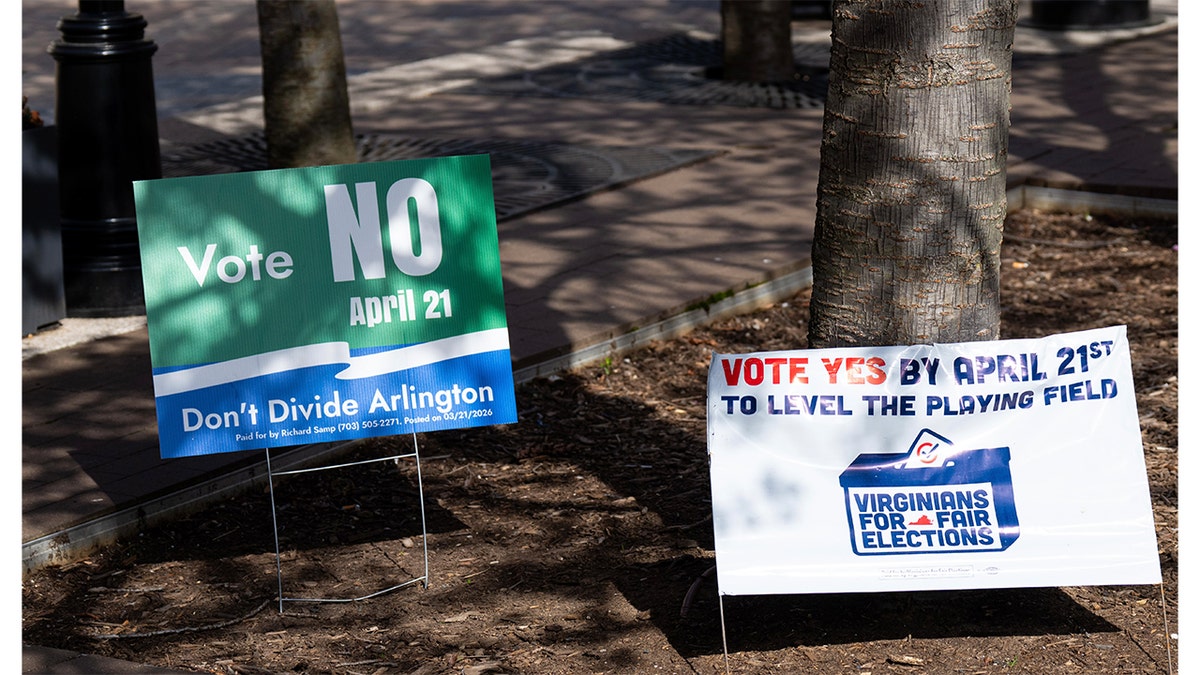
Signs urge early voters to vote yes or no on the Virginia redistricting referendum at the Ellen M. Bozman Government Center in Arlington, Va., on Tuesday, March 31, 2026. Early voting continues across the state for Virginia’s redistricting ballot referendum. (Bill Clark/CQ-Roll Call, Inc via Getty Images)
«But the Court let the process move forward, and Virginians sent a message loud and clear: we see President Trump’s brazen power grab in states across the country, and we won’t stand for it,» Kaine continued.
Kaine also echoed Piker’s sentiment that the ruling «eviscerates» the Voting Rights Act.
House Minority Leader Hakeem Jeffries, D-N.Y., said they’re «exploring all options» to fight back against Virginia’s high court’s ruling.
BLOCKBUSTER SUPREME COURT VOTING RIGHTS RULING IGNITES REDISTRICTING WAR ACROSS SOUTHERN STATES
«The decision to overturn an entire election is an unprecedented and undemocratic action that cannot stand,» Jeffries said in a statement.
«MAGA Republicans have adopted voter suppression as a strategy, as also evidenced by far-right extremists on the Supreme Court gutting the Voting Rights Act to open the door to a Jim Crow-like attack on Black representation across the American South,» Jeffries continued.
Meanwhile, Speaker of the Virginia House of Delegates Don Scott took a more pragmatic approach, saying he respects the high court’s ruling.
«We respect the court. But we will keep fighting for a democracy where voters — not politicians — have the final say. Because in Virginia, power still belongs to the people.»
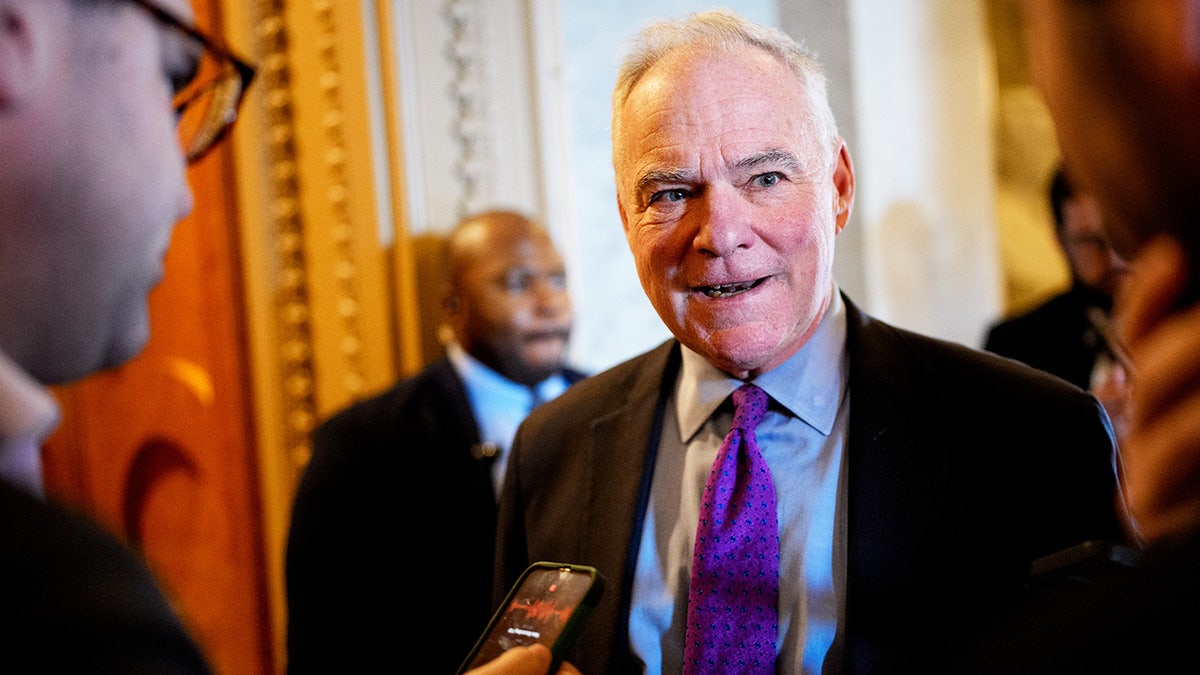
Sen. Tim Kaine, D-Va., speaks to reporters as he walks into the Senate chamber in Washington, D.C., on Dec. 11, 2025. (Andrew Harnik/Getty Images)
CLICK HERE TO DOWNLOAD THE FOX NEWS APP
As Democrats describe the Virginia Supreme Court’s ruling as a violation of the Voting Rights Act, Republican National Committee Chairman Joe Gruters, who spearheaded the lawsuit over the maps, said Virginia’s ruling was not based on politics but on the «rule of law.»
«Democrats just learned that when you try to rig elections, you lose,» said Chairman Gruters. «The RNC led the charge in court against this blatant power grab, where Virginia Democrats poured more than $66 million into an effort to lock in control and silence voters. We took them to court, and we won.»
supreme court, democrats elections, midterm elections, virginia, republicans elections, politics










INTERNACIONAL
Rusia fue acusada de difundir desinformación a favor de la extrema derecha alemana antes de las elecciones

La intensificación de la desinformación en redes sociales, detectada en las últimas semanas por activistas y organismos de inteligencia, apuntan a un intento de influir en las elecciones regionales de Alemania. Las campañas, atribuidas por varios actores a operaciones rusas, generaron inquietud entre autoridades y sectores de la sociedad civil, que advierten sobre el posible impacto en los comicios de septiembre.
En el este del país, Alternativa para Alemania (AfD) lidera las encuestas en Sajonia-Anhalt y Mecklemburgo-Pomerania Occidental, y aspira a controlar un gobierno regional por primera vez desde 1945. El avance de la formación prorrusa y antiinmigrante sería un golpe para la coalición del canciller Friedrich Merz y marcaría un hito en la política alemana.
Ante la proximidad de las elecciones, se multiplicaron las publicaciones con desinformación en plataformas como X, TikTok y Bluesky. Según grupos de monitoreo y diputados alemanes, la hipótesis central es que Rusia estaría detrás de estos ataques, empleando estrategias para beneficiar a la extrema derecha y erosionar la confianza en los partidos tradicionales.

Las sospechas de injerencia rusa en las campañas digitales fueron avaladas por legisladores y activistas, quienes señalan la aparición de cuentas falsas y la difusión de acusaciones de corrupción contra rivales de AfD y BSW, un pequeño partido de extrema izquierda también identificado como prorruso. Las operaciones utilizaron versiones falsificadas de medios reconocidos, como AFP, ARD y Deutsche Welle, para amplificar el impacto de la desinformación.
La organización Antibot4Navalny, un colectivo anónimo que lleva el nombre del opositor ruso asesinado, documentó dos campañas desde junio. “No hay otra explicación plausible”, sostuvo un activista del grupo en diálogo con la AFP, quien aseguró que las maniobras guardan similitud con la operación Matryoshka, vinculada previamente al Kremlin.
El gobierno alemán evitó pronunciarse directamente sobre la operación Matryoshka, aunque reconoció: “Las operaciones de manipulación de información… constituyeron durante mucho tiempo una amenaza diaria”. Esta postura refleja una respuesta cautelosa, en parte para no amplificar involuntariamente el alcance de las campañas de desinformación.
Konstantin von Notz, diputado de Los Verdes y vicepresidente del comité de supervisión de inteligencia, fue tajante en conversación con la AFP: “La narrativa que se difunde desde Rusia a Alemania, con un presupuesto millonario, es luego retransmitida deliberadamente por la AfD de forma selectiva”. Von Notz también criticó la falta de reacción gubernamental y exigió respuestas más contundentes ante lo que considera un peligro real.

Por su parte, la embajada rusa rechazó las acusaciones, calificándolas de “ridículas” y advirtiendo que Alemania y Europa siguen “un camino extremadamente peligroso” que perjudica a sus ciudadanos. La coalición gobernante, liderada por la CDU/CSU y el SPD, denuncia regularmente una “guerra híbrida” de Moscú, que iría más allá de la propaganda y abarcaría espionaje y sabotaje.
El servicio nacional de inteligencia (BfV) confirmó estar al tanto de la campaña digital y de sus similitudes con operaciones rusas, aunque hasta el momento no se han anunciado acciones concretas para contrarrestarla. Marc Henrichmann, presidente del comité de supervisión de inteligencia y diputado de la CDU, subrayó la necesidad de cautela: “Si al dirigir una campaña a un público específico conseguimos darle aún más publicidad, entonces, obviamente, habremos cometido un error”. Henrichmann también abogó por otorgar mayores poderes a los servicios de inteligencia para combatir el fenómeno.
Desde la AfD, la respuesta ha sido de rechazo a las acusaciones. Ulrich Siegmund, principal candidato del partido en Sajonia-Anhalt, declaró a la AFP: “Buscar un entendimiento razonable con otro país no significa que estés trabajando para conseguirlo”. El político insistió en que el interés alemán debe guiar las acciones del partido, incluyendo la defensa de la compra de energía rusa barata y la reducción del gasto en Ucrania e inmigración.

Entre los simpatizantes de la formación, la percepción de Rusia como un aliado natural es recurrente. Hans-Joachim Dietrich, camionero jubilado, expresó a la AFP: “Creo que debemos defender con más firmeza, incluso dentro de la AfD, que Rusia es nuestro aliado natural”.
Henrichmann advirtió sobre el riesgo de una “guerra cognitiva” impulsada desde Moscú, destinada a sembrar miedo y división en Alemania, especialmente en un contexto de reformas militares y apoyo a Ucrania frente a Rusia.
“No hay duda: la AfD es el portavoz del presidente ruso Vladimir Putin en Alemania y está explotando conscientemente estas narrativas”, afirmó el legislador. Sin embargo, tanto Henrichmann como activistas reconocen que, por ahora, el alcance de la campaña digital es limitado, aunque advierten que la vigilancia debe continuar y que es necesario reforzar los poderes de los servicios de inteligencia para proteger el proceso democrático.
(Con información de AFP)
Domestic,Politics,Europe,Government / Politics
INTERNACIONAL
Amy Coney Barrett recalls heartbreaking question from 12-year-old son over bulletproof vest
NEWYou can now listen to Fox News articles!
Justice Amy Coney Barrett told the House Appropriations Committee the uptick in threats waged against her and fellow Supreme Court justices have taken a toll on her children.
«They have required my children to think about and see things that children should not have to see or think about,» Barrett testified Tuesday.
Barrett shared how her security detail gave her a bulletproof vest to wear, and one day when she brought it into her bedroom, her 12-year-old son asked what it was.
«And I didn’t know how to respond because maybe I lack imagination, but I didn’t expect that performing this service was going to put me in the position of explaining to my children what a bulletproof vest was and why I had to wear one,» Barrett told the committee.
SUPREME COURT JUSTICES HEAD TO CAPITOL HILL FOR FIRST CONGRESSIONAL APPEARANCE SINCE 2019
Barrett and Justice Elena Kagan’s testimony before Congress came as the Supreme Court seeks a 10% budget increase for fiscal year 2027, with roughly $16.6 million of the $20.7 million increase dedicated to expanding security for the justices.
Supreme Court justices Elena Kagan and Amy Coney Barrett testify before the House Appropriations Committee on Capitol Hill July 14, 2026, in Washington. (Finn Gomez/Getty Images)
Barrett, who was the target of a swatting incident in May, recounted how her and her family’s lives drastically changed following the leaked Dobbs decision in 2022, which ruled that abortion was not a constitutional right, causing threats on her life to intensify.
In that incident, someone falsely reported gunshots at her home, Barrett testified, saying her teenage son and his friends were the first to discover the street filled with police.
AMY CONEY BARRETT DRAWS BACKLASH FROM CONSERVATIVE CRITICS WHO WANT HER TO BE A TRUMP PARTISAN
«I was very, very grateful that I had Supreme Court police outside my home because they were able to stop and meet with and explain to the county police that it had been a false alarm, and so the police did not actually attempt to enter our home,» Barrett said.
She also shared that her and other justices are receiving anonymous packages being sent in the name of Daniel Anderl, the 20-year-old son of U.S. District Court Judge Esther Salas, who was killed in 2020.
The gunman was an attorney posing as a delivery driver. Judge Salas was his target. Salas’ husband was seriously injured as well.
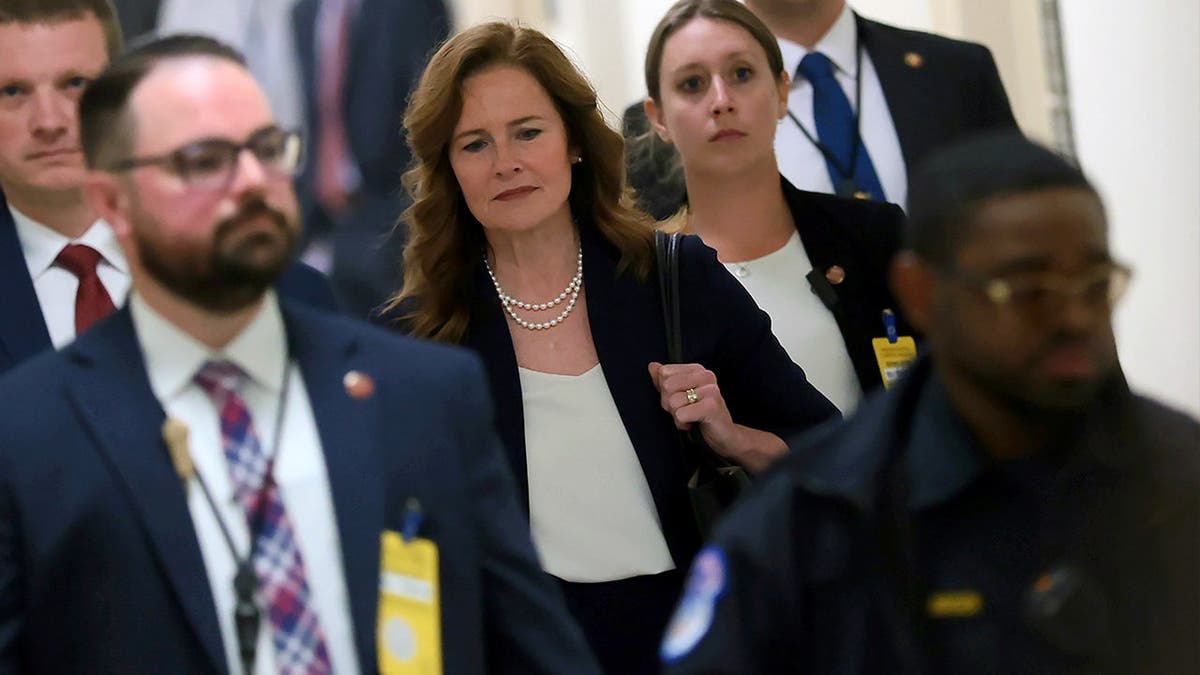
Supreme Court Justice Amy Coney Barrett arrives to testify during a House Appropriations Subcommittee on Financial Services hearing on Capitol Hill in Washington July 14, 2026. (Kent Nishimura/AFP)
MORNING GLORY: THE SUPREME COURT OFFICIALLY CLOSES THE BOOKS ON ANOTHER TERM
«I think the message on these deliveries being sent in his name is clear,» Barrett said. «As Justice Kagan said, federal judges across the country, throughout the judiciary, including the Supreme Court, continue to do their jobs without fear or favor, but the threat level is really high.»
The testimony underscored the urgency behind the Supreme Court’s push for more security funding during its first appearance before Congress since 2019.
In total, the Supreme Court is requesting roughly $89 million to cover personal security costs, which Kagan said is necessary given that the justices have experienced a 35% increase in threats just in 2026, compared to a 25% increase in threats the year prior. Kagan noted how recent growth in the budget can be entirely attributed to security expenses.
«For some of us, those threats have come very close, and all of us live with the knowledge that they may again materialize,» Kagan testified.
She recalled that when she arrived at the Supreme Court in 2010, justices did not receive around-the-clock personal protection. Instead, the court’s police primarily guarded the building, and she only had security accompanying her during work-related public events.
But Kagan said the heightened focus on justices’ security began after Justice Antonin Scalia’s death in 2016. Scalia died while on a hunting trip in Texas, where he was hours away from security personnel after declining a private security detail for the trip.
Kagan recalled that Rep. Darrell Issa, R-Calif., and the late Rep. Elijah E. Cummings, D-Md., went to Chief Justice John Roberts to push them to step up security.
«This was how the chief described it to us — they said, kind of like, ‘We think you’re crazy, you know, that you have less security than the director of the Office of Personnel Management does. And we think that you have to do better.’
CLICK HERE TO DOWNLOAD THE FOX NEWS APP
«Then, of course, the Dobbs leak happened, and that really increased the urgency of the entire thing,» Kagan said. «But we’ve been working on this now for about a decade and actually, I think, are grateful to Congress for coming to us and saying, ‘You have to up your game in this area.’»
supreme court, judiciary, federal courts, hearings house of representatives politics, national security



Argentina-Inglaterra: la historia y el presente de un clásico especial antes de una semifinal con peso propio

Rechazaron el pedido de Martín Insaurralde para apartar al fiscal Sergio Mola de la causa por presunto enriquecimiento ilícito

Importante bodega de San Juan está en crisis con 380 cheques sin fondos y deuda de $680 millones

Rusia fue acusada de difundir desinformación a favor de la extrema derecha alemana antes de las elecciones

Argentina vs. Inglaterra: El día que Diego Maradona venció al «ejercito» inglés con la «mano de Dios»

Movilizaciones, marcha federal y piquetes: el plan de lucha de los movimientos sociales contra el Gobierno

“Hablame bien”: el tenso cruce de Lionel Messi con el árbitro en la victoria de Argentina ante Suiza en el Mundial

El álbum de las vacaciones soñadas de Darío Barassi con su familia: “Ibiza, nos vas enamorando”

El petróleo sube más de 3% tras la reanudación de los ataques de EEUU contra Irán y la amenaza de cierre del estrecho de Ormuz

Cámara de Comercio panameña cierra filas y llama a fortalecer la Zona Libre de Colón

 CHIMENTOS2 días ago
El álbum de las vacaciones soñadas de Darío Barassi con su familia: “Ibiza, nos vas enamorando”
- ECONOMIA2 días ago
El petróleo sube más de 3% tras la reanudación de los ataques de EEUU contra Irán y la amenaza de cierre del estrecho de Ormuz
- INTERNACIONAL3 días ago
Cámara de Comercio panameña cierra filas y llama a fortalecer la Zona Libre de Colón