INTERNACIONAL
De la revolución industrial a la IA: el recorrido de los papas ante grandes transformaciones sociales y tecnológicas


El papa León XIV publicará este lunes su primera encíclica, Magnifica Humanitas (“Magnífica Humanidad”), un documento centrado en las cuestiones éticas que plantea la inteligencia artificial, en línea con una larga tradición de pontífices que fijaron posición ante transformaciones científicas, sociales y tecnológicas.
La encíclica será la primera de su pontificado, una suerte de manifiesto con el que los papas suelen pronunciarse sobre grandes temas de su tiempo.
Con este texto, León XIV se sumará a una tradición que atraviesa más de un siglo y en la que distintos pontífices intervinieron frente a cambios de gran impacto, desde la Revolución Industrial hasta la expansión de internet y las redes sociales.
La primera gran respuesta estructurada de la Iglesia ante una transformación tecnológica llegó a fines del siglo XIX. En 1891, en plena Revolución Industrial, León XIII publicó la encíclica Rerum Novarum (“De las cosas nuevas”).
Frente a la urbanización acelerada, el crecimiento de las fábricas y la precariedad creciente del proletariado, el papa buscó proponer un camino entre el capitalismo liberal y el socialismo revolucionario. El documento defendió tanto la propiedad privada como los derechos de los trabajadores, en particular su capacidad de organizarse colectivamente. La encíclica sentó además las bases de una doctrina social católica construida sobre principios como la dignidad de la persona, la solidaridad y el bien común.

Poco después de su elección en mayo de 2025, León XIV explicó que eligió su nombre en referencia a León XIII y a esa doctrina. Su nueva encíclica, además, fue firmada el 15 de mayo, exactamente 135 años después de Rerum Novarum.
En el siglo XX, la Iglesia enfrentó otra revolución: el auge de los medios de comunicación masivos. A mediados del siglo pasado, la expansión de la prensa, la radio, el cine y la televisión transformó profundamente la circulación de la información.
En ese contexto, el Concilio Vaticano II (1962-1965), una etapa de reformas y apertura dentro de la Iglesia, adoptó en 1963 el decreto Inter Mirifica (“Entre las cosas maravillosas”). Por primera vez, esos nuevos medios fueron considerados una cuestión central de la vida social y cultural. La Iglesia reconoció su papel en la formación de la opinión pública y reclamó un uso responsable, tanto por parte de quienes producen contenidos como de las audiencias.
El texto insistió además en la necesidad de contar con información confiable y completa, y pidió evitar cualquier “daño espiritual”.
Ese documento marcó un cambio importante dentro del Vaticano: en lugar de mantenerse a distancia, la Iglesia optó por involucrarse en esos nuevos espacios y alentó, entre otras iniciativas, la creación de medios católicos.

Ese mismo año, otro escenario de crisis global llevó al papado a pronunciarse sobre la amenaza nuclear.
Publicada en abril de 1963, pocos meses después de la Crisis de los Misiles en Cuba de octubre de 1962, la encíclica Pacem in Terris (“Paz en la Tierra”), de Juan XXIII, apareció en un momento en que el mundo estaba al borde de una guerra nuclear.
En nombre de la “justicia… la recta razón y la consideración de la dignidad y de la vida humanas”, el pontífice pidió el fin de la carrera armamentista entre Estados Unidos y la Unión Soviética. El documento sostuvo además que “las armas nucleares deben ser prohibidas. Debe alcanzarse un acuerdo general sobre un programa adecuado de desarme, con un sistema eficaz de control mutuo”.
Décadas más tarde, la informática e internet abrieron una nueva etapa de transformación.
Desde la década de 1990, la digitalización de los intercambios y la aparición de una esfera pública global marcaron una nueva fase, en la que el Vaticano volvió a intervenir. Juan Pablo II consideró internet un medio inédito de comunicación y difusión. La Iglesia alentó una presencia activa en línea, aunque al mismo tiempo pidió un uso responsable.
Benedicto XVI profundizó esa reflexión y subrayó riesgos propios del mundo digital, como la fragmentación de las relaciones, el predominio de la inmediatez y la dificultad para distinguir información confiable.

Con el auge de las redes sociales, el Vaticano también advirtió sobre la polarización del debate y la difusión de contenidos engañosos, especialmente durante el pontificado de Francisco (2013-2025).
Con la encíclica Laudato Si’ (“Alabado seas”), publicada en 2015, el papa argentino también criticó los excesos de un modelo tecnocrático y económico considerado responsable de la crisis ecológica.
Con Magnifica Humanitas, León XIV volverá a fijar posición sobre una transformación tecnológica de alcance global, esta vez centrada en las cuestiones éticas que plantea la inteligencia artificial, en continuidad con una tradición papal de intervención ante los grandes cambios de cada época.
(Con información de AFP)
Revolución Industrial,Inteligencia Artificial,papas,tecnología,Vaticano,sociedad,futuro,historia,iglesia,transformación










NEWYou can now listen to Fox News articles!
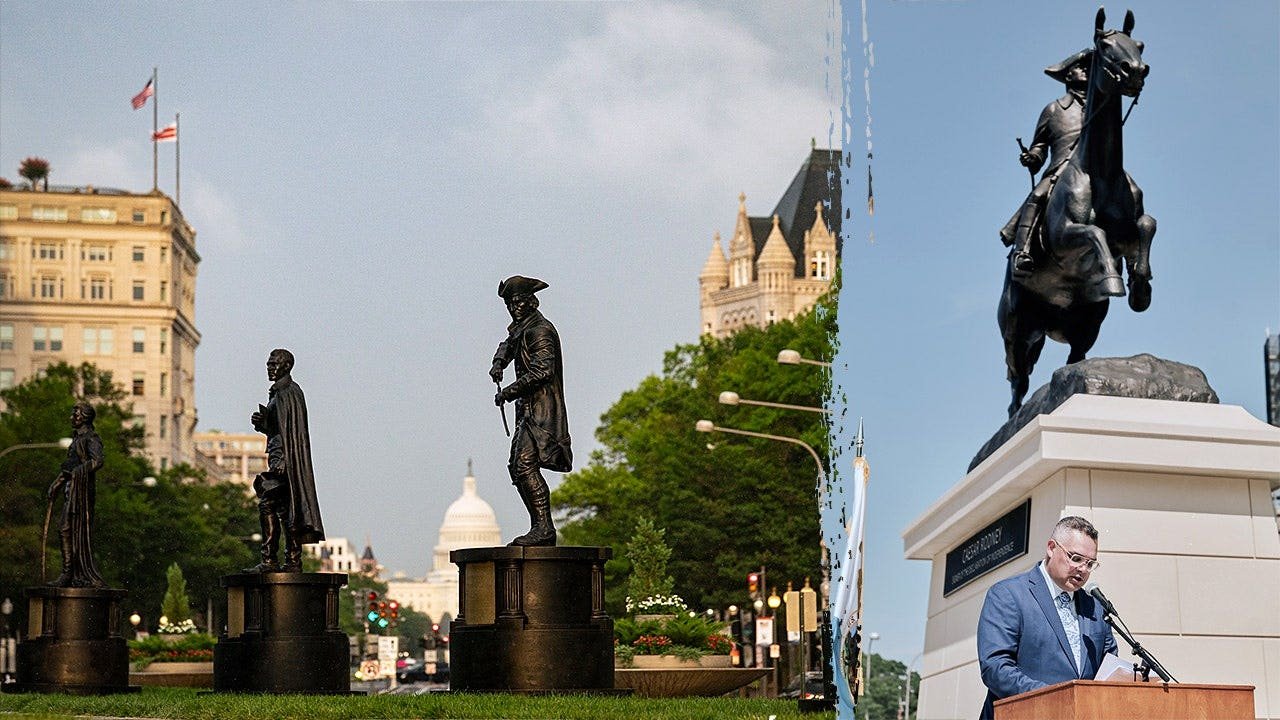
EXCLUSIVE: Beneath a towering 23-foot bronze figure holding the Declaration of Independence aloft, designer Matthew Taylor stopped beside an equestrian statue that many Americans have likely never seen, or even heard of.
«Most Americans have never heard of Caesar Rodney,» Taylor told Fox News Digital during an exclusive tour of the new Spirit of ’76 exhibition at Freedom Plaza. «But we owe this man an enormous debt of gratitude.»
The temporary installation, unveiled as part of America’s 250th anniversary celebration, transforms Freedom Plaza into an open-air gallery honoring Revolutionary War figures whose names rarely appear in history textbooks.
Commissioned by President Donald Trump, the exhibition features 22 statues and sculptural installations, including a restored equestrian monument of Rodney, a towering «Spirit of Liberty» centerpiece, bronze figures representing Revolutionary soldiers, and an immersive memorial honoring Americans who died aboard British prison ships during the Revolution.
EXPERTS FINALLY SOLVE MYSTERY OF TEENAGE REVOLUTIONARY WAR SOLDIER 246 YEARS AFTER HIS DEATH
Matthew Taylor stands beneath the Caesar Rodney statue with members of the fabrication team during the opening of the Spirit of ’76 exhibition at Freedom Plaza. (Dan Fleuette)
According to the National Park Service, the exhibit was created to honor the «heroes and martyrs of the Revolution» during America’s semiquincentennial and is intended to celebrate the enduring «Spirit of ’76’ that continues to live on in every American heart.»
The centerpiece installations include the Caesar Rodney equestrian statue, the «12 Soldiers of the Revolution,» the Prison Ship Martyrs memorial and the 23-foot Spirit of Liberty statue.
ARCHAEOLOGICAL DIG AT BATTLE OF BUNKER HILL SITE UNCOVERS REVOLUTIONARY WAR ARTIFACTS
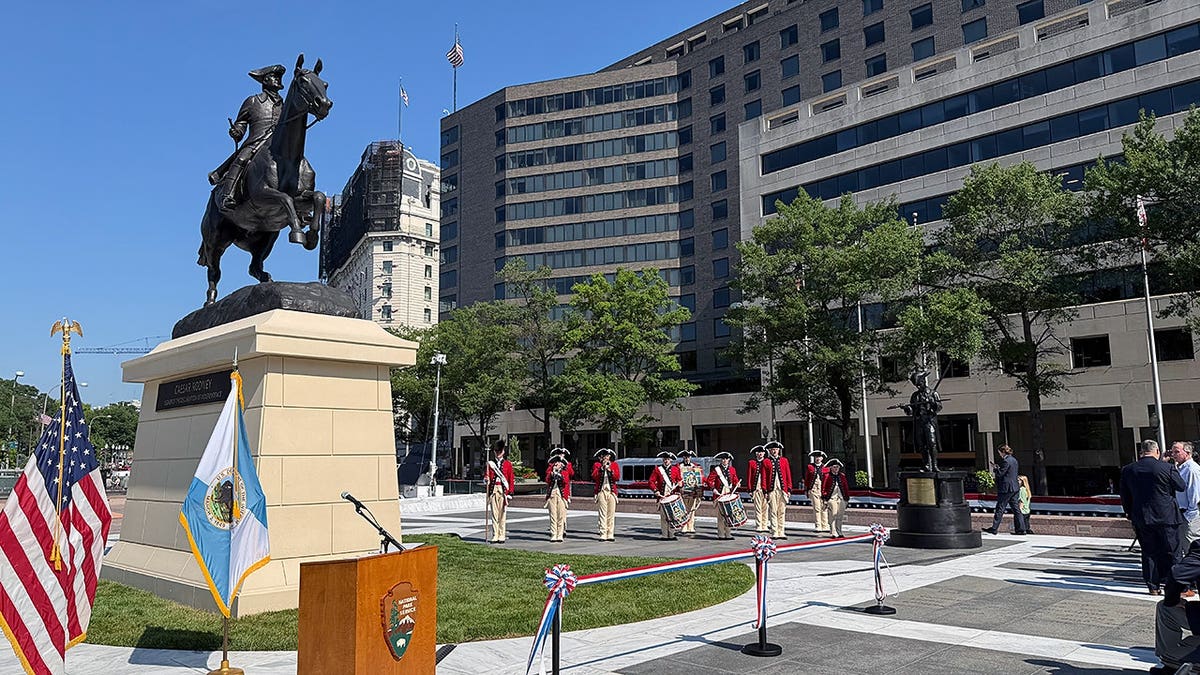
The restored Caesar Rodney equestrian statue stands at Freedom Plaza during the opening of the Spirit of ’76 exhibition in Washington, D.C. (Dan Fleuette)
Rather than beginning with George Washington or Thomas Jefferson, however, Taylor chose to introduce visitors to Rodney.
The Delaware statesman, one of the signers of the Declaration of Independence, is remembered for his legendary overnight ride from Dover to Philadelphia in July 1776. Suffering from severe illness, Rodney rode roughly 80 miles through a storm to cast the vote that broke Delaware’s deadlock in favor of independence.
«Of all the signers of the Declaration of Independence, Caesar Rodney is one of the most exciting,» Taylor said. «When Delaware’s delegation was deadlocked, he rode through the night to cast the vote that helped secure American independence.»
THE REVOLUTIONARY LANDMARKS WHERE WASHINGTON, ADAMS AND JEFFERSON CHANGED AMERICA
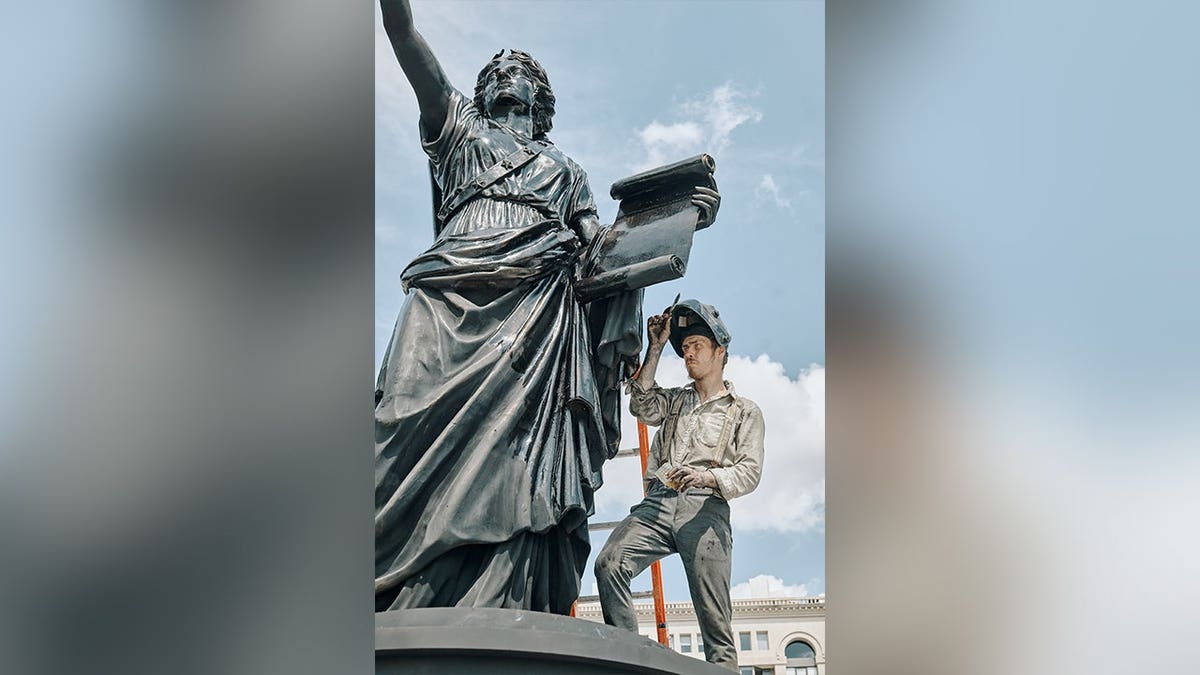
A welder from Atelier Missor places final touches on the «Spirit of Liberty» statue before the installation was made public earlier this month. (Dan Fleuette)
For decades, the bronze statue stood in Wilmington’s Rodney Square before being removed in 2020. It now occupies one of the most prominent locations in the nation’s capital, just blocks from both the White House and the Capitol.
From Rodney’s ride, Taylor naturally guides visitors into the next chapter of the American story.
Arranged around the plaza are bronze sculptures representing 12 Revolutionary War soldiers. Rather than depicting famous generals, the statues celebrate ordinary Americans whose individual stories reflect the sacrifices of the Revolutionary generation.
«These are ordinary citizens who did extraordinary things,» Taylor said. «Every one of these statues tells the story of someone who answered the call during the Revolution.»
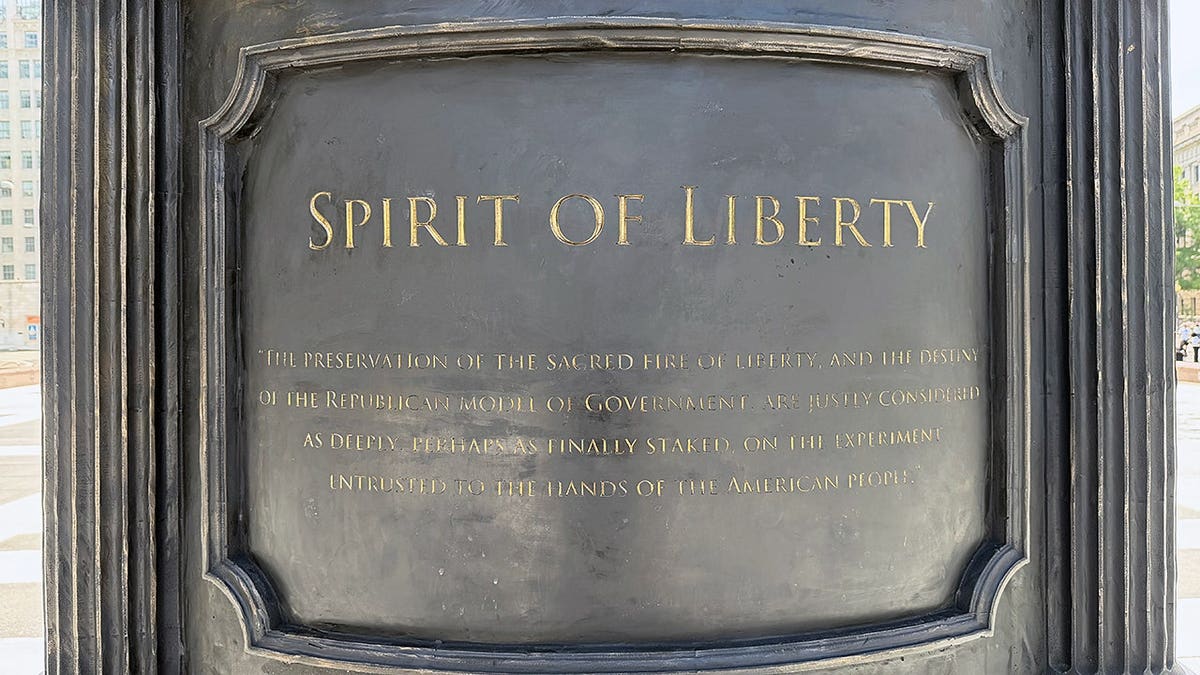
An inscription featuring a quote from George Washington appears on the base of the Spirit of Liberty statue at Freedom Plaza in Washington, D.C., during America’s 250th anniversary celebration. (Dan Fleuette)
Among them is Samuel Whittemore, who fought British troops at age 78. According to Taylor, Whittemore was bayoneted multiple times, shot in the head and left for dead before surviving and living into his 90s.
Another figure, Simon Knowles, enlisted at just 15 years old and served alongside George Washington throughout much of the Revolutionary War before returning home to live as a farmer.
Taylor said those stories represent the exhibition’s central message.
«Unlike monuments to George Washington or Thomas Jefferson, these statues honor ordinary Americans who did extraordinary things,» he said.
Nearby, another installation tells one of the Revolution’s lesser-known tragedies.
Designed as visitors physically walk through its narrow bronze panels, the Prison Ship Martyrs memorial recreates the outline of a British prison ship. According to the National Park Service, nearly 12,000 Americans died aboard prison ships during the Revolutionary War; even more than were killed in combat during the conflict.
Taylor said the memorial is meant to immerse visitors in that experience.
«As you walk inside, you hear the water from the fountain,» he explained during the tour. «It helps place you inside the story.»
The fountain itself has also become part of the experience. Taylor noted it was recently restored to operation after years of sitting idle, providing the soundscape surrounding the memorial while complementing the plaza’s redesign.
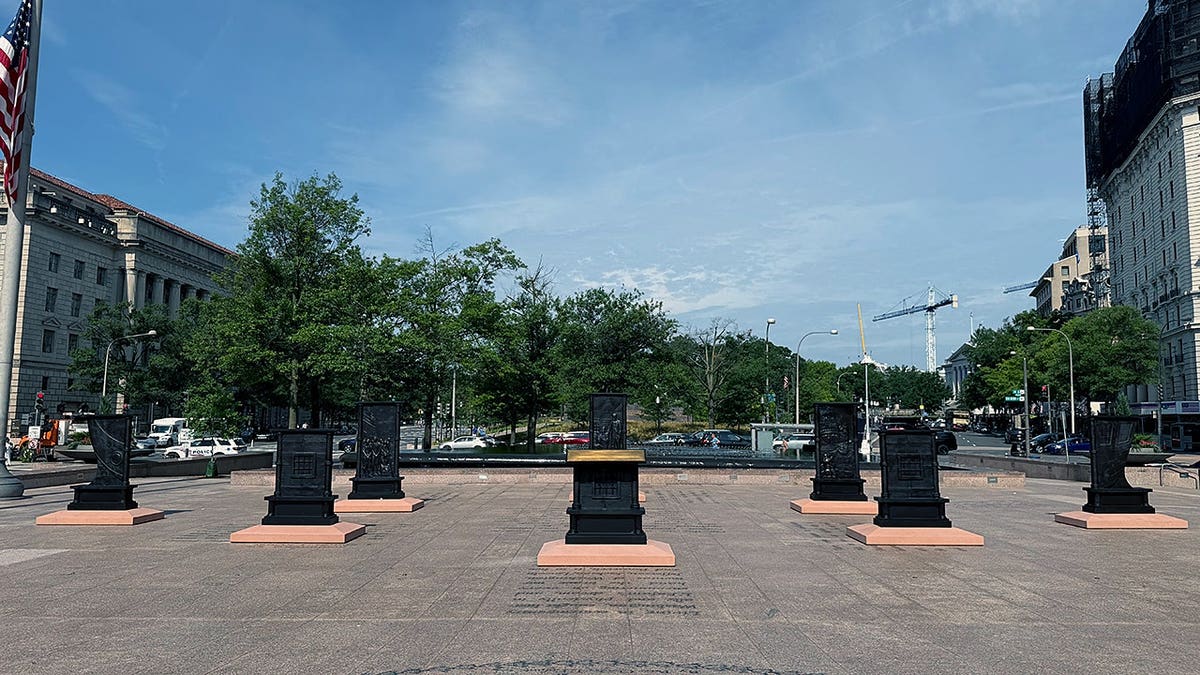
The Prison Ship Martyrs memorial at Freedom Plaza honors Americans who died aboard British prison ships during the Revolutionary War. (Dan Fleuette)
Towering above the entire exhibition stands the Spirit of Liberty, a new bronze figure inspired by iconic American monuments while looking toward the country’s next 250 years.
Standing 23 feet tall, the statue holds an exact bronze replica of the Declaration of Independence in one hand while raising a sword skyward with the other. Around its base are reliefs depicting three defining moments of the Revolution: the signing of the Declaration of Independence, George Washington crossing the Delaware River and the British surrender at Yorktown.
«The Spirit of Liberty represents the sacrifices that gave birth to this nation,» Taylor said.
During Fox News Digital’s visit, visitors gathered around the plaza to photograph the statues against the Washington skyline. Low-angle views of the bronze figures framed them against bright summer skies, while Rodney’s horse appeared frozen mid-stride as though continuing the historic ride that helped shape the nation’s founding.
For Taylor, whose career has largely been spent both behind the camera and behind the scenes designing historical works, the exhibition is about more than commemorating famous names.
Instead, he hopes visitors leave thinking about people they had never encountered before arriving at Freedom Plaza.
CLICK HERE TO DOWNLOAD THE FOX NEWS APP
«When visitors leave here,» Taylor said, «I hope they realize they can do extraordinary things themselves. America was built by ordinary citizens who answered extraordinary moments.»
The Spirit of ’76 exhibition is free to the public and is scheduled to remain on display throughout the nation’s 250th anniversary celebration.
america 250, american stories, washington dc, historic sites, politics
INTERNACIONAL
Italia: insólita guerra de guerrillas por las obras de un tren de alta velocidad en Turín


NEWYou can now listen to Fox News articles!
The race to become America’s next economic heavyweight may already have a frontrunner.
The latest Internal Revenue Service (IRS) migration data show billions of dollars in taxpayer wealth flowing into Texas, while Census figures show the state’s largest metropolitan areas continue to outpace much of the country in population growth, strengthening a decades-long shift in America’s economic center of gravity.
What’s more, Texas isn’t relying on a single boomtown. Dallas-Fort Worth added more residents than any metropolitan area in the country over the past year, while Houston, Austin and San Antonio also ranked among the nation’s fastest-growing metros.
That unusual breadth gives Texas multiple engines of economic growth, providing businesses with larger labor pools, diversified industries and a broader customer base than states anchored by a single dominant city.
Critics have argued that Texas’ economic success is mostly a numbers game. But the latest federal data suggest there’s more to it. (Mike Lawrie/WireImage/GettyImages)
BILLIONS IN TAXPAYER INCOME ARE LEAVING TWO ICONIC STATES — AS A NEW ECONOMIC MAP EMERGES
The population boom has been accompanied by an influx of wealth. IRS migration data analyzed by the Tax Foundation show the Lone Star State gained more than $5 billion in adjusted gross income from interstate movers, while California and New York recorded multibillion-dollar losses.
«Capital follows where there is confidence,» Texas Association of Business Chief Policy Officer Gabriela von zur Muehlen previously told Fox News Digital. «And right now there is a tremendous amount of confidence in Texas.»
Von zur Muehlen said Texas’ tax structure and predictable regulatory environment continue to attract businesses and investment from other states, helping reinforce the state’s economic momentum.
While Florida attracted the nation’s largest influx of taxpayer wealth and South Carolina posted the strongest inbound migration rate, Texas stood out by combining billions in new taxable income with rapid growth across Dallas-Fort Worth, Houston, Austin and San Antonio.
Economists say that combination matters because higher-income households bring spending, investment, entrepreneurship and tax revenue that can accelerate job creation, fuel commercial development and attract even more businesses. Over time, those forces can transform fast-growing metros into some of the nation’s most influential economic hubs.
ONE SOUTHERN CITY YOU’VE NEVER HEARD OF IS GROWING FASTER THAN ANYWHERE ELSE IN AMERICA
Unlike simple population counts, adjusted gross income offers a glimpse into the economic resources newcomers bring with them. Higher-income households can contribute disproportionately to consumer spending, investment and local tax collections, making income migration an important measure of a region’s long-term economic strength.
The migration data are only part of the story.
Earlier federal estimates showed Texas wasn’t just adding residents — it was becoming wealthier on a per-person basis. Despite adding roughly 419,000 residents in 2025, more than any other state, Texas’ economic output climbed to about $2.9 trillion, while per-capita GDP continued to rise, suggesting the state’s economy was becoming more productive rather than simply larger.
THE RED STATES RACING AHEAD IN AMERICA’S POWERFUL WEALTH BOOM — AND THE STATES FALLING BEHIND
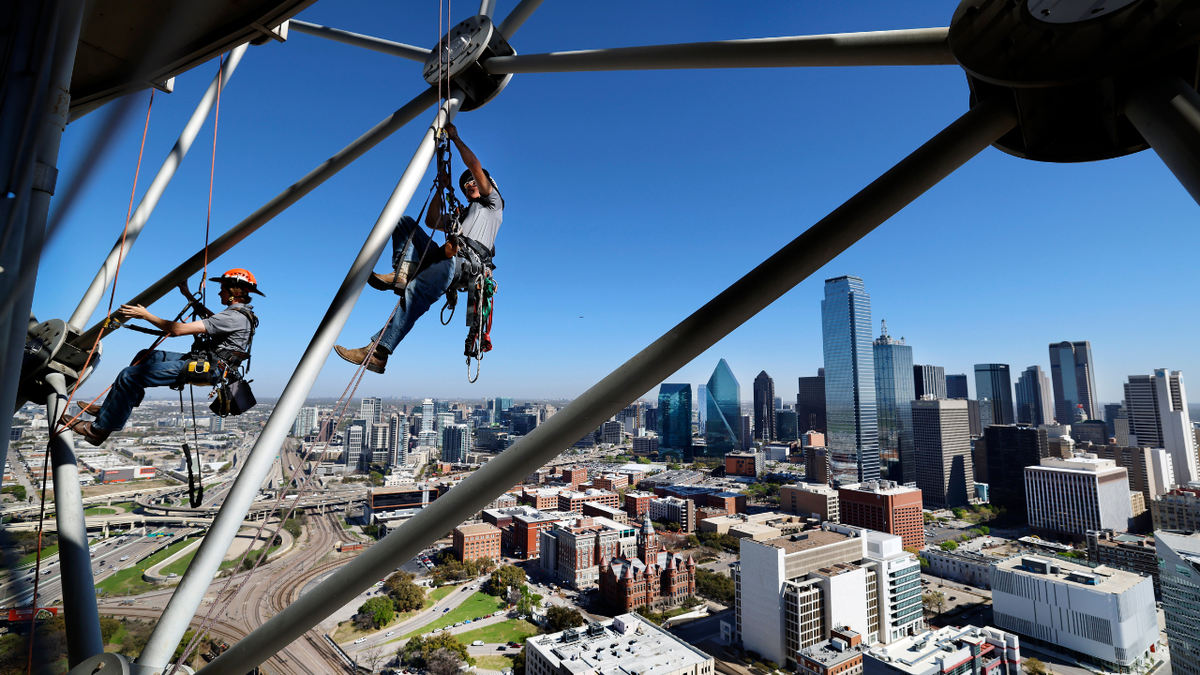
As businesses leave high-cost states, Texas has become the undisputed top destination. (Tom Fox/The Dallas Morning News/Getty Images)
Business leaders say those trends are creating a self-reinforcing cycle. As more workers and higher-income households relocate to Texas, companies gain access to a larger labor pool and customer base, encouraging additional hiring, investment and expansion. That growth, in turn, creates more jobs and opportunities that can attract even more residents.
The migration has coincided with years of corporate relocations and business investment across the state, particularly in technology, finance, manufacturing and energy. The influx has also fueled new housing developments, logistics hubs, manufacturing projects and expanding commercial corridors across many of Texas’ fastest-growing metropolitan areas.
Supporters of Texas’ economic model argue its lack of a state income tax, relatively affordable cost of living and business-friendly climate continue attracting both employers and workers, reinforcing the state’s long-term growth.
CLICK HERE TO DOWNLOAD THE FOX NEWS APP
California and New York remain among the nation’s largest and most influential economies.
But the latest Census, IRS and federal economic data suggest Texas continues gaining ground by attracting people, taxpayer wealth and economic output simultaneously, an uncommon combination that could reshape where businesses invest, jobs are created, and economic influence grows over the coming decade.
texas, economy, growth, politics, taxes, demographics

Joaquín Furriel reveló el mal momento que pasó con su novia española: «Situación incómoda»

Por qué el campo quedó conforme con el discurso de Javier Milei en Palermo

La reacción de la oposición al conflicto diplomático entre Argentina y Brasil: “Es malo y riesgoso”

Dani Olmo apunta contra Roberto Ayala tras el incidente en la final del Mundial: «Falta a la verdad»

Everyday Revolutionary War heroes take center stage in Trump’s ‘Spirit of ’76’ exhibit

La contundente respuesta de Javier Milei al pedido del campo de eliminar para siempre las retenciones

Jorge Berredo, general retirado de las FFAA, asumió como Secretario de Seguridad en San Isidro

Sin la anestesia mundialista, aflora la crisis del conurbano y Milei necesita reconectar con lo popular

Senado: Bullrich y Sturzenegger cierran filas para tratar de avanzar con la extranjerización de tierras
Marc Stanley destacó el potencial de Vaca Muerta para “estabilizar la economía” y evitó hablar de política interna

 POLITICA3 días ago
Mientras espera la vuelta de Macri, el PRO ya activó contactos con LLA: cómo sería la estrategia electoral en la Provincia
- POLITICA3 días ago
González Charvay: el juez que disputa la causa por la quinta de Pilar y los extraños movimientos para que todo termine en su juzgado
- POLITICA3 días ago
El Gobierno restituyó en Plaza de Mayo las piedras en homenaje a las víctimas del Covid-19