INTERNACIONAL
Crece la tensión en Medio Oriente: Irán atacó las bases de EE.UU. en Jordania, Kuwait y Bahréin

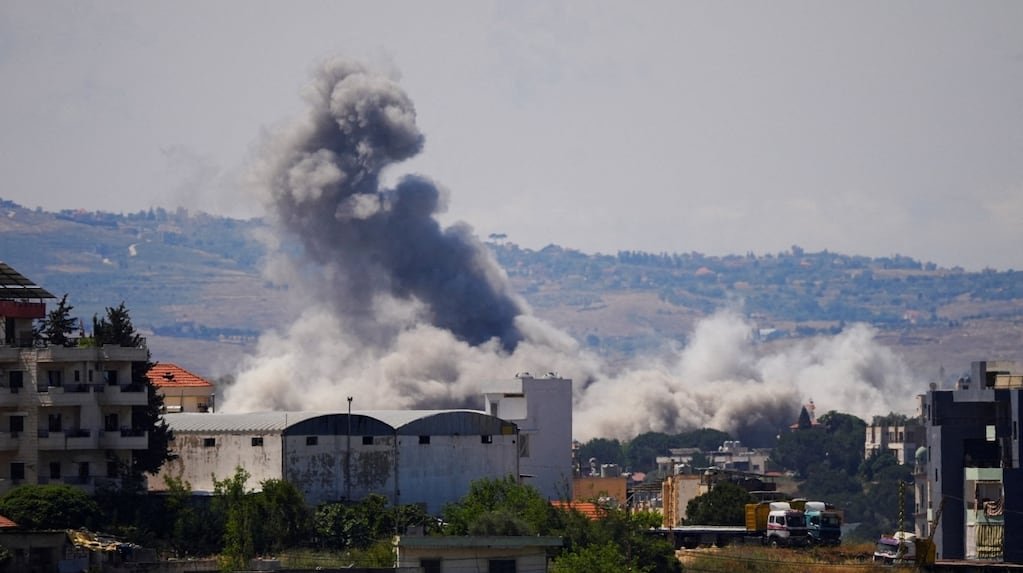
La tensión en Medio Oriente volvió a escalar a niveles críticos. En la madrugada del miércoles, Irán lanzó una serie de misiles y drones contra las bases de Estados Unidos en Bahréin, Kuwait y Jordania, en respuesta directa a los bombardeos estadounidenses sobre territorio iraní.
El Cuerpo de la Guardia Revolucionaria Islámica (CGRI) confirmó los ataques y advirtió que podrían intensificarse si continúan las agresiones.
El conflicto se desató luego de que Washington ordenara ataques en el estrecho de Ormuz, tras el derribo de un helicóptero Apache estadounidense cerca de esa zona estratégica.
El Mando Central del Ejército de Estados Unidos (CENTCOM) sostuvo que la ofensiva fue “una respuesta proporcional a la agresión iraní injustificada”.
Ataques cruzados y advertencias: cómo se desató la escalada
Según la Guardia Revolucionaria iraní, uno de los principales blancos fue una base estadounidense en Baréin.
En un comunicado, los Guardianes afirmaron: “Estados Unidos atacó esta madrugada varios puntos en Jask, Sirik y Qeshm bajo falsos pretextos, y dañó una torre de telecomunicaciones en Sirik y destruyó dos tanques de agua en la ciudad”.
“Desafortunadamente, tras este ataque, 20.000 habitantes de la región se han quedado sin agua potable, y con temperaturas que oscilan entre 45 y 50° C, las condiciones son extremadamente difíciles”, declaró un responsable de la empresa local de agua, según la televisión estatal. Una mujer sostiene una bandera iraní en Teherán. (Foto: Reuters/WANA/Majid Asgaripour).
Además, la Guardia Revolucionaria aseguró que “en respuesta a la cruel acción del enemigo, los combatientes navales de los Guardianes lanzaron un ataque con drones contra la 5ª Flota de Baréin a las 02:30 (23:00 GMT del martes)”. El mensaje fue claro: si las agresiones continúan, las respuestas serán “más contundentes”.
El CGRI también anunció un ataque contra una base estadounidense en Jordania. Según medios estatales iraníes, las fuerzas atacaron y destruyeron “cuatro objetivos importantes, entre ellos grupos de cazas F35 en una base aérea y el centro de mando militar estadounidense” de Azraq.
En Kuwait, las Fuerzas Armadas informaron que sus sistemas de defensa aérea interceptaron “objetivos aéreos hostiles” en medio del intercambio de ataques.
“El Estado Mayor del Ejército anuncia que los sistemas de defensa aérea kuwaitíes están enfrentando actualmente objetivos aéreos hostiles de acuerdo con los procedimientos operativos establecidos”, comunicó el Ejército en X, sin precisar el origen de las amenazas.
Trump ordenó los bombardeos y crece la amenaza de una guerra abierta
La escalada se produjo después de que el presidente estadounidense, Donald Trump, responsabilizara a Teherán por la destrucción del helicóptero militar y ordenara bombardeos contra objetivos iraníes.
Trump había anunciado en redes sociales que Irán derribó la aeronave durante un patrullaje sobre el estrecho de Ormuz y advirtió: “Estados Unidos debe, por necesidad, responder a este ataque”. Según el mandatario, ambos tripulantes del helicóptero resultaron ilesos.
La respuesta iraní no tardó en llegar. El ministro de Exteriores, Abbas Araqchi, lanzó una advertencia directa a Washington: “Abandonen nuestra región, si desean estar a salvo”.
Además, remarcó que las fuerzas armadas iraníes “no dejarán sin respuesta ningún ataque ni amenaza” y recordó que “la historia del golfo Pérsico cuenta con numerosos capítulos sobre el terrible destino que han corrido los intrusos extranjeros”. Un helicóptero MH-60R Sea Hawk se acerca al USS Delbert D. Black (DDG 119) después de patrullar el mar Arábigo en apoyo al bloqueo de Estados Unidos contra Irán (Foto: EFE)
Araqchi también apuntó contra la estrategia estadounidense: “A pesar de sus derrotas en el campo de batalla, Estados Unidos decidió poner a prueba nuestra determinación”.
La cancillería iraní afirmó además que los ataques dañaron los esfuerzos diplomáticos internacionales para negociar una salida al conflicto.
“Lamentablemente, Estados Unidos está dañando este proceso diplomático con los mensajes contradictorios que está enviando, con sus reiterados giros de posición y de demandas y, lo peor de todo, con sus repetidas violaciones del alto el fuego” en vigor desde el 8 de abril, dijo en un video publicado por medios locales el portavoz del ministerio de Exteriores, Esmail Baqai.
“Cualquier proceso diplomático se ve dañado por el uso de la fuerza y el recurso a acciones ilegales sobre el terreno”, enfatizó
Un conflicto que sacude la economía mundial y amenaza la tregua regional
La nueva escalada de violencia puso en jaque una tregua de dos meses que ya venía debilitada. El día anterior, Irán e Israel intercambiaron fuego por primera vez desde el frágil alto el fuego de abril. La televisión estatal iraní informó que los ataques israelíes del lunes mataron al menos a dos integrantes de las unidades de defensa aérea iraníes.
Desde que Estados Unidos e Israel iniciaron operaciones contra Irán el 28 de febrero, el conflicto impactó de lleno en la economía global: subieron los precios de la energía y se encarecieron productos básicos, incluidos los alimentos.
Leé también: Crece la tensión en Medio Oriente: luego de que Irán derribara un helicóptero militar, EE.UU. respondió con un ataque
Las negociaciones para transformar el alto el fuego en un acuerdo permanente no avanzaron, en parte porque Israel intensificó su campaña militar en el Líbano contra Hezbollah, la milicia respaldada por Teherán.
La región se encuentra en máxima alerta y el mundo sigue de cerca cada movimiento, ante el riesgo de que la escalada derive en un enfrentamiento aún mayor.
Irán, estado unidos, Medio Oriente










NEWYou can now listen to Fox News articles!
A Sudanese asylum seeker accused of blinding a Belfast man in one eye during a stabbing attack appeared in court Wednesday as anti-immigrant unrest spread across Northern Ireland.
Hadi Alodid, 30, was ordered to be held in jail after appearing by video in Belfast Magistrates’ Court, where prosecutors accused him of blinding Stephen Ogilvie in his left eye during Monday’s attack.
Alodid was charged with attempted murder, threatening to kill a radiographer and possessing a knife. He declined legal representation through an Arabic interpreter and did not enter a plea.
The attack, which occurred shortly after 10:30 p.m. Monday in north Belfast and was captured in graphic video footage that quickly spread online, sparked outrage and fueled demonstrations that turned violent overnight. Police said Ogilvie, a man in his 40s, suffered serious injuries to his face, neck, back and eyes, and officers recovered what they believe was a kitchen knife from the scene.
POLICE USE WATER CANNON IN RESPONSE TO ANTI-IMMIGRANT VIOLENCE IN NORTHERN IRELAND TOWN
Burned out cars and boarded up houses on McMaster Street in east Belfast after violence erupted on Tuesday night on the streets following a stabbing attack in the Kinnaird Avenue residential area close to the busy Antrim Road in the city, leaving the victim with serious eye, face and back wounds. Picture date: Wednesday June 10, 2026. (Liam McBurney/PA Images via Getty Images)
Video circulating online appeared to show members of the public confronting the attacker, including one person wielding a hurling stick. PSNI Assistant Chief Constable Ryan Henderson praised the bystanders as «heroic,» saying their intervention helped save the victim’s life.
Police said Alodid entered Northern Ireland from the Republic of Ireland in 2023, applied for asylum and was granted a five-year permit to remain. Authorities initially identified him as Somali before later correcting his nationality to Sudanese.
PSNI Assistant Chief Constable Ryan Henderson said investigators had «no information to suggest that this was a terrorist-related incident» and were not seeking additional suspects.
WAVE OF ALLEGED MIGRANT MURDERS IGNITES FURY ACROSS US AS OFFICIALS WARN OF MORE CARNAGE, CRACKDOWN NEEDED
Masked men set fire to several homes they believed housed immigrants following the incident. They also burned trash bins, torched a Belfast bus and threw objects at police officers. Firefighters rescued multiple people from burning homes.
Police said they had declared a critical incident and increased their presence across Northern Ireland amid concerns about further unrest.

Police work at the scene of a stabbing on Kinnaird Avenue in north Belfast, Northern Ireland, on June 9, 2026. (Paul Faith / AFP via Getty Images)
Anselme Shima, a Belfast resident originally from the Democratic Republic of the Congo, said he witnessed the aftermath of the unrest near his home.
DUBLIN PROTESTERS CLASH WITH POLICE, BURN VEHICLE AFTER MIGRANT ACCUSED OF SEXUALLY ASSAULTING IRISH GIRL
«I’ve lived on my street for almost 10 years, I have a good relationship with my neighbors, but last night was a horrific one,» he told Reuters. «We don’t know what to do. I’m scared. Seeing this, I’m wondering if I’m next.»
First Minister Michelle O’Neill of Sinn Fein described the unrest as «thuggery.»
«Groups of masked men burning families out of their homes is nothing less than disgusting cowardice,» she said.
AUSTRIA STABBING ATTACK SUSPECT IS SYRIAN MIGRANT WHO PLEDGED ALLEGIANCE TO ISLAMIC STATE, OFFICIALS SAY
Deputy First Minister Emma Little-Pengelly of the Democratic Unionist Party said that «taking frustration at the evil actions of a person out on those who had no part in it is utterly wrong.»
British Prime Minister Keir Starmer called the stabbing attack «sickening» and condemned violence targeting people because of their background.
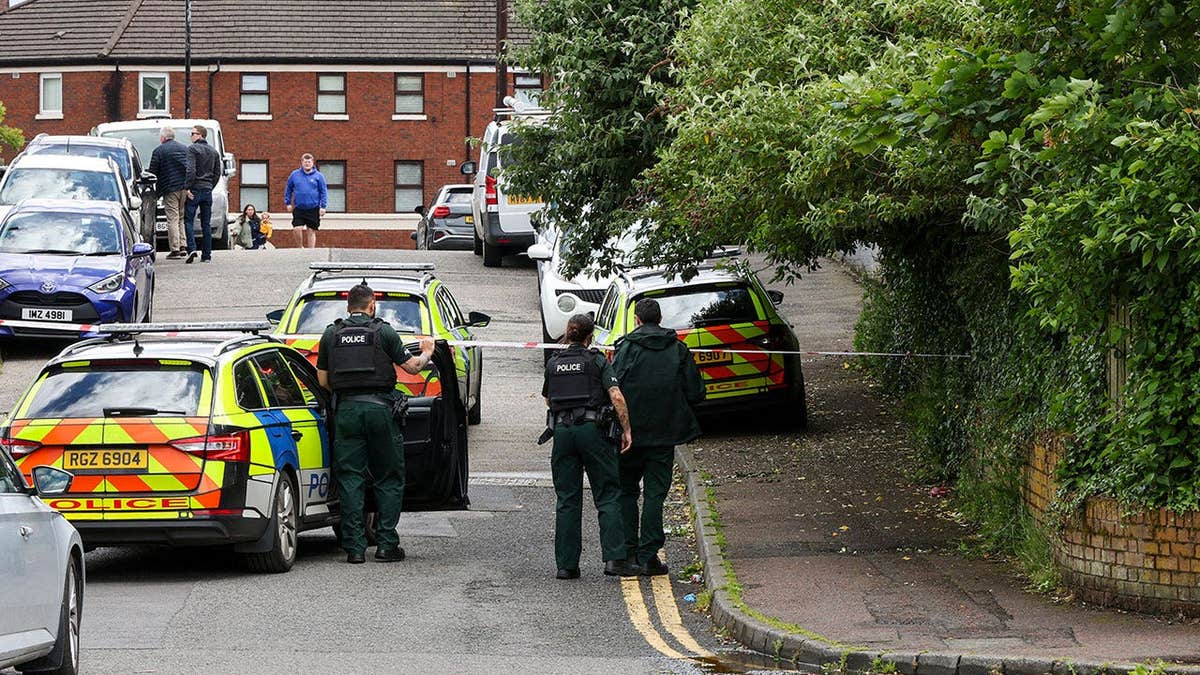
Police attend the scene following a stabbing attack in North Belfast on June 09, 2026 in Belfast, Northern Ireland. (Charles McQuillan/Getty Images)
«The scenes in Belfast last night were shocking and completely unacceptable,» Starmer wrote on X. «There is no justification for the violence and disorder that we saw threatening our communities, nor for those who encouraged it, online or elsewhere. It is clear that people were targeted last night because of their background and I will not tolerate it.»
AMERICAN TOURIST STABBED IN FACE BY SYRIAN AFTER DEFENDING WOMEN ON GERMAN TRAM: REPORT
The unrest was amplified online by anti-immigration activists, including Stephen Yaxley-Lennon, better known as Tommy Robinson.
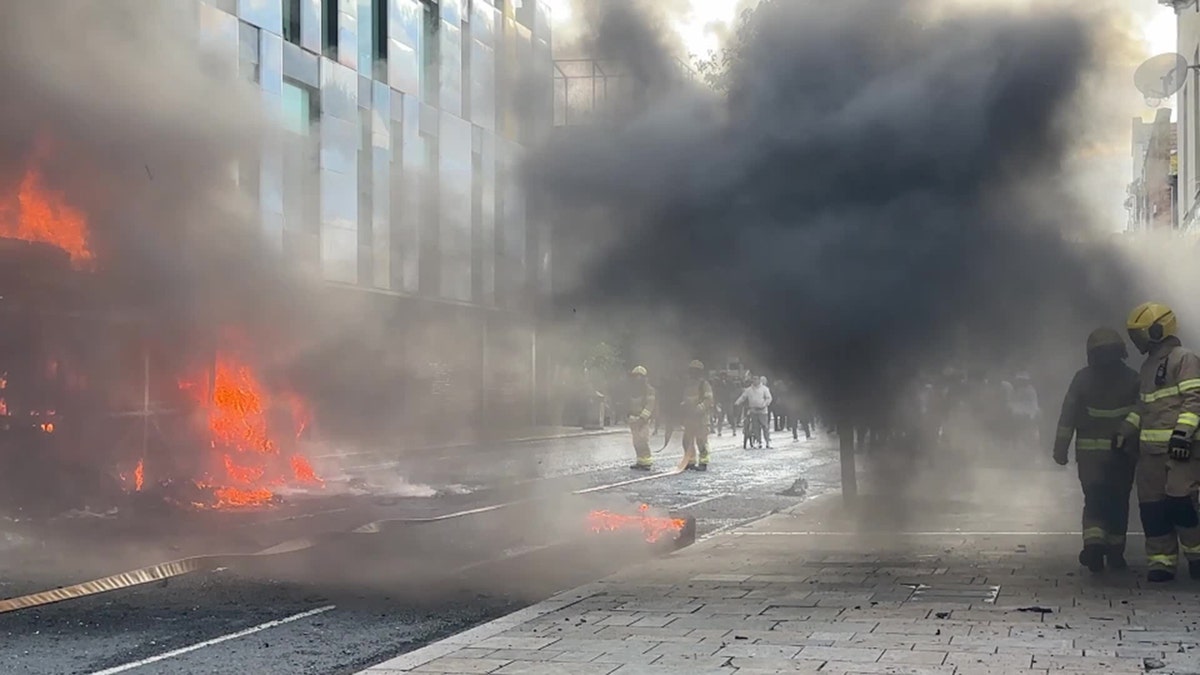
A Glider bus burns on Newtownards Road in east Belfast during an anti-immigration protest following a stabbing attack in the city. (Liam McBurney/PA Images via Getty Images)
Some politicians said the stabbing should prompt a review of the open border between Northern Ireland and the Republic of Ireland, a highly sensitive issue because free movement across the border is a central pillar of the peace process that largely ended decades of violence known as «The Troubles.» The conflict involving Irish republican and British loyalist militants, as well as U.K. security forces, left nearly 3,600 people dead before the 1998 peace accord.
Much of Tuesday’s unrest took place in working-class areas where former paramilitary groups continue to wield influence.
HENRY NOWAK’S KILLING EXPOSES BRITAIN’S DANGEROUS TWO-TIER JUSTICE SYSTEM
The case comes amid ongoing debate in Britain over another fatal stabbing that drew national attention in Southampton, England, last year.
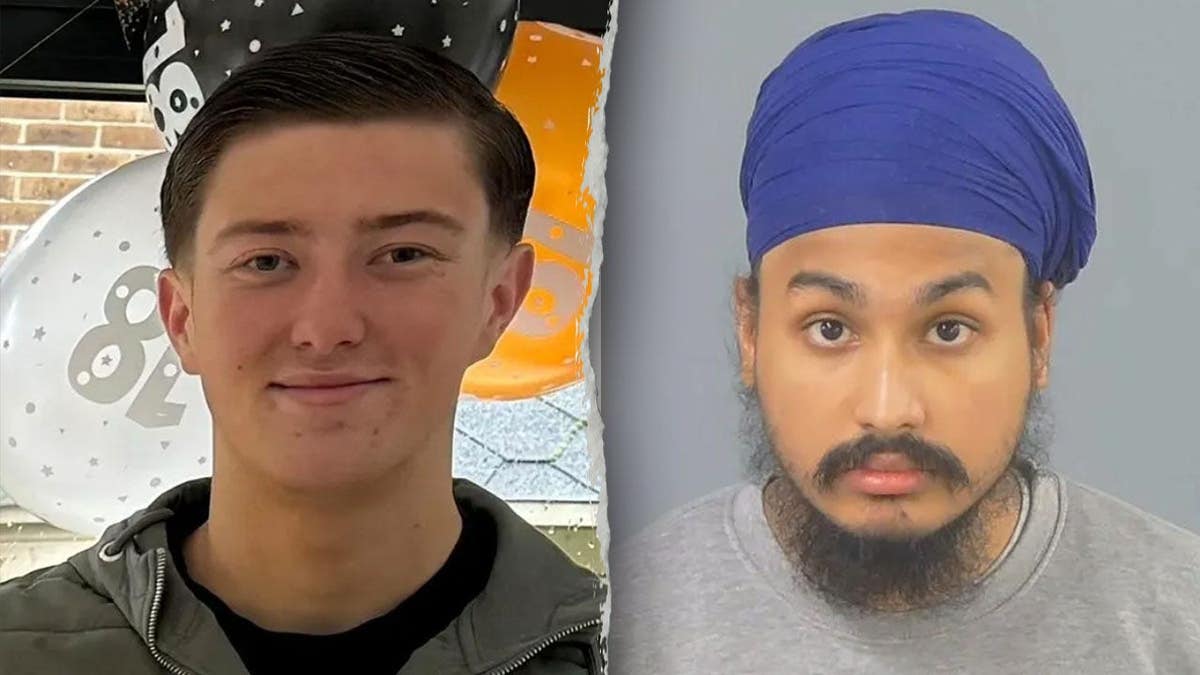
Freshman student Henry Nowak was stabbed many times by Vikram Digwa who used an eight inch ceremonial knife in December 2025. (Hampshire Police; Press Association via AP Images)
Henry Nowak, who was White, was killed by Vickrum Digwa, a Sikh man who falsely claimed to police that he had been the victim of a racist assault by Nowak. Officers initially treated the wounded Nowak as a suspect before recognizing his injuries and attempting to save his life.
CLICK HERE TO DOWNLOAD THE FOX NEWS APP
Digwa was convicted of murder and sentenced last week to life in prison with a minimum term of 21 years. The case has fueled debate about policing and race, and a protest following the killing turned violent, with some participants attacking officers with chairs and rocks. Several people were later charged with violent disorder.
Fox News Digital’s Efrat Lachter and The Associated Press contributed to this report.
in court, immigrant rights, vandalism, homicide, refugees
NEWYou can now listen to Fox News articles!
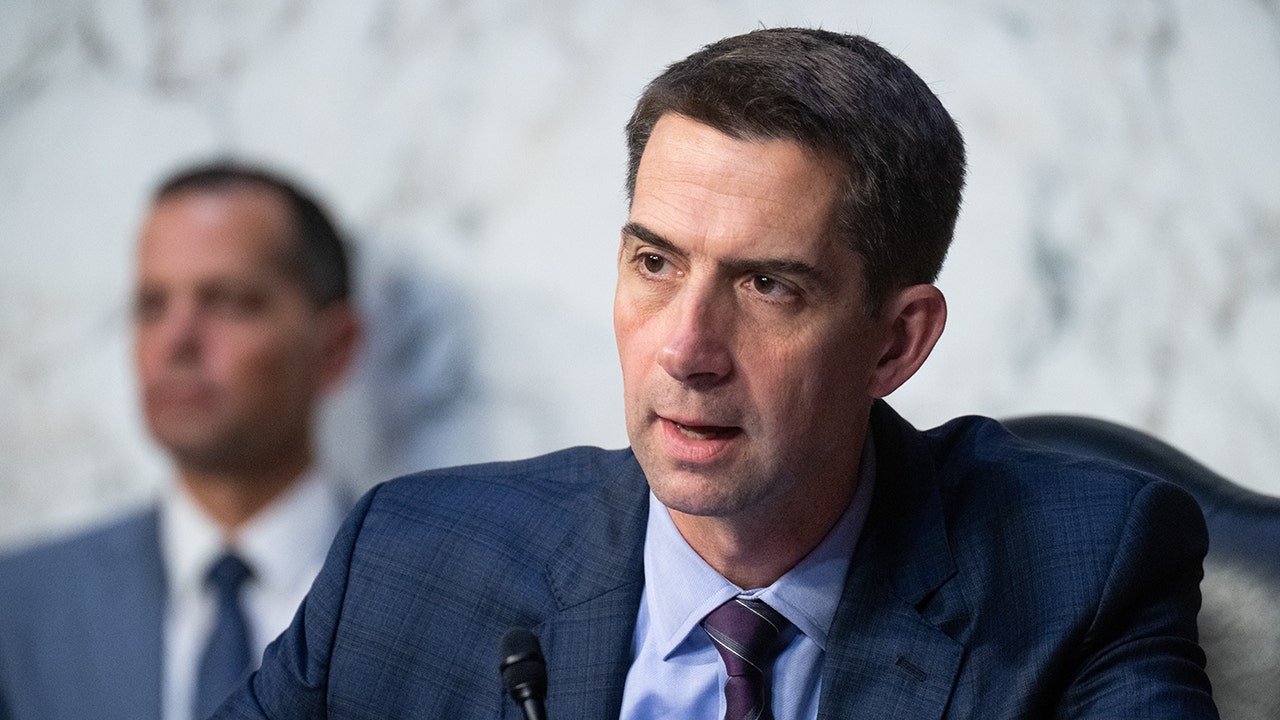
Sen. Tom Cotton urged the Justice Department to investigate a covert campaign linked to China designed to «kneecap» America’s rapidly expanding artificial intelligence infrastructure in a letter obtained exclusively by Fox News Digital.
In the letter to Acting Attorney General Todd Blanche, the Arkansas Republican calls for federal investigators to examine whether foreign actors are attempting to shape U.S. public opinion and policy against data centers and AI development as Washington and Beijing compete for dominance in artificial intelligence.
As a network of organizations supported by far-left activist Jodie Evans (second from left) and her husband Neville Roy Singham (right) protest America’s AI development, data centers and other technology advancements, Sen. Tom Cotton (left) sends a letter to Acting Attorney General Todd Blanche, urging him to investigate the groups for possible violations of the Foreign Agent Registration Act (FARA). (Bill Clark/CQ-Roll Call, Inc via Getty Images, Chip Somodevilla/Getty Images, Dave Kotinsky/Getty Images)
«Recent reports show that Communist China is attempting to influence our policy and public opinion on data centers. The reason is obvious: they want to kneecap our processing power to win the AI race,» Cotton told Fox News Digital.
«Americans should decide their own future free of communist propaganda. I’m encouraging the Department of Justice to investigate,» Cotton said.
REPORT: CHINESE PROPAGANDA, SINGHAM NETWORK, FOREIGN DARK MONEY LINKED TO CAMPAIGNS AGAINST DATA CENTERS
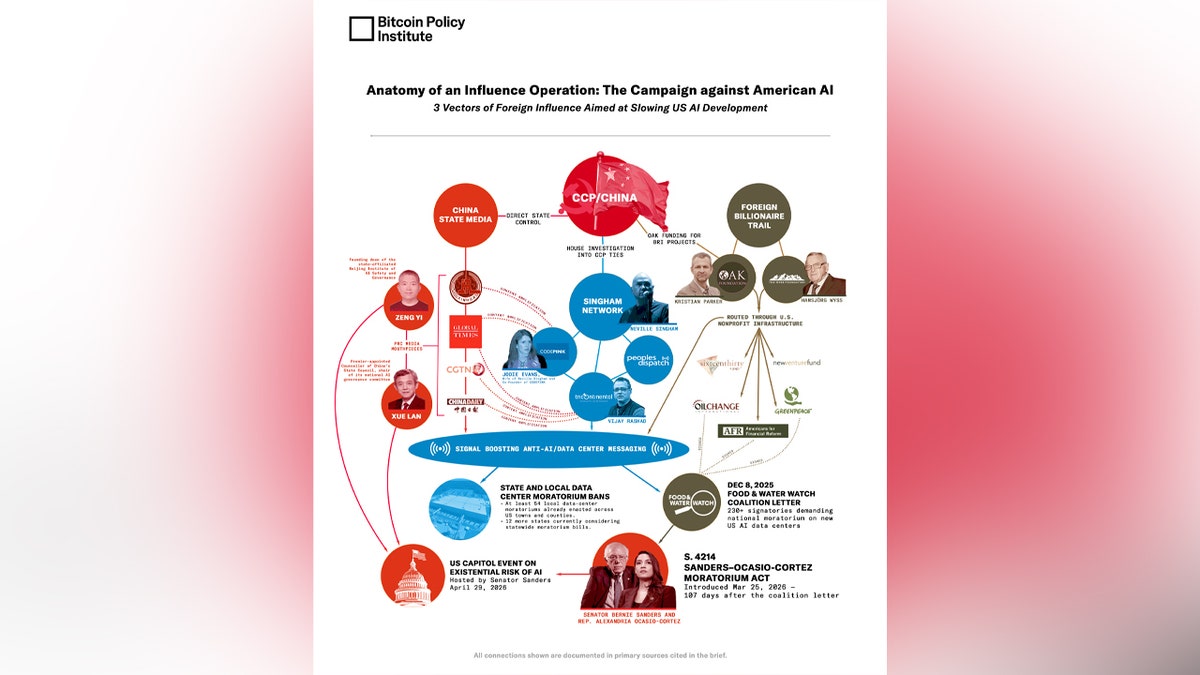
The Bitcoin Policy Institute released a report alleging that nonprofits aligned with Chinese interests are driving a campaign against U.S. data centers. (Bitcoin Policy Institute)
Cotton’s request follows the release of a report last week from the Bitcoin Policy Institute, a think tank based in Washington, D.C., alleging that Chinese state media, foreign-funded advocacy groups and a network of organizations funded by American tech tycoon Neville Roy Singham have spent years building opposition to U.S. data center construction and AI infrastructure projects.
Singham, an avowed Marxist and the founder of a Chicago-based company, Thoughtworks, that he sold in 2017, now lives in Shanghai, and has become a growing focus of congressional scrutiny and federal investigations. In March, as members of the Singham network were journeying to Havana to support the Communist Party of Cuba, Earlier this year, Fox News Digital published a five-part series documenting how Singham has funneled $278 million into a series of nonprofits, including groups at the heart of the protests against AI, data centers and technology firms in the U.S.
As Fox News Digital has reported, 501(c)(3) nonprofits from the Singham network, including CodePink, the People’s Forum, Tricontinental and BreakThrough News, have participated and led campaigns opposing AI development, semiconductor export controls and large-scale data center projects. Singham, a self-avowed communist, started pumping the money into the groups after his 2017 marriage to Jodie Evans, the co-founder of CodePink.
POWER COUPLE OF CHAOS: HOW A TYCOON AND ACTIVIST BUILT A ‘REVOLUTIONARY BASE’ AT THE HOUSE OF SINGHAM
For years, groups funded by Singham have worked closely with two self-described communist groups in the U.S. — the ANSWER Coalition and the Party for Socialism and Liberation — that have organized foot soldiers to protest major U.S. technology, defense and logistics companies, such as Palantir Technologies, Lockheed-Martin and Google, to try to name-and-shame the firms for doing business with the U.S. government on issues from immigration to global geopolitics where China has major interests, including in Israel, Iran, Venezuela, Cuba, South Korea and even Greenland.
Pro-China protestors have seized on high electrical costs associated with operating a data center. One of the key themes of new protests is the rising electricity bills that consumers have been seeing in recent months. Earlier this year, Cotton introduced a bill, called the «DATA Act of 2026,» that would lift regulatory controls to allow manufacturers, data centers and other energy-intensive industries to build new electricity systems separate from the consumer electrical grid.
More widely, Senate and House lawmakers have launched inquiries into the nonprofits in the Singham network, while questioning whether the groups should be required to register as «foreign agents» under the Foreign Agents Registration Act, called FARA, which demands that entities or individuals working for the interests of foreign interests register with the U.S. Justice Department as foreign lobbyists.
«Alarming reports indicate that a network of foreign actors, led by the Chinese Communist Party (CCP), is attempting to manipulate U.S. policy and public opinion on data centers,» Cotton wrote in the letter.
AGITATORS UNITED BY CHINESE MONEY, HATE FOR AMERICA TARGET DATA CENTERS, EXPERTS WARN
Climate activists, anti-Israel protesters and other activist movements with very different agendas have become strange bedfellows united by a shared disdain for America and funding from China, according to experts who warn the trend is weakening the United States amid a rapidly accelerating AI race. They are seen as part of a «red-green-green alliance,» an ideological overlap between three elements: communist movements, characterized by the color red; Islamist activism, described as green; and environmental protest groups, symbolized as green.
Cotton argued that America’s position in artificial intelligence will have sweeping implications for the country’s economic strength, military capabilities, diplomatic influence and national security. He warned that foreign adversaries shouldn’t be allowed to exploit public concerns over energy use, utility costs and water consumption to slow U.S. technological development.
The Bitcoin Policy Institute report, «Foreign Influence in the Campaign Against American AI,» alleges that three separate streams of influence — Chinese state media, the Singham network and foreign-funded advocacy organizations — have increasingly aligned around efforts to block or delay new AI-related infrastructure in the United States.
LAWMAKERS RAISE ALARM OVER NEVILLE ROY SINGHAM’S $278M NETWORK SPREADING CCP PROPAGANDA IN THE U.S.
After their wedding in early 2017, Singham and Evans have transformed far-left protests in the United States, creating a machine that sounds the alarm for new protests from clear command-and-control centers within the Singham network, churns out pre-printed protest signs, shares common messaging and galvanizes around common themes that support China and condemn «AmeriKKKa,» as an «imperiaist nation,» borrowing on Russian and Chinese propaganda.
According to the report by the Bitcoin Policy Institute, the Singham network «has spent nearly five years producing parallel domestic content opposing U.S. AI infrastructure, AI labs, and AI export controls.»
The report argues that the campaign against American AI infrastructure creates a strategic advantage for Beijing at a time when China is aggressively investing in its own AI capabilities.
«While Beijing’s state media warns American audiences that data centers are environmentally and economically dangerous, the Chinese state subsidizes up to half of the energy costs of its own AI data center operators,» the report states.
KEVIN O’LEARY WARNS CHINA ‘KICKING OUR HEINIES’ IN AI RACE AS REGULATORY ROADBLOCKS STALL US
The issue has become increasingly prominent as policymakers, investors and technology leaders warn that the U.S. risks falling behind China if it fails to rapidly expand the computing infrastructure needed to power next-generation AI systems.
One of the most vocal advocates for expanded AI infrastructure has been billionaire investor Kevin O’Leary, who has argued that data centers, power generation and advanced computing capacity are now strategic assets in the global competition for artificial intelligence leadership.
The broader concern raised by Cotton, O’Leary, the Bitcoin Policy Institute and others is that pro-China campaigns opposing U.S. AI infrastructure are advancing narratives that ultimately benefit Beijing as the U.S. States and China battle for technological and economic supremacy.
BERNIE SANDERS’ PLANS TO SCHMOOZE WITH TOP BEIJING AI EXPERTS IGNITES BACKLASH: ‘HOLY SH–‘
Earlier this year, Sen. Bernie Sanders (I-VT) and Rep. Alexandrio Ocasio-Cortez (D-NY), both leaders in the Democratic Socialists of America, organized an event on the «existential threat of AI.» The event featured speakers closely affiliated with the Chinese Communist Party, including Zeng Yi of the Beijing Institute of AI Safety and Governance and Xue Lan, a counselor to China’s State Council and chairman of China’s national AI governance committee. Sanders, Ocasio-Cortez, Yi and Lan didn’t respond to requests for comment.
Cotton noted in his letter that Lan is affiliated with Tsinghua University, an institution frequently scrutinized by U.S. officials because of its role in China’s military-civil fusion strategy.
As reported, last fall, during a conference of the «Global South Academic Forum,» which Fox News Digital first reported, Singham publicly praised the Chinese Communist Party and Chinese President Xi Jinping’s global campaign for a «new world order.»
CLICK HERE TO DOWNLOAD THE FOX NEWS APP
artificial intelligence, national security, congress, investigations, xi jinping
INTERNACIONAL
Irán respondió a los ataques de Estados Unidos con bombardeos a países de la región y la tregua quedó en jaque
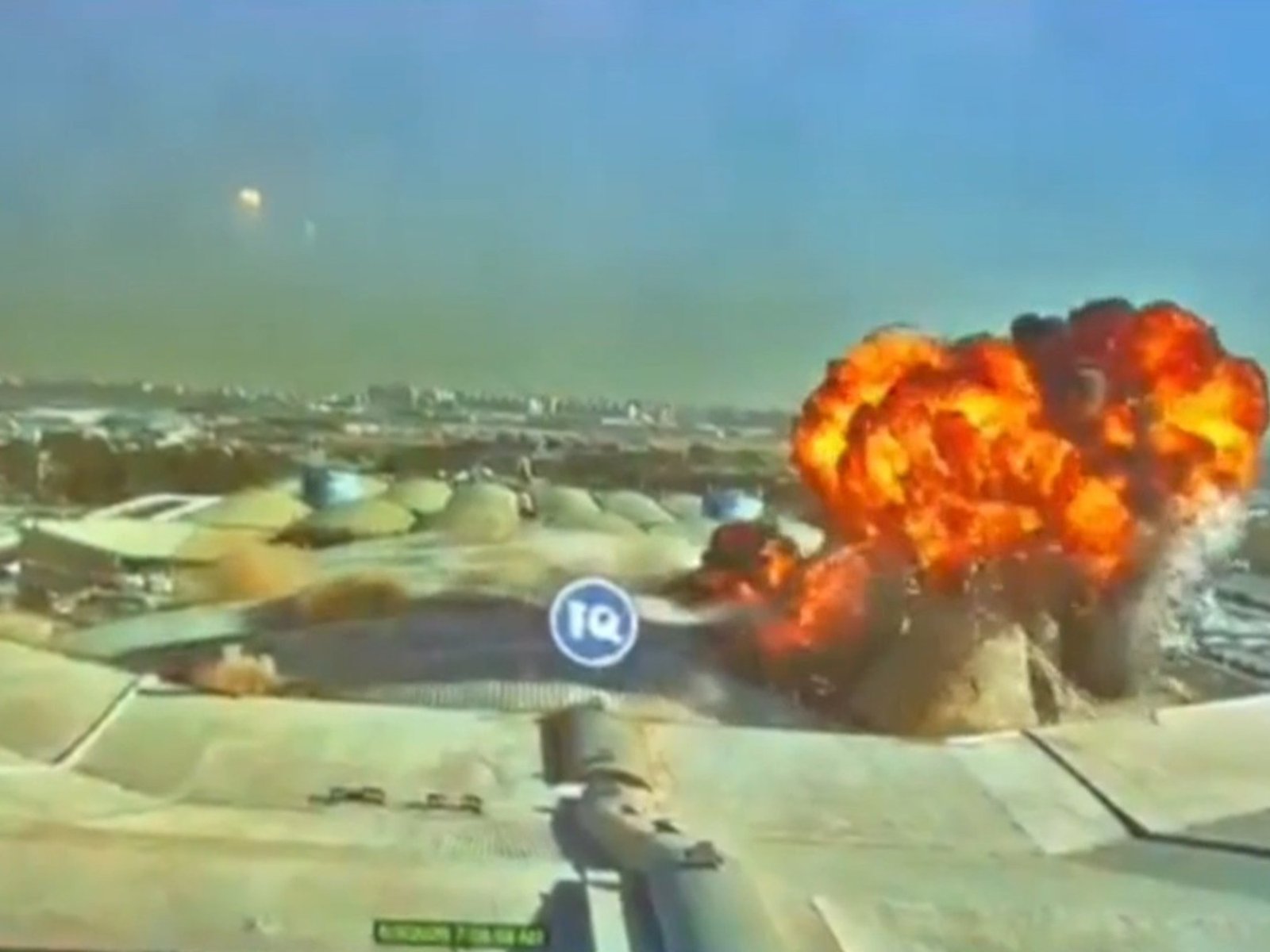
La tregua en la guerra en Medio Oriente quedó en su punto más endeble, luego de un nuevo recrudecimiento en los bombardeos entre Estados Unidos e Irán. A tal punto que Teherán afirmó este miércoles que va a revisar la continuación de las negociaciones con el Gobierno de Trump; y el portavoz del Ministerio de Exteriores iraní, Ismail Bagaei, aseguró que el proceso diplomático necesita un clima de estabilidad.
El martes, las fuerzas norteamericanas atacaron varios puntos del sur iraní como represalia por el supuesto derribo de un helicóptero, y bombardearon sistemas de defensa aérea, estaciones de control terrestre y radares de vigilancia ubicados cerca del estrecho de Ormuz, utilizando municiones de precisión lanzadas desde cazas de la Fuerza Aérea y de la Armada.
Los intercambios de fuego se produjeron un día después de que un helicóptero de ataque AH-64 Apache del Ejército de Estados Unidos se estrellara cerca del estrecho de Ormuz después de chocar con un dron iraní, según un funcionario estadounidense, que habló bajo condición de anonimato para comentar una investigación en curso. No estaba claro si la colisión fue intencional.
“La operación fue una respuesta proporcional a los recientes ataques contra fuerzas de Estados Unidos y buques comerciales internacionales que transitan por aguas regionales”, dijo el Comando Central.
Por su parte, autoridades iraníes afirmaron que en los ataques estadounidenses fueron destruidas varias torres de comunicaciones y dos desalinizadoras en la zona de Sirik, lo que ha dejado sin agua potable a 20.000 personas.
La Guardia Revolucionaria anunció que respondió a esos ataques con bombardeos contra 21 objetivos militares estadounidenses en todo Oriente Medio, un extremo negado por Washington. Entre los objetivos se encontrarían bases estadounidenses en Jordania, Kuwait y Baréin.
Jordania dijo el miércoles que derribó cinco misiles entrantes, que Irán dijo que tenían como objetivo la Base Aérea Muwaffaq Salti. Esa base aérea ha albergado aviones de combate F-35 estadounidenses y otras aeronaves. Baréin y Kuwait dijeron que interceptaron fuego entrante, sin dar más detalles.
Se trata del que es quizás el mayor intercambio de ataques entre Irán y Estados Unidos desde el inicio del alto el fuego el 8 de abril, y se produce en medio de las negociaciones para alcanzar algún tipo de acuerdo para reabrir el estrecho de Ormuz.
Es la segunda ocasión en la semana que los ataques de ida y vuelta pusieron a prueba el alto el fuego después de que Irán e Israel se atacaran mutuamente el lunes, y volvió a plantear la pregunta de cuánta presión puede soportar el acuerdo antes de que se quiebre.
Aunque el presidente de Estados Unidos, Donald Trump, ha insistido en que las negociaciones con Irán para poner fin a la guerra están avanzando, ha alternado repetidamente entre expresar ese optimismo y advertir que estaba listo para volver a una guerra total.
Irán, por su parte, ha demostrado resiliencia pese a haber enfrentado semanas de intensos bombardeos, apostando a que su capacidad de cerrar de manera efectiva el estrecho de Ormuz, un paso crucial para el petróleo y el gas natural del mundo, le da una fuerte carta de negociación.
Ambos países parecen estar buscando una manera de poner fin al conflicto, si pueden lograr venderlo como una victoria en casa. Pero el primer ministro israelí, Benjamin Netanyahu, parece decidido a perseguir objetivos mucho más difíciles: el colapso del gobierno teocrático de Irán, la eliminación de su programa nuclear y la destrucción del grupo político y militar Hezbollah, aliado de Irán, en Líbano.
Los ataques de EE.UU. e Irán sacuden Oriente Medio desde que Trump y Netanyahu comenzaron la guerra con ataques contra Irán el 28 de febrero.
Los mediadores, encabezados predominantemente por Pakistán, llevan semanas tratando de cerrar un acuerdo. Si bien Trump, receloso de los altos precios del combustible y de las próximas elecciones al Congreso en noviembre, parece buscar una victoria rápida, también está haciendo exigencias que serán difíciles de aceptar para Irán.
Mientras tanto, Irán ha seguido insistiendo en que cualquier acuerdo para poner fin a la guerra también debe poner fin a los combates entre su aliado Hezbollah e Israel. En cambio, Israel ha intensificado su campaña militar contra el grupo político y militar.

YPF dejará de fabricar un insumo clave para productos de limpieza y preocupa a una gran empresa de consumo masivo

¿Cuánta plata le entraría a River si Julián Álvarez ejecuta la cláusula de 500 millones?

El Gobierno busca recuperar la iniciativa en Diputados y avanza con el super-RIGI y la ley de lobby

Belfast burns after Sudanese migrant arrested in brutal knife attack

A horas de presentar su declaración jurada, Adorni bajó el perfil y fue relegado del juego político

Cirugías y viajes: la vida de lujo de la estrella de TikTok de Zona Oeste presa por vender droga

Desde Neuquén, Myriam Bregman pidió “organizar la bronca para terminar con Milei y su legado”

Cuantas reservas internacionales quieren acumular Milei y Caputo para evitar el riesgo K en 2027

Victoria Villarruel envió una corona de flores al funeral del Indio Solari y buscó diferenciarse del Gobierno

Reforma laboral: qué cambia para los trabajadores con la revisión de más de 100 convenios colectivos vencidos

 POLITICA2 días ago
Victoria Villarruel envió una corona de flores al funeral del Indio Solari y buscó diferenciarse del Gobierno
- POLITICA2 días ago
Reforma laboral: qué cambia para los trabajadores con la revisión de más de 100 convenios colectivos vencidos
- ECONOMIA2 días ago
El salario mínimo vale menos que en 2001 y debería triplicarse para recuperar su poder de compra original