INTERNACIONAL
Asian nation with 1,500-year-old imperial line insists only men can become emperor in policy revision


NEWYou can now listen to Fox News articles!
Japan’s Parliament voted Friday to enshrine male-only succession for the imperial throne, part of a monarchy that traces its origins back roughly 1,500 years.
Lawmakers did so by revising an Imperial House Law dating back to the 1800s, despite warnings from experts that limiting succession to men in the paternal line will hasten the decline of Japan’s shrinking and aging imperial family, according to the Associated Press.
To address the dwindling number of eligible heirs, the revisions allow distant male relatives to be adopted into the imperial family to father future successors. However, strict rules remain in place limiting the throne to men with royal blood. The changes also allow princesses to retain their royal status after marrying commoners.
The new rules passed by Parliament come as many Japanese had been calling for Princess Aiko, Emperor Naruhito’s 24-year-old daughter, to be allowed to succeed him — now an impossibility.
Japan’s Princess Aiko, left, the daughter of Emperor Naruhito and Empress Masako, arrives to mark the 110th anniversary of the death of the wife of former emperor Meiji at Meiji Shrine in Tokyo, on April 10, 2024. (Kazuhiro Nogi/Pool Photo via AP)
IN ATTEMPT TO CONNECT WITH YOUNG PEOPLE, JAPAN’S ROYAL FAMILY DEBUTS ON INSTAGRAM
«The emperor is a symbolic figure, and I don’t see why women cannot serve in the role,» Junichiro Tsujimaru, a 78-year-old sushi chain founder, told the AP.
Under current law, the 66-year-old emperor’s younger brother is next in line. After that, his 19-year-old nephew, Prince Hisahito, will inherit the throne, and then the emperor’s 90-year-old uncle.
Hisahito is the only boy to be born in four decades, and only five of the 16 adults in the imperial family are men.
Prime Minister Sanae Takaichi and other conservatives say the male bloodline is the source of the emperor’s authority and legitimacy.
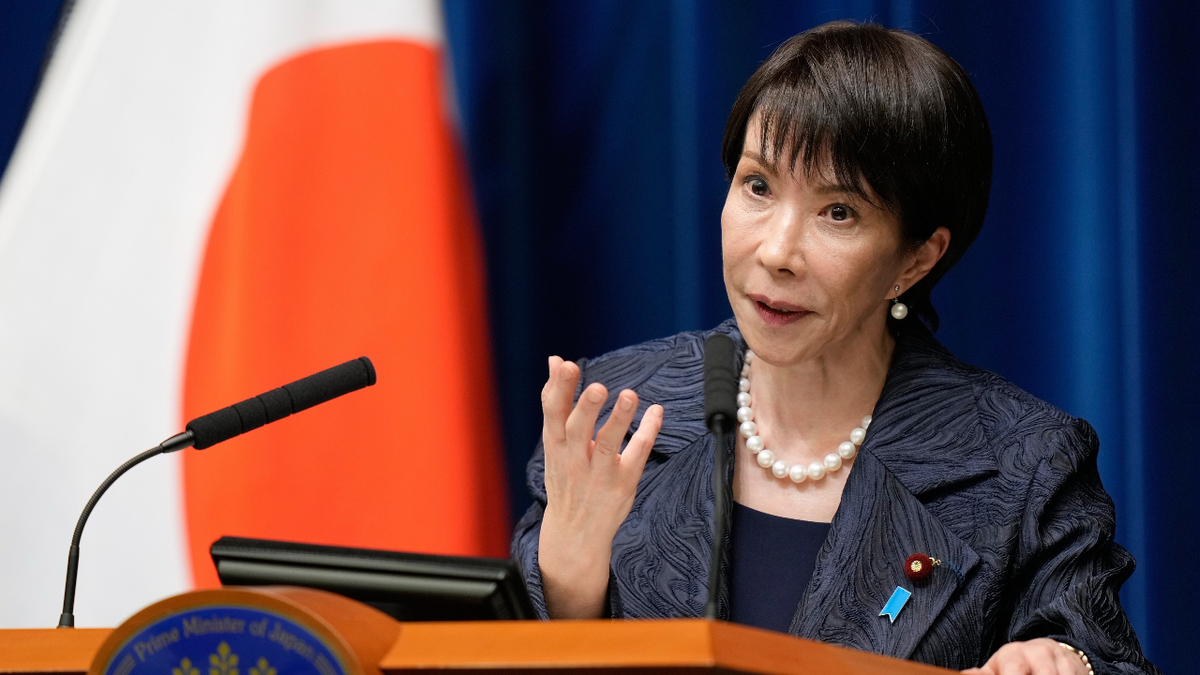
Japan’s Prime Minister Sanae Takaichi speaks during a news conference at the prime minister’s office in Tokyo, Oct. 21, 2025. (Eugene Hoshiko)
SHINZO ABE POSTHUMOUSLY GIFTED HONORS, NOBILITY BY IMPERIAL FAMILY HE DEVOUTLY SUPPORTED
«It’s a declaration to prevent female monarchs … and to defend the male-lineage at all costs,» Hideya Kawanishi, a Nagoya University expert on monarchy, told the AP. «They cannot say it’s male chauvinism, so they call it tradition.»
Chizuko Ueno, a prominent feminist and sociologist, recently suggested it was ironic that Japan’s first female prime minister was the one to ensure male-only succession.
Ueno said the new rules «treat male royals as stallions and put female royals under pressure as ‘childbearing machines’ to produce male offspring.»
Japan has had eight empresses descended from the male line in its centuries-long history as a hereditary monarchy. The last woman to reign was Empress Go-Sakuramachi, who sat on the throne from 1762 until 1771, when she abdicated in favor of her nephew.

Japan’s Prince Hisahito, right, attends his coming-of-age rituals on his 19th birthday at the Imperial Palace in Tokyo, on Sept. 6, 2025. (Japan Pool/Kyodo News via AP)
CLICK HERE TO DOWNLOAD THE FOX NEWS APP
Female eligibility for the throne was first eliminated in 1890 under the original Imperial House Law.
That change was carried over into the modern Imperial House Law, enacted in 1947, the same year Japan’s new constitution stripped the emperor of governing authority after the country’s defeat in World War II.
Like Britain’s royal family, Japan’s imperial family remains an important national symbol.
The Associated Press contributed to this report.
japan, world, politics, british royals













NEWYou can now listen to Fox News articles!
A confidential report prepared for Iran’s presidency is raising a consequential question for Washington and its allies: Do extraordinary levels of public anger and support for systemic change justify reassessing whether the Islamic Republic may be more vulnerable to regime change than previously believed?
The classified document, titled «What Iran Wants,» reportedly found that only 9% of respondents supported maintaining the status quo, with 53% calling for fundamental or structural reforms and more than 19% favoring changing the political system outright.
Taken together, nearly three-quarters of those surveyed reportedly supported either deep structural reform or replacement of the existing system — findings that could strengthen arguments that Iran’s political crisis has moved beyond dissatisfaction with individual leaders or policies.
IRANIANS SPEAK OUT OVER POSSIBLE TRUMP-REGIME DEAL
Protesters march in downtown Tehran, Iran, Monday, Dec. 29, 2025. (Fars News Agency via AP)
IranWire reported on July 13 that it had obtained the document, which was compiled by Ali Rabiei, President Masoud Pezeshkian’s social adviser and a former government spokesman. It was based on polling conducted by the Ara Opinion Research Center in May 2026 and circulated among institutions within Iran’s governing structure in June, according to the outlet.
Miad Maleki, a senior fellow at the Foundation for Defense of Democracies, told Fox News Digital that the report should prompt a fresh assessment of the potential for political upheaval inside Iran.
«If anything, this research understates the depth of Iranians’ rage,» Maleki said. «And that is what makes it remarkable: even a survey prepared for the regime’s own president, by its own pollsters, records anger levels above 63%, well beyond the highest rate Gallup has ever recorded anywhere in the world, alongside 81% struggling to put food on the table and a majority expressing hopelessness.»
Maleki cautioned that polling conducted under an authoritarian government cannot be treated as precise because respondents may fear the consequences of expressing opposition.
«In a police state where expressing the wrong opinion can cost you your job, your freedom, or your life, respondents self-censor, which means these findings are best read as a floor, not a ceiling,» he said.
TRUMP ADMIN BYPASSES TEHRAN’S ISOLATION CAMPAIGN TO REACH IRANIANS DIRECTLY
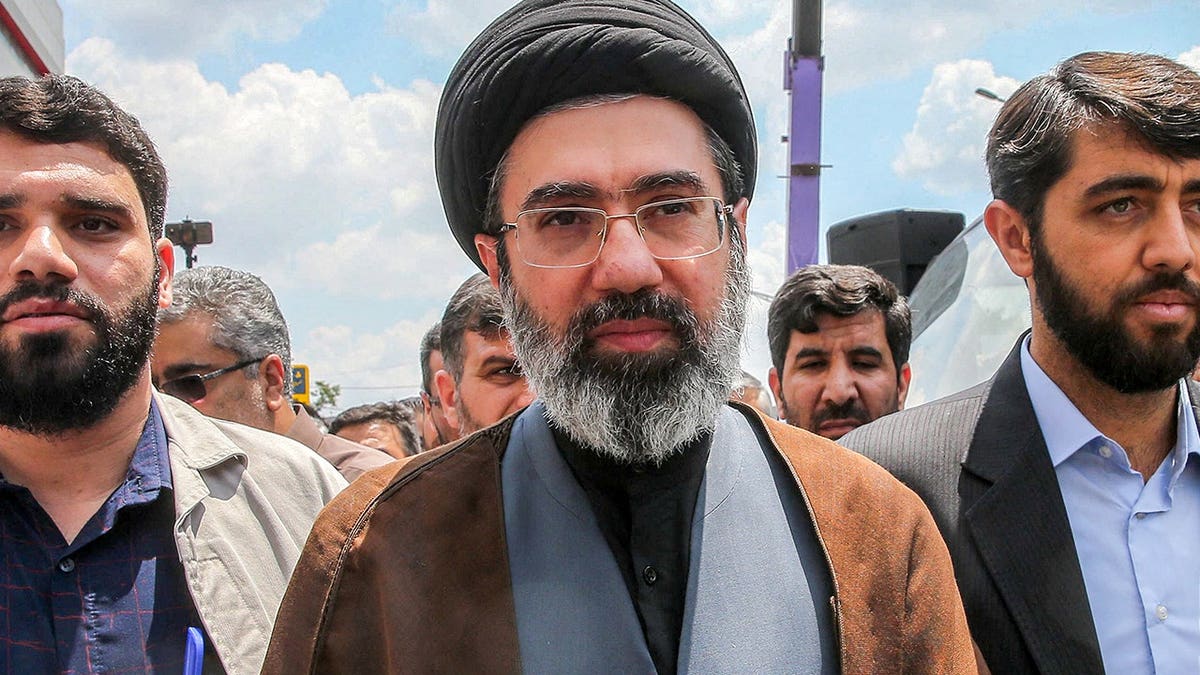
In this picture obtained from Iran’s ISNA news agency, Mojtaba Khamenei (C), son of Iran’s supreme leader Ayatollah Ali Khamenei, walks along a street in Tehran on May 31, 2019. (Hamid FOROUTAN / ISNA / AFP via Getty Images)
The complete survey methodology was not included in the material obtained by IranWire. The report reportedly did not disclose how respondents were selected, who was questioned or whether the sample reflected Iran’s geographic and demographic makeup.
Its findings therefore cannot be independently verified or treated as definitive measurements of Iranian opinion. The report also cannot establish that dissatisfaction will translate into an organized movement capable of removing the government.
Still, its findings portray multiple pressures converging at once.
Approximately 64% of respondents reported persistent anger, up roughly 12% points from a previous government survey conducted in December 2025. Half reported hopelessness, approximately 48% reported sadness or depression and about 45% reported persistent fear or anxiety, according to IranWire.
Economic distress also appears central to the public anger.
More than 81% experienced severe or partial difficulty obtaining enough food, while 75% struggled to cover medical costs, IranWire reported. Fifty-four percent said their income did not cover current household expenses, and only 8% reported earning enough to save.
Respondents blamed domestic governance more frequently than international pressure. 46.9% cited government inefficiency as the cause of Iran’s economic problems, 26.3% blamed corruption and 20.7% cited foreign sanctions.
IRAN TO EXECUTE FIRST FEMALE PROTESTER TIED TO ANTI-REGIME UNREST
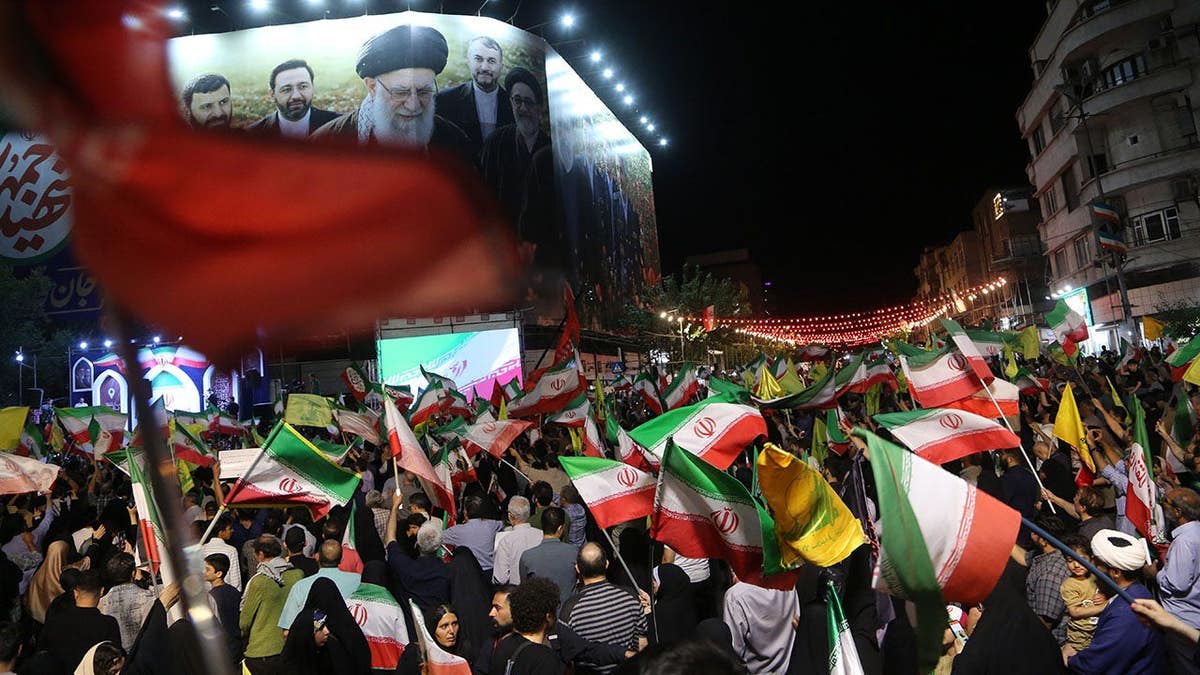
Thousands gathered at Revolution Square in Tehran on May 30, 2026, to protest attacks by the US and Israel on Iran, carrying Iranian flags and posters of the late Supreme Leader Ali Khamenei. (Fatemeh Bahrami/Anadolu)
That finding could be especially significant to the regime-change debate because it suggests many Iranians do not primarily blame outside powers for their deteriorating living conditions.
The document also points to a crisis of institutional confidence. Roughly 60% reportedly distrusted major government institutions, while 61.2% negatively assessed officials’ ability to solve Iran’s problems. Distrust of the government, parliament, judiciary and state television remained above 50%, IranWire reported.
The report’s recommendations, however, reportedly centered on managing dissatisfaction rather than addressing demands for systemic change.
Rabiei urged state institutions to better explain the impact of sanctions, moderate the rhetoric used by officials and religious platforms, present a more inclusive image through state television and avoid policies that place the government in direct confrontation with society.
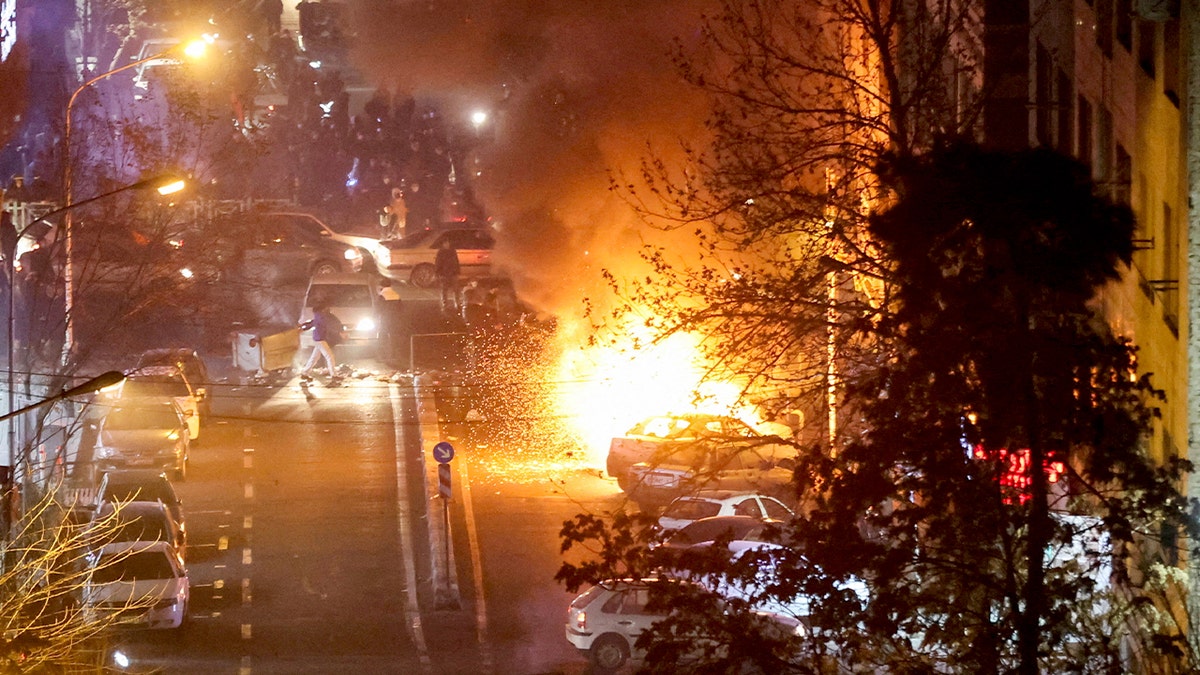
Cars burn in a street during a protest over the collapse of the currency’s value in Tehran, Iran, Jan. 8, 2026. (Stringer/WANA (West Asia News Agency) via REUTERS)
IranWire’s follow-up analysis argued that the recommendations treated Iran’s crisis primarily as a communications and public-perception problem. The report offered few concrete proposals involving institutional accountability, political liberalization or fundamental economic reform, according to the outlet.
Maleki said the findings were consistent with the expanding scale of unrest, citing demonstrations that spread from more than 80 cities in 2017 to more than 200 cities across all 31 provinces this year, alongside what he described as a quadrupling of strikes.
«Iranians have moved from being skeptical of what another revolution might bring to concluding there is no alternative to one, because reform has proven impossible,» Maleki said.
Yet the report does not resolve one of the largest obstacles to regime change: The Islamic Republic has spent decades building institutions designed to monitor, deter and violently suppress organized opposition.
«This regime was born of revolution, by revolutionaries,» Maleki said. «Preventing and crushing the next one is the one thing they genuinely know how to do.»
CLICK HERE TO DOWNLOAD THE FOX NEWS APP
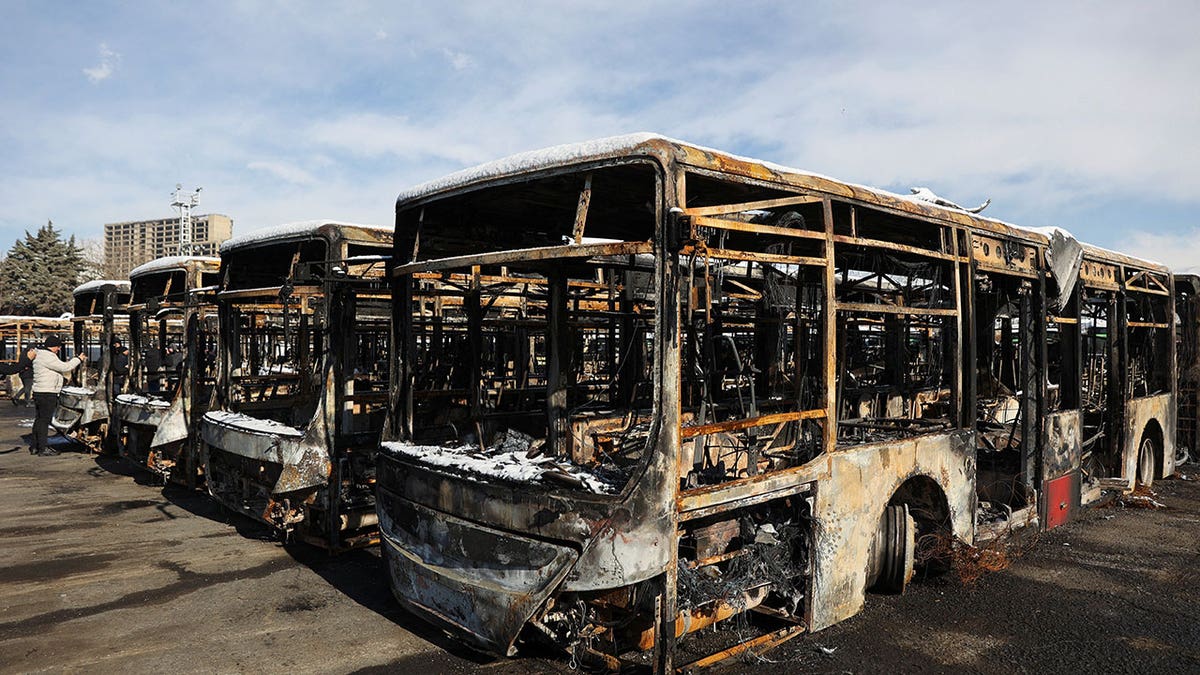
Buses that were burned during Iran’s protests, in Tehran, Iran, Jan. 21, 2026. (Majid Asgaripour/WANA (West Asia News Agency) via Reuters)
He nevertheless argued that further unrest was inevitable.
«So the discontent will translate into renewed protest,» Maleki said. «The question is not if, but when, and whether anyone is prepared to stand with the Iranian people when it does.»
war with iran, iran, world protests, world
INTERNACIONAL
State Department fires back after Walz doubles down on pardon of convicted child rapist

You always look for the ‘new bottom’ with Democrats: Jonathan Fahey
Laura Ingraham and former Acting I.C.E. Director Jonathan Fahey strongly criticize Democrats for their approach to illegal immigration and criminal justice. They highlight Minnesota Gov. Tim Walz’s controversial pardon of a child rapist, who was also an illegal alien, and a lenient sentence for an illegal alien truck driver in California. Ingraham also questions why victims’ rights often seem secondary.
NEWYou can now listen to Fox News articles!
After Democrat Tim Walz doubled down on his move to pardon a foreign child rapist prior to his deportation, the State Department took another swing at the Minnesota governor in an escalating back-and-forth.
The Minnesota Board of Pardons, comprised of Walz, state Attorney General Keith Ellison and state Chief Justice Natalie Hudson, granted clemency to Laotian national Tou Lue Vang, 42, on June 10. Vang was scheduled to be deported from the United States before the pardon.
«Governor Walz’s pardon of a convicted foreign sex offender was a grave and unconscionable betrayal of the very people he is supposed to defend,» State Department Assistant Secretary Dylan Johnson told Fox News Digital.
Minnesota Gov. Tim Walz testifies during a House Oversight and Government Reform Committee hearing in the U.S. Capitol in Washington, D.C., on March 4, 2026. The hearing examined alleged misuse of federal funds for Minnesota social services and Medicaid programs. (Anna Moneymaker/Getty Images)
WALZ, MINNESOTA BOARD OF PARDONS CLEARS CONVICTED ILLEGAL ALIEN CHILD SEX OFFENDER FACING DEPORTATION
«Walz’s plot to sacrifice the safety of Americans on the altar of open borders was thwarted by Secretary Rubio. Now this foreign criminal will never harm another American,» he continued.
Vang was convicted for repeatedly raping a 10-year-old girl between 2002 and 2004, and told authorities after he was arrested that «it is a cultural thing… to marry and have sex with girls as young as 12.»
Secretary of State Marco Rubio revoked Vang’s visa earlier this month, and he was deported back to Laos.
Walz defended the clemency move in a Tuesday press conference, contending that deportation of a convicted child rapist did not make the U.S. safer.
«Did that make us any safer?» Walz questioned. «Did that make the children that are left behind any more stable? Did it improve the idea that we can’t all be judged by our worst day?»
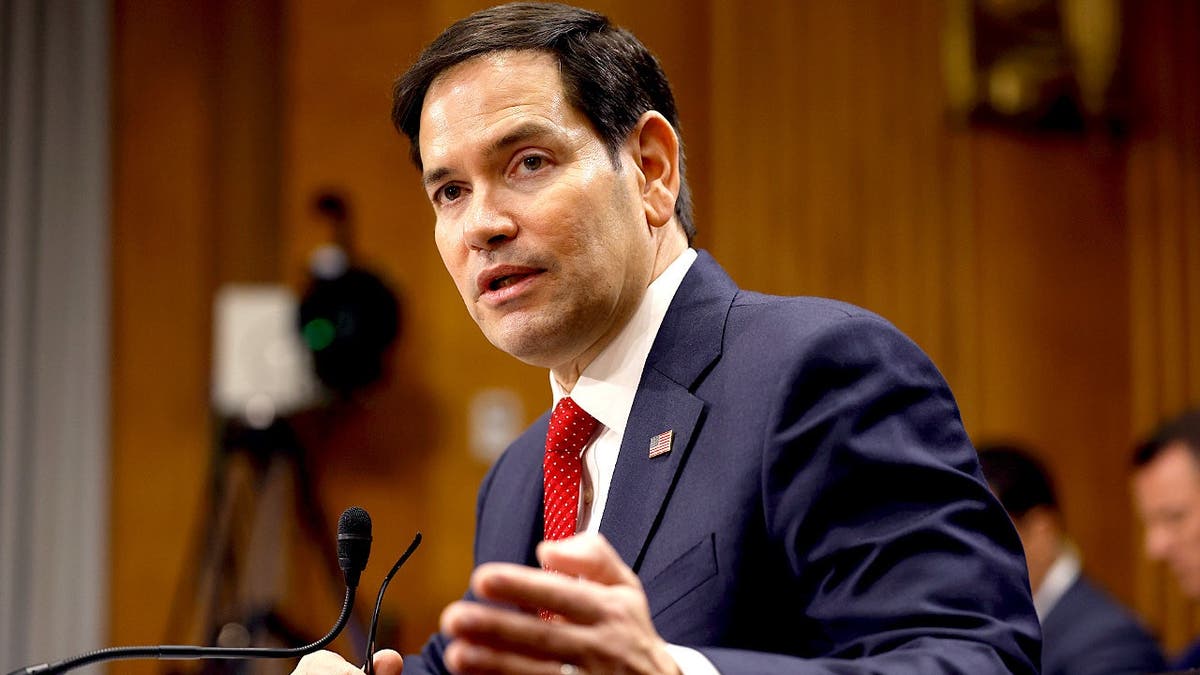
U.S. President-elect Donald Trump’s nominee for Secretary of State, Sen. Marco Rubio (R-FL) testifies during his Senate Foreign Relations confirmation hearing at Dirksen Senate Office Building on Jan. 15, 2025 in Washington, D.C. (Kevin Dietsch/Getty Images)
TIM WALZ OFFERS STRANGE DEFENSE FOR PARDONING CONVICTED CHILD RAPIST TRUMP ADMINISTRATION DEPORTED
Still, Walz admitted that Vang’s crimes were «horrific.»
The State Department raked Walz over the coals for downplaying Vang’s crimes.
«Walz sides with foreign criminals. Secretary Rubio sides with the American people,» Johnson told Fox News Digital of the governor’s remarks. «Walz wants open borders. This administration ended the era of mass migration. Walz endangered the American people. Secretary Rubio protected them.»
EXPOSED DOCS REVEAL WHY TIM WALZ BOARD AWARDED REPEAT CHILD RAPIST PARDON: ‘NO FUTURE’
Upon last week’s announcement that the State Department had skirted Walz’s pardon and deported Vang anyway, Rubio scolded Walz for granting Vang clemency in the first place.
«Americans should never have to live in fear that foreign sex predators — shielded from deportation by their own elected officials — could endanger them or their children,» he told Fox News Digital
«That’s why I terminated his legal status in the United States,» he continued. «Vang has now been removed from our country and will never pose a threat to any American ever again.»

Mugshot of Tue Lue Vang, a convicted Laotian illegal alien child rapist who has been deported from the United States. (Department of Homeland Security)
CLICK HERE TO DOWNLOAD THE FOX NEWS APP
At the time of Vang’s pardon, the Department of Homeland Security (DHS) feared that the move would shield the criminal illegal alien from deportation.
«Governor Tim Walz’s decision to pardon an illegal alien convicted child rapist so he can remain in our country is disgusting,» DHS Acting Assistant Secretary Lauren Bis said at the time.
«These are the criminal illegal aliens he and his Minnesota sanctuary politicians are protecting.»
state department, migrant crime, marco rubio, tim walz, politics, deportation
INTERNACIONAL
El diario The Guardian pidió que Inglaterra restablezca negociaciones con la Argentina por las Islas Malvinas

La exhibición de una bandera sobre las Islas Malvinas por parte de los jugadores de la Selección en la semifinal del Mundial 2026 reabrió el debate sobre la disputa de la soberanía argentina por el archipiélago. En ese contexto, el diario británico The Guardian publicó un editorial en el que instó al Reino Unido a retomar las negociaciones con la Argentina y sostuvo que las islas “no pueden ser británicas para siempre”.
En el artículo, el periodista Simon Jenkins sostuvo que mantener indefinidamente la soberanía británica sobre las Islas Malvinas resulta “insostenible” desde el punto de vista político y geopolítico. En esa línea, mencionó el reciente acuerdo alcanzado entre el Reino Unido y España sobre la caída del muro fronterizo en Gibraltar. “Pero, ¿será mucho esperar que una negociación similar surja producto de la semifinal?“, planteó Jenkins.
“Ninguno de los territorios de la era imperial británica tiene el derecho eterno de permanecer como están, menos uno que le cuesta a los contribuyentes británicos más de 60 millones de libras esterlinas en materia de defensa por año”, cuestionó.
Según el editorial del diario The Guardian, la firme defensa de la soberanía británica sobre las Islas Malvinas encuentra una de sus principales explicaciones en el rédito político que obtuvo la ex primera ministra Margaret Thatcher con la victoria en conflicto bélico de 1982. “No pueden ser británicas para siempre”: el contundente editorial del diario The Guardian sobre la soberanía de las Islas Malvinas (Foto: Reuters)
“Lo que se olvida es que, antes de la guerra, los gobiernos británicos estaban negociando la transferencia de la soberanía de las islas con Argentina”, recordó Jenkins. Según explicó, esas conversaciones se apoyaban en un acuerdo firmado con Buenos Aires en 1971, que “permitió a los isleños comerciar y viajar con el continente, utilizando sus hospitales, comercios y demás servicios”.
Y agregó: “La cuestión no radicaba en derechos históricos —un argumento eterno— sino en el sentido común geográfico. Para Gran Bretaña, era absurdo que un Estado europeo financiara una gran armada para defender territorios distantes y en disputa. Desesperado por ahorrar dinero, el gobierno ya se estaba retirando del Atlántico Sur. Las Malvinas quedaron expuestas e indefensas”.
Para The Guardian, la guerra puso fin a las negociaciones que ambos países mantenían hasta ese momento, pero no justifica que el Reino Unido haya descartado cualquier diálogo sobre la soberanía durante más de 40 años
“La realidad es que estas colonias, inevitablemente, tarde o temprano, se convertirán en parte de sus continentes. No pueden ser protegidas indefinidamente por un patrón europeo y los reclamos argentinos no se irán a ningún lado”, señaló.
En ese sentido, el columnista consideró que el gobierno de Reino Unido terminará retomando las conversaciones con la Argentina, pero advirtió que “el Ministerio de Asuntos Exteriores y de la Commonwealth y el ministro de Defensa pospondrán el problema”. Giovani Lo Celso deja la bandera con la leyenda «Las Malvinas son argentinas» en la cancha tras la victoria de la Selección por 2 a 1 contra Inglaterra. (Foto: AFP/Jewel Samad).
«Sería gratificante si la bandera de las Malvinas exhibida durante un partido de fútbol sacudiera a alguien para que pase a la acción», concluyó el editorial.
Los kelpers cuestionaron a la Selección argentina por la bandera de Malvinas
A través de un comunicado oficial difundido este jueves, las autoridades del archipiélago manifestaron su “decepción” por lo ocurrido durante la semifinal del Mundial, reclamaron que la política no interfiera en el deporte y solicitaron a la FIFA que evalúe la aplicación de sanciones.
En el texto, las autoridades locales señalaron que lamentan la decisión del plantel argentino de utilizar ese símbolo en un partido que, según sostienen, “de ninguna manera involucraba a las Islas Falkland”.
“El pueblo de las islas fue víctima de una invasión agresiva en 1982, que dejó a muchas personas traumatizadas. Por lo tanto, la bandera exhibida por Argentina anoche fue particularmente insensible para muchas personas de las Falkland”, afirmaron.
Islas Malvinas, Reino Unido, soberania

Un jefe de CoD: Modern Warfare 4 habla del miedo a coincidir con GTA 6, pero tiene una opinión muy distinta a la de otras compañías que evitan a Rockstar

La Justicia recibió un informe sobre el patrimonio de Adorni con inconsistencias y la fiscalía ya trabaja en un pedido de explicaciones

Cuántos dólares gastarán los argentinos que van a ver la final del Mundial

Leaked Iran report finds record public anger as regime focuses on holding power

Pamela David habló de la salud de Daniel Vila tras su operación en Estados Unidos: “Salió todo muy bien”

Mano a mano con el argentino Mattia Colnaghi: qué le falta en la Fórmula 3, el trabajo de su equipo y su frase sobre Red Bull que ilusiona

Operativo Reelección 2027: Los 8 Cambios Urgentes que Javier Milei Debe Implementar para Asegurar su Continuidad

El machete del arquero inglés en una botella que sorprendió a Messi tras el triunfo: el dardo de un ayudante de Scaloni a Inglaterra

Aumentó 900% la cantidad de repartidores de plataforma en los últimos 6 años

El mensaje de Messi tras la última práctica de Argentina en Kansas antes de la semi contra Inglaterra: las cuatro fotos que eligió

 DEPORTE1 día ago
El machete del arquero inglés en una botella que sorprendió a Messi tras el triunfo: el dardo de un ayudante de Scaloni a Inglaterra
- POLITICA17 horas ago
El fuerte cruce público entre Victoria Villarruel y Patricia Bullrich tras los chats filtrados antes de la sesión del Senado
- ECONOMIA3 días ago
Vaca Muerta promete renta anual del 15% y desata una fiebre inmobiliaria sin precedentes