INTERNACIONAL
Trump’s grip on GOP tested in Indiana as primary battles target defiant Republicans

NEWYou can now listen to Fox News articles!
President Donald Trump’s immense sway over the GOP was on the line tonight in Indiana’s primary, as the president’s endorsements in key Republican state Senate nomination races were being tested.
And it appears Trump’s grip over the Republican Party remains extremely strong.
Five months ago, Republicans in the GOP-dominated Indiana state Senate withstood immense pressure from Trump and his allies and voted down congressional redistricting, which would have given solidly red Indiana two more right-leaning U.S. House seats ahead of the midterms.
Fast-forward to present day, and eight of those state senators faced GOP primary challenges. Seeking retribution, the president endorsed challengers to seven of the eight Republican lawmakers who voted against the redistricting bill.
DEMOCRACY ’26: STAY UP TO DATE WITH THE FOX NEWS ELECTION HUB
Indiana Lt. Gov. Micah Beckwith announces the results of a vote to redistrict the state’s congressional map at the Statehouse in Indianapolis on Dec. 11, 2025. (Michael Conroy/AP Photo)
The Associated Press reports that five Trump-endorsed candidates have won, with one incumbent surviving, and one race yet to be decided.
Trump-backed Blake Fletcher has defeated incumbent state Sen. Travis Holdman in Indiana’s 19th District, in the northeastern part of the state. And Michelle Davis, who was supported by the president, topped incumbent Sen. Greg Walker in District 41 in central Indiana.
Tracey Powell, who was also supported by Trump, defeated incumbent state Sen. Jim Buck in District 21 in central Indiana. Buck was backed by former Vice President Mike Pence, who was elected congressman and later governor of Indiana before serving as Trump’s first vice president.
In District 11 in northern Indiana, incumbent Linda Rogers was defeated by Trump-endorsed Brian Schmutzler.
And the AP also reports that in northwestern Indiana’s District 1, Trump-supported Trevor De Vries topped incumbent state Sen. Dan Dernulc.
Only one state senator has survived so far. Sen. Greg Goode defeated two challengers, Trump-backed Brenda Wilson and Alexandra Wilson, in District 38, in western Indiana.
Meanwhile, in District 39, Trump-backed Jeff Ellington won the GOP nomination in an open-seat race where there was no incumbent.
The president’s allies shelled out more than $6 million to try to oust the state senators, according to the national ad tracking firm AdImpact.
Leading the charge were Hoosier Leadership for America and American Leadership PAC, which are aligned with GOP Sen. Jim Banks, a top Senate ally of the president. Groups allied with Republican Gov. Mike Braun were also part of the full court press. And two well known national groups: Turning Point USA’s political wing and the Club for Growth, also had the president’s back in Indiana.
The intraparty battle was seen not just as a test of fealty to Trump but rather a fight between MAGA forces and more traditional conservatives for the future of the GOP.
SIX MONTHS TILL MIDTERMS: THE TEN RACES THAT WILL DETERMINE THE SENATE’S MAJORITY
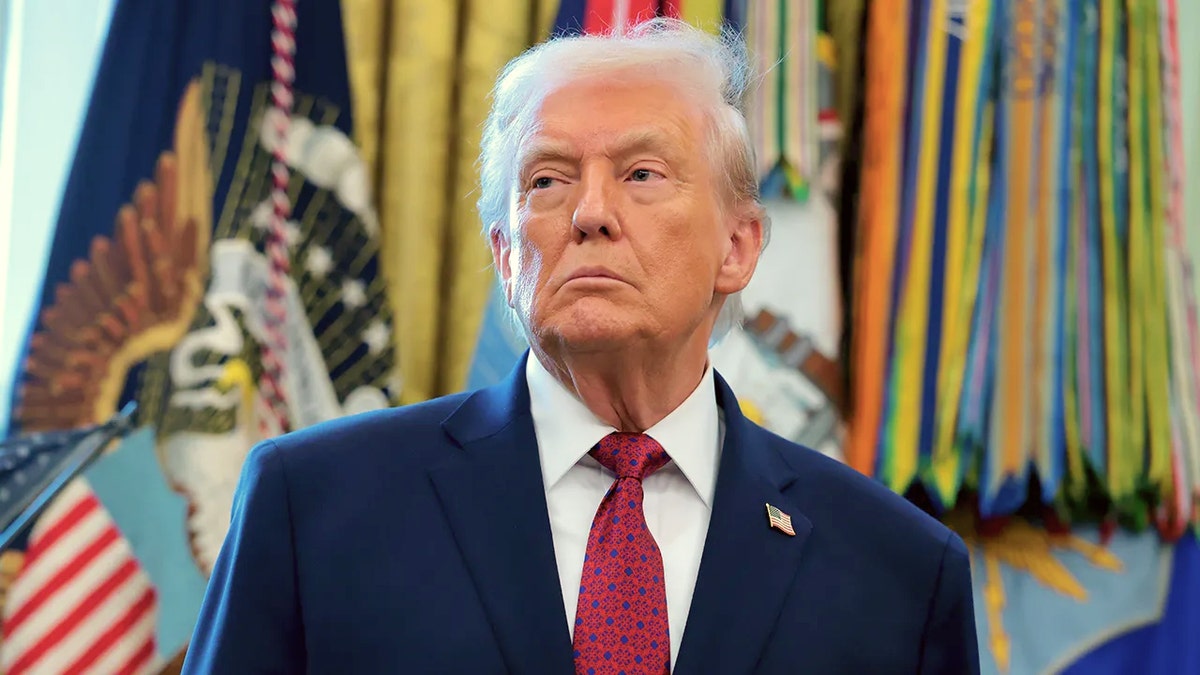
President Donald Trump vowed in December to «take out» the Republican leader of the Indiana Senate after opposition to a congressional map he supported, in the Oval Office on Dec. 2025. (Anna Moneymaker/Getty Images)
We’ve got to change those old-style Republicans, put in people who will fight, fight against the Democrat gerrymandering,» Club for Growth President David McIntosh told Fox News Digital.
McIntosh, a former congressman from Indiana, said, «I want to see my state do the right thing.»
TRUMP VS. HISTORY: HOW PRESIDENT’S POLL NUMBERS COMPARE TO BIDEN, OBAMA, BUSH AHEAD OF MIDTERMS
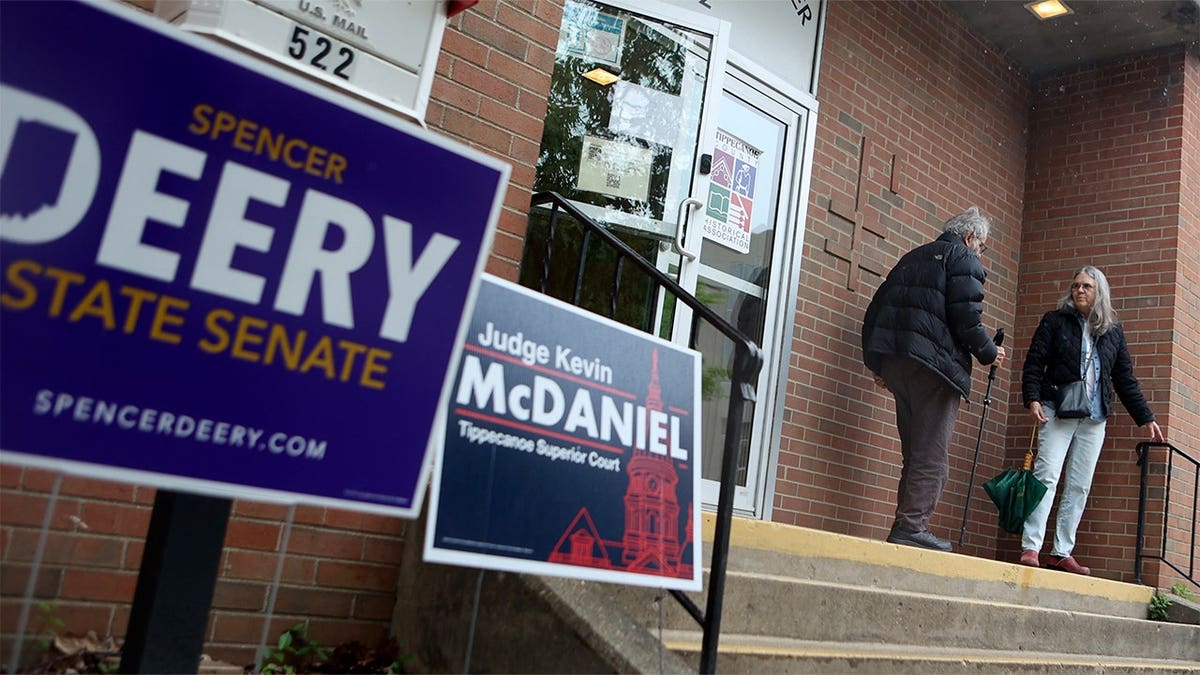
Voters walk out into the rain after casting their ballot in a vote center at the Tippecanoe County Historical Association history center during a primary election on Tuesday, May 5, 2026, in Lafayette, Ind. (Cara Penquite/AP Photo)
But the besieged incumbents significantly outraised their challengers, and were also boosted by the Indiana Senate GOP caucus.
CLICK HERE TO DOWNLOAD THE FOX NEWS APP
A pro-Trump source involved in the Indiana showdowns told Fox News Digital on the eve of the primary that a victory would be considered winning half the seats, and anything beyond that would be a major win.
midterm elections, indiana, donald trump, state and local primaries, republicans, elections, republicans elections









INTERNACIONAL
Biden scores temporary court victory as Trump-appointed judge delays release of Hur investigation materials
NEWYou can now listen to Fox News articles!
Former President Joe Biden has won another three weeks to block the release of audio recordings and transcripts tied to special counsel Robert Hur’s classified documents investigation after a federal judge granted a temporary injunction while a federal appeals court reviews his challenge.
The recordings stem from Biden’s interviews with Mark Zwonitzer, the ghostwriter of his 2017 memoir, «Promise Me, Dad.»
U.S. District Judge Dabney Friedrich, a Trump appointee, on Friday issued an injunction pending appeal that prevents the Justice Department from releasing the materials while the D.C. Circuit considers the case. The order came just hours after Friedrich denied Biden’s request for a preliminary injunction that would have stopped the release altogether.
The legal battle could determine whether Americans ever hear the recordings that helped shape Hur’s decision not to prosecute Biden over his handling of classified documents. The audio has been the subject of intense scrutiny because Hur raised questions about Biden’s memory in explaining why he declined to bring charges against Biden for mishandling classified documents.
GREGG JARRETT: RELEASE THE BIDEN TAPES AND LET AMERICANS HEAR THE TRUTH FOR THEMSELVES
Although the Justice Department previously released audio from Biden’s interviews with Hur, the recordings at the center of the current legal battle involve separate conversations between Biden and Zwonitzer.
Hur’s 2024 report repeatedly referenced Biden’s recorded conversations with Zwonitzer. The special counsel described some exchanges as «painfully slow» and said Biden at times struggled to recall events and relay information, observations that fueled scrutiny of the Biden’s cognitive abilities during an election year.
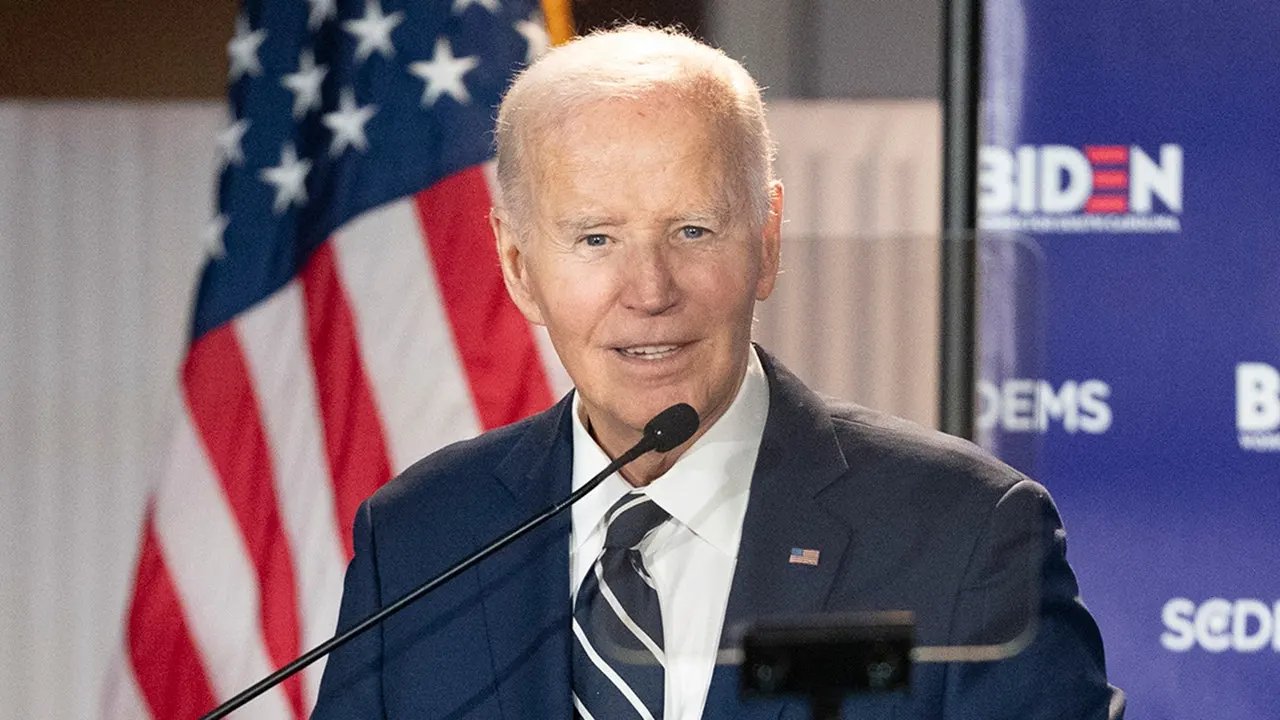
Former President Joe Biden speaks to a crowd during a fundraising event with the South Carolina Democratic Party at the Columbia Museum of Art on Feb. 27, 2026, in Columbia, S.C. (Sean Rayford/Getty Images)
The Heritage Foundation and its Oversight Project director, Mike Howell, have spent more than two years seeking the recordings and transcripts through FOIA requests.
Heritage Foundation officials have argued the public has a strong interest in reviewing the materials referenced throughout Hur’s report, particularly because the special counsel relied on the recordings in explaining his decision not to pursue criminal charges.
Biden has been fighting to keep the potentially embarrassing recordings under wraps.
CNN HOST SUGGESTS ROBERT HUR ‘UNDERSOLD’ EXTENT OF BIDEN MEMORY LAPSES DURING SPECIAL COUNSEL INTERVIEW
After Friedrich denied Biden’s motion for a preliminary injunction Friday, Biden’s legal team immediately sought emergency relief to preserve the status quo while appealing the decision.
In an emergency filing, Biden’s attorneys argued that disclosure would effectively end the case before appellate judges could review the legal questions involved. They maintained that once the recordings are released, any privacy protections would be permanently lost, and the appeal would become largely moot.
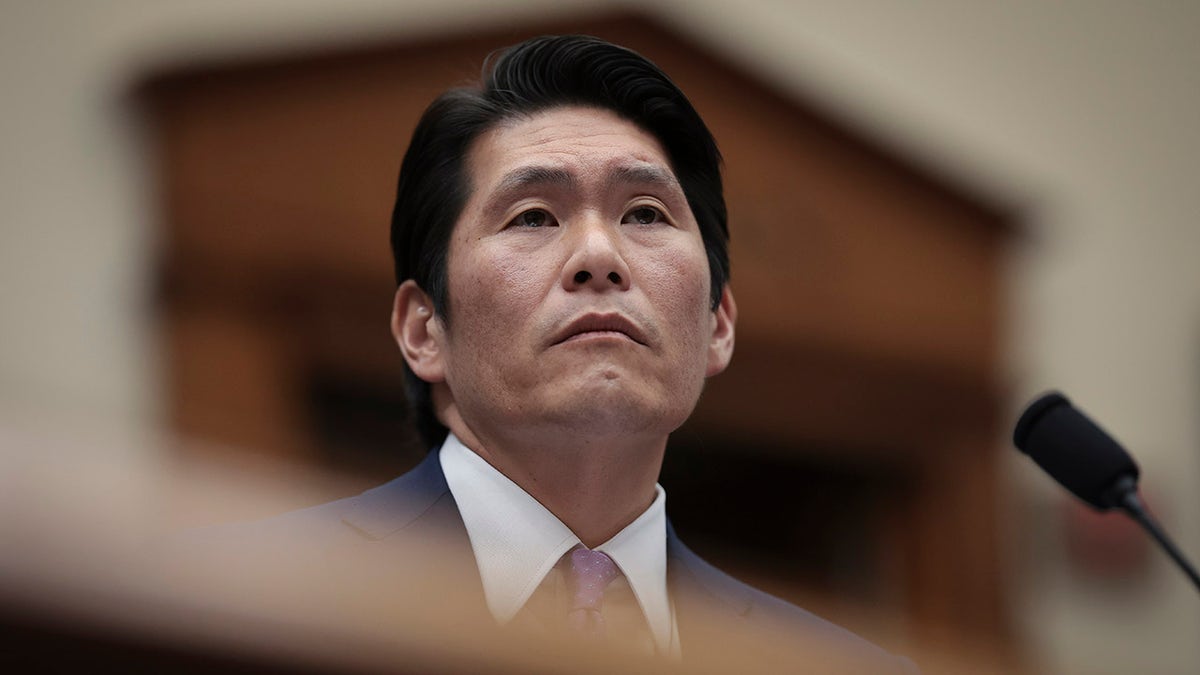
Former special counsel Robert K. Hur testifies before the House Judiciary Committee in Washington, D.C., March 12, 2024. Hur investigated President Joe Biden’s handling of classified documents and published a report with conclusions about Biden’s memory. (Win McNamee/Getty Images)
The filing also stressed that the FOIA litigation has already been pending for more than two years and argued there was no urgent public need requiring immediate disclosure of conversations that occurred roughly a decade ago between Biden and his ghostwriter. Biden’s attorneys noted that the former president is now a private citizen who neither holds nor is seeking public office.
OBAMA-APPOINTED JUDGE WITH TIES TO ANTI-TRUMP CONSPIRACY THEORY HIT WITH MISCONDUCT COMPLAINT
The Justice Department initially withheld the recordings and much of the transcript material under several FOIA exemptions. Earlier this year, however, the department reversed course and determined the records could be released with redactions after concluding that significant public interest existed in understanding evidence relied upon by Hur during his investigation.
After the Justice Department announced plans to release the recordings, Biden filed suit in May to stop the disclosure, claiming the audiotapes contain private conversations that should remain protected from public release and, if released, would be in violation of the Privacy Act.
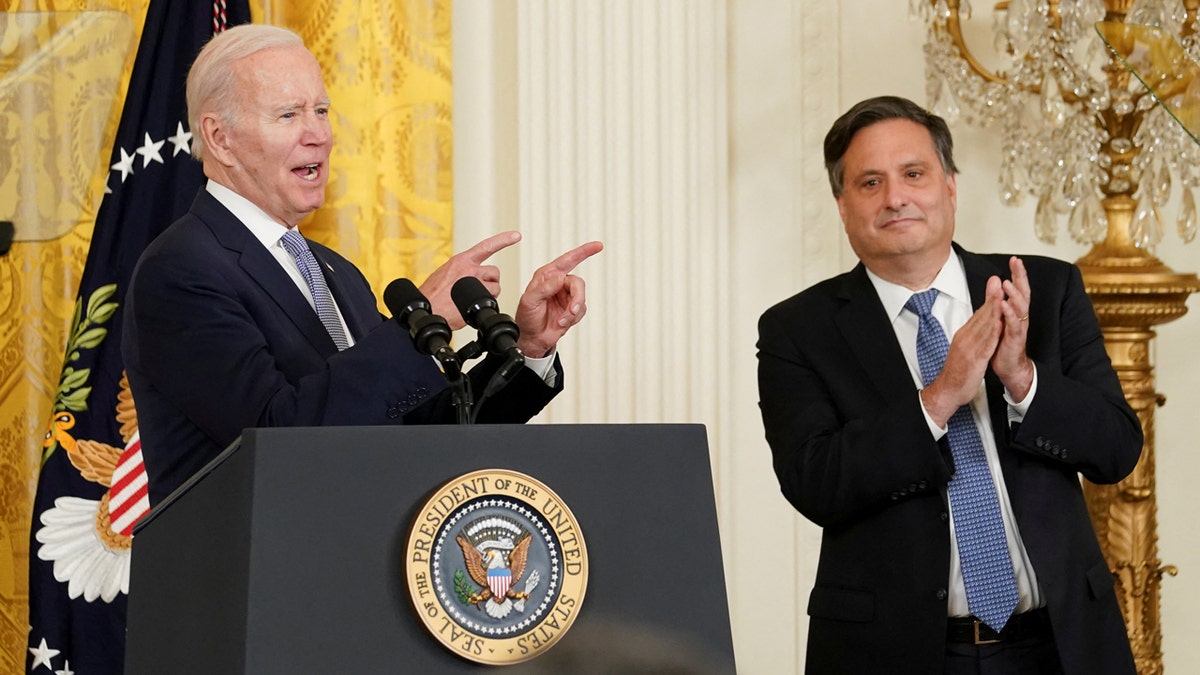
President Joe Biden speaks during an official transition event to thank Ron Klain for his work and to welcome successor Jeff Zients. (Reuters/Kevin Lamarque)
His legal team argued that the department’s decision violates the Privacy Act and constitutes arbitrary agency action under the Administrative Procedure Act.
CLICK HERE TO DOWNLOAD THE FOX NEWS APP
Leading Biden’s legal effort is Amy Jeffress, a partner at Washington-based law firm Hecker Fink and a former Justice Department national security official. Jeffress has served as the primary attorney advancing Biden’s challenge to the release of the materials and signed the recent emergency filing seeking to prevent disclosure while the appeal proceeds.
Jeffress has also drawn attention because she is married to U.S. District Judge Christopher Cooper, an Obama appointee who recently ruled against the Trump administration in a high-profile dispute involving the Kennedy Center. Cooper’s ruling prompted criticism from some Trump allies and conservative commentators who pointed to the judge’s family connection to Biden’s attorney, suggesting a conflict of interest may be at play in Cooper’s work.
in court, joe biden, how justice happens, appeals, trials
INTERNACIONAL
Balotaje en Colombia: un país dividido elige presidente entre un libertario y un socialista


INTERNACIONAL
African and Caribbean leaders call for payments, debt cancellation, formal apologies over slavery
NEWYou can now listen to Fox News articles!
African and Caribbean leaders are demanding financial compensation, debt cancellation and formal apologies from countries that benefited from the transatlantic slave trade after adopting a sweeping reparations plan at a conference in Ghana.
The 19-point framework calls for financial compensation, debt relief, a Global Reparations Fund and the return of looted cultural artifacts and ancestral remains. It also seeks reforms to international financial institutions that supporters say disadvantage Third World countries.
The proposal is expected to be presented at the next UN General Assembly as African and Caribbean nations step up a coordinated push for slavery reparations.
The plan was adopted Friday by the African Union and the Caribbean Community (CARICOM) Commission on Reparatory Justice at the end of a three-day conference.
REPARATIONS ADVOCATES PUSH FOR PAYMENTS TO BLACK AMERICANS DESPITE BUDGET AND LEGAL CHALLENGES
John Dramani Mahama, president of Ghana, and other dignitaries attend a wreath-laying event at Christiansborg Castle in Accra, Ghana, Friday, during a high-level conference on the United Nations resolution addressing the trafficking of enslaved Africans. (Ernest Ankomah/Getty Images)
«None of us gathered in this hall today can be held personally responsible for the atrocities of the transatlantic slave trade,» Ghanaian President John Dramani Mahama told delegates.
«History does not ask us to inherit guilt, but it asks us to inherit responsibility,» Mahama added.
The proposal does not identify specific countries that should provide compensation or issue formal apologies.
TULSA MAYOR PROPOSES $100M REPARATIONS PLAN FOR DESCENDANTS OF 1921 TULSA RACE MASSACRE
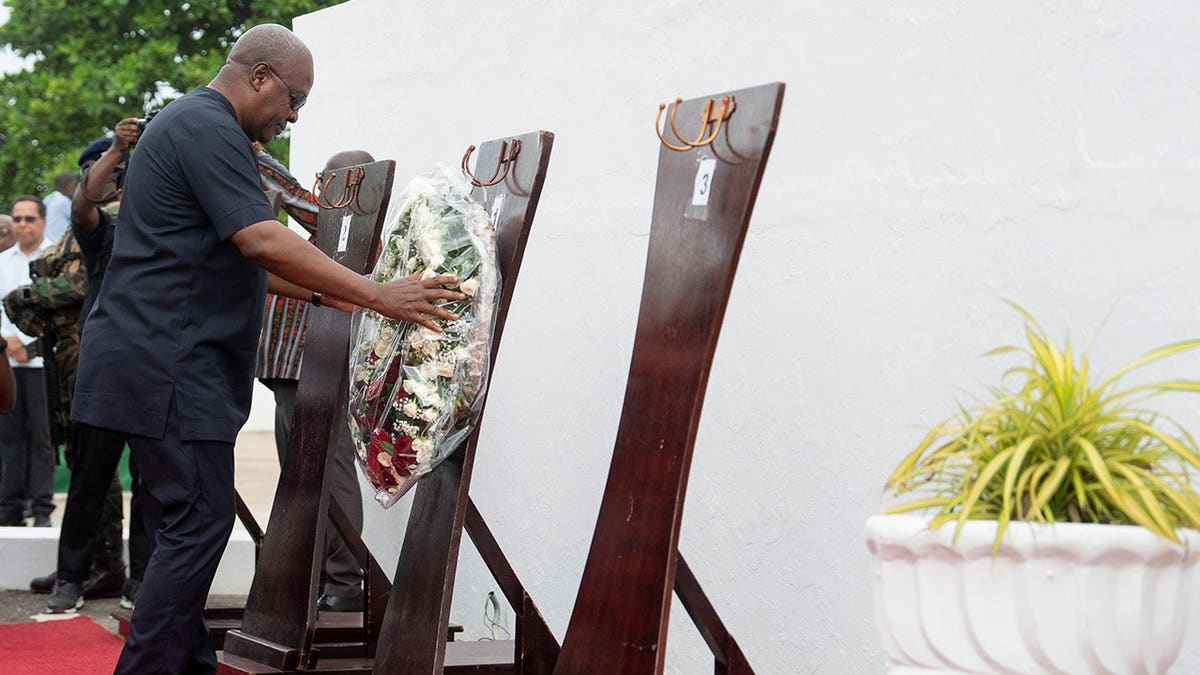
John Dramani Mahama, president of Ghana, lays a wreath at Christiansborg Castle in Accra during a high-level conference on the United Nations resolution addressing the trafficking of enslaved Africans on Friday. (Ernest Ankomah/Getty Images)
It does call for debt cancellation, climate justice financing, expanded citizenship pathways for Africans in the diaspora and what organizers describe as a «right of return» for descendants of enslaved Africans.
The plan also urges African countries to preserve former slave forts and castles as memorial sites.
According to advocates, at least 12.5 million Africans were kidnapped and transported aboard European ships between the 15th and 19th centuries. Supporters of reparations argue the effects of slavery continue to be felt across Africa and the Caribbean generations later.
UN COURT RULES WEALTHY NATIONS PAY UP FOR CLIMATE CHANGE DAMAGES IN CONTROVERSIAL GLOBAL RULING
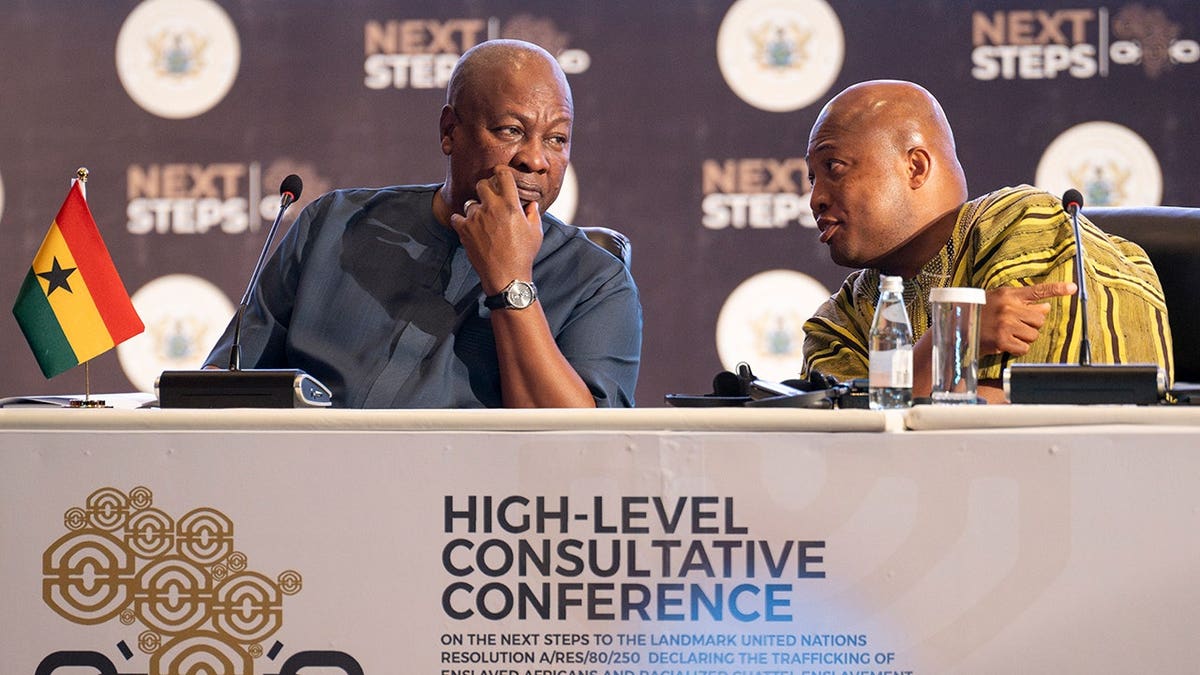
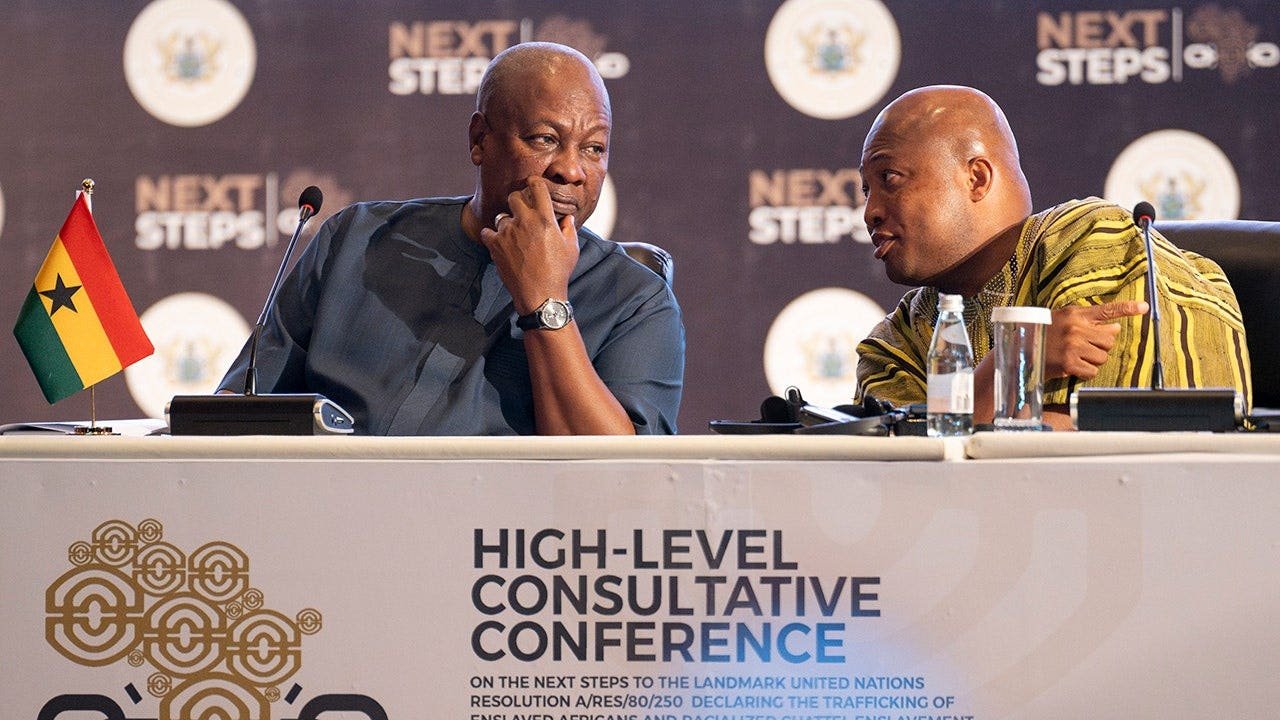
President John Dramani Mahama and Minister Samuel Okudzeto Ablakwa host a high-level consultative conference on the next steps following the United Nations resolution on trafficking of enslaved Africans in Accra, Ghana, on Thursday. (Ernest Ankomah/Getty Images)
The conference follows a UN vote in March recognizing transatlantic slavery as the «gravest crime against humanity.»
The resolution passed with 123 votes in favor, but the U.S., Israel and 52 other countries either voted against it or abstained.
According to Reuters, the United States and European Union raised concerns that the resolution could be interpreted as creating a hierarchy among crimes against humanity by treating some atrocities as more serious than others.
MACRON TAKES THE STAGE UNINVITED AT AFRICA SUMMIT TO SCOLD CROWD FOR ‘TOTAL LACK OF RESPECT’
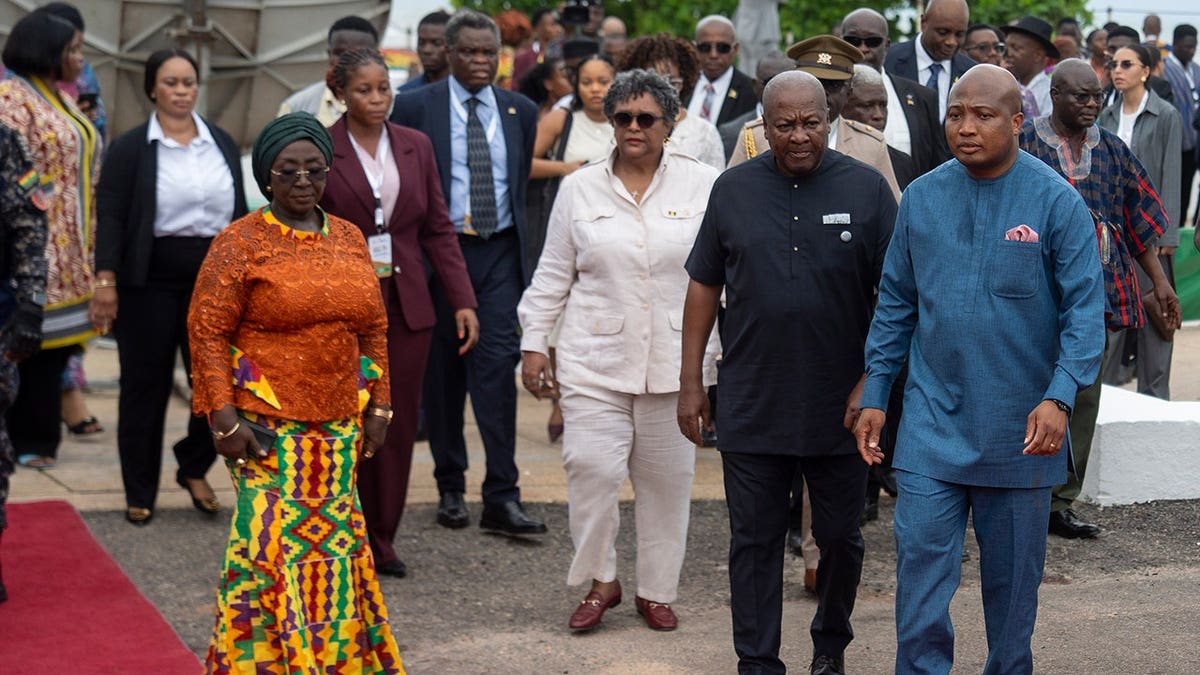
John Dramani Mahama, president of Ghana, Mia Amor Mottley, prime minister of Barbados, and Samuel Okudzeto Ablakwa, Ghana’s foreign affairs minister, attend a wreath-laying event at Christiansborg Castle in Accra, Ghana, Friday, during a high-level conference on the United Nations resolution addressing the trafficking of enslaved Africans. (Ernest Ankomah/Getty Images)
Heads of state from Namibia, Liberia, Senegal, Barbados and Sao Tome and Principe attended the conference, along with senior officials from several other countries.
French President Emmanuel Macron addressed the gathering virtually from the Élysée Palace, where he acknowledged the suffering caused by slavery.
CLICK HERE TO DOWNLOAD THE FOX NEWS APP
Enslaved people were «torn from their homelands, deported, dehumanised, and treated as goods,» Macron said.
Macron also said reparations should not be viewed «as an end point, or a cheque written to bring the story to a close.»
The conference in Ghana brought together separate reparations efforts previously pursued by African and Caribbean nations into a single document that organizers plan to take before the United Nations.
Reuters contributed to this report.
africa, united nations, caribbean, heritage, general assembly, world

Biden scores temporary court victory as Trump-appointed judge delays release of Hur investigation materials

El horóscopo de hoy: domingo 21 de junio

Arsat | Citas en un hotel, cenas con vino y un viaje a Córdoba: la trama detrás de un sensible contrato millonario que benefició a Huawei

Nueva Zelanda vs. Egipto: formaciones, hora y dónde ver por tv

Círculo rojo: ni el Mundial corre el eje del escándalo Adorni y el Gobierno define qué quiere hacer en el Congreso

¿Nintendo Switch Lite 2? No, es un clon de la portátil recientemente anunciado bajo el nombre de RG 55G1 – Nintenderos

Patricia Bullrich: “El Presidente considera que Adorni dio una explicación razonable”

El Gobierno envía señales de que Adorni tiene las horas contadas para evitar que sesione el Senado

GOP Gov DeWine urges Ohio to abolish the death penalty, says it is no longer a deterrent

El lapidario posteo de Javier Milei contra Florencia Peña por la fake news sobre la muerte del papá de Messi

 POLITICA2 días ago
El lapidario posteo de Javier Milei contra Florencia Peña por la fake news sobre la muerte del papá de Messi
- SOCIEDAD3 días ago
Un nutricionista detalló cuál es la bebida alcohólica que causa más resaca y cómo influye el color
- POLITICA3 días ago
El Gobierno aprobó un nuevo anticipo financiero para tres provincias