INTERNACIONAL
Universities face funding threat as lawmakers target schools with ties to adversarial nations

NEWYou can now listen to Fox News articles!
EXCLUSIVE: A bipartisan group of lawmakers is moving to crack down on foreign influence in American education by targeting universities’ financial ties to adversarial nations.
The package would ban federal funding to colleges that operate «branch» campuses in adversarial countries or accept research funding for sensitive fields like artificial intelligence, biotech and quantum computing.
China, for example, has been a major source of foreign influence in American education through its Confucius Classrooms, which states like Oklahoma have cracked down on.
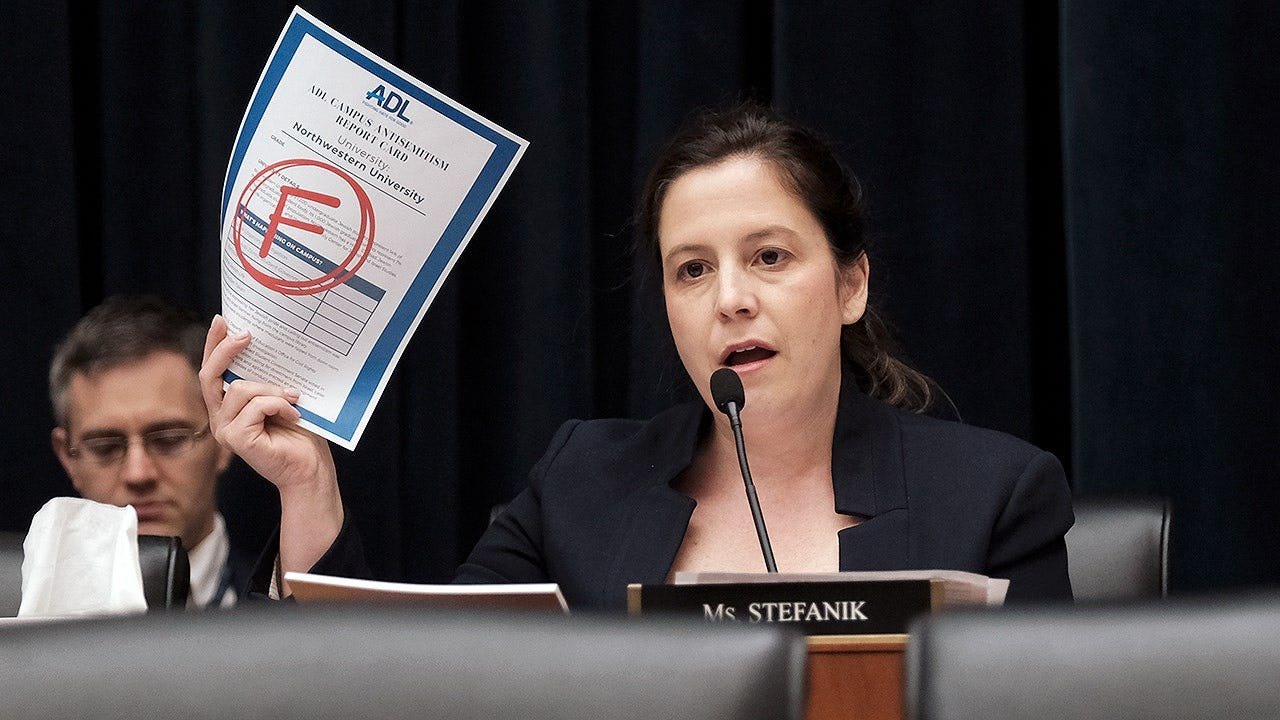
On a federal level, Rep. Elise Stefanik, R-N.Y., has taken the mantle of defending education against issues from foreign influence to antisemitism on campus, famously headlining a hearing after which UPenn’s president resigned amid pressure over her responses to the latter.
HOUSE GOP LAUNCHES BLITZ OF BILLS TO SHUT DOWN CCP INFILTRATION OF US SCHOOLS: ‘COMMONSENSE’
Stefanik again is out in front of an education protection endeavor, telling Fox News Digital she is part of a bicameral, bipartisan group focused on keeping foreign influence away from America’s young and growing minds.
«I introduced the No Branch Campuses in Hostile Countries Act with Senator Rick Scott, and this is part of the broader higher education reform effort that I have been leading on in the Congress,» Stefanik said in an exclusive interview.
Rep. Elise Stefanik, R-NY, creates a viral moment during an education hearing. (Michael McCoy/Getty Images)
«One of the challenges that I’ve seen is the influence of foreign adversaries sowing discord on our higher education campuses. And part of this has been coming from the foreign dollars flowing in, but also the existence of branches in these foreign adversarial countries.»
She noted her home state of New York has major universities operating branch campuses in Chin, but said the problem extends beyond the Empire State to other top schools in Chicago, Washington and elsewhere.
Stefanik added that Confucius Institutes and classrooms were recently banned by the national defense bill and that, just as that effort was bipartisan, so is her second education security bill this week.
The Defending American Research Act prevents any institution of higher education from receiving federal research funding for five years if it receives funds from certain foreign countries, including Qatar, Venezuela, Turkey and North Korea.
In Stefanik’s book, «Poisoned Ivies,» she noted she dove into the topic of dangerous aspects of today’s campus life from foreign influence to antisemitism.
«[Ours] was the most viewed hearing in the history of Congress. It led to multiple university presidents’ resignations, but, importantly, it set off an earthquake in higher education reform. There have been seismic shifts in higher ed, both in the marketplace, as you’re seeing parents and students voting with their wallets and feet, as it’s shifted,» Stefanik said.
She added that many American youths are seeking collegiate education at southern schools where the liberal northeast and west coast influence is more muted.
STEFANIK TO RELEASE NEW BOOK ON COLLEGE ANTISEMITISM AS SHE EYES BID FOR NY GOVERNOR

A Chinese flag flies near the Capitol dome in Washington, D.C., amid new legislation targeting lobbying by former government officials for China. (Douglas Rissing/Getty Images)
Sen. Rick Scott, R-Fla., and Rep. Josh Gottheimer, D-N.J., are joining Stefanik in the effort, and Scott told Fox News Digital that America «has enemies» and should «start acting like it» when it comes to their influence on higher education.
«Countries like Communist China and terror-supporting Qatar should not be able to use America’s colleges and universities as outposts to spy on us, steal sensitive research and spread anti-American propaganda, but we’ve been letting them do it for years,» Scott said.
MORE THAN 160 HOUSE DEMS VOTE AGAINST CRACKDOWN ON FOREIGN INFLUENCE IN US SCHOOLS
«This legislation is critical to America’s national security and the future of our higher education system, neither of which should be for sale.»
While the list includes more obvious entries like North Korea, Cuba and China, Qatar is also included, even as it remains a somewhat neutral or cooperative partner on national security concerns such as evacuations from Afghanistan and the Iran conflict.
However, Stefanik said when it comes to its influence on U.S. education, her research led her to «billions of dollars» from Doha appearing to prop up antisemitic interests and «pro-terror professors» at some universities, including in her home state.
«I think that’s one of the major ways we need to push back on this foreign influence that’s really shifting away from the founding missions of these higher education institutions,» she said.
CLICK HERE TO DOWNLOAD THE FOX NEWS APP
Other nations on both bills’ lists include the Bolivarian Republic of Venezuela, Islamic Republic of Iran and the Russian Federation.
The bill sponsors’ collective hope is that their measures will provide the leverage needed to force U.S. universities to cut ties with adversarial governments or risk their bottom line.
national security, congress, republicans elections, education, legislation, politics














NEWYou can now listen to Fox News articles!
Speaker Mike Johnson’s plan to bypass Democratic opposition on a key election integrity bill took a major step forward in the House of Representatives on Wednesday.
It’s a major victory for Johnson, R-La., who had to overcome a wall of left-wing opposition and threats of a rebellion within his own GOP ranks.
House Republicans are working to move the Safeguarding American Voter Eligibility (SAVE) America Act as part of a larger $95 billion budget bill that, if successful, would completely sideline Democrats to implement election reforms sought by President Donald Trump.
They’re using a mechanism called budget reconciliation, which allows the party in power to pass sweeping fiscal policy by lowering the Senate’s threshold for advancement from 60 votes to a simple majority. In exchange, however, the legislation is subject to intense scrutiny under a strict set of guidelines about what actually counts as true fiscal policy.
Speaker of the House Mike Johnson, R-La., talks with reporters in the U.S. Capitol on June 10, 2026. (Tom Williams/CQ-Roll Call, Inc via Getty Images)
The bill up for consideration on Wednesday was just the first House-wide step in passing a reconciliation package, which is adopting a framework with spending instructions for relevant committees who will then cobble individual portions together into a massive piece of legislation. Both the House and Senate must pass identical versions before it goes to the president’s desk.
All but three members of the House Republican Conference supported the measure: Reps. Thomas Massie, R-Ky., Warren Davidson, R-Ohio, and Kevin Kiley, I-Calif., voted against it.
The framework was adopted in a narrow 216 to 214 vote, with all Democrats opposed.
REPORTER’S NOTEBOOK: HOUSE’S FINAL SPRINT PUTS SAVE AMERICA ACT AND IRAN FUNDING IN PLAY
It comes after fiscal hawks warned for days that they are uneasy with the lack of budget cuts in the framework to offset the $95 billion in new spending.
Rep. Chip Roy, R-Texas, said he was leaning in support but still undecided.
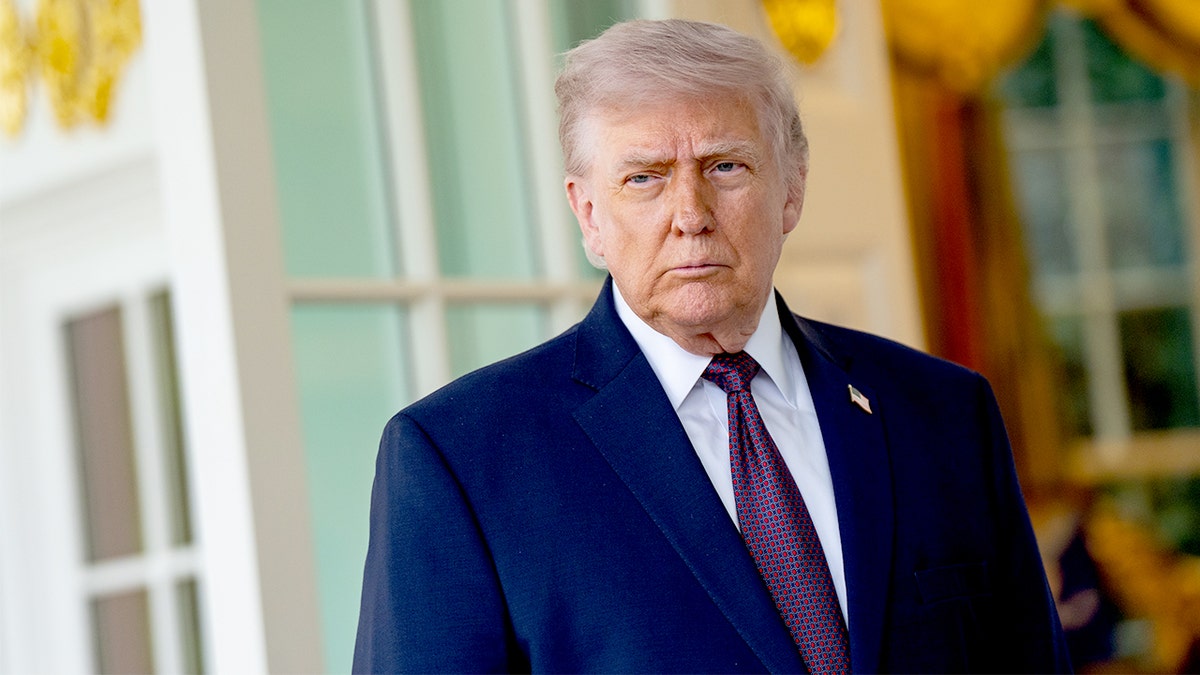
Donald Trump speaks to members of the media outside the Oval Office of the White House in Washington, D.C., U.S., on Monday, April 13, 2026. (Salwan Georges/Bloomberg via Getty Images)
«People wonder why the so-called 3AM caucus exists and why we hold our votes to the last minute to put pressure on Republicans in Congress to deliver? It’s because they revert to the mean — which is spending, amnesty, unlimited immigration and political show votes. I want FULL SAVE. I want this unpaid-for spending to be paid for in the 4th reconciliation bill. I want clarity on our war mission while we are backfilling munitions,» he told Fox News Digital.
TOP TRUMP OFFICIAL MAKES NEW SAVE ACT CASE TO REPUBLICANS BEHIND CLOSED DOORS
Rep. Eric Burlison, R-Mo., had told reporters, «I just wanted to let them know if you’re doing a whip count right now, I wouldn’t put me in the yes column…I’m not 100% convinced that the SAVE language is going to be held solid through the Senate. In fact, I would bet against it. I just, I don’t have any confidence that the Senate will keep that language tight.»
Both voted in favor of adopting the framework, however.
With just a razor-thin majority, Johnson could lose no more than than two Republicans to still pass anything on partisan lines.
The budget plans for for $73 billion aimed at the U.S. war with Iran, $12 billion for aid to American farmers, and $10 billion for states to implement election integrity measures in the SAVE America Act — namely federal voter ID rules and a proof of citizenship mandate to register to vote.
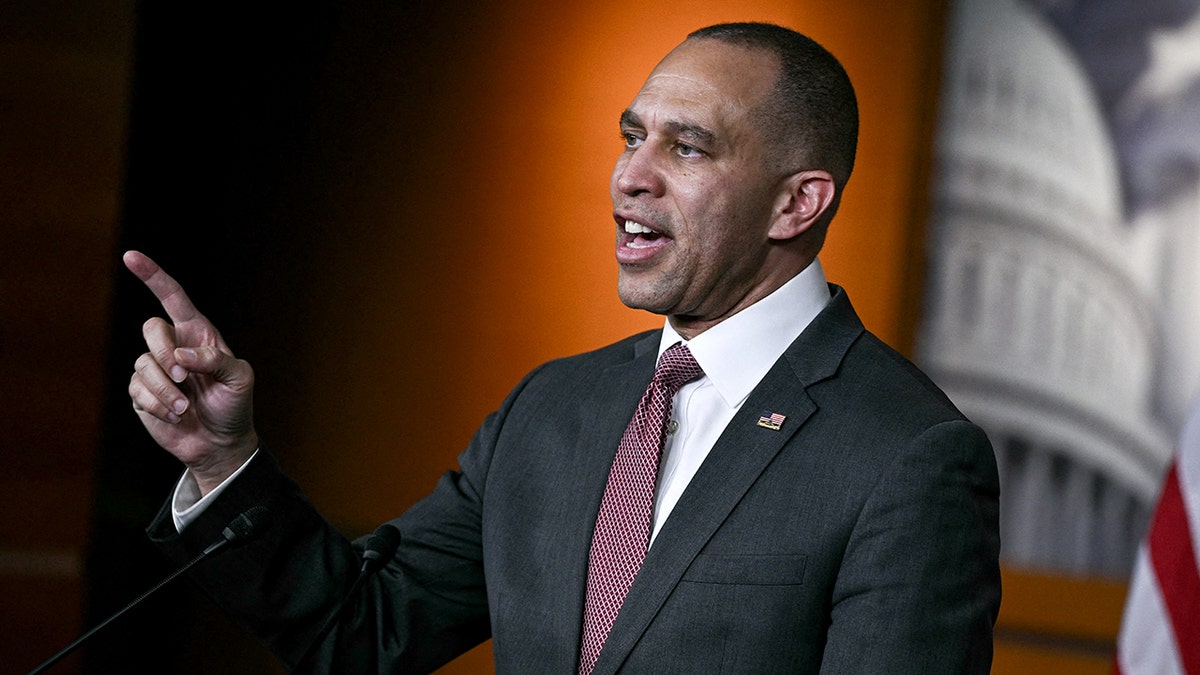
U.S. House Minority Leader Hakeem Jeffries, Democrat from New York, speaks before an upcoming House vote on funding for the US Department of Homeland Security, on Capitol Hill in Washington, D.C., on March 5, 2026. (Brendan Smialowski / AFP via Getty Images)
Democrats and some Republicans have been wary about funding the Iran war without additional oversight from Congress. And Democrats in both the House and Senate have been vehemently opposed to the SAVE America Act, calling it tantamount to voter suppression.
CLICK HERE TO DOWNLOAD THE FOX NEWS APP
But Republicans have near-uniformly argued that it is aimed at enhancing confidence in American elections.
Trump posted on Truth Social on Tuesday, «Thank you to all of the House Republicans who are supporting the first step towards getting as much of THE SAVE AMERICA ACT, as possible, in the Budget Bill, and to our Great Speaker, Mike Johnson. I am asking all House Republicans to VOTE YES on this very important Budget Resolution. I am watching the vote very closely, and hope Republicans can UNIFY to secure Elections against all forms of Foreign Country Interference, and Illegal Alien voting.»
domestic policies, republicans elections, voting, mike johnson, politics

La investigación por el asesinato del ingeniero argentino Facundo Rico en Madrid logró reconstruir en pocos días cómo se desencadenó el ataque. Para los investigadores, el acusado, a un hombre de 65 años, creía que la víctima era el amante de su esposa. Eso lo llevó a presentarse en su departamento donde lo apuñaló 13 veces y, menos de 24 horas después, se quitó la vida.
El crimen ocurrió el martes 14 de julio, cerca de las 10 de la mañana, en un departamento alquilado del barrio Las Tablas, en el distrito madrileño de Fuencarral. Hasta allí llegó el presunto agresor, también ingeniero, quien ingresó a la vivienda y mantuvo un violento enfrentamiento con Facundo.
La pelea terminó en la cocina de la casa. Según la reconstrucción policial, la víctima recibió 13 puñaladas, varias de ellas en la espalda y en la zona del omóplato. El cuchillo quedó abandonado en el piso y en una de las paredes se hallaron restos de gas pimienta, que el atacante llevaba consigo y utilizó durante la agresión.
Para los investigadores, la violencia desplegada durante el ataque demuestra que el hombre contemplaba la posibilidad de matar. De hecho, consideran que el hecho de haber llevado un aerosol de gas pimienta refuerza esa hipótesis, aunque todavía se analiza si había planificado el homicidio desde un principio. La principal hipótesis de la Policía sostiene que el ataque fue cometido por un hombre de 65 años que estaba convencido de que Rico era el amante de su esposa. (Foto: AP)
Tras el crimen, el agresor escapó rápidamente del edificio. En el hall se cruzó con el encargado, que había sido alertado por una vecina luego de escuchar los gritos de la víctima y percibir un fuerte “olor químico”.
Después subió a un auto rojo, estacionado frente a una clínica, y emprendió viaje hacia la provincia de Ávila. Parte de ese recorrido quedó registrado por cámaras de tránsito.
La obsesión que habría motivado el ataque
Las primeras declaraciones de familiares y allegados de Facundo orientaron la investigación hacia un posible móvil sentimental.
La principal hipótesis sostiene que el agresor estaba convencido de que el ingeniero mantenía una relación con su esposa. Esa sospecha, según la investigación, derivó en una obsesión que terminó desencadenando el ataque, indicaron fuentes de la investigación a El País.
Los detectives establecieron que la mujer, de unos 50 años, y la víctima asistían al mismo gimnasio, ubicado a pocos metros de la casa donde vivía Facundo.
Además, fuentes cercanas al caso señalaron que ella pretendía separarse de su marido, quien habría comenzado a investigar si existía una tercera persona en su vida.

Facundo Rico era oriundo de San Juan y vivía en Madrid hacía al menos una década. (Foto: Facebook / Facundo Rico)
Después del homicidio, el hombre llegó a una segunda residencia que el matrimonio poseía desde hacía dos años en La Adrada, un pueblo de casi 3.000 habitantes ubicado a menos de dos horas de Madrid, donde habían remodelado un antiguo chalet.
Según la reconstrucción de los investigadores, el agresor le dijo a su esposa que durante ese día había estado realizando distintos trámites, sin dar mayores explicaciones. Mientras tanto, la noticia del crimen ya ocupaba los principales medios españoles.
Al día siguiente, cuando comenzaron a difundirse la identidad de la víctima y los detalles del brutal ataque, el hombre se dirigió hasta el paraje conocido como Charco de la Olla y se arrojó a una garganta, donde murió. Antes de suicidarse fue visto por una pareja que caminaba por el lugar, cuyos integrantes luego declararon que lo habían notado con “muy mala cara”.
Una investigación cerrada
Con la muerte del presunto autor, la causa quedó prácticamente concluida desde el punto de vista penal, ya que no existe la posibilidad de continuar el proceso judicial.
De todos modos, los investigadores del Grupo V de Homicidios de la Policía Nacional ya habían reunido una importante cantidad de pruebas.
Leé también: Quién era el ingeniero argentino asesinado de 13 puñaladas en España por una sospecha de infidelidad
Las cámaras de seguridad de la urbanización registraron el ingreso del sospechoso, cuya contextura física resultaba fácilmente reconocible, mientras que el encargado del edificio confirmó haberlo visto salir poco después de escuchar los gritos provenientes del departamento.
La esposa del agresor quedó en estado de shock cuando la Policía le comunicó las sospechas sobre la participación de su marido en el crimen. Incluso, según fuentes cercanas a la investigación, en un primer momento se negó a creer que pudiera haber cometido el asesinato.
España, Crimen, Infidelidad

La tensión en los mercados globales y el salto del petróleo hicieron subir al riesgo país, que se aleja de los 400 puntos

¡Enojo y reproches! Diego Latorre confirmó todo sobre el escándalo de Messi y su arenga: “El tiempo es sabio y ya falta poco para que hablen Messi y los demás futbolistas”

Hernán Lombardi: “Está abierta la negociación para acompañar a Milei o presentar un candidato propio del PRO”

Pagó USD 3 por una vieja chaqueta y descubrió que había pertenecido a una leyenda de la NBA: la vendió por casi USD 90.000

El Gobierno abre el juego a los gobernadores para suspender las PASO y aprobar el Presupuesto

Escándalo en estadio emblemático de fútbol por corte de luz y millones en cheques sin fondos

Sin la Copa y sin Messi en el avión, vuelve Tapia y deberá enfrentar tres frentes de tormenta tras la pausa del Mundial

Escándalo Mundial: Las presiones secretas, la amenaza de la FIFA por Malvinas y la verdad detrás del partido contra España

Samuel L. Jackson llamó a Argentina “el país más racista del mundo”: la contundente respuesta que le dejó Bárbara Lombardo

Le ganan a la inflación: los senadores pasarán a cobrar $12 millones brutos a partir de agosto

 DEPORTE2 días ago
Escándalo Mundial: Las presiones secretas, la amenaza de la FIFA por Malvinas y la verdad detrás del partido contra España
- CHIMENTOS3 días ago
Samuel L. Jackson llamó a Argentina “el país más racista del mundo”: la contundente respuesta que le dejó Bárbara Lombardo
- POLITICA3 días ago
Le ganan a la inflación: los senadores pasarán a cobrar $12 millones brutos a partir de agosto